A few more candid reader reactions

Despite nearly 60 years of writing, I’m still not accustomed to having readers come up to me in public with enthusiastic reactions.

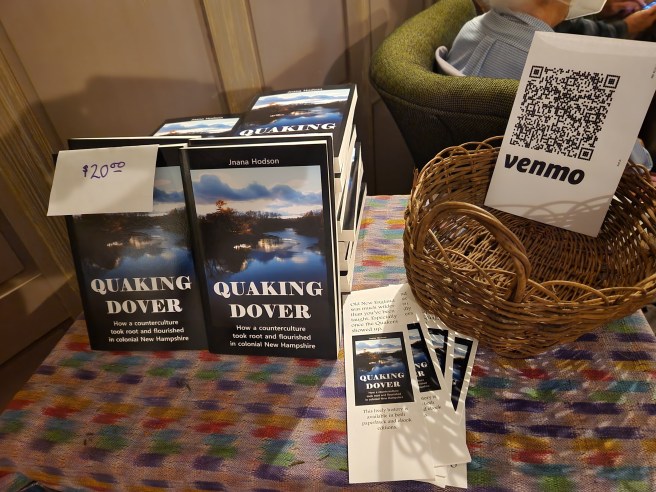
My book Quaking Dover just may change that.

Here are two recent examples.

“It’s like you’re speaking right to me! It’s not like a history at all!”

That’s from a city councilor far from Dover.

I do hope that doesn’t put off history book addicts, though.

On the other hand, a Dover history buff said this:

“The clearest presentation of George Burdet I’ve read. Usually the histories of him are convoluted and hard to follow.”

When she first mentioned him, I felt some trepidation. Burdet wasn’t a Quaker and in fact predated them. He was one of those side details that could trip up the central argument if I had misread something.

More important than any praise is the confirmation. Or correction, too, for moving forward.

Now for a word from Friends Journal magazine

A classy magazine published 11 times a year in Philadelphia and having a readership in all 50 states and 43 foreign countries has reviewed my book Quaking Dover. Yay!

As Friends Journal critic Marty Grundy asks, “What was it about Dover, N.H., on the Piscataqua River separating it from Maine, that enabled early Friends ministers to establish first a toehold and then to gather a third of the populace into the meeting, in spite of New England’s violent opposition to Quakers?”

Dover, I might venture, is way off the radar of the usual Quaker heritage addicts.

For answers, she notes, “This book offers an alternative history to the usual Puritan-centric stories,” a volume where “history is not just the result of the larger, impersonal scope of folkways, economic and political forces, or social class. It is lived by individuals who are part of families, individuals who make personal choices and influence those with whom they live. So Hodson also traces family connections showing that both a bold embrace of Quakerism and bitter persecution of the disturbers of the status quo tended to run in families.”

Yes, it is about people.

As Grundy also observes, “The book is an artifact of COVID in that it was created using what is available on the web, including secondary sources, much older published accounts, and summaries of meeting minutes … As anyone knows who has tried to do historical research recently, there is a gratifyingly wide variety of materials available electronically. Hodson has done a good job of mining; juxtaposing; and, as he says, ‘connecting the dots’ to produce a somewhat speculative but eminently well-argued and documented account,” one “also filled with verbal asides as the author comments on what he is discovering and sharing with the reader. He offers various versions of events and cheerfully acknowledges when he can’t find facts to fill in gaps.”

For the full review, see the magazine’s March issue.

My, and this was in a periodical going back only to 1827.

A writer’s humble request

Reading can be an intimate connection between an anonymous individual and a writer. The action really is one-on-one, even for a bestselling book.

Too often, though, it’s one way, like therapy with no one piping up on the other end.

Authors typically work in isolation on a work of passion and then step forward in a state of exposure. It can be especially tense if you’ve taken risks, knowing they can backfire.

Unless you’ve been there, you have no idea how much a reaction, positive or negative, can feel. There really is a shock and elation when you see that someone else “gets it.” Or even if they don’t, they’ve at least engaged.

Typically, though, there’s silence.

That’s why I’m still astonished by people who tell me they love the tone and content of my new book.

In addition, even a brief review or comment can help a writer sharpen the direction of future work.

Reactions to Quaking Dover are definitely encouraging fresh perspectives for my own public presentations around the work. Remember, one publishing house rejected the book because they detested first-person. Thankfully, I listened to a wise beta reader and reacted accordingly.

I definitely look forward to hearing your reactions. In addition, if you like the book, please leave a brief review plus stars at your retailer’s website or other places. Nothing beats word-of-mouth, either, in the book world.


How about a few more readers’ candid responses to my new book?

In case you’re wondering how things are going with Quaking Dover, here are some early reactions:

“The book purports to be merely a history of the Quakers at Dover, New Hampshire, but it is much more than that. It is a history of the beginning and spread of the Religious Society of Friends (aka Quakers) in the USA, the best exposition of their faith that I have read so far, a history of their persecution by the Puritans, and of the bloody conflicts between the Puritans and the native peoples. …

“Most of all, I had not previously been exposed to the reality of the Quakers’ faith, revealed in their own words. Jnana Hodson, himself a Quaker, has done extensive research in old records and journals and includes extensive quotations that bring the faith to life. Including their peaceful acceptance of persecution, their prudent approach to courtship and marriage and their belief in the work of the Holy Spirit in the heart.” – Bob Goodnough, Saskatchewan

(For his full review, visit his Flatlander Faith blog post of Dec. 12, 1922.)

~*~

“I enjoyed your conversational writing style – sharing the research that you did — and confidentially whispering (in your writing style), ‘This is what this finding means and how it should be interpreted.’ … To ascertain what really happened you checked primary documents, read previous accounts of Dover, New Hampshire – triangulated your sources and showed us readers how you reached your conclusion. A very enlightening read – well researched, well written.” – Joe Clabby, author of A History of Eastport, Passamaquoddy Bay, and Vicinity

~*~

“Love it!” – Susan Wiley, Sandwich, New Hampshire

~*~

“Deftly told. I really like your voice. It’s engaging, light, and easy to read.” – Jim Mastro, science fiction novelist

~*~

“An enjoyable book!” – Arnie Alpert, longtime peace activist

~*~

“A rich feast of a book.” – one of my favorite authors and fellow Maine resident

~*~

“I truly appreciate all the work and careful thought and interpretations you put into it.” – Canyon Woman, New Mexico

~*~

“I enjoyed your book very much. I particularly liked relearning about early life in Dover and surroundings, and was impressed by how much research you did to fill in details. Not only about the life of early Quakers and their trials and tribulations, but the connection they had to the rest of New and Old England. I did not understand how important the settlement of Dover was compared to Portsmouth, Exeter, and other towns.” – John Dawson, Lee, New Hampshire

~*~

“Thank you for writing this record of Dover Friends Meeting. The ‘Children of the Light’ had me on the verge of tears as I read it to Andrea.” – Harvin Groft, Berwick, Maine

~*~

What if God came down to walk in the garden with Adam and it was more like She?

Not a bearded old fart but a wise, calming, older woman?

Would it change the workings of the story for you?

~*~

That’s something I’d been pondering even before Regina Renee Ward’s amazing Bible half-hour presentations at New England Yearly Meeting’s sessions last summer. (Do check them out at NEYM’s website, even if you have an allergy to Scripture. She understands that aversion.) Aware of our varied backgrounds and outlooks, she tenderly took us very deeply into ourselves, personally and as a gathered body, via her selected verse of the day and its context plus brief commentary.

One of the books she recommended was Christena Cleveland’s God Is a Black Woman, and I wound up ordering a copy.

Let me say I definitely find it refreshing. Should I add, eye-opening? She was transformed by her encounters with the famed Black Madonna icons in Europe. Take it from there.

~*~

It has me returning to the concept of thinking in metaphor, which I feel is essential to religious slash spiritual practice.

Metaphor compresses image and concepts and actions in ways that legalistic, “thou shalt not” teachings fail to comprehend.

We can begin with the ways we envision something like God or Christ. To that, let me add, the concept of Holy Spirit becomes quite liberated from the earlier English translation of Holy Ghost. The first is definitely infinitely bigger than the second.

~*~

Well, the story of the Garden of Eden is one I come back to endlessly. It’s pointedly not a children’s tale, despite the efforts of Sunday schools, and that rib Adam lost is something, uh, more erotic. OK?

For now, though, I’m quite wrapped up in my new book about one community’s Quakers in early New England – which as readers of this blog, I hope you’re aware of.

So here we are! How ‘bout a walk?

In case you’re wondering what others are saying

Listen to this from a five-star review Beth Collea posted at Smashwords.com’s Quaking Dover page:

Jnana Hodson combines solid historical research with his engaging writing style. Light touches along the way keep the text moving. His own historical wonderings give us the feeling of personal involvement in the quest for insights and answers.

Drawing on the work of David Hackett Fischer, he contrasts the local folkways and customs of the area of England where the Puritans came from and the Devon region where the settlers to the Piscataqua area originated. Spoiler alert: the English in the Devon region so highly valued hospitality and welcome that they dared to host and harbor traveling Quaker ministers, especially if they were in need.

Hodson gives us a wonderful historical lens to use as a framework for general understanding and especially for exploring Quaker history in the U.S. The timing is perfect as the City of Dover prepares for the 400th anniversary of European settlement in 2023.

~*~

Photo by Jessica J. Williams.

Giving the devil his due

In researching a project of any scope, you can’t ever read everything touching on the subject, and sometimes that can be a blessing in disguise.

For one thing, it may mean you have to examine points afresh and unguided rather than relying on another’s assumptions or conclusions.

And, for another, you may find reassurance or in seeing how another researcher has come to the same results you have independently or, in another vein, you may strengthen your disagreement.

That’s where I find myself on The Devil of Great Island: Witchcraft and Conflict in Early New England, Emerson W. Baker’s 2007 examination of a paranormal outbreak of flying rocks in an inn on an island in Portsmouth, New Hampshire, ten years before the infamous Salem witch trials just to the south. Now that I’ve finally read it, I can say he’s cleared up some questions I had on events upstream and provided backup for some of my deductions.

My new book, Quaking Dover, takes place one colonial town upriver from Great Island, today’s New Castle, and shares some of the same cultural and historic influences. While I examine a sharp divide in Dover between its English settlers from Devonshire and the Puritans from East Anglia, Baker identifies this in Portsmouth and much of the rest of New England as the Old Planters, of Anglican faith, being pushed aside by the newer Puritans, and their rigid Calvinism. Quite simply, the tensions were more prevalent and widespread than I’d assumed.

The target of the airborne mineral projectiles was innkeeper George Walton, along with his family and guests, evening after evening through an entire summer.

Baker labels Walton repeatedly as a Quaker, as he also does for the identity for Nicholas Shapleigh, continuing a widespread misconception. The prominent Shapleigh proved a valuable ally but, as his descendants point out, he was never a member of the Society of Friends (Quakers). While Major Shapleigh suffers persecution for maintaining some of the Friends positions, nothing in Walton’s life or character suggests he did so. Quite the contrary, there were many reasons he would have been disciplined and disowned, if he had been part of a Quaker Meeting, the closest one being at Hampton.

As Baker, a Salem State University history professor, lays out Walton’s family and neighbors, what becomes clear that just about everyone had good reason to target the contentious innkeeper. As for a devil on Great Island, I’d have to say it was Walton himself.

Baker sees the New Castle incident as a precursor to similar events that culminate in Salem, and he traces individuals who would have been familiar with the Walton stoning incidents to the outbreaks elsewhere. He further finds common elements that include contested land claims and political upheaval, which far outweigh theological issues.

Baker has since written much more about witchcraft, befitting his locale. The Devil of Great Island is a fun and fast read and a fine introduction to a definitive moment in the American experience.

As I’m arguing, there’s much more in New England’s past than you were ever taught. Or maybe even suspected.


There’s more to history than the usual names-and-dates scenario

As I’ve admitted, many of the historical persons in my new book, Quaking Dover, really deserve full-length biographical treatment or maybe individual operas or Hollywood blockbuster movies, if only we had time to linger. Four hundred years requires a lot of compression and that meant keep moving ahead. Anyone looking for a writing prompt can dig in with a host of possibilities on the list.

Retired librarian Olga R. Morrill, bless her, rises to the challenge with her historical fiction, Vagabond Quakers: Northern Colonies, published in 2017, focusing on the three women missionaries who came to Dover in 1662 and were whipped out of town in what was essentially a death sentence.

In doing so, she also portrays Richard Waldron and Nicholas Shapleigh as fully fleshed characters, even though they both have much more ahead in their lives after the three troublesome Quakers venture off-stage, the part she follows as the women venture south. (Yes, we need a full bio for each of the guys, please.)

As fiction, Vagabond Quakers resorts to some creative history and plausibility to fill in huge gaps. I see this in Waldron’s chronology, especially – with details where my findings and her tale conflict – but she does induce a compelling drama even in the minor players. She weaves fact and fiction seamlessly and manages a credible dialogue. (What they actually said would sound unintelligible gibberish to our ears.) If only I were sure which parts arise in her invention and which parts rest on solid evidence.

I’m happy to see that she examines Waldron’s life as a major figure in Boston, not just his existence as the most powerful man in New Hampshire, where he’s usually confined in the telling. Dover may have been his private fiefdom, out on the fringe of New England, but he wasn’t exactly provincial. She even manages to stir some sympathy for the man I dub the perfect villain.

She also gives full due to the deep conflicts in the town church before the Quakers arrive. Those are something I’ve long suspected contributed to the willingness of so many residents to join Friends early on. My one quibble is that I think Elder Starbuck would have been in the other party than the one where she places him.

For me, Morrill’s biggest contributions come in her envisioning the proceedings from the women’s perspective – not just the Quakers, but even those in the Waldron household. In the actual dates-and-names history, they’re mostly invisible. Many of Dover’s earliest wives remain ciphers, and even too many of their first and maiden names are missing. As for their language, demeanor, and dress? Morrill has me willingly suspending disbelief in her storytelling. Was one of the Quakers of short stature? Not that I’ve found anywhere. As for singing? Unlikely, but the quirk does pop the individual into three dimensions.

The events she describes in what would seem an out-of-the-way frontier settlement remain an important breakthrough in establishing religious freedom, anywhere.

Morrill and I both find these events to be endlessly fascinating, and hope you will, too.

Let me know of examples of courage you find that match the Quaker women’s.

You’ve got to meet Willow

Among the fascinating voices who show up regularly in my WordPress Reader is Willow Croft, “Bringer of Nightmares and Storms,” a writer included in an anthology of “ladies of horror fiction.”

Not to worry, her blog is gentle and warm as her she surveys the alt-indie world of literature and related arts, and from her shelf at Goodreads, it’s hard to imagine a more adventurous or prodigious reader. Better yet, she generously shares her discoveries with the wider world, often through their own voices.

One of her ongoing features is “Five Things Friday,” a handful of deep questions posed to the day’s selected writer. I was so honored yesterday, and I’d love for you to hop over to Willow’s blog to see the results.

There’s nothing generic in her five inquiries. They’re tailored to the day’s guest, and she does her research. Somehow, she homed in on the essence of what I do while also making me think about it in a fresh light. One of her points indulges in special interest of hers – food – but even there, she makes it personal to her guest, as you’ll see.

I’ll apologize for the length of my answers, but the questions were multifaceted and stirred up much more than I could possibly include. She was free to cut or condense, of course, but didn’t.

~*~

Willow herself is also a fellow poet, and that feeds into her compassionate curiosity.

Still, she’s surprisingly elusive in a digital age, even while being a comforting presence. Her blog, for instance, has no About page.

From the bits I’ve gathered, she grew up somewhere in the South, where she quickly resisted the enforced conformity, and recently relocated from New Mexico to Kansas, even though she dreams of someday settling in Scotland. Oh, yes, she also favors British spellings over American, as in “colour.”

I’m supposing she’s a water sign – Cancer, Pisces, or Scorpio. She claims to be middle-age, though I would have guessed a very wise late twenties to mid-thirties, based on her uninhibited tastes, and a cat lover.

A croft, by the way, is a small enclosed pasture, often with a cottage – and a resident known as a crofter. As for willows? How evocative – there’s water, after all, and resiliency.

A clue to her name and outlook may be this, from a piece she wrote for MookyChick: “Transform your backyard from a one-note turf lawn to a meadow-like garden that has a little something for every visitor; be it birds or flying insects and bugs. Avoid the use of leaf blowers, weed whackers, and pesticides in order to give nature the chance to tend to itself.”

Actually, that’s not a bad description for what you’ll see in her own work and life as well.
Psst! Care to look at the books I’ve been reading?

I was long overdue for a reading orgy — you know, an indulgence in books — and a little while ago, before the quarantine, in fact, I immersed myself in ebooks by other authors at Smashwords. Some of the volumes are even free.

If you’re curious about what I was reading, zip over to the books reviewed by me at the bottom of my Jnana Hodson page at Smashwords.com. Yes, I thought about posting the reviews here, too, but there was already a lot on the agenda.

Most of the ebooks touch in one way or another on topics in my own novels. It’s lovely finding kindred spirits. Well, it’s a lot like the ways we here at WordPress connect, too.