Here I am living in a most photogenic terrain

Others have pointed out that most of the places I’ve resided in have been rich in natural beauty. While I’ve dampened that with an argument that you can find beauty wherever you are, or at least visual stimulation, I do have to concede how rarely that’s the case.

Many places, in fact, are brutal on the eyeballs.

Part of the attraction to Eastport for me was, after all, its access to wilderness and a rugged shoreline. Good shots seem to be waiting everywhere.

It shouldn’t be surprising that I’m overwhelmed by the number of solid photos I’ve been taking. How on earth is one supposed to organize them, much less share them?

It’s not like the old days of light meters, F-stops, film, or even focus, either.

Digital makes it a snap. All you have to do is look and see something.

And, yes, sometimes the camera – or cell phone – sees something more.

Eastport is a pedestrian-friendly village with old houses and storefronts, meaning more variety and detail than you’d find in the average drive-by suburb. It’s surrounded by forests, shorelines, and streams that present more opportunities. No wonder we see people pointing their lenses everywhere, and not just for selfies.

Where are all of these images going to go, anyway?

When a painter writes poetry, too

I love the idea of artists who are inspired by other artistic fields. Too often, alas, they’re stuck in their own genre.

The term for what I’m discussing here is cross-disciplinary.

For example, I’m primarily a writer, lately of fiction as well as a poet, but I’m moved most intensely by classical music and then opera, jazz, folk, film, theater, and yes, painting and related visual fields. And I consider myself essentially a visual person?

Maybe you get the idea.

So a few months ago, I got news that a friend now living in California had a new book, Roots, Stones, & Baggage, and I assumed it was a catalog for his most recent gallery presentation. He is, after all, a marvelous painter, still active in his 90s.

What arrived in the mail was mostly his selected poems, revealing a whole other side of himself. They’re good, by they way. He respects craft. And there is a sampling of his paintings over the years, too.

I remember his reply during a Q&A at his gallery show opening at the Ogunquit Art Museum in Maine when he said he understood Blake’s poetry, something that left many dumbfounded. Think of understanding as gut-level rather than legalistic, OK?

The new booklet’s worth getting even for the wonderful introduction by his son, the celebrated novelist Jonathan Letham.

And the poet slash painter in question is Richard Brown Letham, still going strong.

Brisket and a hunk of binge viewing

Somehow, this past winter I got struck by a sustained sense of cabin fever. Should that be “stuck”? To my thinking, that’s not necessarily a “bad” thing and was not unexpected, given my relatively isolated situation combined with the continuing Covid precautions and the usual northern New England long nights and winter snow, ice, sleet, and unassisted general deep cold. I do believe there’s value in periodically clearing some of the clutter from one’s life and regaining a sense of direction, and I have found a huge difference between solitude and loneliness, so here I was.

Mostly, I was feeling a bit directionless, having completed a big revision of the Dover history and wanting to move forward with its publication but not yet having clarity on exactly how that would go. I mean, as books go, this was one more niche item, not likely to hit the bonanza list, no matter how original the findings. Emotionally, then, I was feeling stuck, not my best mental state. It even leads to fidgetiness.

Breaking that up was a visit by family – or should I say invasion – that included time with movies and TV series on the 40-inch screen I usually leave dark. Me? I’d usually read and listen to the radio. I’ve tried to avoid television series, seeing them as addictive couch-potato time-sucks.

A year ago, though, they hooked me on the first season of Mad Men, which we had on DVD. Whew! I was free only after admitting there is some quality writing and performing available and losing a full weekend in full immersion.

This Christmas, they hooked me with Murders Only in the Building, which again fortunately had only one season.

But during a return visit a few weeks later, we shared a phone conversation with the daughter in California who had just made our son-in-law his favorite meal for his birthday, and that mention of brisket led to my memories of being introduced to the cut as a Jewish tradition by my almost parents-in-law, if only, and those stories now had us sitting down in front of streamed episodes of The Marvelous Mrs. Maisel. The fam scooted off, leaving me to catch up on all of the available seasons, and I’m now miffed I have to wait for more on the way. I hate being left dangling. Worse yet, I was told Prime had the remaining Mad Men episodes – so I caught the final six seasons in a bit over a week, how many hours did I squander there? And the last two of Mozart in the Jungle plus all but one season of the Secret Diary of a Call Girl, which was quite sassy but not nearly as hot as touted. There may have been another series I’m overlooking.

Said family was highly amused by my engagement with works they deeply appreciate, but I am still appalled the hours I lost and by one more manifestation of my obsessive side.

For the record, I’m blaming the younger daughter and her brisket for this latest outbreak. Now, just when is the last time I’ve had a slice of one?

What do you suggest I stream next?

In the comfort of my own home

Oh, the joys of online streaming! In my case, music, classical and jazz. Or when everyone else is up visiting, what we’re watching on the big screen. The one I call the wall of death, when it’s black with nothing on, or even when it’s blazing action blood, aliens, car crashes, and meaningless gore.

Yeah, I love having my beloved circle spending time in this place that’s ultimately theirs. For now, it’s like our extraordinary tides. Hopefully, I can roll with it.

Call me a fuddy-duddy, one living in a remote fishing village with a lively arts scene on an island in Maine, but that doesn’t mean I’m isolated from what I might be dialing in on the radio in Boston or New York, much less attending live. I have an ear on weekly orchestral concerts or Metropolitan Opera, for starters. And we do have some incredible live performances here, musical and theatrical, just less frequently. Oh, my, do we! Many of them are only eight blocks from home, an easy stroll.

Well, the opportunities for ethic food deliveries are another matter – even pizza. Things you might take for granted. But that’s offset by things like fresh scallops, which you’ll never eat anyplace else.

I’m not so sure how I’d feel about all this if I were exiled to some small place in North Dakota or the Upper Peninsula of Michigan, by the way. But this really feels like home.

One thing for sure. I had no idea this was my destination, back when I was in college back in Indiana. But I really have no complaints, other than trying to keep warm through deep winter.

LET’S CAST AN IMAGINARY MOVIE

In the (imaginary) movie version of my new novel, What’s Left, who would you cast as Cassia’s great-grandmother Dida and her sister Athina?

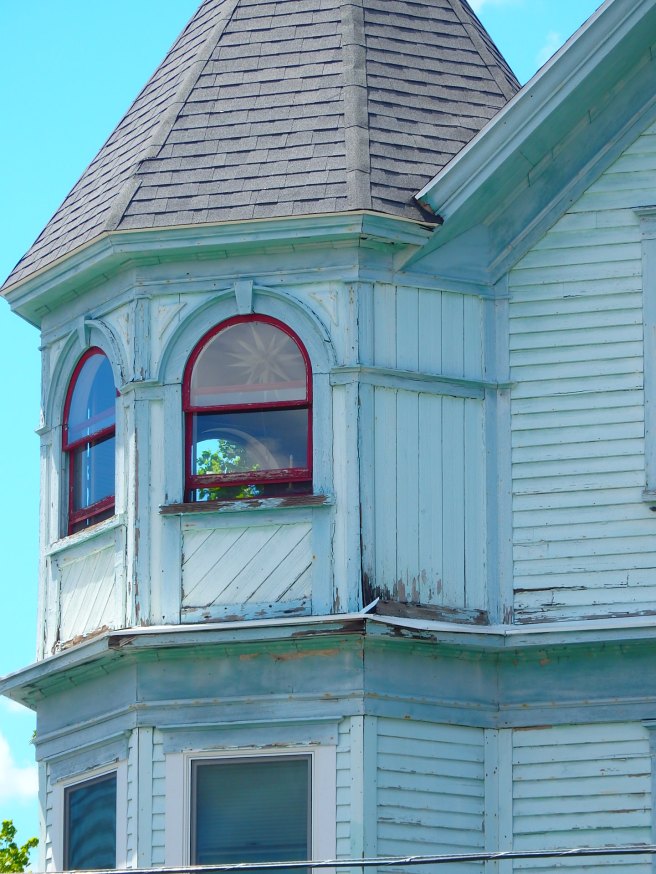
A large Queen Anne-style house with a distinctive witch’s hat tower something like this is the headquarters for Cassia’s extended family in my new novel, What’s Left. If only this one were pink, like hers.

MONET AT THE WINDOW

I’ve often joked (or was it boasted?) that we have the best stained glass windows in town. And not just at this time of year. Actually, there’s something basic in the Quaker practice of having clear windows, whether the view opens to the city jail next door or a busy highway or a placid burial ground – we’re not isolating ourselves from reality when we worship.

Sitting on the clerk’s bench one morning one May, I found myself looking out at a Monet. Well, the spring green for three-quarters of the hour fit the tones he used, until it turned metallic in the last quarter-hour when the sunlight turned harsh. Most weeks after that, I tried to identify which painter the view brought to mind – a sequence of Corot, Diebenkorn, Mitchell, Twombly, Klimt, Pollack, even the Zen painting of six persimmons (ours, however, had about twice that amount of fruit), and maybe a bit of Chagall or Hopper. (What was I saying about our Meeting not being blue-collar? Here I am, expecting most Dover Friends to know most of these artists!) Occasionally, even a Kaufmann, as Dick and Jane’s heads appeared in the lower corner while they walked up the ramp to the door. Sometimes the dogwood tree presented a flat image; other times it had holes, opening to the depth behind it; eventually, come winter, it was only sketches in front of a more distant landscape, and etchings, rather than paintings, came to mind. Expecting the Monet to return the next May, it didn’t, for whatever combination of reasons, although there was one week when it was adorned with pale stars – its flowers.

Not that any of this is essentially profound, other than as a recognition of the play of light – just as we encounter various presentations of Light within the room and ourselves through the hour. But I do consider ways our perceptions and expressions differ from the earliest Friends who sat in the room. These artists, for one thing, came after them, except for the 12th century persimmons (and those were off in China, anyway); the now familiar language from science or psychology, too, to say nothing of sports jargon and even military expressions. Did those Friends ever have a bagpiper playing at the edge of the yard, or some equivalent to our sirens on the street or music from a neighboring church? How did they see the world, in ways that we don’t? Somehow, all kinds of differing eras come together when we, too, sit together. So just how do we see each other through all of these seasons and ages?

~*~

This piece originally appeared in Types and Shadows, the newsletter of the Fellowship of Quaker Artists.

TOMBSTONE: THE PREMISE

One late October afternoon, after most of the foliage had fallen, Randy Kezar and I simultaneously looked up from our pathway and beheld a large red maple fully aflame in sunlight as we strolled through the burial ground behind our Quaker meetinghouse. It was the embodiment of the single detail that says everything, the flash of perfection; this individual tree expressed the season as much as all of the previous color change and shifting light we had savored in the previous weeks. “I suppose if we were Japanese, we’d sit down and write a haiku on the spot, in celebration,” he said. Later, I took up the challenge and came up with a few lines I hope come close:

Somehow each New England autumn
comes down to boughs in a graveyard

– a common of stone and bone –

But my provocation and observations kept ranging wider, invoking a calendar not just of the place across  a year but also the epochs that fill what went from a boneyard and burial ground to a Victorian cemetery to the present, as well.

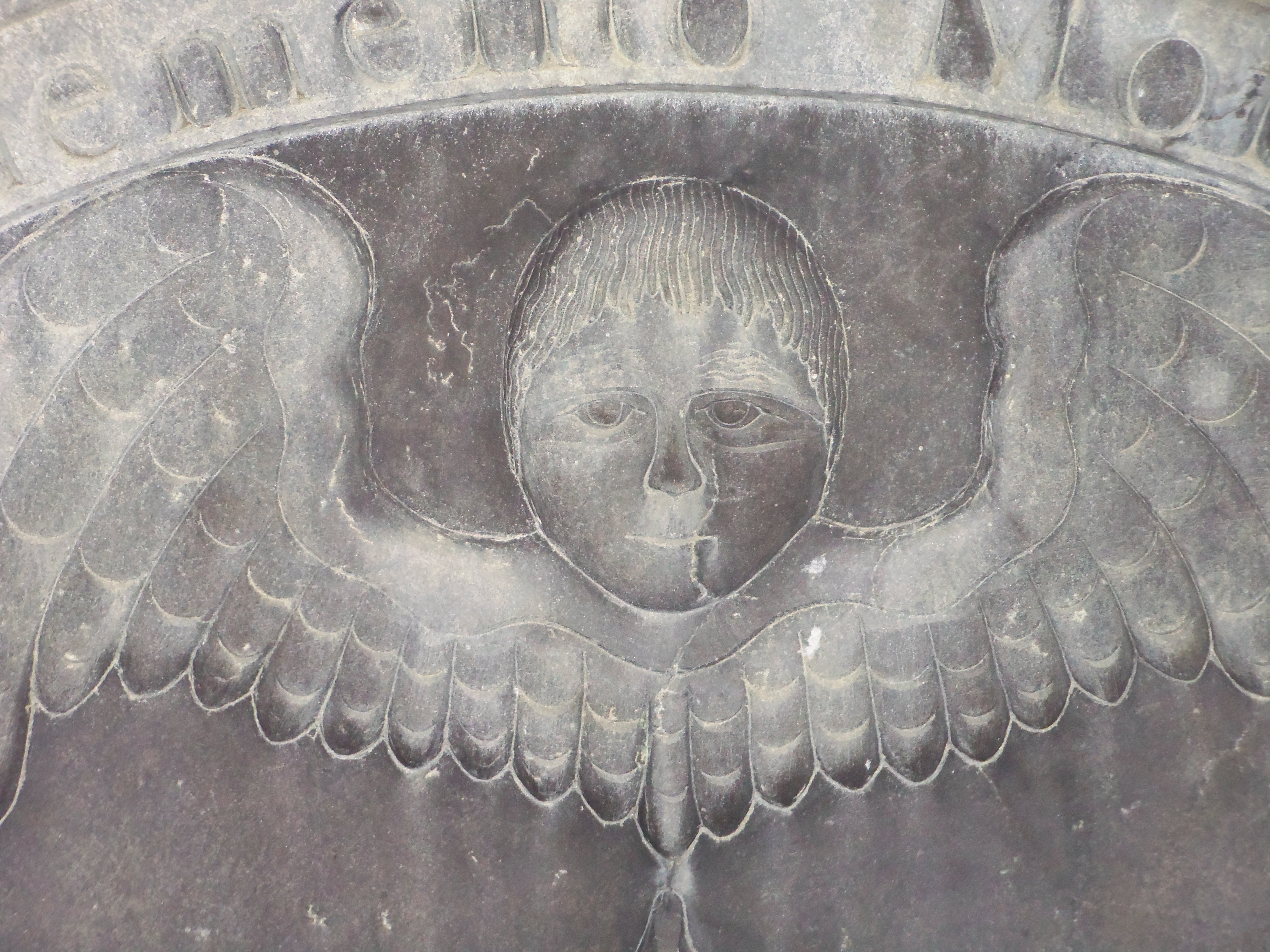
The winged death's head is a common gravestone motif in New England. This example is in Watertown, Massachusetts.
The winged death’s head is a common gravestone motif in New England. This example is in Watertown, Massachusetts.

The poems that resulted have one foot in Portsmouth and Dover, New Hampshire, and another in Portsmouth and Newport, Rhode Island, where I quote from the 1664 will of Alice Shotten Cowland and some of the activities of her son-in-law, Robert Hodgson – sometimes spelled Hodson, as well as Hutchin. (I detail what is known of their lives in my genealogy blog, The Orphan George Chronicles.) She was part of the early dissent against Puritan authority, first with Samuel Gorton and then as one of the first Quakers in the New World. I love Robert’s memorial minute, which calls him “an ancient traveler in the Truth.” He arrived in America on the historic voyage of  the tiny Woodhouse, causing turmoil in Manhattan and Long Island before heading on to Boston. As far as I can determine, he was no relation to my line, no matter how much many have tried to find the link.

~*~

Winged Death 1To see more, click here.

SNOBBERY, ALL THE SAME

To see the old meetinghouse at China, Maine, as it’s been turned into a Friends Camp arts studio (a messy one, at that) is a pointed symbol of the tensions many of us encounter as we attempt to live out our faith – and not just on the cultural front. (For the record, I am, after all, a published poet and novelist, a professional journalist, an avid contradancer, gallery-goer, foreign film buff, occasional violinist and harmony singer, and a lover of opera and classical music – all of which can raise eyebrows in various spiritual circles, and most of which would have been forbidden in traditional Quaker discipline – all this even before we turn to the struggles of the workplace, families, neighbors, or politics. Call me a snob, if you will.) The fact remains that the Society of Friends today is filled with many artists pursuing every imaginable medium. Dover Meeting is not alone in its range of talent.

A while back, I spoke of practice as something that’s ongoing and never finished, in contrast, say, to a performance or even a rehearsal. Practice as something done more for its own exploration and pursuit of a discipline than for any finished product. Practice as being part of a bigger encounter: the practice of prayer, practice of poetry, practicing musical scales, play practice, football practice, even medical practice. Something done with care, and if freedom follows in critical situations, as we often hear in interviews after a Patriots’ game, then all the better. Weeding and composting, I suppose, are part of the practice of gardening, apart from any harvest.

When I think about qualities that mark Quaker artists, I would tentatively suggest: placing the ongoing work ahead of themselves; “cool” rather than “hot”; a sense of experience and discovery rather than make-believe or escape; honesty rather than pretense; wonder rather than irony; humility rather than egotism or arrogance; candor rather than flamboyance; a preference for simplicity over complexity; directness rather than confusion; economy rather than extravagance; calmness rather than shrillness; curiosity and listening rather than dogma or bombast.

We might also turn the old Quaker views toward a critique of today’s cult of celebrities (almost universally entertainment/professional sports figures) and their exorbitant incomes – a situation that I believe accompanies a lessening of power within our communities. To that we could add the ways the arts are often used as a secular religion to sanctify public occasions. As for the Oscars?

But maybe that’s just another part of our unfolding spiritual awareness.

KEEPING IT NEAT

Barb Knowles of the blog saneteachers has nominated me for a Real Neat Blog award, and I thank her for the nod. If you’re not yet familiar with her site, let me tell you that anyone who knows what an Oxford comma is ranks high in my book — especially after all of those years as a journalist when I couldn’t use them on my paying job, contrary to my own standards. Here, though, things are different.

Allow me to confess, though, I’m of mixed mind when it comes to these awards. On one hand, WordPress (especially) is filled with marvelous bloggers who deserve wider recognition. On the other hand, I’ve found that trying to nominate others can be, well, embarrassing when you find they’ve already received that award somewhere in their past, even before coming up with fresh questions.

A while back I resolved to pass on these things, but then the temptation of participating can be fun. And then there’s that matter of time itself, which on this end will soon involve some major home and garden projects. Alas.

So here I am, looking at the seven questions, which I’ll tackle. But for now, I’ll wait before nominating others or coming up with seven new questions for them. Unless, of course, you’d like me to nominate you (go ahead, be bold and ask). After all, if you’re dropping by the Barn, you’re already cool — in all due humility. Any volunteers?

real-neat-blog-award1Here goes:

If you were alone on a deserted island with only one book, which would it be? 

Make it the Bible. Not for the reasons most folks would assume — like what God’s trying to tell us. Rather, there’s plenty to chew on here about just being human, pro and con. And Wycliffe and Tyndale (those courageous early translators) do shape our English language, more than Shakespeare, actually. Your followup question would be which translation to pack, and there I’m stumped — I use many, each one adding nuances to the close-to-the-grain sources. By the way, are we to assume it’s a long stay on that island?

What is your favorite color and why?

Blue. Intense electric blue, the shade befitting Aquarius, the color of the clearest sky. Or its cousin, cobalt, the call of the North Atlantic on a clear day a few miles from where I live.

I like favorites, so what is your favorite song?

Since you didn’t ask about symphonies or sonatas or operas or chamber works, I’ll look at song as something that’s sung — in a form other than the traditional A-A-B-A musical form plus verses. (Bet you weren’t expecting that response!)

As a baritone in a choir, I’d put Sicut cervus, a Palestrina motet from the Renaissance, up there, along with a fuguing-tune anthem, Euroclydon, by the Colonial American William Billings.

Now you have me wondering about having the whole choir on that desert island. The plot thickens.

If you could make a memory, what would it be?

Our first grandkid. Leading to my learning to change a diaper. (I jumped in as a stepfather, later in the game.)

If you could join a TV show (present or past) and be a new character on that show, which one would you choose?

Mozart and the Jungle could use a third conductor. Maybe a sane counterpoint, mentor for Rudolfo? Or maybe just to send the older one back to Cuba?

What’s your ringtone?

Ringtone? Tracfones have them? Mine’s whatever I inherited back when.

Where were you born?

Ohio.