A change of direction in the search

Working the line of our old house downward quickly led to a tangle. You’ve been following what I uncovered at the Washington County courthouse, but at this point, an earlier reference was not recorded in the transaction at hand. Zip, zero, nada. Without that, I was stuck at 1975, well within my own lifetime, not exactly historic in my viewpoint.

The sale to the Greenlaws, according to the record, involved Oscar L. Whalen, executor for estate of Arline F. Vaughn, of New York, and someone named Rose Lee. But there was no Book and Page mention to lead me to the next entry.

The best I could do was to try working from the earliest residents and hope to build a line to 1975.

Since the 1855 map labeled our house “Shackford Est,” looking at the Shackford family made sense. Maybe Arlene was one of them.

Revisiting the Tides Institute and Museum of Art’s online survey of the homes of Eastport, I found that they had added a notation to their photo of our house. They quoted the weekly Eastport Sentinel account of U.S. Navy Commander Albert Buck returning home after World War II. Home, of course, is the one where we’re now living.

Buck? That gave me another family to start investigating, especially since they were living across the street in the 1855 map.

A varied decade of occupants

The Milanos were also short-term owners of our house. They sold the property in June 1978 to Dora and Merrill Lank junior. He was an Eastport native who served a stint as a city police officer and also enjoyed making wreaths. Both of them had grown up in Eastport — he in the north end and she in the south — and had children.

When the Lanks took ownership, our house had a slate roof, one with a pink scalloped pattern worked it. It was sided it what Dora has called ugly blue asphalt shingles. They divided the two big rooms upstairs into four, added the closets at the top of the stairs, and installed the casement window over the kitchen sink and the pass-through to the front parlor before moving in with her mother a few blocks away.

The house was then rented to Mel Soctomah, newly retired from the U.S. Army. He was Passamaquoddy in his late 40s and moved in with his wife, three children, and a dog. At liberty to make renovations, he installed the big wood and oil-fired cook stove that occupied the kitchen when we arrived. He recalled that the flue drew well, an important consideration in a place as windy as Eastport. They then left for a stint in Florida before returning to Eastport and neighboring Sipayik for good.

Dora and Merrill divorced, though, and complications emerged after she moved on. There was a sale from Bangor Savings Bank to the U.S. Department of Housing and Urban Development on October 8, 1982, with a supplementary entry on August 5, 1983. This was during a national recession that included a depressed real estate market and foreclosures. Somehow, Gordon Greenlaw reappears in this sale.

Sometime during this period and the one that followed, puzzling rough-sawn dark ceiling beams were erected in the two front parlors — “pseudo-rustic pop 1970’s kitsch,” in the words of one current resident, or “ye old Lion’s Den tavern,” in the mind of another. Those ceiling beams are distinctive, in that love- it-or-hate-it kind of way. For us, our reaction often depends on the day you might be asking. Looking closer, touches appeared in the kitchen, like the Montgomery Ward electric stovetop that came with the house when we bought it. Monkey Ward, for the record, went out of business in 2000 and probably had no outlet anywhere near Eastport well before that. I am wondering about some of the shelves, though, and considering them her Calla’s. Or now, maybe Mel’s. Nice work, either way. Particle board cabinets that also arrived at now scheduled for replacement, as are the triple-track storm windows.

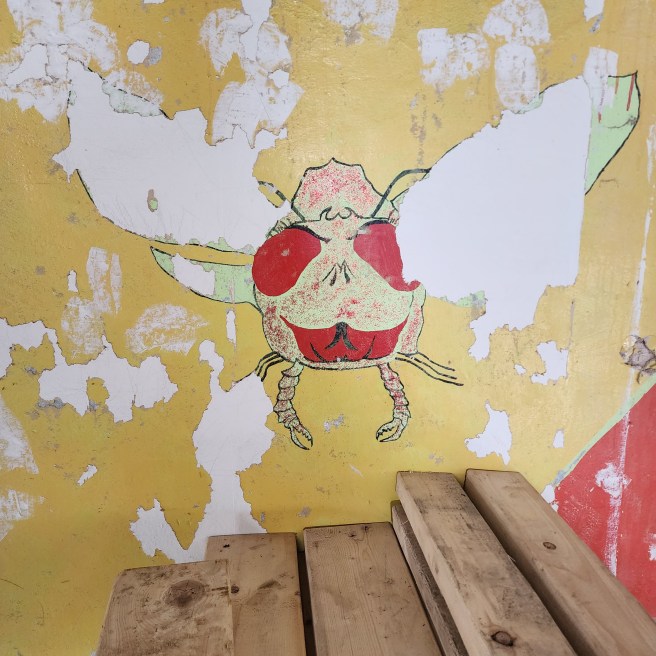
We can still ask who added the knee walls or the cosmic crab wall painting we found under the wallpaper upstairs.

Two important conclusions

The first is, that the Convention must have enjoyed in a very singular degree, an exemption from the pestilential influence of party animosities, the diseases most incident to deliberative bodies, and most apt to contaminate their proceedings. The second conclusion is, that all of the deputations composing the Convention, were either satisfactorily accommodated by the final act; or were induced to accede to it, by a deep conviction of sacrificing private opinions and partial interests to the public good, and by a despair of seeing this necessity diminished by delays or by new experiments.

James Madison in Federalist No. 37

Wheeling and dealing with the Greenlaws

Continuing the history of our old house:

Gordon and Calla Greenlaw purchased the house in January 1975 but then sold in in December of that year to Frank and Georgia Miliano.

With the Greenlaws, the plot takes a distinct turn. Gordon received a Purple Heart award in World War II. He died in August 2014 in Florida and was buried at the Maine Veterans Memorial Cemetery in Augusta.

Crucially, this was a second marriage for both of them, sometime before mid-1969.

Greenlaw and its variant, Greenlow, is another surname that goes back in Downeast history, as I’m finding.

He engaged in a string of real estate transactions — 66 in Washington County, from what I found in a quick survey, some of them purchases of properties seized on tax liens.

She predeceased him by a month, and while her obituary dutifully named her as Mrs. Calla R. Greenlaw, she was buried alongside her Magoon kin in her native Crawford, a distance from Augusta. It was noted that she died peacefully in her sleep of natural causes but curiously no location was mentioned. She was 99.

As the obituary observed, “Mrs. Greenlaw lived the greater part of her life in Eastport. She attended school in Crawford and Calais. She was the consummate businesswoman. She worked in the Calais Post Office for many years and later owned and operated the Red Ranch Inn in Eastport and dabbled in real estate.”

Mention of the Red Ranch Inn raises some eyebrows. It still has a reputation as a roughneck bar in its time, the kind where everybody would roll out onto the State Route 190 (the only road into town) for a wild brawl. The kind where the Washington County sheriff would show up with a Thompson submachine gun and fire off a clip in the air to get their attention. Yet, also, the kind where a seasoned waitress could walk between the combatants to calm them down. For others, its appeal was music and dancing, “a lot of fun,” as more than one woman has told me. Usually, the music was from a well-stocked jukebox, though there was the occasional live band. As for the fights? “It did have some action,” as one replied tersely with a sly grin. Do note that “consummate businesswoman” Callie alone is named in the obituary as the owner and operator.

There’s a good reason why. Her first husband, Milton A. Peacock, in partnership with Robert L. Tait, bought the restaurant in June 1963 from its founder, William J. “Bill” Bowen senior. In November 1965, while living in Los Angeles, Tait sold his half-interest to Peacock. That month, Milton and his wife, Calla R. Peacock, sold the restaurant by a warranty deed to Gordon Greenlaw. Yes, her future husband. In a 1967 real estate sale, Gordon was listed as a single man (more accurately, divorced) and that transaction was witnessed by Calla Peacock. By July 1969, though, she was Calla R. Greenlaw in the property dealings.

Did Gordon have any role in running the restaurant or its bar? The picture gets complicated, thanks to the presence of D & V Inc. of Bangor, which somehow concurrently owned the property or the business or both. While Bill was recognized as the restaurant founder, D & V applied for the liquor license in 1969.

A black-and-white photo of the Red Ranch presents an isolated building across the railroad tracks, a kind of diner with huge letters PIZZA emblazoned along the exterior and a two-story farmhouse attached to one side. Another photo found online has the interior with the jukebox and a row of counter stools that were always full, as a comment noted, along with the fact that they were beige, not red.

As for the food? Several women have said, “I couldn’t go there till I was old enough to drink.” Another, though, insists the menu was good.

The Greenlaws apparently exited the scene when D & V sold the Red Ranch to Ernest J. “Ernie” Guay in 1972 — three years before the Greenlaws bought our house. Under Ernie, the restaurant became a bar only. Sometime after that, Jeanette, his wife, used it for an antique shop. In the end, it served as a bottle- and can-deposit redemption center.

The structure was erased from the landscape when their son, Ernest junior, sold it in 2003 and Cornerstone Baptist Church was erected the next year. So much for an overlooked footnote of local history.

Calla’s real estate business involved owning rental properties around town, or so I’m told.

One claim in the obituary especially intrigues us. “Calla missed her calling as a master carpenter. In her heyday she could build anything and was meticulous to a fault. Anything she put together had to be exact, and all work would stop until it met her specifications.”

At first, we didn’t see much evidence of that in our house, but it soon prompted speculation of which ‘70s touches were hers. In our renovations upstairs, the back side of baseboards we removed had the professionally lettered words STEW, and then VACANCY, BOILED LOBSTER, and, my favorite, FULL COURSE DINNERS $1.50 UP. We’re keeping those, though we’re not yet sure where.
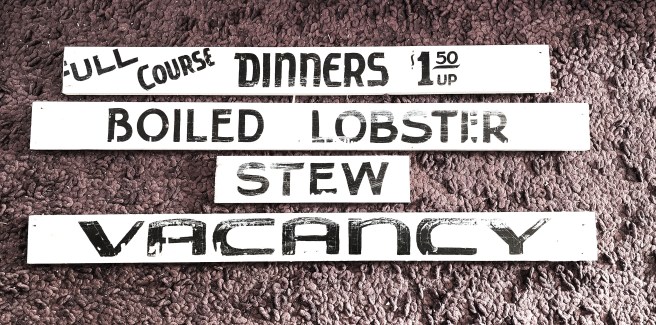
I originally thought they were from the Red Ranch, a reflection of the Yankee frugality that recycles forever, if it can. Do note that no paint was squandered covering the lettering, since it was facing the wall anyway. Or was it intended for future history, the way a time capsule is?

Well, the obituary did insist, “She loved working and was always busy.” Did that include cooking or even gardening? The kitchen wasn’t a master chef’s ideal. Leave it at that.

The obituary also acknowledged, “She raised and adored her poodles. She always had at least two of them running around.” That might account for some of the badly scratched doors and floors. Poodles, I’ve heard, attract a specific fandom, usually not of the Wild West saloon crowd. That would have suggested pit bulls or, dare we venture, mastiffs.

Regardless, “In her later years she wintered in Florida but always called Eastport her home.”

One thing the obituary didn’t mention was an earlier marriage to Milton Peacock, the father of her daughter Sandra R. Stevens. After the divorce, he relocated to South Portland and Sanford, Maine, and is likely buried in Brunswick, Maine, amid Mitchells — perhaps his sister and brother-in-law?

Curiously, Calla and Sandra share a twin-hearts, mother-daughter headstone in Crawford reflecting what I’ll assume was a close emotional bond. The daughter died in Bangor a year before her mother, and, from what I find, had married at 18. That marriage ended in divorce. The second is more nebulous, though he died in 1993 in Newfoundland and Labrador and is buried in Eastport. I still have no clue to how her Stevens surname fits in. Not that it matters in terms of our old house.

Also buried in Crawford is Calla’s grandfather who inspired a 1988 book, George Magoon and the Downeast Game War. He adamantly resisted Maine’s early 1900s’ hunting laws, especially the part about having to buy a license.

That said, what interests me is a sense of a lifestyle for our occupants over the years, along with the many remaining questions. For our Greenlaws, especially, dare we call it colorful?

From what I see in Gordon’s real estate transfers, the Greenlaws didn’t live in the house much, if at all. Their address was soon the house just to the north, as well as properties at the other end of Water Street.

Charles Ives saw music ‘as the lens through which we can glimpse the divine’

For him, that also shook up the universe.

The 150th anniversary of the birth of the American maverick takes place Sunday, the 20th, and despite his relative obscurity, he was a giant as an uncompromising modernist classical composer and as an innovative executive in the insurance industry.

Born in Connecticut and a graduate of Yale, Charles Ives’ musical transformation was certainly one of the most extraordinary cases in history, made all the more remarkable by the fact that he was forced to compose largely without hearing many of his adventurous works played by an orchestra or soloists until a half-century or more after their composition. Even the sonatas, songs, and chamber music suffered from widespread neglect.

As a matter of confession, I am quite fond of his music, from the wonderfully rich late-Romantic scores of his youth to the craggy, thorny modernist fireworks of only a few years later. I am among those who feel scandalized by the fact that this season orchestras aren’t playing even one of his symphonies in celebration, much less all four. Two of them did win Pulitzers, by the way, once they were finally aired, and riotous cheers often break out at the conclusion when the works are performed.

For a biographical overview of this American original, turn to my post, “Thoughts while listening to Charles Ives,” of November 5, 2013, at my blog, Chicken Farmer I still love you.

Today, I’m offering a Double Tendrils. Let’s start with ten quotations about music.

  1. You goddamn sissy… when you hear strong masculine music like this, get up and use your ears like a man.
  2. It is more important to keep the horse going hard than to always play the exact notes.
  3. Please don’t try to make things nice! All the wrong notes are right. Just copy as I have – I want it that way.
  4. In “thinking up” music, I usually have some kind of a brass band with wings on it in back of my mind.
  5. The possibilities of percussion sounds, I believe, have never been fully realized.
  6. There is more to a piece of music than meets the ear.
  7. Music is the art of thinking with sounds.
  8. Beauty in music is too often confused with something that lets the ears lie back in an easy chair. Many sounds that we are used to do not bother us, and for that reason we are inclined to call them beautiful. Frequently, when a new or unfamiliar work is accepted as beautiful on its first hearing, its fundamental quality is one that tends to put the mind to sleep.
  9. The beauty of music is that it can touch the depths of our souls without saying a single word.
  10. Good music is not just heard; it is felt with every fiber of our being.

~*~

And here are ten Ives quotes about life itself.

  1. The word “beauty” is as easy to use as the word “degenerate.” Both come in handy when one does or does not agree with you.
  2. An apparent confusion, if lived with long enough, may become orderly … A rare experience of a moment at daybreak, when something in nature seems to reveal all consciousness, cannot be explained at noon. Yet it is part of the day’s unity.
  3. Awards are merely the badges of mediocrity.
  4. Every great inspiration is but an experiment – though every experiment, we know, is not a great inspiration.
  5. Expression, to a great extent, is a matter of terms, and terms are anyone’s. The meaning of “God” may have a billion interpretations if there be that many souls in the world.
  6. You cannot set art off in a corner and hope for it to have vitality, reality, and substance.
  7. The fabric of existence weaves itself whole.
  8. Vagueness is at times an indication of nearness to a perfect truth.
  9. The humblest artist will not find true humility in aiming low — he must never be timid or afraid of trying to express that which he feels is far above his power to express, any more than he should be in breaking away, when necessary, from easy first sounds, or afraid of admitting that those half-truths the come to him at rare intervals, are half-true; for instance, that all art galleries contain masterpieces, which are nothing more than a history of art’s beautiful mistakes.
  10. Most of the forward movements of life in general … have been the work of essentially religiously-minded people.

The Tennesseans

Continuing the history of our old house:

In September 1983, Elwood Stackwood Richardson and Mary Blanche Richardson of Smithville, Tennessee, took possession for use as a summer home. They already owned and operated the Dennys River Inn, a B&B in neighboring Dennysville, Maine. A decade later, the house was conveyed to Mary Blanche’s daughter and son-in-law, Wayne Henry and Mary Jo Warner of McMinnville, one county south in Tennessee. The move was essentially to handle the details of selling the site.

This stage of occupancy centers on Mary Blanche, who was born in 1916 in Puyallup, Washington, to a family of transplanted Maine lumbermen. After 1976, she married widower Elwood Richardson, born in 1907 in Bristol, Pennsylvania, and relocated with her daughter, Mary Jo, to Philadelphia. That’s where Wayne Henry Warner, born in 1941, enters the picture. He married Mary Jo, born in 1943, and became a high school football, track, and baseball coach in Tennessee.

Thus, they all would have been adults in their times in Eastport.

For them, Eastport was a summer home, one not rented out in winter, in part because of its rundown physical condition, as Mary Jo told me. Her mother had relatives in Maine, either in Whitney or Whitneyville, neither one far from Eastport. She also loved antiquing. Guests during the family’s summer often liked to tour the Franklin D. Roosevelt estate across the water in Canada, causing her to quip that she visited Campobello more than Eleanor had.

Elwood, meanwhile, enjoyed fishing.

Bicycling and taking nearby ferries were other summer activities.

Mary Blanche was responsible for having the shingles put on the exterior and would have appreciated our raising of the roof upstairs. “It was something she wanted to do,” I was told. The move was apparently inspired by New England author and illustrator Tasha Tudor. Mary Blanche did have a cat named Tasha, reflecting the fondness.

Mary Jo also confirmed that the beams in the front parlor existed at the time, along with the “rather basic” kitchen and its Montgomery Ward stovetop. The property across the street also a house trailer blocking a direct view of the ocean. The modular home came later. And she remembered how small the only bathroom was.

She also asked about the sewage situation in the cellar. What?

And then about our contractor, quite surprised that he shows up on time and sticks to his promises. No comment there.

She was equally delighted to learn that the downtown is no longer boarded up and that the arts scene has emerged. Her stepfather, Elwood, took up painting in his summers in Eastport and was part of a circle that had outdoor shows in town.

Eastport did look quite different that recently. It was a time when the population was sinking and many of the remaining but vacant canneries and their piers lining the downtown were falling into the sea, one by one.