OVERLAPPING OR UNCONNECTED CIRCLES

My daughters are quite fond of Venn diagrams as a way of analyzing situations, and lately it’s had me thinking about the Society of Friends, in an abstract sort of way. And from there, it’s had me thinking about a lot of other applications.

Let me explain.

To make a Venn diagram, you begin by drawing a circle to represent something. For example, if we’re looking at a group of people, we could draw a circle to represent families with children living at home. If a large proportion of the members fits this category, we’ll make a relatively large circle. Next we can draw another circle to represent households with children living elsewhere – say off at college or raising children of their own. There might be some overlap to show families who fit both categories, as well as no overlap for others. But a third circle of members who have no children at all would stand entirely apart. Adding another qualifier, such as “members living in Dover” or “households living under the poverty level,” would have us draw a circle that would spread over sections of the other three, and its size would reflect the amount of dual identity; often, we would shade that swath to help it stand out graphically. The emerging diagram begins to give us new perspectives on what had originally been defined by the single matter of membership, and we can begin to adjust our programs and mission to better match its needs.

*    *   *

Ideally, I’d say, Friends have assumed that the local Quaker meeting, as a community of faith, would emerge as a set of concentric rings, like the ripples radiating from a single pebble tossed in a still pond. At the heart of it would be our individual faith experience, surrounded by meeting for worship, meeting for the conduct of business, family, the body of Friends as Monthly, Quarterly, and Yearly Meeting, community, occupation, and larger society. In that, we would be in a state of essential unity or even Gospel Order.

In reality, of course, we’re much more like a handful of stones tossed out, and each of us creates a different set of ripples. They overlap for us, because we’re radiating on the same pond we call Dover Meeting, at least where I am. Conceptually, though, not all of our circles are radiating out across the water. Imagine instead that some are angled out into the air – our jobs or classrooms, for instance, or families where one spouse is active in Meeting and the other is not. This is certainly a much more complex model, leaving us many possibilities for being disconnected with the rest of the surface.

Looking at Meeting itself, and expecting the Meeting for Worship and/or the Meeting for Worship for the Conduct of Business to be our central focus, we might expect to see a host of other circles all converging on that point, to create something resembling a flower. Looking at attendance at Monthly Meeting, however, I would suggest some other model would be more accurate, and maybe some of the circles do not touch each other at all. Indeed, some people observing Friends Meetings have suggested there are circles with no overlap: Christocentric versus universalist, or social activists versus spiritual monastics – or whatever. What moves and motivates one Friend may leave another untouched. Still, where exclusivity is perceived, I would urge us to look closer, to find elements where overlap might actually exist and where the remainder of one circle might energize and support the remainder of another. I believe there we will find the key to a revitalized sense of urgency among Friends, and the ability to shake the earth for miles around.

*    *   *

The reality is that none of us identify ourselves by a single category. We apply many, and some are more important than others. For example, I’m a Quaker and also male, married, stepdad, retired from full-time employment, a published poet and novelist, a so-so baritone in a very fine chorus, a contradancer … well, it becomes a very long list and in my daily actions, some of my interests overlap with those of others I encounter.

My wife and I love those parties that mix three or four circles of very interesting people and then seeing the interaction that ensues. When it works, everyone seems to come away enlivened and enriched.

In a way, that’s part of what I’ve been trying to do with the Red Barn. Yes, I do try to rotate the entries among my 11 categories each month or so – American Affairs, Arts and Letters, Home and Garden, Newspaper Traditions, Personal Journey, Poems, Poetry Footnotes, Personal Journey, Postcards, Quaker Practice, and What’s New. But in reality, there’s a lot of overlap. The Home and Garden projects often stimulate the Poetry, while Newspaper Traditions often reflect American Affairs, yet Arts and Letters may emerge from my Personal Journey or Quaker Practice. And Postcards, meanwhile, reflects whatever shows up in the camera. Hopefully, each reader, initially attracted to one category, may soon be following the others.

See how our circles overlap? Or, for that matter, even enlarge.
END OF THE LINE

Maybe the last of the high-visibility newspaper chiefs was Dave Burgin, an abrasive, volatile, but brilliant editor who began his legendary career at the New York Herald Tribune in 1963 and then went on to head a dozen-and-a-half major metropolitan daily newspapers, most of them already in their death throes, ranging from the Washington Star to the Orlando Sentinel (his one big success story) to the Dallas Times Herald to the San Francisco Examiner (where he was fired – twice) to the Oakland Tribune. Of course, it’s hard to leave a lasting impact if you don’t stay long in any community.

Still, one boss I had always returned in amazement after a visit with Burgin. Said he was the only person in the entire business with a real vision for a future or the changing needs of younger readers, along with the reasons they were avoiding newspapers en masse. He, too, saw the value of the weird comic strip “Zippy” for his Bay Area readership and was willing to run it page-wide on Page A2. Not that it would fly quite the same in Dallas.

One of his lasting bits of wisdom was the question, “What do I have in the paper today that will bring a reader back tomorrow?” I’ve looked at a lot of newspaper copy with that question over the years and felt we were missing the answer.

Actually, it’s a good question for a lot of businesses. I think it’s even a matter of getting down to the basics.

FREE OF THE ENTOURAGE

Most newspaper writing and editing is done is large, open newsrooms rather than small, private offices. It’s amazing to think anyone can actually concentrate and work amid the surrounding mayhem, especially when the scanner is blaring police and fire dispatches and the television’s on overhead. (Well, I took to streaming opera and music by living composers to blot out that hysteria.)

Still, a few management-level editors had offices, and we’d get visitors who’d head there or to the conference room for private meetings. Usually, the men would be in navy blue suits, along with a woman or two in high heels. That is, they’d arrive and depart as a team. Since New England Cable News also had a presence in our newsroom, I’d sometimes get a phone call from my younger daughter, the political activist. “Do you know who’s standing behind you?” No, I hadn’t looked. I was too busy working. And she’d call out the candidate’s name.

Not that they were all politicians. Sometimes they were business executives or lobbyists of one stripe or another. Even the writers and artists seemed to travel in packs. And often a face would look familiar, but I couldn’t quite place it. Let me add that many of them look quite different in person than they do on video.

Late one afternoon, though, I looked up from my terminal and noticed a dignified solitary personage striding into the room. He was taller than I’d suspected but the face was one I soon identified. David Broder, a Washington Post columnist my college professor had called the best political reporter in the country decades earlier, an evaluation that remained dead right.

I didn’t interrupt with a greeting as he walked past. Respected his space and thinking. But I was far more impressed than I’d been by any of the celebrities who had posed behind me.

STROKE OF GENIUS

“Do we have any cream rinse?” I asked, heading for the shower.

“The WHAT?” replied the chorus.

“You know, the stuff you put in your hair after you’ve used the shampoo.”

“Oh! You mean the CONDITIONER! They haven’t called it cream rinse for decades.”

Yeah, that stuff. There I go again, showing my age. Only to be corrected by my wife and kids.

Actually, I have to admire someone’s marketing savvy, however far back. Cream rinse, introduced to me by my first lover, always sounded like an indulgence – a luxury, superfluous but comforting. (She did have silky hair.) But conditioner? Now that sounds like something you might need to counter the, uh, harshness of shampoo. Not a luxury, but a necessity, making it all the better for marketing and sales.

Just goes to show the power of one word, doesn’t it.

THIRD TIME’S A CHARM

Just want to thank all of you who have downloaded your own copy of my novel Hippie Drum and to say how much I hope you’ve enjoyed it.

Since it’s my third published novel, and another in what’s considered the “experimental” literature realm, I’m grateful for all of the positive reaction.

If you haven’t yet joined the club of readers, let me encourage you to join now. Just click here for your own free copy.

REMEMBERING JULIA

The Canterbury Shaker Village is a remarkable place to revisit history. I’ve had a lifelong appreciation of Shaker architecture and furniture. In fact, we used to bicycle out to what had been a Shaker village and catch crawdads in the stream. Our denomination also had its orphanage and retirement center at another former Shaker village not far south of us, and I remember touring its remaining buildings.

But Canterbury was one of the last two villages, and one Friend speaks fondly of his conversations with the sisters. Today it is a well preserved living history museum.

So one weekday, when I was free of the office, my girlfriend and I went up for a tour. As we arrived, I noticed one of my coworkers, Ellie Ferriter, and in greeting, asked what she was doing there. “I’m here to meet Julia Child,” she replied. Yeah, sure. “No really, she’s here to tape an interview with the chef.”

One of the things the museum had done was open a restaurant with a menu drawn from the distinctive Shaker recipes, and there was reason to celebrate the cuisine.

Sure enough, when we came back from our tour, there was Ellie, interviewing Julia. Now Ellie was a large woman, but Julia was larger – in fact, towering above and around the interviewer. I hadn’t expected that, even though one profile had described her as having very long legs when she went to work in military intelligence back during World War II.

Julia had already had a long influence on me. In high school, when we finally got a TV set that included UHF, I could finally watch the “educational station” out of Cincinnati, and there, through the snowy image that barely came through, I was introduced to exotic foods like lobsters, asparagus, artichokes, baguettes and croissants, hollandaise. Well, introduced to their concepts and preparation. The actual introductions would come across the years, and what had been exotic has long since become standard.

We settled into the Creamery, the small restaurant, for lunch – my girlfriend and I along with a couple from England at one table, Julia and Ellie at the next one. We could overhear every word. Our English visitors, meanwhile, had no idea who Julia was.

Later, I noticed Julia sitting alone in a shaded spot. Wondered if she was lonely or just needed a break. I was tempted to approach and introduce myself, but refrained.

*   *   *

About that same time, I was talking with a woman who knew someone whose husband conferred with Julia several times each year, and the wife was expected to serve lunch – a daunting prospect. What do you prepare for one of the world’s most famous cooks and food writers? And then she discovered that a boiled lobster and fresh green salad were always savored.

How I’ve come to love that insight when facing a seemingly impossible assignment – a simple but elegant solution, as the Shakers demonstrated, may be the ideal.

Here’s to Julia’s 101st birthday.

SMOKING GARDEN

At night these strands twinkle.

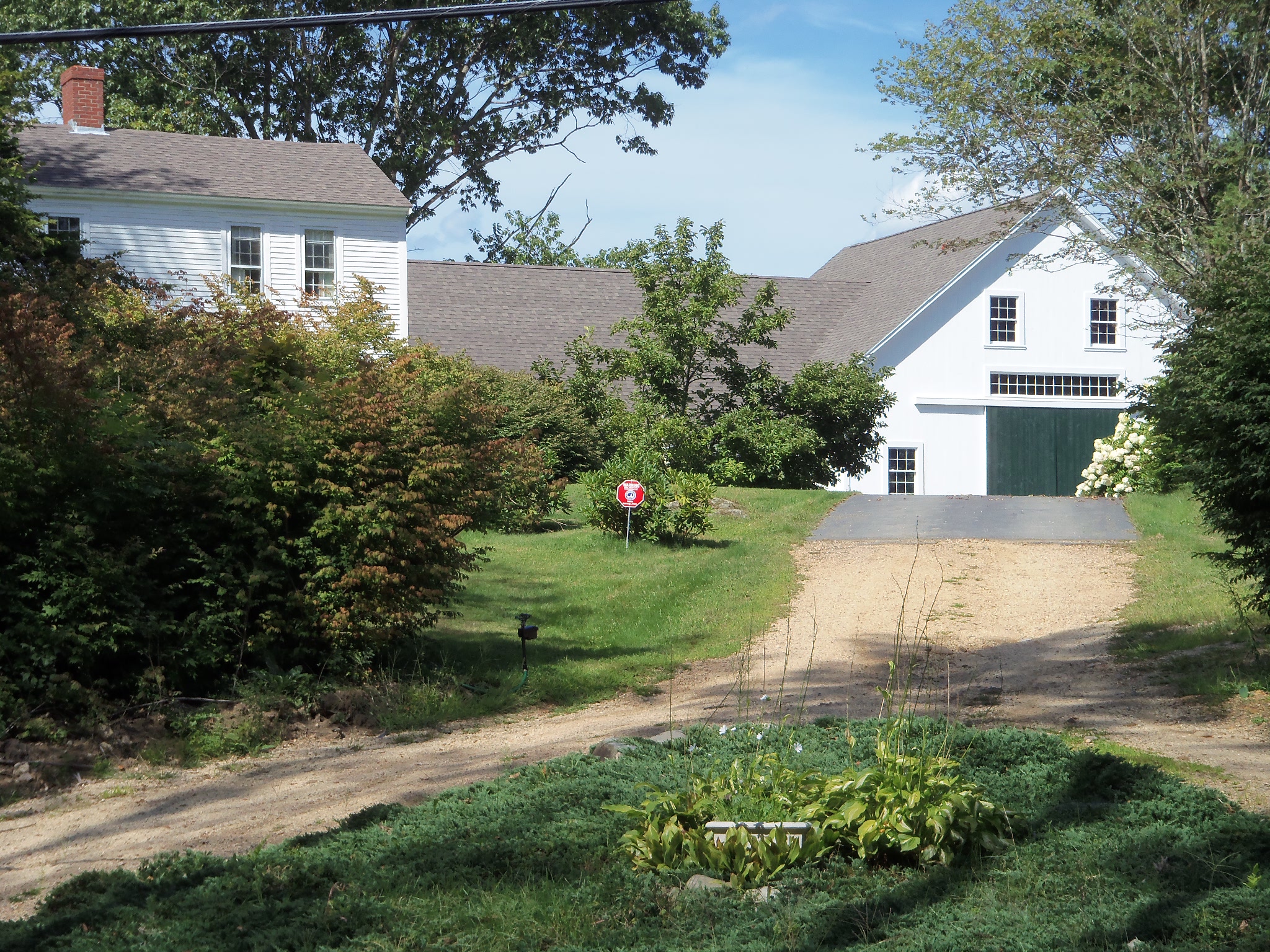
I’ve mentioned the space we whimsically call the Smoking Garden – the funky patio, as it were, beside the barn.

It’s great for late afternoon and evening dining all summer, or parties ringed by Tiki torches, though it’s been a while.

Even so, here it is.

PAINFUL NEUTRALITY

At the least, the pursuit of objectivity has meant that news reporters and editors cannot engage in political activities. Even community-wide charity drives become suspect. I learned early on I couldn’t wear political buttons or put a bumper sticker on the car, much less participate in a protest line. The ethics policy at the Kansas City Star was famed for telling its personnel that the only organization where they could vote was their church. (And, presumably, public elections, although some journalists have argued even that would taint their professionalism.) To be honest, even though we Quakers never take a vote in our business sessions, I felt some relief to know that my church was taking public stands in my stead.

It’s not that we don’t have values or don’t believe that reforms are needed. Rather, it’s an awareness that to report all sides fairly, we need to have some distance from participating in the battle itself. We have to be able to report shortcomings even in the places where we feel most sympathetic.

Still, I’d like those who accuse journalists of bias to try living under such strictures themselves. Maybe they’d even see a bigger picture.