Because we rely on a wood stove to heat part of our house, one of my annual rituals involves ordering and stacking timber. Living where we do in northern New England, there’s plenty of forest to draw on and we can anticipate suffering through an extended winter. With the advance of “renewable energy” sources, however, we’re also competing with the local electrical utility, which has begun using wood to fire some generators. Since we reside in a small city and have full-time occupations (though not always of the paying variety), we depend on the services of independent entrepreneurs who proclaim, as the saying goes, CUT – SPLIT – DELIVERED. Cordwood, for the stove, being a couple of inches shorter than fuel for the fireplace. It’s a crucial distinction.
This is not something I grew up with. Nobody we knew had a working fireplace, or if they did, it wasn’t used in our presence. My appreciation of wood fires originated in Boy Scout outings with a troop dedicated to backpacking and primitive camping – quite a feat, when you think of it, for a troop based in southwestern Ohio. My first-hand experience with working fireplaces came later, with my residency in an ashram in the Pocono mountains of Pennsylvania, in a single winter of living in town in Washington State, and in the house I owned for a couple of years in the Rust Belt – a half-dozen years, altogether. Thus, my sustained encounters have been largely in the past dozen years in New Hampshire, though I suspect the applications are fairly universal.
Ordering in itself is an act of faith. You find a phone number – perhaps in one of the weekly neighborhood newspapers or perhaps on a kiosk in a local store or perhaps by word of mouth, and eventually dial (one of my delays is making sure I could pay for the wood on delivery; the timing of our income-tax refund is often a factor); usually you wind up leaving a message on an answering machine and hoping for a reply. Even then, there’s no guarantee the woodcutter will reply or follow through on a promise to deliver. For the dealer, arranging for trees can be iffy – a warm, wet winter, for instance, may keep cutters out of the woods. One year, this meant our pile never arrived, and we were stonewalled on our inquiries. These days, our firewood comes from a man in his early seventies. How much longer he’ll continue, of course, is in question. In typical Yankee farmer tradition, he shows up when he’s ready – anywhere from a month to three or four months after he’s expected. We don’t need to dicker over price – he’s well in line with the going rate, and I’ve always been impressed with the quality he delivers.
After some irregularity in our annual pace, we’ve settled on ordering four cords a year, green wood we hope will arrive in time to lose much of its sap before late autumn. Since we’ve been burning about three-fourths of that amount, I’m hoping to get ahead enough to have enough well-seasoned wood, having had more than a year to turn from yellow to gray, to sustain us – a goal that still eludes me. Maybe we won’t have the creosote buildup this year that has afflicted our chimney by March the past two years, but I can’t convince my wife that the savings in purchasing green wood outweighs the cost of the chimney sweep, something she says we have to do anyway. Seasoned wood also burns hotter and catches more easily. Maybe this year will be different. I keep hoping.
The delivery comes in two parts, each one dumped in our driveway to produce a lovely, chaotic heap of timber that also releases a heavenly aroma, especially after a light rainfall. And then I typically set to work, between my required rounds at the office (who knows what will happen, now that I’m retired) and usual household activities. Let me admit, I don’t rest easily while the driveway is covered; I’m like a beaver when it hears running water. So stack I do, probably more than is healthy for a largely sedentary creature of my age and condition.
By now, I have something of a routine down – maybe that’s in the nature of a ritual, too. The location of the two firewood stacks has been determined, in part as a consequence of landscaping decisions by previous owners of the property and in part as a result of my own tinkering. Half of the wood will go on one side of the house, by the lilacs; the other half, on the other side of the house, well be behind the barn and our shed.
The ritual sets in as I fill my wheelbarrow and begin moving the wood, piece by piece. Immediately, I search out pieces that are squared off, having four sides rather than three; these are essential for constructing the corners. Some are flatter than others, and will be used for the lower levels of what has some resemblance to a filled box or brickwork – three pieces set at a right angle atop three more, alternating as high as needed. Eventually, the warped pieces begin fitting snuggly, and if there’s any lean to the line, I want it to slant toward the pile itself to let gravity add to the stability of the stack. At first, the task of reducing the pile appears overwhelming; there’s no visible progress at the source, and little on the other end. Here I must rely on previous experience, remembering that it’s something that is accomplished, one step at a time. The hard work has already been done – the cutting, moving, and splitting of the wood.
A rhythm sets in. I recognize that each piece has already been handled multiple times. Now I handle it at least twice – once to put it into the wheelbarrow, and again when I add it to the stack. There, it may be turned or jiggled for a secure fit in the emerging puzzle. It will be handled at least twice more, once to be carried to the kitchen and then to be placed in the stove. The ashes, of course, will be carried out and spread on the garden. For now, I regard the wood itself, trying to identify the species (maple, birch, oak, ash, beech, mostly) as well as the color and shape. No two pieces are exactly the same, and some that are gnarled or curved are placed aside, reserved for the top of the stack, where stability won’t be quite as essential.
A pattern emerges, or rather a fascinating movement of visual design. Not that visible harmony is on my mind as the pieces amass; instead, my concern is for engineering security and solidity against settling and the elements. I long learned that no matter how stable the stack feels now, it will slip in the months ahead; while one stack will begin dwindling by Christmas or my birthday, and its interlocking tensions need hold only so long, I am planning on the other stack staying in place a year beyond that, so its lines need to remain shipshape. If anything, I try to anticipate the many small shifts, so that the weight of one row will brace another. Still, there’s a degree of chance on how any of this will fare, no matter my care. A Zen Buddhist saying flits through my mind, “In nothingness, form; in form, nothingness,” though “chaos” or “chance” substitute well for “nothingness” here. In other words, look and see: things come together.
The labor also has me reflecting on how I write a poem – or many other works, for that matter. I usually start with a pile of debris – observations and scattered thoughts I’ve jotted down and collected. I’m not one for formal structures or invention; to my senses, that’s more like carpentry or cabinetry, and the related ritual would be stacking 2x4s from the lumberyard. No, I’m sticking closer to the grain, or the quest of exploring wilderness. The irregular spaces in the stack, resulting from half-moon ends and triangular thrusts and other geometric possibilities coming together fascinate me more. The negative gives dimension to positive, shadow plays into light, and small critters will likely find shelter somewhere in the heart of all this.
I can also see the woodpile as a metaphor for my faith community, though there the number of craggy pieces may be multiplied, and I keep hoping for more new greenwood – we seem to be seasoning a bit too much for a good mix, and I’m not alone in that observation.
Either way, you work with what you are given.
So here I am, pleased to have two woodpiles in place by early July. One measures roughly six by six by six, the other 3½ by ten by six – each about 210 cubic feet, in other words, short of the purchased measure (a cord being 128 cubic feet), but fitting the normal practice. I’m not complaining. Besides, I pack tight in my stacking, unlike the typical woodcutter. With the promise of winter comfort, of caring for my family, of coming home from the office (as I often did) around midnight and loading the stove for the remainder of the night, I stand back for a moment, admiring my sculpture. Yes, Jesus did warn against the man who built a huge barn, expecting to hoard forever, so my regard of my woodpiles is tempered. Still, I know the arrangement will go too quickly, and the process will happen all over again next year, if I’m blessed.
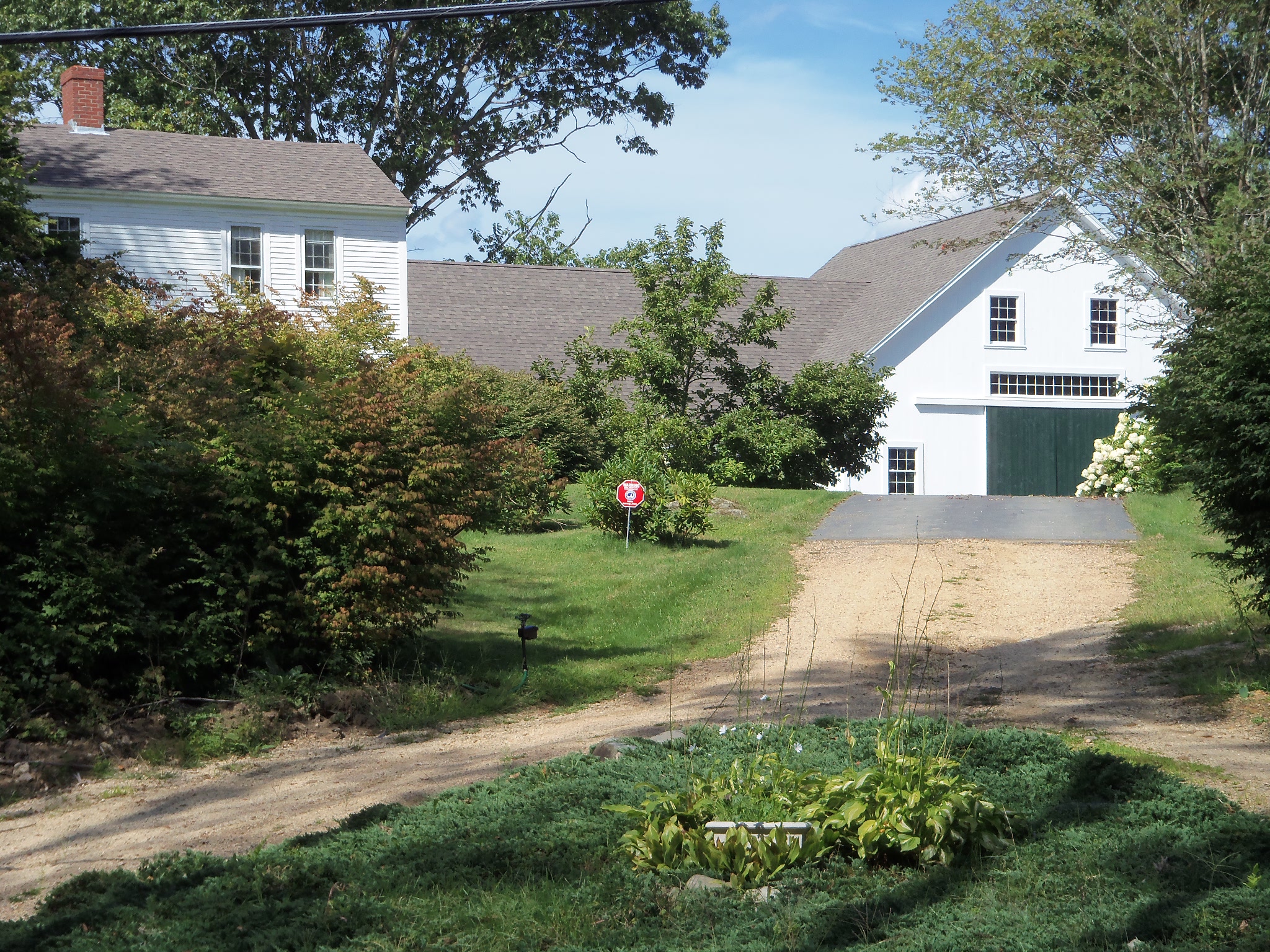


 Jnana's Red Barn