Regarding Samuel Shackford and son Samuel

Captain John senior and Esther had one other son, Samuel, who died in South America in 1820. His wife, Elizabeth Lincoln, had been born in Hingham, Massachusetts, and died in 1884 in Eastport, age 90.

The only child, Samuel, became a ship captain and, in 1851 in Eastport, married Mary Tinkham. He was also the one who provided the Shackford family profile in William Henry Kilby’s 1888 Eastport history volume.

Samuel junior turns out to be a remarkable figure in his own right.

As the 1895 Album of Genealogy and Biography, Cook County, Illinois with Portraits detailed, “He was, like his father, a shipmaster, which calling he followed until he came to Chicago, in November, 1853. Immediately on reaching this city, he engaged in the commission produce business, an enterprise which he carried on until the great Chicago fire, after which he removed to Winnetka.

“While living in Chicago, he was one of the early members of the Board of Trade, and served two terms in the city council during Mayor Rice’s administration. For five years he was a member of the Cook County board of supervisors, serving on several important committees, and for a time was chairman of the finance committee. During the Civil War, over two-and a-half million of dollars of soldiers’ bounties passed through the hands of this committee. He served about four years as a member of the Chicago board of education. … For many years he was a trustee of Rev. Robert Collyer’s church in Chicago, and was an exemplary churchman, never noted for extreme piety, but highly respected for his practical ideas of Christianity. He has been for years a trustee of the village of Winnetka …”

In addition, “Mr. Shackford has always been highly esteemed as a public-spirited and useful citizen. Before the Great Fire he had, perhaps, the finest and most complete records of city and county affairs ever in the possession of any one person, and his excellent memory aided him in the recollection of important transactions, which made all very valuable to the citizens. The people seemed to feel, and often expressed themselves in saying, that if he was chairman of a committee, that committee would do its full duty in advancing the interests of the city. He was indefatigable in looking after the affairs of the public in general, nor was he negligent of his own business.

“He has the best genealogical record of the Shackford family, and more interesting family records and mementoes than any other man in the state. Members of the old Shackford family are related to the first families in New England, proof of which he has in his possession. Mr. Shackford has written and left to posterity many valuable genealogical records, which have been, from time to time published. Notable among these, because of national interest, is ‘The Lineage of President Abraham Lincoln,’ as published in the New England Historical and Genealogical Register for April 1887, in which the writer, whose mother was a Lincoln, proves beyond a reasonable doubt that the brothers Mordecai and Abraham Lincoln, sons of Mordecai and Sarah (Jones) Lincoln, of Scituate, Massachusetts, were the ancestors of the Lincoln families of Pennsylvania, and that Abraham Lincoln, the Martyr President, was descended from the brother Mordecai …”

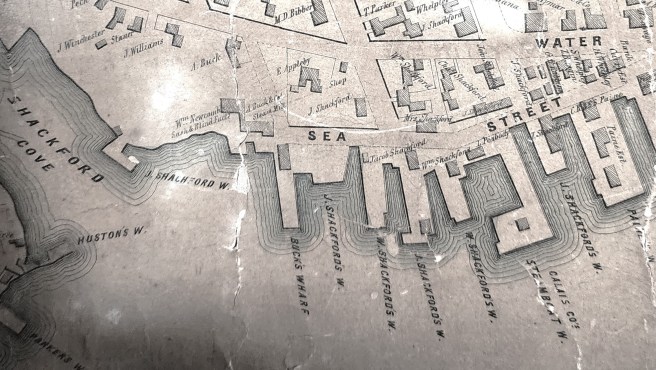
The 1855 Eastport map, produced shortly after Samuel had relocated to Chicago, illustrates how much the family had flourished. At least 13 buildings are labeled Shackford — most of them along Water and Sea Street just below our house. Many of the latter were likely warehouses and offices related to the six Shackford wharves and piers flanking the Calais Co.’s Steamboat Wharf, at the time owned by John junior.

The 1850 Census had eight Shackford households in Eastport. The 1860 Census had ten. And soon there were none.

So much for the Shackfords who grew up in the house we now own and their descendants.

Now for a touch of scandal in the family

The house at the corner of Water and Key streets came into the ownership of Jacob’s nephew, John Lincoln Shackford, who had married Elizabeth S. Clark in 1838 and, following the occupation of his father and siblings, became a mariner.

In 1847 Captain John Lincoln Shackford he was advertising freight and passage aboard the brig Carryl, traveling for Saint Marks and Newport and from Pennsylvania to the Isle of Lobos and Havana.  He also was reported as rescuing members of the crew of the bark Cambria and conveying them back to New York.

The 1850 Census recorded him living in Eastport with his parents, his wife Elizabeth, and three children. In 1860, they were with her parents and two children, presumably while he was at sea. Shortly after that, the family moved to New York, where he was recorded in Brooklyn at 111 Adelphi.  In 1863 he was listed on the Brooklyn Civil War draft registration, and in 1864, he was at Hamilton north of Fulton Avenue.

Among their children was Abby, who died at age seven in Cuba — suggesting that Elizabeth and the children had accompanied him on his voyages as a captain — and her twin Esther, who died in Brooklyn at 21, and sister Fanny, who died as an infant.

Shortly before February 1871, John’s wife returned to Eastport, where she filed for divorce, dower, and alimony, asking for all right title and interest in any and all real estate he had in the County of Washington, Maine. Before the case was settled, he died, December 20, in the Virgin Islands.

As the case was submitted, “To the Honorable the Justices of the Supreme Judicial Court next to be Holden at Calais, within and for the County of Washington in said state on the fourth Tuesday of April AD 1871.

“Elizabeth S. Shackford of Eastport in said County, respectfully represents that she was married to John L. Shackford now of St. Thomas, at Eastport in said County on the tenth day of December AD 1838 and had by him two children now living to wit; Joshua C. Shackford & Regina T. Shackford. That after her said marriage she cohabits with said Shackford in said State of Maine, and always conducted herself as a true and faithful wife.

“That the said John L Shackford unmindful of his marriage vows and covenants, and the duty affection and respect he owed her, deserted her more than three years ago, and has not supported her for the last three years.

“That he has been living with another woman to your Libelland Unknown in St. Thomas.

“That he has been married to said woman as he has declared in letters to others.

“That he has a daughter by said woman and committed adultery with said woman.

“Wherefore, because a divorce from her said bonds of matrimony would be reasonable and proper, conducive to domestic harmony and consistent with the peace and morality of society, she humbly prays your Honors such divorce accordingly …”

Additional documents listed John L. Shackford’s estate value at five thousand dollars (the number is crossed out and rewritten).  The court ordered payment to Elizabeth and ensured that the United States Consul to St. Thomas delivered a copy of the document to John L. Shackford (misspelled Schackford on the document).  The court then allowed Elizabeth to sell land to include property at the corner of Water and Key streets (formerly Greenwich Street), land on the northerly side of Shackford’s Cove, along with other property valued at $1,471.02.

Curiously, widow Elizabeth returned to New York, where she died in 1882.

The Eastport Sentinel reported, October 2, 1889, “Mr. T.M. Bibber moved last week from the Shackford house at the corner of Water and Key Streets to the Chapman house on Boynton St.” The Bibber connection may have been thicker than I’ve uncovered so far.

Obviously, Shackford descendants were ranging far from Eastport, never to return.

Jacob Shackford’s line

Captain John senior and Esther’s son Jacob commanded the steam brig New York, the first steam vessel to enter the harbor of Eastport.

He followed the sea up to 1832, when he and his brother established W.& J. Shackford & Company. Independently, Jacob did build ships, including four brigs in a few years in the 1850s. One of them was noted for riding out the devastating gale of 1854. He also dealt in real estate, as his running advertisements in the Eastport Sentinel of 1865 illustrate: “House lots on Shackford and Water streets. Also two lots. For sale on reasonable terms by Jacob Shackford.”

Jacob’s son, shipmaster George, died August 1, 1863, age 39, during the Civil War. I’m left wondering whether his death resulted from civilian or military seafaring.

Jacob’s son William did serve, from 1863 to 1865, aboard the USS Home, USS Winona, and USS Nahant.  In 1870 his residence was in Eastport; in 1880, Philadelphia; and 1890, New York, reflecting a successful shipmaster’s social mobility. His summer vacations at Cape May, New Jersey made the society pages of newspapers.  The August 2, 1897, New York Tribune reported the arrival of Mrs. William Shackford and Miss Carrie N. Shackford. An August 29, 1897, article in the Philadelphia Inquirer noted that Captain William Shackford joined his wife at the Congress Hotel to recover from “an attack of isthmus fever to regain his health.”

Back in Eastport, as Weston noted that Captain Jacob Shackford’s will, written on September 2, 1868, named his beloved wife Elisa D., his homestead on the corner of Water and Key Streets, a daughter Eliza A. Shackford, a son William Shackford, and another daughter Matilda, the wife of Charles B. Paine. It also left part of the estate to his son Henry Nevis Shackford, if known to be living at the death of his wife [Eliza]. Henry had left on a ship and never returned.

Son-in-law, C.B. Paine, husband of Matilda, had constructed the home on the corner of Water and Third streets, across from us, in 1841.

Jacob died June 19, 1869, age 79.

Over time, Jacob’s house at 4 Key Street grew from a federal style house and narrowly averted the devastating 1886 downtown fire. At some point, at his wife’s urging, the structure was turned 90 degrees, from facing the waterfront, to its present orientation, facing north, and drastically restyled.

When Eliza died on February 17, 1879, age 85, she was no longer residing in the house, as far as I can tell.

Remember, Jacob grew up in the house we now own.

As for William Shackford’s line

The second son of John senior and Esther was William, who “went to sea as a boy and continued to be a sailor all his life,” as the family said. Or maybe not quite that long. He did retire to land, as you’ll see. “He commanded the Active in 1807 and was subsequently master of the Sally, Orient, Blockade, and Five Brothers, ships largely concerned in the West Indian trade.” Naming the Blockade, by the way, sounds like an act of defiance, don’t you think? And Sally would have been a nickname for his first wife.

As a sea captain, he frequently ventured far from Eastport. As we’ve previously mentioned, at age 29 he was captured by French pirates off the coast of Spain, eventually ransomed, and made it back to Maine just before the British blockaded the American Atlantic coast during the War of 1812.

As related in another account, “He was in command of the brig Dawn when that American ship was captured by a French cruiser during the war with the French in the time of Napoleon I. He was carried to France, and upon being relieved at the instance of the American minister, he went to England and came before the mast as an ordinary seaman. He next commanded the Lady Sherbrooke and then the Sarah. His last vessel was the Splendid, a fine packet engaged in the freight and passenger traffic between Eastport, Portland, and Boston. He retired from sea service in 1833 and engaged in mercantile pursuits with his brother, Jacob.” More specifically, the firm was W. & J. Shackford & Company, merchants, shipbuilders, and fishermen. Lorenzo Sabine was a partner briefly enough to explain the “and company.”

The retirement from sea service came around the same time the Shackford siblings surveyed their shared land holdings and began dividing it. There was much wheeling and dealing among the siblings and their nephews and nieces in the years that followed. Between 1840 and 1849, for instance, William sold or transferred or traded 33 parcels, including six to his brother Jacob.

William’s home at 10 Shackford Street is one block up and a block over from ours. Like others in the neighborhood, it was remodeled as styles changed. Parts of the structure may date to the early 1800s, while the front part of the house has the symmetry and simple lines common in area homes in the 1830s and ’40s. Much later (after his death) the home was updated with Queen Ann period details popular in the late 1800s. A close look at the structure reveals later additions such as the modest tower (which would have had a practical purpose, offering views of the harbor) and a decorative porch, for the summer breezes off the sea, I’ll venture — or even watching the daily parade up and down the street.

So much for the real estate pitch. Today, Joe and Mary Clabby have overseen its marvelous restoration.

Three of William’s four sons went on to become sea captains.

John William Shackford for many years commanded the steam packet ship Illinois and other ocean steamships and was then master of Jay Gould’s famous steam yacht Atalanta. (It has its own Wikipedia entry.) He died in Philadelphia in 1905.

Edward Wallace Shackford graduated from the Eastport high school, learned the trade of block and spar making at Machiasport, and then shipped on a vessel trading with the West Indies as ordinary seaman. His second voyage was on a ship that made the hazardous journey to the Pacific coast of the United States by way of Cape Horn, South America, reaching San Francisco in 1860, and sailed as far north as Puget Sound, where he passed the year 1861-62, and returned to Maine by the same route, reaching home in 1864. His next voyage was before the mast, first mate and captain of the brig Emily Fisher, commanding the brig in 1866. His next sea experience was on a steamer on the American line between Philadelphia and Liverpool, England, in the capacity of second officer, and he made four voyages on the steamships. He commanded a bark after leaving the steamship, and in 1887 resigned the command of the bark Ormus to assume a like position on the steam yacht Atalanta, owned by the aforesaid Jay Gould, on a voyage to the Mediterranean — was William introduced by his brother? He was captain of the schooner Johannah Swan, built by Albert M. Nash at his shipyards in Harrington, Maine, from 1889 up to the time the schooner was wrecked in the terrible gale of November 1898, in which gale the steamer City of Portland was lost with all on board and scarce a vestige of the vessel was ever found. William’s wrecked schooner, however, withstood the gale for seven days, when Shackford and his crew were rescued by the German bark Anna. On his arrival home, which was no longer Eastport, Shackford abandoned the life of a sailor and retired from active participation in business life.

All of this reflects the realities of sea life in a changing era.

Edward Wallace Shackford established a winter home at Harrington, Maine, and a summer home that was a “comfortable cottage by the sea,” at Point Ripley, “which has proved so delightful a summer retreat to seekers for an ideal seaside rest.”

He also found congenial spirits at the periodical meetings of Eastern Lodge, No. 7, Free and Accepted Masons, of Eastport; Dirigo Chapter, Royal Arch Masons of Cherryfield; and Tomah Tribe, No. 67, Improved Order of Red Men, of Harrington, Maine. He was elected a member and chairman of the Harrington Republican town committee. He was chairman of the Harrington school board for three years, represented his district in the house of representatives of the state of Maine in 1903-04, and was a member of the senate of the state of Maine 1905-1906. He was president of the Ripley Land Company of Maine from its organization and attended the Baptist church, where his wife was a member.

And that was essentially the end of the Shackford influence in eastern Maine.

Price check alert

He promised lower prices. Here are ten you can bet will go up because of his promise of “lower taxes.”

  • Fuel. As in gasoline, diesel, and home heating oil. We pump and refine some in the United States, but not nearly enough to meet demand. When demand outstrips supply, as basic economics theory contends, prices go up. It’s part of what’s ironically known as a free market.
  • Coffee and tea. Imported and subject to new, stiff tariffs.
  • Vanilla. Ditto. Along with a lot of other spices and flavorings.
  • Chocolate. The beans are imported, as are some chocolate products. If you were considering cocoa as your new beverage of choice, think again.
  • Olives. Yes, we raise some, mostly California, but the U.S. is not in the top five olive-growing countries. Spain and Italy top that list. As for olive oil, which many fine cooks consider essential and which nutritionists tout as healthy? There will be suffering.
  •  Cars, SUVs, trucks, and parts. It’s a complex picture, but you can’t build new factories and hire and train workers overnight.
  • Electronics. Ditto.
  • Clothing. Check those labels. As for building factories and hiring and training workers? Once again, it won’t happen overnight.
  • Wine and spirits. Yes, we make these in the USA, too, but imports are major. There are no substitutes when it comes to discriminating tastes. And here’s another case of demand outstripping supply in a so-called free market.
  • Bananas. Most of them come from plantations in countries formerly controlled by American owners. You know, banana republics.

One place prices seem to be going down is stocks.

More on John Shackford junior’s impact

I’m presuming that the house Jonathan Delesdernier Weston recollected as town’s second conventionally wood-framed house, built after 1812 but removed shortly before 1888, was John junior’s. The 1855 map shows a J. Shackford house at the southeast corner of Water and Middle streets that doesn’t match current buildings. Weston, incidentally, built the 1810 Federal-style house at the corner of Boynton and Middle streets, a place now noted as housing John Jacob Audubon on his residency in town.

The Eastport Sentinel in September 8, 1880, noted, “The close observer, as he walks about town, notices many changes and improvements within the past year. … It is of the fixing up that we all speak particularly. The John Shackford house on Water Street has been repaired and remodeled by Mr. Warren Brown so that it bears little resemblance to its former self.” Brown was a tailor and fish packer with a growing family, and the John Shackford in question would have been dead 12 years. As a further complication, among the residences destroyed in the 1889 fire was Brown’s.

John junior’s first son, Benjamin Batson Shackford (1811-1884), most likely
spent his early life “aboard his family’s ships training for his shipmaster’s qualifications,” as Joanne Shackford Parkes wrote in the Shackford Family History blog.  “In 1833, when he turned 21, he married Harriet Bibber, daughter of Thomas Bibber and Dorcas Pettengill. They made their home in Eastport and had eight children.

“Seventeen years later, the family was doing well financially as reflected in Benjamin’s 1850 Census report of having property valued at $1,400. By then, Benjamin, the sea captain of the brig Waredale, was traveling to Baltimore, St. Thomas [Virgin Islands], and Trinidad.”

She found that in 1855, newspapers reported the Waredale and Shackford sailing from Norfolk to St . Croix in February; Guayanilla, Puerto Rico, to New York and then St. Thomas in May; Maracaibo, Venezuela, to Eastport in July; and Eastport to Calais and then to Bathurst, Africa, in October.  She adds to that his sailing multiple times between 1856 and 1858 to Trinidad, bringing back molasses. And in mid-1858, he added South Carolina; the Turks; Mobile, Alabama; Surinam; and Matanzas, Cuba, and Remedios, Cuba, to his rounds.

The 1860 Census valued his real estate at $1,200 and his personal assets at $400. That year, as Parkes wrote, he sailed on multiple trips to Puerto Rico, up and down the New England coast, and to the Turk islands. By 1863 he was sailing the Waredale frequently to Jamaica and Cuba.

She then describes how in 1864, on his second trip as captain of the bark Zelinda from Matanzas or New Orleans to Philadelphia (reports vary), he was overtaken and boarded by the Confederate privateer ship Florida while off the coast of South Carolina. The crew was placed aboard another captured ship, the schooner Howard and sent back to port while the captain of the Florida set fire to and destroyed the Zelinda. “It appears that the crew was not allowed to take much with them, and after the Civil War ended, Capt. Benjamin B. Shackford filed a claim in the Alabama courts reporting that he had lost his belongings, and in 1875 he was reimbursed $2,303.85 for his losses. In 1883 he gave a deposition stating that another member of his crew had also suffered a loss of clothes, outfits, and articles.”

She notes that when Benjamin’s father John died in 1866 without a will, he left properties valued at $3,200. “The probate dragged out until 1872 and finally resulted in a division of the land which included some prime real estate in Eastport which was divided between Benjamin and the families of his siblings, Charles William and John L. Shackford.

“This increased Benjamin’s real estate holdings significantly and, in the 1870 census, he reported real estate valued at $3,000. The American Bureau of Shipping lists him as the master of the L.L. Wadsworth around that time and newspaper articles show him sailing to Freeport and Trinidad. While his last trip on the L.L. Wadsworth was around 1872, Benjamin continued to list his occupation as sailor in the 1880 Census.

After a life of sailing and adventure to many places in the world, Benjamin Batson Shackford died in Eastport in 1884 at the age of 72.

His children were Joshua Shackford (1834-?); John Edward Shackford (1836-1862), blacksmith, died in New York; Harriet Elizabeth Shackford (1838-1861); Marietta Shackford (1840-?), married Joseph R. Gilman; Ann Pearce Shackford (1841-1924), married Andrew V. Bradford, moved to Oregon by 1900, died in Oregon in 1924, gravestone is in Eastport, Maine;
Emma Shackford (1842-?); Gertrude Shackford (1844-?); and Stella Woodwell Shackford (1853-1918), married William Pearce Higgins, died in Oregon.

Remember, John junior grew up in the house we now own.

John Shackford junior had his own legacy

In following the history of our house, we’ve veered off from Captain John and Esther’s children as other families added their names to the dwelling. At this point, I’d like to return to the Shackfords to give you a better sense of the family’s additional impact on the community as well as ways the town itself changed over the years. When the Shackfords first arrived, the place wasn’t even called Eastport but rather Passamaquoddy or Moose Island on Passamaquoddy Bay. Sometimes it even went by all three at once. While the sons’ and sons-in-law’s escapades during the War of 1812 have been noted, their seafaring ventures continued well after.

~*~

John junior, for instance, not only commanded the first vessel owned in the town, but he also ran the first packet in the Boston and Eastport line, “through winter’s storms and summer’s fogs.” A packet was a new concept in shipping, with vessels departing on a regular schedule, rather than waiting for a full load or a set number of passengers. The innovation could be risky for the investors or highly profitable, depending.

In a fuller telling, he “was commander of the first vessel owned in the town and commander on the first freight and passenger traffic boat established between Eastport, Portland, and Boston, and his last packet, the Boundary, the swiftest vessel on the coast after 21 years in this service, had to give place to steamships.”

The May 9, 1828, edition of the Eastern Argus announced that the schooner Boundary, 142 tons with John Shackford, master, the schooner Edward Preble, and the Thomas Rogers would be running between Eastport and Boston, stopping at Portland both directions. That gives us a date and a possible commercial association of the three vessels. After that, newspaper mentions of the Boundary arriving or departing Eastport or Boston with Captain Shackford at the helm were common.

He “knew by sight all the dangerous places along the coast, but never had more than a passing acquaintance with them, and during his long experience as shipmaster never had occasion to call upon his underwriters for a dollar.  The Boundary, his last packet, so well known as the swiftest vessel on the coast, was driven off the route on the introduction of steamships, when she was 21 years old; but for 20 years after she was a staunch craft, engaged in the coasting trade.”

Coasting, should you wonder, refers to traffic that followed the coastline rather than crossing the open ocean. The swift, agile coasting schooners could easily run into trouble further out from the coast.

The December 2011 edition of the Maine Coastal News described the Boundary as having two masts and dimensions 79 by 22 by 9 feet. And, yes, she was built on Shackford Cove in 1825 by Robert Huston.

There was a legal tangle on June 26, 1826, when, as commander of the Boundary, Captain John appeared before the Boston board of alderman to respond to charges of an alleged breach of the law to prevent the introduction of paupers from foreign ports.

Captain John junior’s sons included three shipmasters: Benjamin Batson Shackford, who died in Eastport in 1885, aged 73; Charles William Shackford, master of the brig Esther Elizabeth, who with his vessel was lost at sea in the winter of 1853-1854; and John Lincoln Shackford., who died at St. Thomas, West Indies. More on him later.

John’s wife, Elizabeth Batson, came from another seafaring family. She died in 1830. Did she travel with him, as many captains’ wives and families did? I suspect he married a second time, perhaps to Eliza A. who died in Eastport on February 17, 1899, age 84 years four months five days.

When John junior died on August 12, 1866, he left no will. His obituary in the Eastport Sentinel, in the manner of the time, did not name other family members, something that might have revealed whether he had remarried after his first wife’s decease. Instead, it said, “He was a devotional man always found at prayer meetings and public preaching when he was able to be there.”

Remember, John junior grew up in the house we now own.

The allure of gold, too

Back to Elsie’s son, Ethel Olmstead. Several accounts have him marrying Abigail C. Harrington and having the son and three daughters, as recorded in the Census. She may be the Abigail Harrington born September 4, 1815, in Eastport to Andrew Harrington, who came to Moose Island from New Brunswick.

Another Loyalist connection?

Ethel’s gold-digger occupation noted in the Census leads us to the California Gold Rush. He died July 22, 1852, in San Francisco and is buried in Golden Gate cemetery, a potters’ field (the gravestone name has been transcribed as Esther and the birth date is 1812 by one source), although Yerba Buena is a second possibility. Both lines of argument have the same date of death but no cause. Natural or violent? Did he go by way of a sailing vessel around treacherous Cape Horn or perhaps crossing Panama? Perhaps working on one of the Shackford vessels? It makes more sense than a wagon train crossing the Prairie, considering the distance from Downeast Maine to the Oregon Trail and then points west. As for a cause of death? We can only speculate.

The Gold Rush angle thickens with the death of Major Ethel Olmstead of Calais, Maine, on March 15, 1856, at age 70, in El Dorado County, California. “No road leads up to the grave and the few trees and bushes surrounding the grave hide it from the outside world” outside the historic gold mining camp of Wild Goose Flat on the east side of the North Fork of the American River in the Sierra Nevada Range.

I do love the description of his final stop, “southerly from Rattlesnake Bar and easterly from Horseshoe Bar.” Those may be watering spots more than places in the river, should you wonder. Perhaps that’s gives you an idea of how widely some individuals traveled from the easternmost homes. His second wife, son, and daughter all continued in California after his death. In Calais, he had been a blacksmith.

This Ethel turns out to be the uncle of the Ethel of our house. I’m guessing neither of them struck it rich.

Since both Abigail and her son James were living at the time of the house sale to the next owner, more questions remain.

I’ll also note that having additional residences in Boston and New York was not uncommon for shipowners or captains, so I do wonder about Lucy Hooper’s husband’s occupation. One more thing to check out, when I can.

Curiously, the recording of that deed did not include a book-and-page citation to a previous sale, leaving me stymied on furthering the property’s earlier history. Still, as you’ve seen, I finally connected the line.

The widow purchases the property title

In a transaction dated December 27, 1859, Elise purchased the property from the Shackford estate heirs for twelve hundred dollars. In addition to Captain John senior’s sons Jacob, John, and William and daughters Esther and Hannah, grandson Samuel Shackford,, and their spouses as the sellers, we find the name Myrick D. Bibber, the furniture merchant who built at the corner of Water and Shackford streets around 1840.

Note that daughter Sarah Shackford Lincoln is not mentioned in this agreement (she died in 1846). In December 1841 she had sold “my right title and deed [?] to the estate of my Father John Shackford, late of Eastport” to William Shackford and Bibber.

In the 1860 Census, the household was enumerated under Elsie’s daughter, Abigail C. Olmstead, 46, dressmaker, personal value $15 or $1,500 — the script is difficult to read. Elsie — or Eliza, as the Census recorded her — was 83 and had a real estate value of two thousand dollars.

The household also had boarders: storekeeper Peter Kane, 21; Sarah Leighton, 72; and Sophia Gleason, 67.

Ten residents in our house would be tight, even if the two ells attached at the time had living space.

An inventory of Elsie’s estate was ordered in August 1868 after she had been declared non-compos mentis and placed under the guardianship of her step-grandson John S. Pierce [Pearce], by way of Hannah Shackford Pearce.

Her death, October 19, 1868, was reported in the Eastport Sentinel as “Mrs. Elizabeth, relict of the late Captain John Shackford, 78 years.” The age would correspond to Elsie’s.

In 1880, her daughter-in-law, Abigail Olmstead, was recorded as age 65 living in the household of her youngest daughter, Mary A. Roberts, 31, in Boston.

The linkage to Fisher Ames Buck and later owners was finally apparent.

That sale was by Abigail’s daughters.

Confirming our house as Captain John’s homestead

The Shackford children had their joint holdings surveyed in January 1833, with Hannah Shackford’s husband, Darius Pearce/Pierce, performing the task. A flurry of real estate transfers followed, formalizing their agreements.

By 1820, according to the Census, the sons were heads of household.

Trying to follow the transactions gets rather confusing.

William and Jacob had even gone into business together in 1833, turning their attention away from seafaring. Their dealings included waterfront between the high-tide and low-water stretches as well as bands of shorefront below our house that would be developed into wharves.

From what I see, the boys weren’t getting a family discount. In 1830, John junior paid his father $1,000 for one parcel next to his brother William’s. In a transaction dated December 30, 1831, John senior specifies a band of waterfront “partially in front of my own dwelling house,” with the sellers being himself and “my wife Elsie.”

Among the deals were one on the easterly side of Water Street “to the fence of my homestead” and then westerly to Water Street, confirming that his homestead included both sides of the road.

Of special interest to me in confirming that our house was the one John senior occupied are the two deeds conveying adjoining land along Water Street. First was a sale to Myrick Bibber, a furniture merchant, on June 13, 1839, for a lot on the southwest corner of Water and Shackford streets, and then on July 10, to Daniel Aymar for the lot between the two.

Each of them is measured to the line of “the yellow house lot owned by me.”

Here’s how the description appeared on the two deeds recorded at the Washington County courthouse.

I was surprised to see that he signed the deeds with his mark, X, as did his wife in several instances. New England was noted for its nearly universal literacy, both men and women.

Here’s his X on his will.

Grandson Samuel Shackford said Esther, John’s first wife, “had been well reared and was a woman of superior intelligence” and that her children “were indebted to their mother for nearly all the educational advantages they ever enjoyed.” Unlike her husband, she signed some of the documents, as noted in the record, “her seal.” “School-teachers were rarely obtainable, in those days, in this then out-of-the-world. For a brief period, the services of William Lloyd Garrison’s [future] mother were secured to teach in the family” when she lived on neighboring Deer Island, Canada..

The real estate transactions indicate the children were all literate.

Esther died June 21, 1830. His second wife enters the picture rather obliquely soon thereafter.

His will of June 14, 1832, bequeathed “to my beloved wife Elsie the use during her life of my homestead or the house in which I now live, together with the lot and privileges thereto.”

Further down, it directs his six children and grandson Samuel to pay “to my wife Elsie the aforementioned annuity of one hundred & fifty dollars. And on my demise the homestead on house in which I now live with the lot come privileges pertaining thereto, and the one of which I have willed I am bequeathing to her during her life, I am bequeathing to them, my six children … in the same proportion of my other property.”

A harder to read codicil of October 5, 1839, raises the amount of the annuity to “my wife Eliza Shackford” to $200 during her natural life and “all my furniture and my pew in Baptist meetinghouse forever.”

After Captain John’s death, as Samuel Shackford confirmed, Elsie (or Elise, in his account) obtained the Revolutionary War veteran’s pension based on his service.

Elsie was later recorded in the 1850 Eastport Census as Eliza Shackford, 70, living in a household headed by Abigail Winslow, 37, along with four children — Anna E, 12; Lucy M., 6; James F., 4; and Mary A., 2; as well as Ethel Olmstead, 37, with his occupation as “gold digger” in the metal mining industry. An index to that Census listing placed Ethel as the head of household, even though he was at the bottom in the family. I am perplexed by the Winslow identity.

All of it, of course, has relevance on the house we bought.