It’s the book I didn’t want to write, but it wouldn’t let go  

I thought we Dover Quakers – or more formally Friends – had our long history covered. I had even helped Silas Weeks, way back, in some of his research for his definitive volume on New England Quaker meetinghouses and burial grounds.

Frankly, after revising and republishing seven novels after the appearance of my eighth, I wanted a break.

A big break.

These are supposed to be my retirement years, OK? Admittedly, I had long imagined devoting myself to the writing as a big part of that dream, but really!

But then a casual request for an overview of Dover Friends history changed everything. It came indirectly, through someone in another denomination who was active in our Sanctuary movement. But then, going back through my filing drawers, I came up empty – couldn’t even find my folders of notes. What we did have was mostly about our three meetinghouses over the years – especially the structure where we’ve worshiped since 1768 – along with a few prominent events.

This left me unsettled.

Unlike many other denominations, the Society of Friends, or Quakers, is first and foremost about its members. Our definition of church is the body of believers – not the building or the polity and definitely not the ordained clergy. It’s why we call our building a meetinghouse and why we organize as Meetings, reflecting the times and ways our church-people come together. Church can happen whenever and wherever we are, even over dinner in our homes or chance encounters on the street or in the midst of social activism. And vitally it’s not just us – we’re meeting God, too.
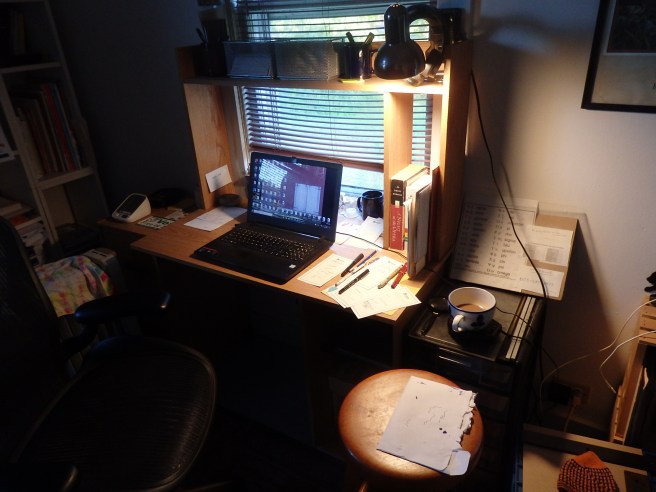
I spent a lot of time at my impromptu workstation in Eastport, Maine, last year working on a history of Quakers in Dover, New Hampshire. And I arrived with what I thought was a largely finished manuscript. I was mistaken.

~*~

WHAT NEEDED TO BE TOLD was the lives of the individuals and families who were the essence of one of the oldest Quaker Meetings in the world.

I resisted as long as I could but finally succumbed. Who were they? Why were they so willing to risk severe punishment and persecution imposed by the Puritan authorities? And in the face of that, how and why did a third of Dover’s population quickly become Quaker? And several generations later, start fading away?

With the 400th anniversary of the settling of Dover – and thus New Hampshire, too – coming up next year, the timing for our side of the history felt right.

Now that the book’s written and revised, I’ll be sharing some of my findings with you as well as news of publication itself as that nears.

~*~

WHAT EMERGED IS A PARTIAL HISTORY, as in partisan, with my focus on a radical religious subculture that thrived in a unique, out-of-the-way, locale. Partial, as well, to the independent streak of New Hampshire against more powerful Massachusetts authorities to the south. Partial even in being incomplete as well as lacking footnotes, and not even the work of a professionally trained historian.

The story is also partial in being biased toward a sequence of unusual, sometimes roughhewn, figures and their families – not all of them Quaker – and inclined especially toward the narrative they shape.

The roots, as you’ll see, arise in the very beginning of English settlement. Forget what you’ve assumed about New England before Paul Revere and Sam Adams and the American Revolution and Boston as the Hub of the Universe.

A lot had already happened before the first Puritans sailed into Boston Harbor. Let’s look instead to Dover, which lays claim to being the seventh-oldest continually inhabited European settlement in the United States.

In the standard telling of the founding of today’s city of Dover, New Hampshire, two brothers arrived from England in the spring of 1623 and settled at the mouth of Great Bay on the Piscataqua River, upstream from the Atlantic Ocean. The brothers were fishmongers, members of one of the oldest and wealthiest guilds, or great companies, of London.

Except, as it turns out, one of the brothers didn’t arrive until a few years later.

Instead, the cofounder of the new settlement was a fishmonger apprentice who would be an important figure in the early years of the colony.
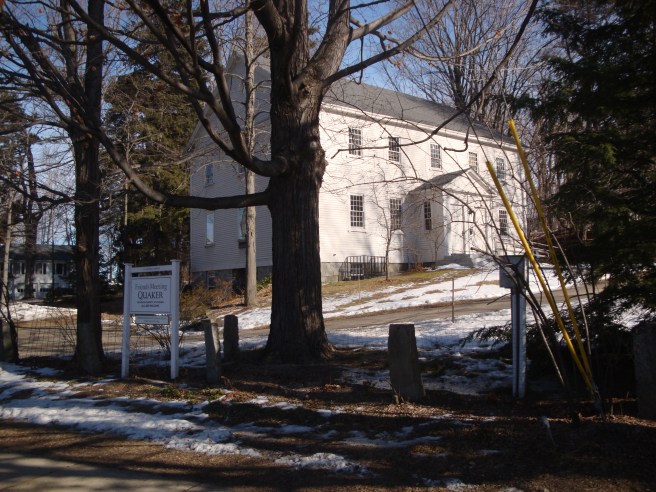
The meetinghouse, Dover Friends’ third, is home to the faith community today. It was erected in a single day in 1768.

~*~

YOU’LL PROBABLY BY AS SURPRISED by this alternative take on New England history as I’ve been. It’s not just Quakers. There’s much more to New England’s past than a Thanksgiving dinner and a riotous tea party followed by a midnight ride and the shot heard ’round the world or even the notorious witch trials.

Here at the Barn, you’ll definitely be hearing a lot more about this big project through the coming year. Believe me, some of the findings will be startling.
Ten largest Native American reservations in Washington state

There are 21 Native American reservations in Washington state. As Joshua and Jaya discover in my novel Nearly Canaan, living adjacent to one, they are home to a unique culture.

Here are the ten largest by area.

~*~

  1. Colville, 1,300,000 acres or 2,031 square miles. A little larger than Delaware. It’s in the arid northeast corner of the state.
  2. Yakama, 837,753 acres or 1,309 square miles. Still larger than Rhode Island. It stretches from the Cascade crest into the arid Yakima Valley.
  3. Quinault, 208,150 acres or 325 square miles. About the size of Omaha or Greensboro. It’s along the Pacific Ocean on the Olympic peninsula.
  4. Spokane, 153,600 acres or 240 square miles. Compare its area to Milwaukee. It’s just east of Colville.
  5. Makah, 23,040 acres or 36 square miles. Still larger than Manhattan. Sits at the northwest tip of the Olympic peninsula.
  6. Snohomish or Tulalip, 8.930 acres or 14 square miles. Sits along Puget Sound north of Seattle.
  7. Port Madison, 1,375 acres or 2.145 square miles.
  8. Quileaute, 837 acres or 1.3 square miles.
  9. Hoh, 640 acres or one square mile.
  10. Lummi, 598 acres.

~*~

Have you ever attended a powwow?


On that day

The meek shall obtain fresh joy in the LORD, and the neediest people shall exult in the Holy One of Israel,

For the tyrant shall be no more, and the scoffer shall cease to be; and all those alert to do evil shall be cut off – those who cause a person to lose a lawsuit, who set a trap for the arbiter in the gate, and without grounds deny justice to the one in the right. …

And those who err in spirit will come to understanding, and those who grumble will accept instruction.

Isaiah 29:19-21, 29 (NRSV)

Enumerator insights

After 7½ years of retirement, I returned to the workplace part-time for two months this year.

The job was supposed to begin in May and run through the summer but got pushed back to August and then abruptly cut off at the end of September.

I was a federal agent.

The private identifying details we recorded are sworn to secrecy – or the equivalent, for those of us who follow Scripture and refuse to take oaths. But I’m still trying to put the experience into perspective.

For nearly 40 years, I’ve worked through the available Census files in my genealogical research, as you’ll see in the posts on my Orphan George blog. It’s become something of a specialty for me, along with the Quaker minutes. I mean, it’s how I learned that Grandpa married the girl next door. There’s also one set of ancestors who were recorded twice in 1860 but with enough differences to make me suspect there were two Jacob Ehrstines closely related – one detail in the 1870 Census cleared that up. And I have one ancestor who shaved another year or two off her age every decade, though I have no idea whether it was intentional or out of ignorance, considering that Quakers didn’t celebrate birthdays.

So I set forth in part out of gratitude for those earlier enumerators. The first ones, incidentally, were federal marshals. This was that important.

What surprised me as I hit the streets and knocked on doors on behalf of the Census Bureau was how physically hard it becomes – bending over an iPhone placed on a clipboard to input data quickly had my back aching, especially. For a dozen years, I managed to work a double shift every Saturday as a newspaper editor, yet here I was pushing my limits when it got close to five hours a day. (Wimp!) Six really maxed it. An article in the Washington Post enlightened me that I wasn’t alone here, so I couldn’t blame it all on age.

I am surprised by how many Americans don’t know what a census is or that it’s required every ten years or that they don’t want to be recorded.

Well, I now also have a clearer understanding of why one household might disappear ten years later but reappear again in a subsequent Census. You know, be there in 1800 and 1820 but not 1810.

I am also surprised how much of my brain space got wrapped in a job again. You know, replaying cases and wondering how I might have done them differently. This was supposed to be something I could let go of at quitting time. Not so, though.

Inputting data in an app on an iPhone still strikes me as tedious. You might have guessed I pretty much hate texting, except as an alternative to an actual phone call. (Emails seem to be my preferred form of communicating these days.) How do kids do it, texting with their thumbs? Or are their exchanges all typos?

Oh, yes, another confession. I’ve typed for nearly six decades now. Self-taught, earned my livelihood with it. Written whole books, even. But ask me to re-create a keyboard from memory, and I have no clue where the individual letters of the alphabet are. The memory is all in my fingers, not my head. Seriously.

So I can’t imagine keyboarding with my thumbs. As I was saying about the kids? Besides, thumbs are awfully fat for those tiny screens. My dry fingers had enough trouble connecting, even before getting to any issue of accuracy.

In my rounds, I had a few near falls (including one wooden step that wasn’t nailed down anymore), a couple of dogs who could have turned nasty, some close calls in traffic, but emerged unscathed.

Some of the most enjoyable interviews turned out to be those where I could put my very limited Spanish to work. Other enumerators had backed off, so I guessed it was up to me, and somehow, we got the required data, often with a lot of laughter. Yes, I made some funnies.

The best part of the job, though, was meeting people who, for the most part, were warm, friendly, helpful. I have a much clearer understanding of the neighborhoods around me.

Would I do it again?

No, I’ll be too feeble – or feebleminded – in another decade.

But maybe you’d want to give it a crack.

Sometimes, you need a bigger map

I’ve loved maps since childhood, so our new interest in Downeast Maine has whetted an appetite to investigate more of the region’s geography, which includes a lot of water. Not just the ragged coastline and bays, but also large lakes and many bogs, marshes, and swamps plus rivers and waterfalls.

One thing that’s rather boggled my mind is discovering of what’s cut off from U.S. maps on that edge of the continent.

For instance, I had no clue of Grand Manan Island, which is 21 miles long with bluffs rising 200 to 400 feet above the Atlantic just nine miles east of Maine. It even has three lighthouses. Getting there’s a whole other matter.

Still, I doubt that many Americans think of anything lying in the ocean east of the United States until you get to the British Isles or European mainland. So is there anything else we’re missing?

Well, there’s tiny Machias Seal Island further south, claimed by both the U.S. and Canada, which has a long lighthouse presence there.

What’s really surprised me is how far the province of Nova Scotia extends south.

From the easternmost point in the U.S., Nova Scotia is more than 82 miles to the southeast.

From Bar Harbor, Maine, it’s 113 miles to the east.

And further south, it runs down past Portland, Maine, where sits more than 200 miles to the east.

Put another way, nearly anyone sailing from Maine has to navigate around this extension of Canada.

If you follow the news, it also puts some of our fishing controversies in perspective.

From Provincetown, at the tip of Cape Cod, for instance, the distance to the tip of Nova Scotia is roughly 230 miles, versus 111 to Portland, Maine, meaning that the southernmost point of Canada juts that much further into what I had considered U.S. fishing grounds.

With the bigger map, one including both the New England, New Brunswick, and Nova Scotia shorelines, you can see how a funnel is formed, one where ocean currents push into Fundy Bay to create the world’s highest tides.

For me, this is a reminder of how often our comprehension of a problem is limited by conventional thinking when we look at the situation.

Just how else do you get outside the box, anyway?

Real Maine


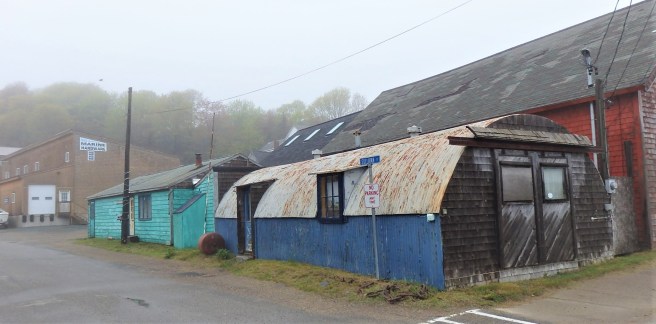
This year the Red Barn has featured a lot of photos from Downeast Maine, many of them taken about a five-hour drive from our home in coastal New Hampshire. (Driving the other direction would put us in Manhattan in the same amount of time.) It’s easy to imagine the remote coastline as idyllic, but the reality is that much is also economically challenged and impoverished. Here’s an example from downtown Eastport.

Ever been out on the Plains?

My novel Nearly Canaan starts off in a railroad crossing called Prairie Depot, and my story The Secret Side of Jaya returns there.

Prairie can be found as far east as Ohio, but it’s more extensive out on the Great Plains.

Here are some tidbits about the landscape.

~*~

  1. It’s bigger than I thought. The region runs from the Rio Grande river bordering Mexico all the way to the Arctic Ocean in Canada, and along the Rocky Mountains to the west. Its width is about 500 miles and it covers about a seventh of the continental U.S.
  2. Rainfall ranges between 13 and 20 inches a year, too little to sustain trees.
  3. Its natural vegetation is a variety of grasslands. And it’s flat or gently rolling.
  4. It had immense herds of bison as well as pronghorn. Prairie dogs, coyotes, prairie chicken, and rattlesnakes remain prominent.
  5. Native American tribes included Blackfoot, Crow, Sioux, Cheyenne, Arapaho, and Comanche. The nomadic tribes followed the bison migration through the year.
  6. The introduction of the horse from Europe dramatically changed the Native culture.
  7. The rural Plains have lost a third of their population since 1920. Ghost towns, which have lost so much population they’re considered extinct, are the most common category of towns.
  8. The climate includes cold, harsh winters and very hot, humid summers.
  9. Without natural trees, hills, or mountains, there’s no protection against wind and erosion.
  10. The region includes Tornado Alley, based on the frequency and intensity of the twisters generated in its open spaces.

~*~

What surprises you here?

Some perspective on four years of upholding a difficult decision

After the last presidential election, I made the hard decision to refrain from posting on White House politics for the duration. Admittedly, it’s been a trial when it comes to biting my tongue.

For one thing, my degree’s in political science, with a strong dose of the Federalist Papers and the foundation of American political theory. For another, I spent most of my career in the newsroom and watched with dread as these developments gathered momentum.

What I sensed with Trump was that I could add nothing from the sidelines. The storm had to play itself out, and vital criticism would ultimately have to come from the so-called conservative side of the spectrum.

What I didn’t anticipate was how appalling the daily affronts would be, each one washing over the previous one before the impact could sink in. No blogger watching the news from afar could react in time to remain current. Well, maybe by taking a longer term view, like once a week, but it would have been a full-time job.

As you can see, I had enough else to post on, trying to maintain a life-is-normal focus, even amid the current Covid culture.

Still, drafting this confession is painful. I long to see decency and intelligence return to leadership and society in general. At this stage, it won’t happen overnight. But we can hope the tide will turn.