As a newspaper editor, I was often startled in looking at coverage from the other side when something I was affiliated with was subject to a story. Or even more startling, when I was quoted and seeing how it looked it print.
It was like working in a restaurant kitchen and shipping dishes to the dining room and then, on a night off, going in for a celebratory dinner.
Seeing a report through the readers’ viewpoint really could be eye-opening. It’s not the “names-is-news” philosophy that many small-minded editors and publishers pursued, either. That approach could be even more boring than reading the phone book. Remember those?
The backbone of most of American newspapers has been the way they connect with their local communities. As one wise editor once told me, it should be news of local interest, rather than just happenings in the place itself. I spent much of my career trying to open parochial outlooks to an awareness of the wider world, both directions, and I do believe that can happen and even be exciting.
When I was calling on daily newspaper editors across the Northeast as a syndicate features field representative, I was surprised by how few of the papers gave a taste of a unique nature of each of the communities. Many of the editors thought of local news as city council and school board meetings plus high school sports scores. As I argue in my novel Hometown News, the real stories – the kind that come home – are found elsewhere and require more reportorial digging. That’s one reason I’ve long advocated local columnists (real writers, not dilettantes, though skilled amateurs are welcome). Few papers had even that much.
When former U.S. House Speaker Tip O’Neill famously proclaimed “All politics is local,” he understood those roots.
~*~
A decade after I’ve left the newsroom, I’m directly experiencing that again, or more accurately, its lack.
In the past 20 years, the number of people employed in newsrooms at American papers has dropped about 60 percent. That leaves far fewer people to write about what’s happening or even be aware of what’s going on at the grassroots level where they live. Much of the nuts-and-bolts editing is being done in clusters far from the paper itself, removing another layer of local nuance and understanding.
In my case, in my participation in events celebrating the 400th anniversary of the founding of Dover, I’m seeing the local paper is doing far less coverage than I would have expected. Not after the family that owned it for generations finally sold out to a media conglomerate.
That disconnect isn’t just print media, either. New Hampshire Public Radio no longer originates any content in the Granite State, as far as I can see. Two decades ago, appearing on one of its shows would have been a natural for a local author like me.
Offering the ebook edition of my new book, Quaking Dover, for free might look crazy, but let me put it into perspective.
Books get lost in the outpouring of new publications these days. Yet for publicity, nothing beats word of mouth, especially when it comes to getting folks to pick up their own copy.
In the old days, I would have sent my paper editions to potential reviewers, but there was no guarantee that would lead to any results. I know, having picked up many free books as a newspaper editor that way, as well as my experience with my first novel, Subway Hitchhikers.
So let’s cut to the chase. Smashwords.com has an annual promotional sale this month, and I’m participating by offering my latest book for free, hoping that if you like it, you’ll give it a brief review on my page there along with five stars. Maybe you’ll even want to give paperbook copies as gifts as a result. Either way, I get a much-needed boost. We’re back to word-of-mouth.
But first you have to download it. Just go to Smashwords and follow through.
Honestly, it might even leave you prepared to order more of my ebooks once you’re comfortable with the process.
Unabashedly, I am a snob when it comes to putting big fireworks together in an aesthetic whole, rather than something that resembles an action movie big car smashup.
A smart design team can use the entire sky as a canvas of evolving colors, combined with the timing of a sharp comedian.
That said, here’s some perspective.
A show like Boston’s on the Charles River Esplanade fires off 5,000 pounds of explosives in its half-hour glory. That performance requires a computerized launch system for five barges floating on the water.
Macy’s, the nation’s biggest, goes for an average 1,600 shells a minute – more than three times as many as a typical town display uses for the entire night. That show has more than 40,000 shells fired from six barges in the Hudson River.
China produces 85 percent of the world’s fireworks.
Many of the styles are named for flowers such as peony, chrysanthemum, or dahlia. Others, after trees, as in willow and palm tree.
Prices vary wildly, especially when you’re looking for some serious color intensity and blending rather than honky-tonk garish.
Shells are sold by tube diameter, commonly six-, eight-, and ten-inches, with each additional inch typically adding another 100 feet of elevation to the shot. Are some of those bursts really a thousand feet overhead?
An aerial shell contains six parts. Or more, depending on what bells and whistles are added on.
Larger shells cost average around $336 apiece and may require an 840-foot display radius.
Even a small-town show will run between $7,500 to $15,000 to produce, just for the fireworks. Add to that set-up and clean-up labor, sanitation, musicians, and public safety expenses. The average municipal show costs $25,000. In contrast, a wedding show is tabbed for $1,500 to $3,000. But don’t hold me to those figures. Other estimates I’ve seen simply soar.
Injuries send about 10,000 Americans to the emergency room every year, two-thirds of them males, and many of the injuries are to children. That’s in addition to 7.9 fatalities. As another safety consideration, more fires are reported on July 4 than any other day of the year – some 19,000.
For the first time since the outbreak of Covid, Eastport is being graced by the presence of a U.S. naval vessel at the Breakwater for the city’s big Fourth of July festivities.
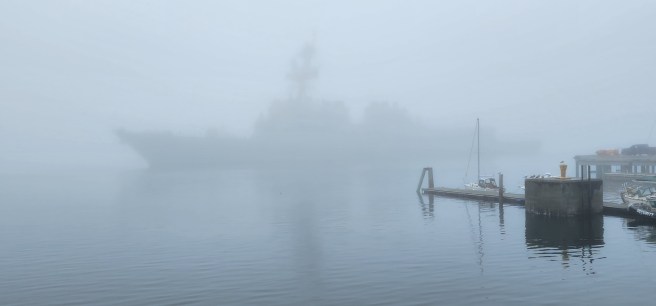
The USS Oscar Austin arrived in heavy fog Friday morning and will depart for Norfolk on the 5th.
The community rolls out a big small-town welcome mat for the crewmen, especially when the landing gives them their first taste of American soil in many months. (Not so, this time; they instead sailed up the coast.) The arrival is rather quaint, actually, even if their focus sometimes seems to be on the local bars. There is a basketball game between the sailors and the high school alum, too, though I doubt the stakes are high.
Eastport does claim to have the biggest Independence Day bash in the state, and the Navy’s destroyer is just part of it. .
Many of the sailors are being joined by their families, who will then continue with them on the final leg of this voyage.
Bringing such a vessel to dock is no small venture. The skipper of such a ship doesn’t just spin the compass to see where he’s going next. Rather, the itinerary is planned months in advance, with many protocols to be observed. In our case, that includes both U.S. and Canadian officials. The pilot’s plan document reads like a small phone book, minute by minute, and it’s not just about tides and currents at the expected time of arrival.
Heavy fog was a complicating factor, and we could hear the ship’s bold horn booming long before we could see the massive vessel emerge nearly alongside the Breakwater.
It materialized out of the fog and a very loud booming horn.Details, including the crew, slowly came into view.The ship was pushed to the dock by tugboats.
One of the subtle changes in the world of high culture in my lifetime has been the widespread acceptance of women as both conductors and classical composers.
Long seen as a bastion of Dead White Males, almost exclusively Europeans, the musical bias was deeply engrained. Few of the world’s leading orchestras even had women in their ranks, much less on their programs or as regular guest soloists. That snobbery, by the way, also excluded American conductors and composers, and people of color in general, across the board in the Old World and the New.
When the gender line began to bend, the first women composers to gain significant attention, as far as I remember, were Felix Mendelsohn’s sister, Fanny, and Robert Schumann’s wife, Clara.
More recently, Amy Cheney Beach has come to the fore. New Hampshire-born and then proper Boston society, she was largely self-taught, a piano virtuoso whose hefty piano concerto and symphony are both personal favorites. Her keyboard works have justifiably gained advocates, and a comprehensive retrospective at the University of New Hampshire marking the 150th anniversary of her birth was a revelation. Some of her gorgeous chamber works, moving into a more Impressionistic vein, actually moved me to tears listening in live performance.
Today, talented women composers are showing up everywhere, even winning major prizes like the Pulitzer. Quite simply, it’s hard to keep up.
~*~
Similar advances are being seen on the podium, led by Americans.
Pioneered in the ‘60s and beyond by Sarah Caldwell at her Opera Company of Boston and Margaret Hillis at the Chicago Symphony Chorus, early conductors of note also included Judith Somogi with opera and orchestral roles across the U.S. and then Europe, Eve Queller at her Opera Orchestra of New York, and Fiora Contino, who I remember from opera productions at Indiana University.
Later, as innovative major symphony music directors, we’ve been blessed with Joanne Faletta at the resurrected Buffalo Philharmonic and Marin Alsop in Baltimore.
It’s all opened the doors for a slew of younger conductors who are moving up the ranks and in the running for major positions like heading the Los Angeles Philharmonic, now that Gustavo Dudamel will be moving on to Gotham.
Looking at the 18 conductors being heard on live Metropolitan Opera broadcasts this season, I see four are women, one twice, something that would have been unimaginable at such a conservative institution only a decade ago.
Do note the trend, then. Anyone else find it exciting?
Readers of my new book are telling me how shocking they find the Puritans’ cruel persecution of the up-and-coming Quaker faith. That reaction is quickly followed with their disgust that the Puritans came to the New World for religious freedom but then refused it to others.
What we need to acknowledge, though, is how deeply our outlook is engrained with an expectation of freedom of speech and religion, something that would have been foreign to mindsets back in the 1600s. There, religion and politics were one, as in a one-party state. In England in the early 1600s, the king had the state church, what we know as Anglican or Episcopal, well under his thumb, while the Puritans had Parliament and its armies. It was a volatile mix, even before we get to New England, where my book is set.
I should emphasize that for us, as modern Americans, it’s all too easy to condemn Puritans as backwater bigots, when in fact they were radical progressives on many fronts. They were decidedly anti-monarchy and proto-democracy, and advanced a less feudal, more equitable economy and society. They championed education and literacy for men and women alike and founded Harvard College within their first six years in New England despite deep divisions within their attempt to establish a godly Utopia. Boston was even prepared to fire cannons at Royal Navy ships in the mid-1630s, had they arrived to revoke the colony’s charter, which the Puritans had obtained from the king in an end-run around the man who was responsible for New England’s development – Sir Ferdinando Gorges, the father of Maine and first cohead of New Hampshire, as you’ll find in my book. He definitely would have torpedoed their application. (Whew! The amassing details do thicken the plot, hard as they become to follow.) A Puritan wife could actually divorce her husband if he failed to fulfill her. And they loved their beer.
In other words, Puritans weren’t nearly as awful as we want to portray them today, even if they do come across as villains in my book, Quaking Dover.
Since its release, I’ve been coming to believe the Quakers pressed the Puritans simply for not going far enough in their reforms and intended Utopia. Historian Carla Gardina Pestana, in her wonderful “Quakers and Baptists in Colonial Massachusetts,” even came to the conclusion that the Quakers (or Friends, as we more often refer to ourselves) went out of their way to provoke the Puritan authorities. Ouch, I’m thinking that’s true.
More recently, in revisiting Kenneth Carroll’s book “Quakerism on the Eastern Shore,” meaning Maryland, I felt affirmed by his statement, “Quakerism was, in some ways, an extreme form of Puritanism,” followed by, “It is not surprising, therefore, to discover that Quakerism, in its opening days in Maryland, reached into the centers of Puritanism … for a great number of its converts.”
Well, that latter point was surprising to me. I do see Friends blending Mennonite strands via the English General Baptists into what emerged.
~*~
While my book is focuses on New Hampshire and its adjacent provinces, I’m finding that religious restraints in the southern American English colonies of the time were far harsher than those in New England. For instance, a provocative essay by Marilynne Robinson, “One Manner of Law, the Religious Origins of American Liberalism” in the November Harper’s Magazine, notes that the under the repressive laws in Virginia the penalty for missing church services three times or speaking ill of the king was death, along with the harshest penalties for minor infractions of other laws. She adds there was no mention of trial or appeal and much of what we consider Common Law was nebulous. The Carolinas were just as extreme.
Carroll, for his part, finds that in contrast to New England’s persecution of Quakers, “there may be a skeleton in the closet of the southern colonies also.” He remarks, “The intense persecution experienced by Friends in Virginia soon drove many of them into Maryland,” followed by a series of drastic laws that even kept Quakers from being allowed to enter the colony. “There was to be no challenge to the Established Church as the one religious institution in Virginia,” something that excluded Puritans, Presbyterians, Baptists, Quakers, and Roman Catholics alike. Carroll then states, “The full nature and extent of persecution suffered by Quakers in Virginia is not known. … We do know that William Cole, of Maryland, and George Wilson, of England, were imprisoned in a ‘nasty stinking, dirty’ dungeon in Jamestown where Wilson was whipped and heavily chained so that ‘his flesh rotted from his bones and he died.’” A number of Indian converts to Quaker faith may have also been sentenced to death because of their conversions. And Maryland for a while also imposed harsh persecution, including the banishment and whipping of Quaker “vagabonds” from constable to constable through the colony.
Among those in the South who had visited Dover were William Robinson, before his execution in Boston, and Alice Ambrose and Mary Tompkins, once they left the north.
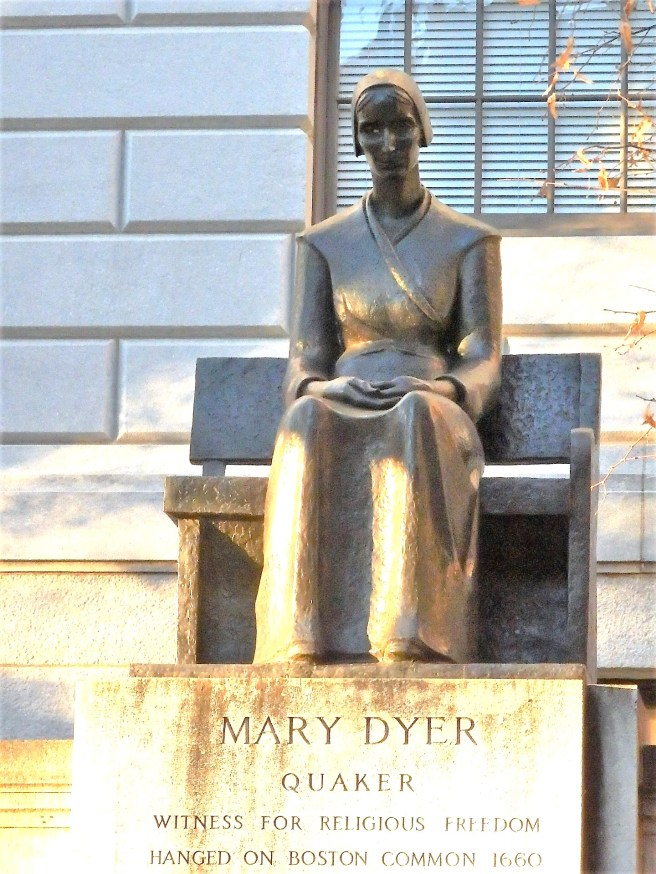
This statue by Sylvia Shaw Judson sits in front of the Massachusetts statehouse, with copies in Philadelphia and Richmond, Indiana. Mary Dyer was one of four Quaker missionaries hanged in Boston because of their faith. She’s the only one who hadn’t visited Dover, New Hampshire, although the site of the gallows later became known as Dover Street. As a fine point, she didn’t offer her life for religious freedom but rather as a sacrifice to a Truth she espoused.
~*~
To see how this played out in Dover, please turn to my book, Quaking Dover.
I, for one, would definitely like to see a fuller understanding of how religious liberty came about in the Southern colonies and also a presentation of how Puritans in New England evolved to emerge, in one strand, as Unitarians.
Among other things, I would love to know more about the livelihoods of Dover’s Quaker families, especially as they evolved over the generations. How did they acquire new skills, for one thing, as the town went from being a fishing and shipbuilding center to timbering and sawmills and then milling in general, even before its emergence as a calico capital?
New England farming, of course, underwent its own permutations, especially after wool was displaced by cotton in the early 1800s.
As Dover shifted from a rural village with agricultural roots and fishing and shipbuilding to an industrial city depending on an immigrant workforce, the Quaker presence shrank to a mere thread. Even so, as I like to think, some of the Friends’ values continued in the descendants of the Meeting’s earlier members, even when the family was no longer Quaker.
Many had moved north or east in search of new farmlands, and others were about to head off to Minnesota and Iowa.
Dover Friends Meeting was already declining when the textile mills started changing the character of the community. Moreover, the new arrivals brought new churches and ethnic identities, and these are stories waiting to be told in the upcoming celebrations. I’ll be all ears.
As the ownership of the mills passed to out-of-town investors, the profits being generated in Dover prospered an upper crust elsewhere, most likely the famed Boston Brahmins. In contrast, Dover became a largely working-class neighborhood. The same can be said for the busy rail lines passing through town.
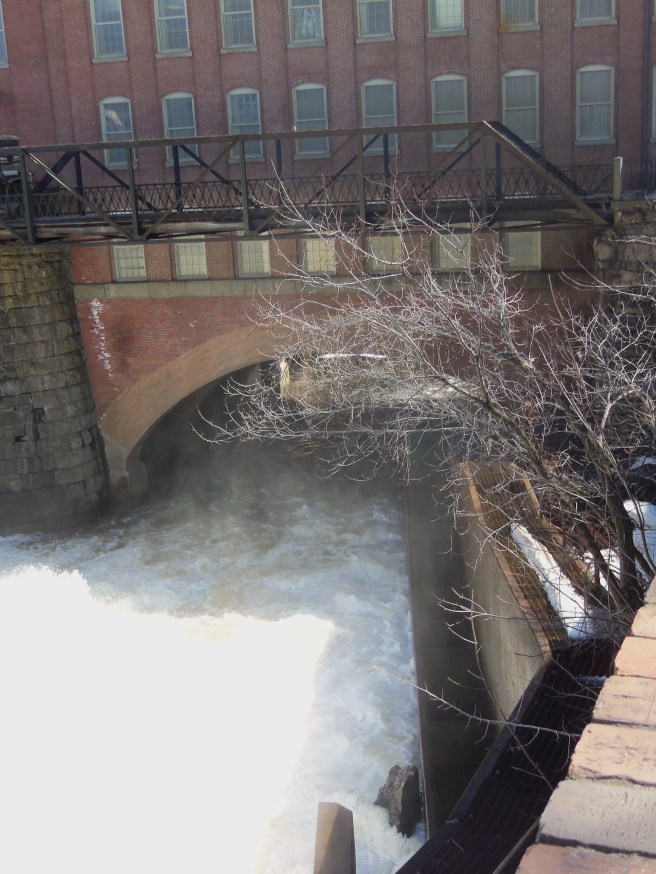
The centerpiece of Dover is the Lower Falls of the Cochecho River, capped by a dam that increased the waterpower to the textiles mills. Here, water from the river rushes into the tidewaters below and runs through an arch in the mills that define the downtown. Who can’t be inspired by such a sight, whether the river’s running high or low, in season?
Although a visitor to Dover today would have no problem seeing the town’s character as New England, its identity today comes from the brick mills erected at the falls four-and-a-half or five miles north of the Hilton settlement. There is no town common, a wide green square surrounded by imposing Colonial houses and white church under a lofty steeple. The same can be said for neighboring Portsmouth, formed around the harbor, and Exeter, with the elite academy. Yes, there are the iconic church spires and rooster weather vane but not the central green common. Hampton, which remained largely agricultural, does have a tiny green, not that it would pasture a single horse.
As my new book and these blog posts note, David Hackett Fischer’s Albion’s Seed: Four British Folkways in America explains that the stereotypical New England arises in the customs and culture of East Anglia, the region of England that produced most of the Puritan migrants who shaped Massachusetts and Connecticut. He sharply counters that with the Quaker migrations from the Midlands into Pennsylvania, and from the Royalist cavaliers who predominated the Virginia planter society, as well as from the Borderlands people in northern England who share commonalities with the Scots-Irish settling the Appalachian spine from Georgia to Maine.
Fischer examines these complex workings in a set of specifics that include distinctive speech, architecture, geographic patterns of settlement, family, marriage, gender, sex, child-rearing, naming of children, attitudes toward aging, religion, magic, learning and education, food, dress, sports, work ethics and practices, use of time and recording, ideas of social order and institutions, authority and power, and more, including differing concepts of liberty and social restraint.
Quite simply, there was no generic Englishman. Even the dialects could prove incomprehensible when taken from one part of the country to the other.
While the new settlers to the Piscataqua settlement were primarily Puritans, imbued with its Protestant ethos, they were also overwhelmingly from Devon, with folkways quite distinct from their East Anglia brethren.
I suspect these contrasting folkways play a major, though previously undetected role, in the deep conflicts about to emerge in the seeming isolation along the Piscataqua as well as elsewhere in other pockets of New England.
Far from being a homogenous nation, Britain was a patchwork of many long-buried identities, some of them resurfacing in new guises. The country had never suffered an Inquisition, either, to suppress them. Its Christianity had been imposed from the conversion of the regional kings, whose subjects might publicly worship one way but another in private.
English Quakers, too, had never suffered the trials of sustained violence with New France and the Indigenous American tribes or racial slavery or a Revolutionary War, as their American coreligionists did, especially in New England. Little wonder the English Friends were baffled by the separations that ultimately divided Quakers in the New World.
It was a rich brew. And, frankly, still is.
~*~
Though Dover Quaker Meeting was reborn in the ’50s after a hiatus, its viability is challenged, but so is much more of contemporary American society. Besides, I’m not comfortable in considering the period as “history,” much less examining it systematically or comprehensively, though I tell what I can. Some early readers think it’s the best part of my book. I won’t argue.
I will say that our Quaker Meeting is a beautiful community, one I love dearly and invite you to experience.
As well as Dover.
~*~
Check out my new book, Quaking Dover, available in your choice of ebook platforms at Smashwords.com.
My Dover history project has taught me how slippery much of the material – especially the early parts – can be. What comes through is often fragmentary.
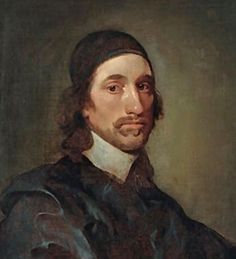
Did Edward Hilton actually look like this?
There’s the very enigma of Edward Hilton, for starters, just trying to prove he was here from 1623. From the circumstantial evidence, I’m convinced that he and Thomas Roberts definitely were, and besides, there are no rival hypotheses regarding their arrival. But that’s not rock-solid documentation doesn’t appear until retroactively. Maybe some of it, taken to London, survived the big fires and plagues and will resurface. Don’t hold your breath.
I’ve seen some of the early charters and patents and, for all of their descriptive prose, find them baffling. The layers of landholding are just the beginning.
What, for instance, did William Fiennes – the eighth Baron Saye-and-Sele – and Robert Greville, the second Baron Brooke, receive in compensation when they relinquished their proprietorship of the New Hampshire province to Massachusetts? And for that matter, how did the Massachusetts Bay colony arrange the transaction?
I would even like to see the details on what Edward Hilton had received when he earlier sold his proprietorship – again, just what did he possess? – to Lords Saye and Brooke. His reason, according to one source, was a sense that the Massachusetts authorities were preparing to seize the Piscataqua and his defense would have been inadequate. Saye and Brooke had clout, as well as a colony in Connecticut named after themselves: Saybrook.
There are also questions of how the “governors” and ministers of the province were selected prior to Massachusetts’ control of New Hampshire.
Just trying to decipher the script and text requires an expert, perhaps even an antiquarian lawyer. And how many of the documents remain, anyway, in the mother country or the New World?
Fellow blogger Mark Everett Miner touches on some of this when he remarks, “It is thought that William Hilton was somewhat educated as he wrote several competent, if poorly spelled, letters.” They are, however, quite convoluted. Here’s an excerpt from a 1633 letter to John Winthrop:
“There arived a ffishing shipe at Pascataque about the 15th of this p’sant moneth where in is one Richard ffoxwell whoe hath fformerly lived in this cuntery he bringeth nuse yt there were tow shipes making ready at Barstaple whoe are to bring passingers & catell ffor to plant in the bay he hath leters ffor mr wearom & divers others at dorchester wch hee intends to bring hr to the bay so soone as posible he can like wise he heard ffrom mr Alerton whoe was making ready at Bristole ffor to come ffor this cuntery other nuse he bringeth not that I can heare of onely mr Borowes purposeth to come ffor this cuntery ffrom london & soe desighring you to convey thes leters in to the bay wth what conveniency you can desighring the lord to blesse you in your lawffull designes I humbly rest …”
How do you make sense of such surviving documents?
In Dover, First Parish records don’t pick up until John Pike set down his memories, beginning with his arrival as minister in 1677. Still, as later minister and historian A.H. Quint observed, “There are no extant Dover church records before Dr. Jeremy Belknap’s ministry,” beginning in 1767, “except that he copied into a record book a list of baptisms and of members, commencing in 1717. The town records are also very defective during the period of Mr. Pike’s residence.” He adds, “This is due partly to the Indian troubles, and partly to the Masonian difficulties.”
By the time Samuel Bownas first visited Dover, the Meeting’s earliest minutes had already been lost – in a barn fire, according to oral lore.
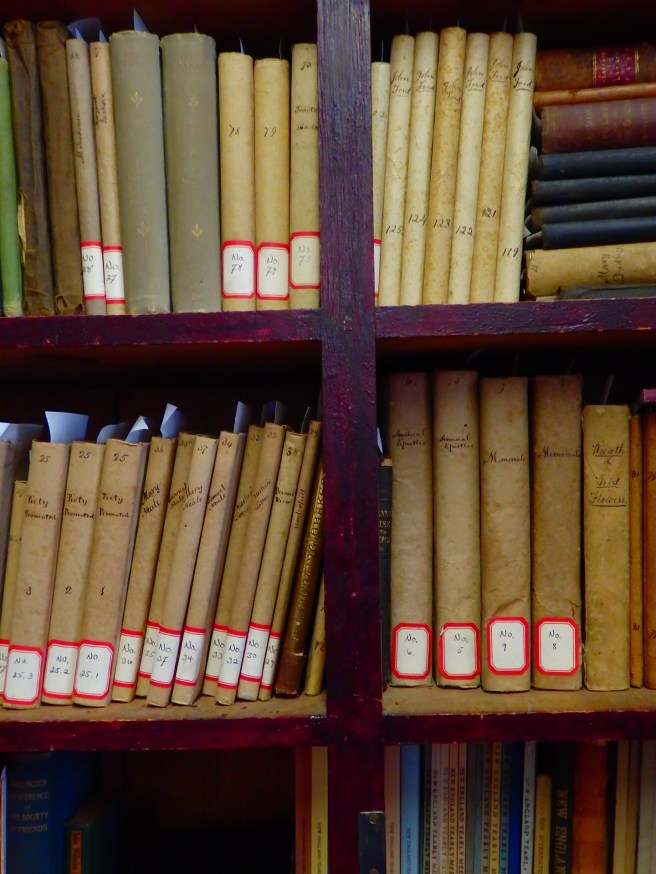
Old volumes in the Dover Friends library tell mostly about Quakers elsewhere. These rare books do not circulate.
In Quakers in the Colonial Northeast, Arthur J. Worrall notes, “The clerk was the most important of the persons active in meeting affairs.” While his examination focused on the yearly meeting level, he remarks, “Clerks had been appointed before 1700, but we know little about their activities. Their note-keeping was careless at best, and … it was not unusual for a clerk of many years’ standing to lose his copy of the minutes.”
One consequence is that we are unlikely to learn much of Dover Quaker life in the early years from the Yearly Meeting books.
Dover’s surviving records begin with the women’s minutes in 1701, with a gap from 1785 to 1814, and the men’s minutes, from 1703. Its vital records stretch back to 1678 but, curiously, were not begun until 1787.
Missing, of course, are the accounts of the early persecutions by the Puritan authorities, the reactions to the Waldron incarceration of Natives or their later attack on the village, or even the early leadership of the faith community.
For family genealogists, the Quaker sources are among the best available family records in America before the 1850 Census, the first to name everyone in a household. The Friends minutes, however, name only those families in good standing as members. Even so, they can be very useful in framing a family overall.
New England records were never comprehensively indexed along the lines of William Wade Hinshaw’s six-volume Encyclopedia of American Quaker Genealogy, covering Pennsylvania and New Jersey, New York, North Carolina, Virginia, and Ohio, or its seven-volume companion by Willard Heiss, Abstracts of the Records of the Society of Friends in Indiana. But Dover Meeting’s surviving family records were serialized from 1903 to 1909 in the New Hampshire Genealogical Record, the Official Organ of the New Hampshire Genealogical Society. Its editor and publisher was Charles Wesley Tibbetts, an attorney. I haven’t been able to determine if he is a direct Quaker descendant, but his kin were prominent in the Meeting.
Dover’s surviving records are preserved in the New England Yearly Meeting archives in the special collections at the University of Massachusetts Amherst, where they can be accessed by researchers and readers. As I already mentioned in an earlier post, a truly close examination of them would add much to a more thorough history of Dover Friends – a list of clerks, for instance, or the Revolutionary War volumes of discipline – but the results would likely be too arcane for my intended audience.
Still, if opportunity ever presents itself, hunkering down for several weeks in Amherst might be revealing.
Other things I would also like to see:
A fuller presentation of the Devon folkways, without the Virginia overlay in David Hackett Fischer’s Albion’s Seed.
A history of Salem, Massachusetts, drawing on the culture clash that runs through my own book. I suspect that much of the witch trial hysteria originates in those differences, abetted by a “perfect storm” of related factors. Likewise, the Salem Friends Meeting and its successor at Lynn need a bigger profile.
Ditto for Hampton Friends, morphing into today’s Amesbury Monthly Meeting.
A major overview of Quakers in Maine. Again, the fragmentary nature of the surviving minutes would require amplification from court records, deeds, and genealogies.
My latest book is nothing like the others I’ve written. It’s not one of the novels, which required me to learn entirely different approaches to a story than I’d used in the daily newspaper business. And it’s not extended essays, like my usual Quaker materials. Nor is it poetry, where most of my literary efforts have been.
At the start, my genealogy came closest, but those are more research notes for others to follow up on – and if I ever get the energy to return to those, they do need a major cleanup.
As much as I’ve loved history, from childhood on, I’m not a trained historian. The closest I came was majoring in political science.
But for the last 50 years, I’ve been a Quaker and become quite grounded in the movement’s history and theology. And that’s what prompted the new book, along with Dover’s upcoming 400th anniversary.
I do like the big picture, and that’s what evolved here. Not just Dover Friends Meeting, then, but the broader forces that shaped and impacted it. So I went digging, drawing on others who had closely examined the early records or, in some cases, drawing on published journals and other early accounts.
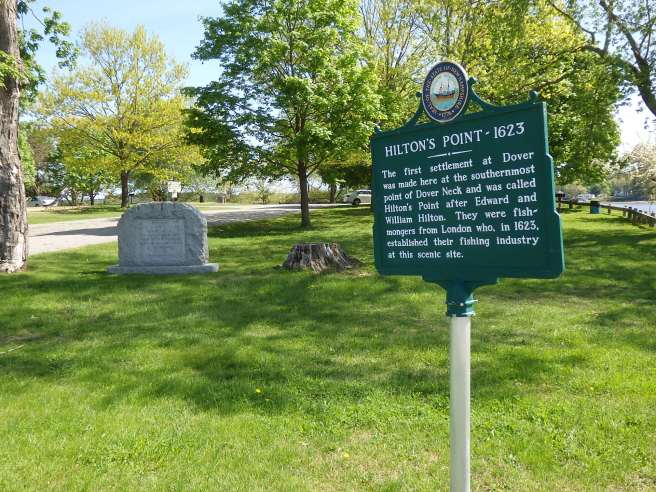
Ground Zero, as it were. Contrary to the historic marker, however, William was not yet on the scene. The honor rather goes to Edward’s apprentice, Thomas Roberts, who was a key player in the early settlement.
What I collected seemed to write itself, which was an exhilarating experience – until I showed it to a circle of Beta readers. And then it was back to the drawing board, cutting the first half of the book by two-thirds and refining the tone by inserting myself into the text. The journalist in me, trained to be invisible, did so uneasily but trusted in the generous advice of a fellow poet and writer.
Also insightful has been historian Stephen Sanfilippo’s quip about being a “footnote historian,” the professional who can spend much of his career investigating minutia that become a paper or dissertation that in turn become a footnote in a “general” historian’s book, one that looks at the broader scene.
Much of my book is a step from that, drawing more on the general historians before me, but that’s led to its own encounters. I’ve often found myself in conversation with them, wishing we could actually sit down together rather than having all these years, even centuries, between us.
The first was Annie E. Pinkham, whose A Brief History of Dover Friends Meeting, a 1935 mimeographed paper, became the springboard for this project. Her material is no doubt based on much of what she had heard passed down in her husband’s family and maybe her own, though I’ve since found that her version of the earliest days of the town reflect common misunderstandings.
I’m also grateful to some people I knew personally, a generation older, who went through the Quaker minutes themselves – Shirley Leslie and Silas Weeks and I sense a few others. Their summaries were sufficient to round out the history, though there are many points where I now see that a more thorough investigation, of a doctoral dissertation nature, might glean answers that currently elude us. (Back to the footnote historians!)
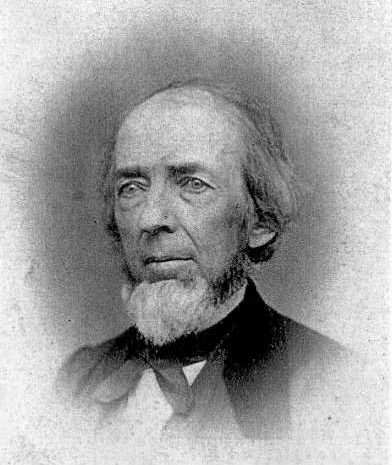
George Wadleigh
Another voice I’ve been deeply grateful to is George Wadleigh, who struggled with many of the town’s often conflicting details and missing data when assembling his own history of Dover, dated April 1882 but not published until 1913.
The volume is prefaced with “NOTICE. It was the intention of the collector of these notes to complete them to a later date, then to revise and publish them, but he did not live to do so. They are now published without the revision the collector would have made, in order that his work may not be entirely lost.”
Originally, I thought that was Wadleigh’s own insertion, but finding that he died two years after dating the preface and that the book had to wait 31 years before publication, the “collector” seems to be Wadleigh himself, with the notice being added by one of the editors.
Either way, Wadleigh apparently had access to perspectives and possibly documents unavailable to earlier historians. He also may have had long discussions of the materials and their implications with other elders. From 1831 to 1868, he was editor and publisher of the weekly Dover Enquirer newspaper.
And then there are bloggers like Mark Everett Miner, some of them working as genealogists. I’m curious to see what they make of my take.
Beyond that, I hope I’m ready for the nitpicking and correction I’ll no doubt hear if anyone actually reads what I’ve produced.
As Stephen Sanfilippo has said, repeating the advice of one of his mentors about working in history, if you think you have the answer, you’re mistaken.
Or as I learned doing genealogy, every new answer you get raises ten more questions.



 Jnana's Red Barn