No, I’m not going swimming nude in a group at a summer lake any more

As I’ve previously mentioned, for much of my adult life, I’ve thought of myself as a retired hippie. Or I’ve simply been called one by others. One of millions and, unlike many, one who’s not embarrassed to admit it, that was a time to remember, no matter how short we’ve fallen from its promise and potential, even though I’m not so sure how much I’d want to go skinny-dipping with others these days or even sleep on the ground or a mattress on the floor.

That said, I’ll also admit that much of my first year after graduation from college in the height of the hippie movement was deep misery and loneliness punctuated by playful discoveries. The writing of Richard Brautigan definitely fits in here.

What’s often overlooked in the era is that the central element was the hippie chick. Plus, personally, I was without one, since mine had moved on and left me stranded. (Oh, misery, oh, woe, I am sounding pathetic, but let’s move ahead.) My novel, Hippie Farm, celebrated her in her many guises, even if you can’t even use the term “chick” anymore without being corrected. At the time, though, it was a badge of honor and invitation – one leading, in this case, to that rundown farmhouse in the mountains outside a college town I definitely restructured in terms of fiction.

A second novel, Hippie Love, retold the same plot line from a different perspective, one more of a what-if optimism. I would love to have heard that story retold from their impressions. Ouch? Were they as lost as I was? One I’ve been in contact with all these years has shared her insights, helpfully, and another, reconnecting much later, barely remembered who I was. And here I had thought she might be The One. Oh, my.

In the light of the publication of What’s Left, those two books were then greatly revised and newly released as a single volume, Pit-a-Pat High Jinks. Compressing the two was a major effort, but ultimately satisfying, at least for me. So much happened personally within that short span.

The inspirations cover quite a cross-section of people, with one becoming a United Way executive, another a U.S. Attorney, yet another one an OBGYN physician. Not that you would have guessed it at the time. As for most of the rest, I have no clue. Some were real losers, likely lost to drugs now. Others, tragically damaged. Being hippie wasn’t always a quest for enlightenment, justice, and equality. And when it was, it was countered by powerfully invested self-interests. Sometimes I’m surprised any of us survived, even before we look at the Vietnam veterans on the other side and their continuing traumas. Not all addicts, by the way, were hippies.

Flash ahead, then, and I don’t see youths today finding community anywhere, much less a shared cause. This is supposed to be an improvement?

Contrary to many people who lived through the era, I saw much that happened needs to be remembered and often cherished, even comically. It’s a place where people can begin rebuilding. I’m holding on, then, in my Quaker Meeting as one root to be grafted.

Look closely at the women, especially, and see how much of the legacy continues in spite of everything. (The kids today have it right, their perception of hippie as a girl thing.) Or, as they say. We’ve come a long way, Baby.

Yet that hippie label, I should add, has undergone its own transformation, rarely positive. Alas. Especially for us males.

Most of them, I hope, come across better in the book.

Still, it’s an account of history as we encountered it.

You can find Pit-a-Pat High Jinks in the digital platform of your choice at Smashwords, the Apple Store, Barnes & Noble’s Nook, Scribd, Sony’s Kobo, and other fine ebook retailers. It’s also available in paper and Kindle at Amazon, or you can ask your local library to obtain it.

On my own, I was writing contemporary literature, except that it turned into underground history

When I was starting out in my career and sitting at the edge of the semi-circular copy desk, one broad story I kept seeing in the headlines didn’t reflect what I was finding in daily life. It was the hippie experience, told one the public side as drug busts, antiwar protests, and rock concerts, while the personal side I sensed something much broader and transformative, which was largely ignored.

Tom Wolfe, who had come to prominence as a newspaper columnist, was right in saying that the great hippie-era novel needed to be written, though he was wrong in thinking a single book could cover it.

From my perspective, a traditional facts-and-quotes approach couldn’t touch the emotional reality, pro or con. Interviewing celebrities posing as leaders wouldn’t work, either – they largely betrayed us, maybe like never-a-hippie Trump would do later. Hippie was a grassroots movement on many fronts, many of them outside of the big media headquarters in the biggest cities.

In previous Red Barn posts, I’ve touched on many of the hippie movement’s continuing influences, things our kids and grandkids take for granted, but so much – especially of the broadest nature – remains to be examined and presented. I’ll leave that to someone else who can give it full and fresh attention.

For my part, I leave four novels as foundations for others to build on.

I’ve looked hard for work by others but found little yet faithfully left reviews online where I’ve could. Those works are, alas, slowly vanishing. Yes, we are passing.

I am haunted by a definitely hippie copy editor from the year I interned as what we called the rim, but he was gone when I returned a year later, perhaps after pressing for union organization. A lot had changed in those nine months. I wish I knew more about him, other than the ticket for Woodstock that I couldn’t accept, considering the scheduling and my bicycle as my only transportation.

~*~

The core of my perceptions remains in four novels to my credit.

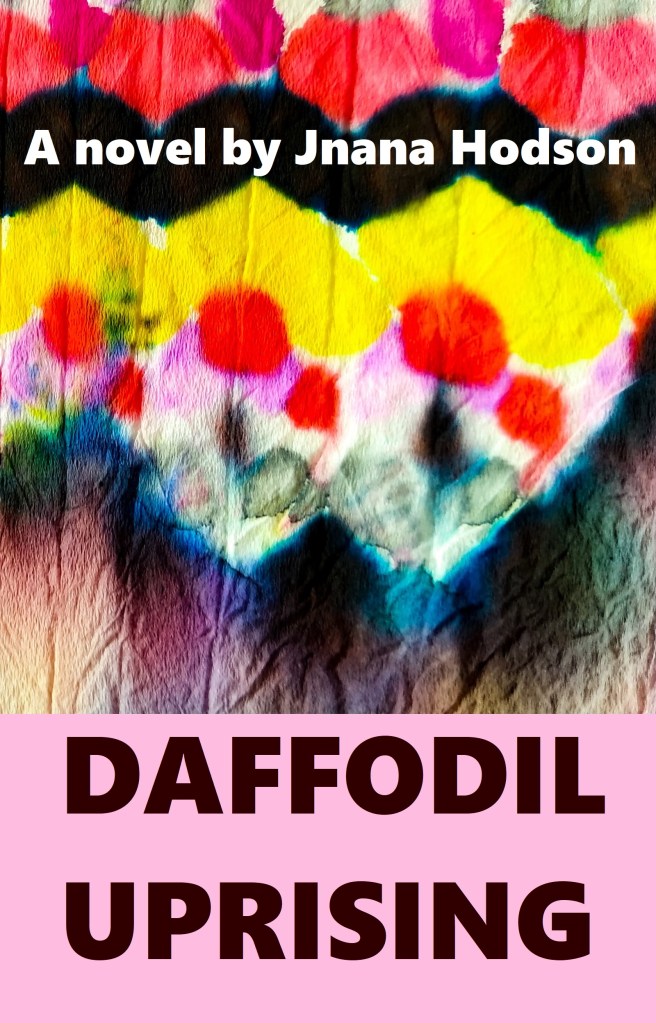
 Daffodil Uprising: I was on campus when the repressive constraints of institutional America blew apart in the late 1960s. Crucially, many of the radical currents emerging on both coasts began connecting in academic nerve centers in the Midwest – places like Daffodil, Indiana, where furious confrontations exposed positions that later generations now take for granted. My novel revisits the upheaval and challenge, both personal and public, triumphant and tragic. As I still humbly proclaim.

Pit-a-Pat High Jinks: The hippie movement that is usually thought of as the Sixties actually appeared most fully during the Nixon administration, 1969-74, and brought changes that younger generations now take for granted. Yes, the ‘70s. In my case, that was Upstate New York where I lived in bohemian circles near the downtown and then on a rundown farm out in the hills where a grubby assembly split the rent and a bit more. My, we were so green and so wild-eyed.

Subway Visions: There were good reasons so many of my freaky housemates and new friends came from the Big Apple. My jaunts to The City, as they called it, provided high-voltage flashes of inspiration that ranged from grubby to psychedelic. It was a whole new world to me, even as a frequent visitor.

What’s Left: So much remained unvoiced and unexamined in the aftermath. I drafted a series of essays that came together as a creative non-fiction volume, but that went nowhere. But then I had the flash to reshape it from the encounters of the hippie protagonist of the previous three books but explored by his curious and snarky daughter. My intention for a big book about the revolution of peace and love turned into one asking what is family, primarily. Hers was quite the colorful circus.

~*~

I still believe there’s much in these that’s “still news” despite the dated surfaces that usually pass for the era.

This year, though, I’m finally saying good-bye to maintaining an effort to engage in an awareness. It’s ultimately in others’ hands.

You can find my novels in the digital platform of your choice at Smashwords, the Apple Store, Barnes & Noble’s Nook, Scribd, Sony’s Kobo, and other fine ebook retailers. They’re also available in paper and Kindle at Amazon, or you can ask your local library to obtain them.

There’s even a Summer of Love

The places I lived in the settings covered in my novel Pit-a-Pat High Jinks long ago fell to the wrecking ball, yet the memories live on. The fictionalized story covers friends and lovers, along with near-misses and poverty-line entry-level work life in an out-of-the-way town and surrounding countryside while venturing out on one’s own after college. It had its downs and ups, including a Summer of Love that included a remote mountain lake.

Believe me, you can’t make up details like these, though you can amplify or reshape others.

It’s one of five novels I’m making available for FREE during Smashword’s annual end-of-the-year sale, which ends January First. The ebook comes in the digital platform of your choice. Do note that it includes adult content, so you may have to adjust your filters when ordering.

Think of this as part of my after-Christmas sale, except that these items are FREE! Remember, you risk nothing in acting now.

For details, go to the book at Smashwords.com.

Of housemates, lovers, and friends


Pick up your free copy now

Celebrity writer Tom Wolfe lamented that nobody had written the big hippie novel, something akin to the Great American Novel, but he was wrong. I’ve said so in some previous postings here.

For my part, let me invite you to Daffodil, Indiana, as its tranquil – some might even say dopy – campus goes radical. No outside agitators are needed in the face of the ongoing repression. The Revolution of Peace & Love is its own calling.

Daffodil Uprising is one of five novels I’m making available to you for FREE during Smashword’s annual end-of-the-year sale. The ebook is available to you in the platform of your choice.

Think of this as my Christmas present to you. Or, as we used to say, If it feels good, do it!

For details, go to the book at Smashwords.com.

The making of a hippie

Remembering the student strikes of ‘70

News reports of protesting students seizing administration buildings on college campuses do bring back memories, and I know I’m not alone.

While there had been earlier seizures of campus facilities in the late ‘60s at schools like Berkeley, Columbia, and Ann Arbor, Michigan, the killing of four protesters at Kent State on May 4, 1970, and two more at Jackson State on May 14 triggered student strikes across the country.

The causes ran deeper than just the ongoing warfare in Vietnam and surrounding countries, do note. My novel, Daffodil Uprising, reflects my experiences in Indiana.

The making of a hippie

While I’m not about to engage in comparisons of today and back then, I am fascinated in the focus on university funding in the current protests. My novel saw that as a crucial factor back then, too – it wasn’t just Dow Chemical, either.

Of special concern, now and back then, is the depth of frustration that finally erupts as rage and revolt. We can assume there are elements in the current actions that go back well before the current Gaza crisis, and not just in the Middle East.  They need to be addressed.

I believe that many of the problems in contemporary America can be traced back to unresolved issues from the late ‘60s For now, I’ll leave it at that.

For any of you interested, my book is available at the Apple Store, Barnes & Noble’s NookScribdSmashwords, Sony’s Kobo, and other fine ebook retailers, and at Amazon in both Kindle and paperback.

I hate having to admit an unexpected ugly side of the hippie outbreak

The ’60s and early ’70s unleashed a revolution, one I tend to see from the progressive side of the experience.

But after writing about it in many of my novels, I’m having to acknowledge a dark underbelly.

There was a strand of ghouls who opposed any kind of common action, including politics. They were deeply angry but wanted to hide in a hole rather than celebrate oneness with each other and the greater universe and then work to advance that awareness.

That points, unfortunately, to the Trumpist ultra-right wing or Libertarians with no broader community sense other than what they can get out of it directly – or otherwise get out of supporting, period.

What I’m having to see as anarchy.

Yup, I’ve overlooked those who just wanted to escape any, well, Peace & Love revolution outside of their own turtle shell.

Maybe that’s the side the younger generations have perceived all too clearly in their negative view of hippie, despite the many other aspects they openly pursue.


Anyone else feeling déjà vu with a hangover?

Not too long ago, the counterculture of the late ’60s and early ’70s looked like ancient history, especially from our grandkids’ perspective.

Not so now.

Here we are again, with a paranoid tyrant in the White House, a nation divided, police gone rogue, civil rights denied, and frustration erupting in protests. Only this time, the situation looks worse, much worse, than it did then, even before we add climate change and the environment to the mix.

We had more community connections, for one thing. And there were more voices of reason, for another. In what we saw as the Revolution of Peace & Love, the gloom and doom before us was often counterbalanced by experiences of joy and unity, often via its outpouring of vivid music in public festivals and rallies. I don’t see that now. Too many people are simply isolated, and the Covid restrictions aren’t helping.

The closest rallying cry for the American dream I’m sensing is BLM. Think about that and how many middle-class, suburban lawns where its signs are sprouting on lawns and in windows.

In retrospect, as I’ve long argued, there was no standard-issue hippie and no creed to subscribe to. Some were outright apolitical, while for others, peace and social justice activism were paramount.

Once again, activism is high on the agenda, across all generations.

My novel Daffodil Uprising: the making of a hippie describes the transformation as it happened, more or less, fifty years ago on a college campus in Indiana and likely elsewhere. Not all of it was hippiedelic, not by a long shot. Things were generally grim.

A neighbor reading the book said some of the scenes regarding the school’s administration and its disregard for the students sound like those his daughter is complaining about at a prestigious university in Greater Boston. Some things never change, or won’t if we fail to nurture a culture of vigilance. Frankly, we got lazy in the intervening years, or at least distracted.

All I can say is that I expect the next month to be one of the most important in our nation’s history. Wise elders, seasoned over time, are needed in the fray. How many of us are willing and ready to stand up?

The making of a hippie

Sandals on men

When you see sandals on an American man, thank a beatnik.

In the 1950s, it would have been nearly unthinkable for a man to dress that comfortably.

Really, we were that uptight.

Now?

They’re everywhere.

At least in summer.

Remember, where I live, we get snow – lots of it, some years.

Can’t blame a beatnik for that.