Pembroke’s Head of the Tide

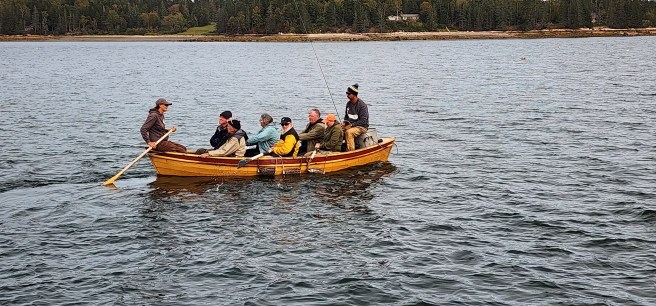
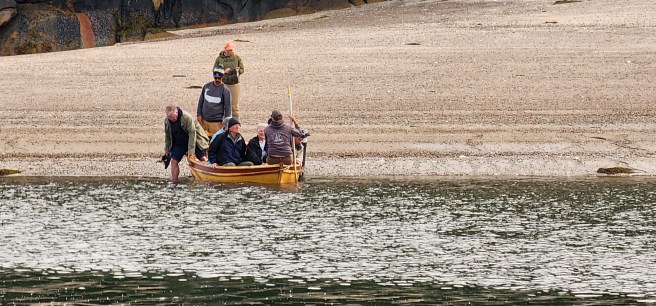
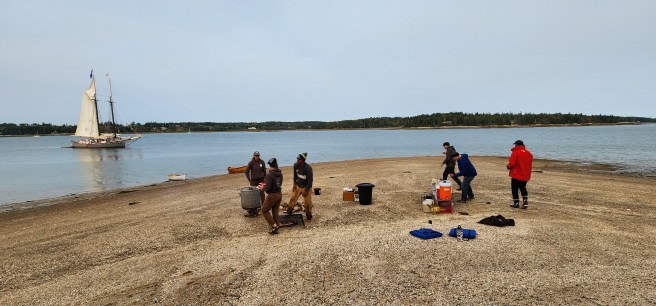
Can you imagine big wooden sailing vessels being launched here for voyages to China, Hawaii, or San Francisco? But they were, including majestic clipper ships.

Now there’s a proposal to dam the small river to capture the tides and use them to generate electricity. A major question is how that would affect the newly restored migratory fish run with tens of thousands of alewives a day heading upstream this time of year.

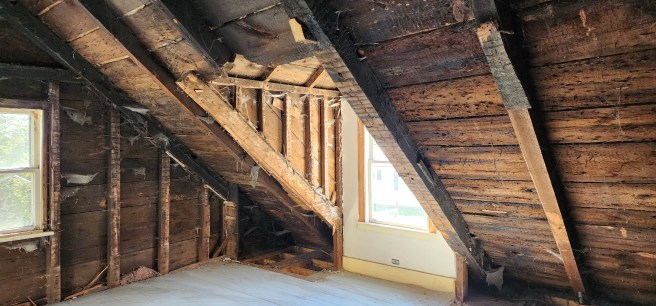
Feeling excited about my new room, especially

Our project was envisioned by other family members and my being included in their dream felt, well, adventurous. They had some definite ideas and strong opinions but were also practical, frugal, and flexible. I would have been content to leave well enough alone, if only their thinking and style hadn’t continued to impress me as we marched forward.

Remember, these are my retirement years, unlike theirs. I’ve been downsizing and discovering how much I can live without. I had some big dreams in the previous move, and when they didn’t manifest, I refocused.

Look at all that extra room.

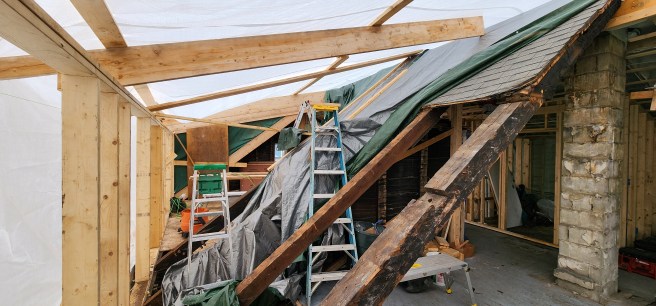
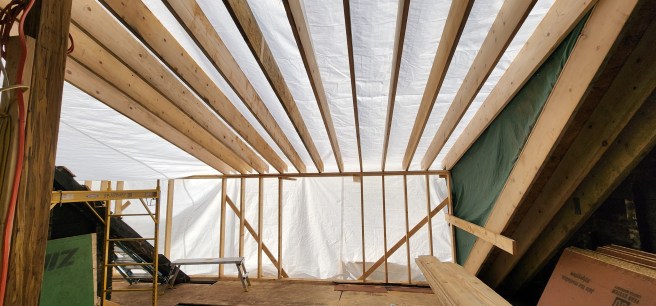
But then, as our new dwelling was stripped of half of its top half, a reality began to excite me: my bedroom and studio workspace were shaping up as something entirely new, tailored for me. I wouldn’t be trying to fit into some previously existing room but rather shaping one to my own preferences. I thought of windows that would allow more bookshelves and wall for artwork yet still flood the room in natural light. The ceiling would feel airy, even though one side would be lower than ideal for me – in this case, we’d make it play into the angle. There would be abundant electrical outlets, too.

No longer would I have a washing machine in one corner, but rather I would have a door between my bed and the household access to the bathroom. Yes, privacy! I would miss the proximity to the kitchen and my overhearing phone-call details of our shared daily life here – that room is the hub of life in our home – but I would also feel freer to dial up the opera when others were also in the house.

We had already agreed to keep the flooring rather rustic, more or less matching the existing planks, and the walls white, to enhance the natural light. That left window coverings and trim color for accents. I was leaning toward blue, especially indigo I associate with Japanese fabric.

The big question was just how much of my goods I could fit into the room and perhaps how much might go into the emerging guest room, the mirror-image at the other end of the hallway.

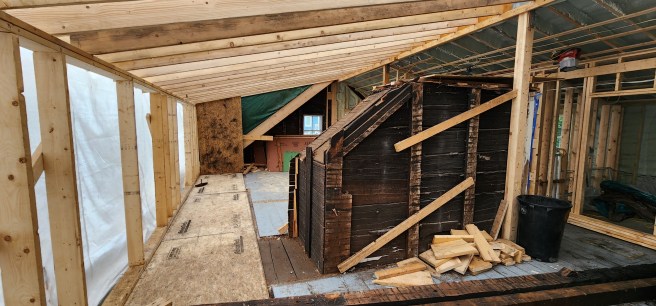
We’re keeping the charred rafter exposed, a souvenir of the downtown fire of 1886..

As we pondered the emerging space, we opted to go for cathedral ceilings rather than flat and later, as a quirky touch, to keep the charred rafters at either gable exposed when the drywall went up.

These two rooms were starting to feel more like nests, actually. Not that there’s anything wrong with that.

In the company of other writers

For 23 years after the appearance of my first book, I was stymied, as far as paper publication went.

Apart from the PDF publication of my second novel, in 2005, I couldn’t get a nibble. Not just the novels, either. Even my poetry books failed to garner print editions.

My on-the-job hours didn’t help either – nights and weekends. So much for networking.

~*~

Looking back, I can acknowledge how some writers’ circles have been very helpful along the way.

The first was an off-campus group in Bloomington gathered around the annual review Stoney Lonesome, named after a village in bucolic Brown County nearby. Once a month, its editors hosted a group that had a featured reader followed by an open mic and sometimes gentle criticism. It gave me the nudge to go deeper into poetry – “You’re hooked,” as one said – along with some great tips for submissions to the small-press scene. I was also invited to coedit an edition, which came out shortly I had relocated to Washington state.

I’ve never been one to be in a writers’ circle closely critiquing each other’s work. The time commitment was one problem, along with the difficulty of finding the right mix of participants. You know, like being a classical musician in a punk band.

There was a group in Baltimore during my sabbatical year, though I’m not sure where its core energy was. The highlight for me was a talk by Tom Clancy just before the movie version of Hunt for Red October was released. I don’t even remember where our regular meetings were held.

In New Hampshire, several open poetry mics took place on nights I could attend. One was weekly in Concord, filled with a hip young crowd and some edgy writing. I was the featured poet there on several occasions.

Another was a poetry group at the local Barnes & Noble, mostly young writers and good energy.

And then I relocated to the seacoast and got bumped to working the second shift, which did free up my Saturdays, if I could get up and away in time.

I joined the Poetry Society of New Hampshire, which had a major event each quarter – the same date, alas, as my ministry and counsel committee of New England Quakers met. The poetry group was more attuned to rhyme-tasters and school programs than to the avant-garde realm I’ve pursued.

Instead, a weekly series just over the state line in Massachusetts filled the gap. Held in a coffee house at the back of a boatyard and overlooking the harbor, Merrimac Mic had a lively bunch of regulars and gave me the featured reader spot multiple times. Isabell was a most appropriately eccentric emcee and organizer.

Performing your work before a crowd is a fine way of measuring its status. The energy of the audience can reflect whether the piece is effective as well as expose deficiencies. Besides, it’s an excellent way to pitch in with a group, as you would at a potluck dinner.

I’m not so sure about contests, but it seems to keep some other writers energized.

At the newspaper, I didn’t go straight from full-time employment to retirement. In the midst of some contentious contract negotiations, some of us were offered a chance to take a buyout. Then it was yanked off the table only to resurface on short notice. I took it.

That gave me a heavenly midwinter month where I indulged in a reading orgy, supported by the monthly severance checks. But the newsroom was short-staffed and wanted me back as a part-timer up to four days a week. Somehow, that felt quite different from the earlier tensions. I could choose which nights I wanted free, and I was no longer party to the office politics.

That’s how I had the Monday night off for a monthly Writers Night Out in Portsmouth, a wide-ranging mix of writers – filmmakers, ad copywriters, playwrights, public relations folks, in addition to poets, short-story writers, and novelists – who met over beer and appetizers or snacks. Writers’ schmooze, as I called it. Each of us briefly shared something about our latest project before the full gathering, accepted feedback, and then broke out into smaller clusters of similarly engaged individuals. Somehow, we weren’t competing with each other – I especially valued the perspective of a well-place sci fi writer and a younger multimedia artist – and the chatter was always helpful. The frustration of marketing was probably our No. 1 topic of discussion.

Those events ran about the time I took up blogging – or building my platform, as we were advised. It’s probably where I first heard about WordPress. And it’s definitely where I first heard mention of Smashwords. (What!?)

Yes, especially, Smashwords.

I hadn’t even considered the option of ebooks, and everything I’d heard up to that point was beyond my budget. Not so here.

Now, as I was saying about getting together with other writers? It really is essential.

How a constitution is breached

… the executive department had not been innocent of frequent breaches of the Constitution. … The great proportion of the instances were either immediately produced by the necessities of war or recommended by Congress or the Commander in Chief. … In most of the other instances, they conformed either to the declared or the known sentiments of the legislative department.

James Madison in Federalist No. 48

On photographer Francesca Woodman

Is she daring us? To what? Her self-portraits from her intense, brief life burn with some secret hunger. Do her images contain clues for answers? How I wish she could speak or at least listen.

In contrast, she leaves us baffled by her short career, ended when she leaped to her death from an open window at age 22.

She can be seen as fascinated with death itself. A few images, such as those with her arms wrapped in bandages or holding a knife, may be from a suicide attempt that’s mentioned in passing.

Her images are infused with a gothic premonition of death – the Romantic obsession with tragic, youthful demise, and lost opportunity. To speak of an eroticism of death is eerily heightened by knowing of her suicide to come – the images of her holding a knife or extending her bandaged forearms or climbing (sometimes naked) through Victorian gravestones become eerily chilling, leaving the viewer with a morbid fascination.

Her shots appear to surface from the birth of photography itself, an homage enhanced by black-and-white – often scratchy – prints.

And then there’s the matter of her family – both of her parents and her brother were artists, each in a different medium.

Consider the sense of self-entombment in her photographic legacy.

As I delved into the images her family had released (there’s criticism they’re withholding much more), I pondered alternative directions my What’s Left novel could have gone. These photos, to me, could have been by Cassia’s father if he hadn’t taken up the Tibetan Buddhism and then been granted the support he received from his wife’s family.

In contrast, I encounter her after three of my novels followed a hippie-era photographer, and the newest tale picked up on his legacy nearly a half-century later. This time, it’s told by his daughter, Cassia, who’s trying to uncover his essence after he vanished in a Himalayan mountains avalanche when she’s eleven. Her biggest evidence as an investigator stems from his cache of photographic negatives. The way we do with Woodman.

Cassia’s research paradoxically forces her to reconstruct her mother’s side of the family in depth and all of the reasons her father found refuge among its members.

His, I’ll presume, are professionally competent and moving increasingly into color as the technology advances. Woodman’s work turns inward; his ranges outward, through the changing times around him. His death comes unexpectedly, in a period of blissful encounters, among the monks and mountains who expand his vision.

So I return to the darkness of her vision and the imagined brightness of his. Both, in their own ways, tragic.

A nod to famous Maine artists, most of them ‘summer people’

The Pine Tree State has long inspired painters and other visual artists, most of them attracted from elsewhere.

Here’s a sampling:

  1. Marsden Hartley, an American Modernist master born in Lewiston and died in Ellsworth. What the desert was for Georgia O’Keeffe, Maine was for Hartley.
  2. Neil Welliver, a Pennsylvanian who moved permanently to Lincolnville. Renowned for his large, square interior Maine nature studies – and a life of controversy and tragedy.
  3. Three generations of Wyeths – N.C., Andy, and Jamie. The most famous, even as summer residents.
  4. Winslow Homer and Edward Hopper. Led a parade of summer people who made the state’s rugged surf iconic.
  5. Alex Katz, a New Yorker who forged a strong Maine connection from 1954 on in Lincolnville. Best known as a precursor to Pop art.
  6. Frederic Church and Thomas Cole of the Hudson Valley School. Made their way to the Pine Tree State, too.
  7. As a child, sculptor Louise Nevelson came from Russia to Rockland. As an adult, she relocated to New York City, something of a reversal of most artists.
  8. Rockwell Kent. Spent five prolific summers on Monhegan Island.
  9. Charles Herbert Woodbury. Founded the Ogunquit colony.
  10. Lithuanian-born William Zorach. His family bought a farm on Georgetown Island in 1923 where they lived, worked, and entertained guests, juggling between New York City. Daughter Dahlov Ipcar also became a noted artist.


Care to look at people around you carved in stone?

What would your obituary say about you? What would you say there, if asked? Before you reply, pay attention to everyday stuff and your aspirations, especially what you love. Note as well how others see you. Besides, how do you fit into your neighborhood or wider community? Feel free to exaggerate, reflecting everyone else.

As a human, you assume a cluster of identities – some of them chosen and changeable, others immutable. My grandfather, for example, proclaimed himself Dayton’s Leading Republican Plumber, invoking a host of other identities as well: Protestant, Freemason, middle-class, married. “Grandfather” wasn’t high up in his awareness, from my perspective. Being male or female or teenaged or elderly, on the other hand, are simply givens. And the history of what we’ve done or failed to do cannot be altered, except in our own perceptions and retelling.

The range of identities is astounding. They include but are not limited to race, religion, nationality and locality, occupation, family (household and near kin to genealogy itself), education and educational institutions, athletics, hobbies and interests, actions and emotions, even other individuals we admire, from actors and authors to athletes, politicians, and historic figures. They soon extend to the people we associate with – family, friends, coworkers, neighbors. And, pointedly, our phobias and possessions.

Curiously, it becomes easier to say what we are not than what we are specifically. That is, set out to define yourself in the positive and you’ll find the list rapidly dwindling, while an inexplicable core remains untouched. Turn to the oppositions, however, and the list becomes endless. I am not, for instance, a monkey. At least, most of the time.

Sometimes, moreover, a specified negative becomes truly revealing: “I am not a crook,” for instance, as the classic revelation.

Behind the masks of public life – our occupations, religious affiliations, social status, economic positions, family connections, educational accomplishments, and so on – each of us engages in another struggle, an attempt to find inner balance and direction for our own life. As we do so, we soon face a plethora of interior and exterior forces that must be reconciled. We get glimmers into this struggle – both within ourselves and within others – in statements that begin “I am” and “I am not,” as well as “I have been,” which recognizes the history and habits we accumulate and carry with us. There are also the voices – “he remembers” or “she insists” – that also recur in our lives, defining and redefining ourselves both within, as conscience or the angel or devil on our shoulders, and without, as any of a host of authority figures and friends or family members.

All that brings us around to my latest poetry collection, Hamlet: A Village of Gargoyles. There, many of the imaginary individuals profiled are identified by occupation while their confessions typically reflect the more  intimate concerns of their lives – relationships, activities, even the weather. These are, then, overheard snippets more than public proclamations.

Hamlet, of course, is a small town or a village as well as a famed play. In this collection, the inhabitants are profiled in five acts of two scenes each, plus intermissions and intermezzos. They’re even exaggerated, the way a stone carver would in creating gargoyles and grotesques.

Listen carefully – especially when others talk of their romantic problems or other troubles – and another portion of a mosaic appears. This collection of poems builds on such moments, constructing a community as a web of each its members. Sometimes, a place appears; sometimes, a contradiction; sometimes, a flavor or sound or color. Even so, in this crossfire, we may be more alike than any of us wishes to admit. We may even be more like the part we deny. Our defenses wither. Our commonality, and our essential loneliness, are revealed.

Just think.

Having originally appeared in literary journals around the globe and then as chapbooks at Thistle Finch editions, this collection of poems is now available in your choice of ebook platforms at Smashwords.com and its affiliated digital retailers. Those outlets include the Apple Store, Barnes & Noble’s Nook, Scribd, and Sony’s Kobo. You may also request the ebook from your local public library.

The move unites the poems in a single volume, rather than a series of ten smaller chapbooks and ten broadsides, and makes them available to a wider range of readers worldwide.

Welcome to town, clown.