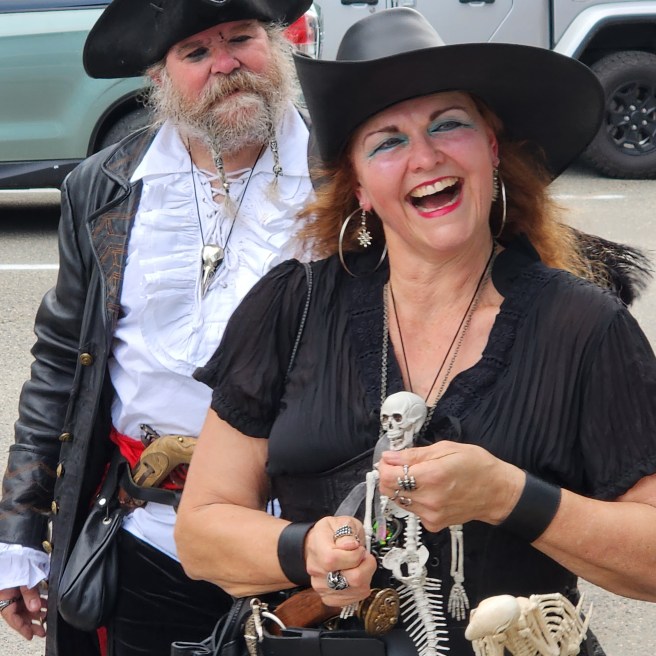
The weekend after Labor Day is observed around here as the Pirate Festival. It’s even a prelude to Halloween.
You never know what we'll churn up in cleaning a stall
The weekend after Labor Day is observed around here as the Pirate Festival. It’s even a prelude to Halloween.
Its origin, I’ve heard, arose in the Quaker peace testimony of 1662, with its refusal to swear oaths. Before that, political factions were supported by their own armies. The Quakers, or Society of Friends, promised to hold firm to their beliefs and yet not coerce others to their stand. Persuasion was another matter altogether. And William Penn, in the colony of Pennsylvania in the years we knew it as the Holy Experiment, insisted on having at least two candidates for every public office.
The Quakers not only refused to bear arms but also conducted their faith community business by consensus, without ever taking a vote. Minority opinions were respected, often leading to a third solution superior to the original options. This was not, do note, a compromise, seen as the lower common denominator, but rather something superior.
Theologically speaking, we sensed that Christ had a better answer for us, if we would only listen. “Mind the Light,” as we said.
Flash ahead to today’s death grip in the United States, where one party has steadfastly stood to obstruct anything proposed by an administration other than theirs. President Obama learned the hard way that they wouldn’t participate in crafting a third way. And he faced their open disrespect, which continued during President Biden’s term. Just look at the F— Biden flags for confirmation. Or their chants of “Lock her up,” regarding T-guy’s first opponent. Not that they would acknowledge the same for their guy, for far better documented reasons.
The Don Old, as we’ve seen, has significantly worsened the conflict and is threatening to imprison those who don’t agree with him.
The conundrum with a democracy could rapidly pivot on what to do with a disloyal opposition.
This could get very ugly, indeed. Before and after the national election.
The first I became aware of Rorem was, I believe, through the Paris Review, possibly set as some very wild topography. Oh, the possibilities it presented!
Over the years, Rorem became a classical music composer I knew of vaguely rather than directly. I may have even heard a few of his songs in recital. And then, in Dover, I was gifted his Paris Diaries one Christmas.
Baring his private scribblings to the public did lead to some notoriety for their candor, even snideness, much of it about celebrities in the contemporary fine arts world, yet the gossip also reveals much about himself, intentionally and otherwise.
Wandering through the broken pedestals in Rorem’s pages has been a guilty pleasure for many. These days it can be seen as a history, too.
one more seal
in the sea
you’ll see
I’m turned about so much
we don’t connect to the guidebook
in my hand
across from Brooklin
on Blue Hill peninsula
wooden boat school renown
and the magazine
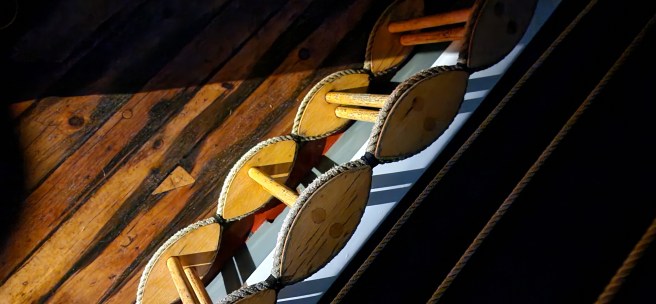
I’m so turned around
the overnight air was humid
we thought the early morning sun
was the moon
we could look at straight
like the nearly full moon
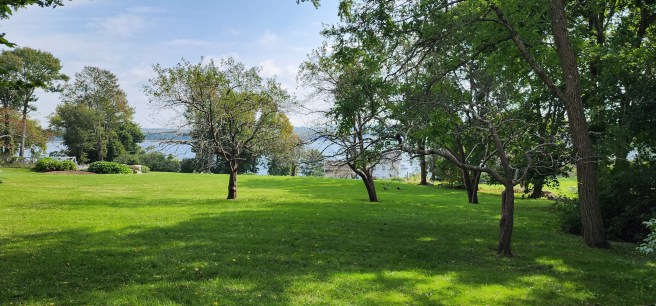
With the ocean in view, this lawn appears impeccable.
The dream itself isn’t so uncommon, or so I’m told.
In my case, it involves trying to go somewhere or finish a project, as in meeting a deadline, except that interruptions and complications keep popping up.
Quite simply, like Zeno’s Paradox in philosophy, the finish line becomes more and more elusive and then impossible to cross. You can never get all the way there.
So that’s how I sometimes feel looking all that remains to be done on this old-house project, even before I confess to myself that I don’t even know about many of the other items on the list.
List? Where is it? Which one?

As you see, our waters aren’t always deep blue.
Sometimes, in writing, at least, starting at the end and moving forward is the way to go. Now that I had What’s Left as the ending of my hippie series, I could revise the earlier books to provide a more uniform development. I had hoped the process would involve simple tweaks.
I was wrong. A thorough overhaul was ahead.
Crucially, Cassia gave me a clearer idea of her father, the aspiring photographer. And in filling him out in the revisions, he went from being known simply as DL to Kenzie, to conform with What’s Left as well as present a more substantial figure.
She had also grown up at the edge of the campus where he had come to study. (Just as I had.) In my return to the university as a research associate, I lived at the far fringe of the college town and saw faces of the community that were quite different from my undergrad experiences.
Some of these played into her story, What’s Left, but others were woven into the transformation of his undergraduate years, what would emerge as Daffodil Uprising rather than Sunrise.
This time, it was more character-driven rather than action.
It’s also darker, including an ominous air and an admission that the hippie movement was often drab rather than psychedelic. Drugs and sex could have serious downsides, and Vietnam weighed heavily on the spirit.
Yes, Bloomington was a gloomier place than I had wanted to paint it, but now, thanks to Cassia, I could acknowledge Gothic and tragic sides – even a paranormal streak.
The plot was restructured into a full four-year chronology, and the hippiedelic excesses, as well as Kenzie’s situation of being a reincarnated Tibetan monk, were toned down or erased.
Age differences, from freshmen to seniors, took importance in the nurture of a student community. And there were significant new characters, including Lee Madbury, named after a New Hampshire highway exit sign.
The college dorm of the first half of the book was loosely modeled on the Men’s Residence Center, which was suffering from neglect on high. I am happy to see via Internet that what I call Mulberry Row in the book has been renovated into the Ralph L. Collins Living-Learning Center, one that’s not all males, either. Sometimes hard reality follows the dreams of fiction.
In moving the second half of the book more off-campus, I imported a large and once-impressive Victorian apartment house from my upstate New York hippie experience after I had graduated. Instead of having the Susquehanna (as well as the Upper Mississippi from yet another one of my personal relocations) just a block or so away, we now have the Ohio River. The distances do create a bit of a joke for folks closer to the action.
I originally thought Daffodil was about hippies. It’s really about the rise of the modern mega-university. David and Goliath with a dash of counter-culture in the face of the military-industrial complex. Really sexy stuff, right? Except that our kids and grandkids are burdened with huge debts in the aftermath of seeking its credentials. I’m thinking of it more as tragedy, with the focus essentially on Cassia’s future father, lost as he was. It might even be seen as a critique of the hippie outbreak. And did my failed engagement a decade and a half later also seep into the story? I was now looking at these events about a half a century later.
~*~
Cassia also gave me a clearer understanding of her aunt, Nita, who had functioned as guardian angel for her father in the campus years. In the revisions, Nita becomes a more central thread through the entire series.
And, thanks to What’s Left, Cassia was freed to comment on her father’s college years life. Why not? She had the advantage that looking back that history allows.
~*~
Cassia even had me adding subtitles to my novels. They’re commonly used for nonfiction, but somehow rarely for fiction. Well, why not? Adding “the making of a hippie” does give a browser (meaning a human rather than an online device) a clearer idea of what might be inside the covers. Should I have used that for the title, rather than what I did?
I do like the colorful batik flowerbed by MsMaya that now adorns the cover, even if I miss the bold single daffodil of the earlier version. To me, it more aptly conveys a sense of the era.
Daffodil The revised story now carries more heft and is, to my eyes, something of a baroque book.
Well, if Kerouac thought his experiences were remarkable, why shouldn’t I, looking at my own? And he did write in big bursts that released a lot of pent-up energy.

Some folks use the striking weed in cooking.
 Jnana's Red Barn