this place is littered with islands
but not Toothache Bay
You never know what we'll churn up in cleaning a stall
this place is littered with islands
but not Toothache Bay
A sloop has only one mast, for starters.
There’s a whole new vocabulary to learn.
It’s a way of looking through the eyes of others.

Those things on the ropes, er, lines are called baggy wrinkles. They protect the lines and sheets, i.e. sails, from harmful rubbing. That is, they’re a furry cover for rope sphering.
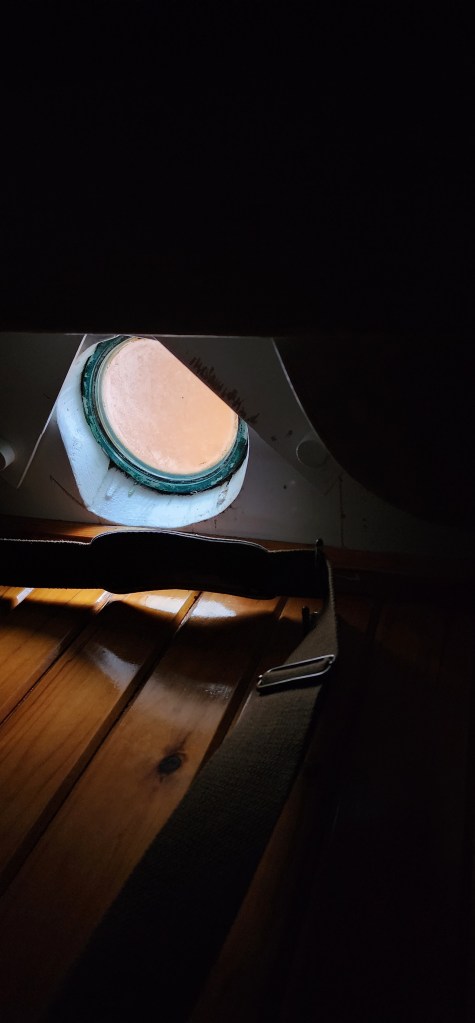
Deck prism is another term. It’s a small round window. Here’s how it looked from my bunk. Overhead, people were walking on it.
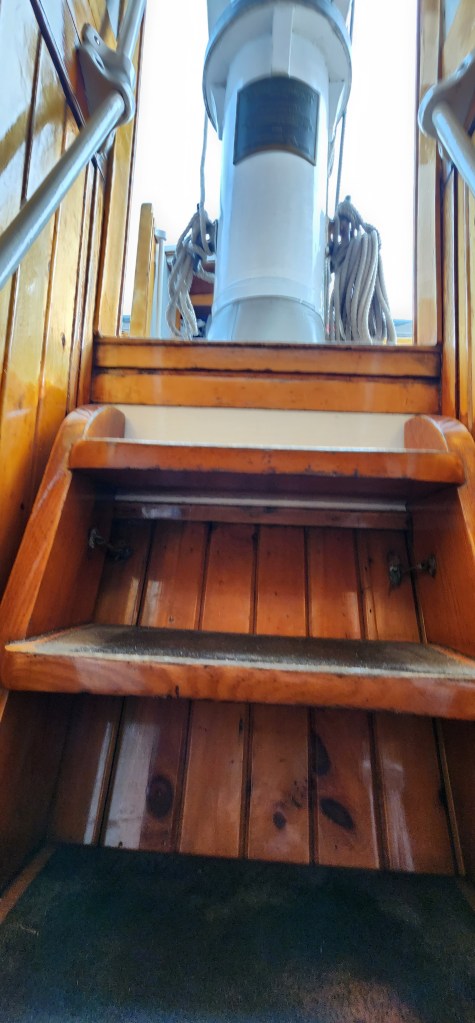
Hatch is the opening between the deck and the hold below. This one connects by a ladder (not stairs) to cabins (aka staterooms).

Another leads to the galley, which includes what others would call a kitchen.

I can’t decide which photo I prefer.

Indiana wasn’t the only thing bogging down my original subway manuscript. The dude’s life off in the countryside after college was another big complication.
Well, that and my grounding as a journalist, meaning focusing on facts as I observed them, in contrast to writing as a novelist, meaning putting feelings and some imagination first.
Head for the hills, then, as I did by default to upstate New York. I didn’t get there quite as I describe Kenzie’s journey, but the route wasn’t that far off, either. In the story, I’ve kept the location rather vague. It could as easily be pockets of western Connecticut or the Berkshires in Massachusetts or even southern Vermont. Let them blend together.
I was pretty lost in my first year-and-a-half after college, the period leading up to my embrace of yoga. It was a wild ride for me, at the margin of general society; my highs punctuated deep depression. Most of my friends – including housemates and girlfriends – were from The City or its wider orb, and that included short trips with them when my work schedule permitted. (I rarely had two days off in a row, much less three.) And, my, was I green.
For much of that period, my own journalism slash writing career and dreams were going nowhere and paid next to nothing. More troubling, my love life was non-existent, even considering how I had a housemate who came back every night with a different bedmate, all of them delectable in my sight. What was my problem? What was wrong with me? What was I missing?
And then I found yoga and everything changed. Even the romance.
What could possibly be wrong with that story?
Well, it had fed into Subway Hitchhikers, but most of what I had drafted there was eventually excised to focus on the urban dimension of the story.
~*~
During this period, my social life revolved around two locations.
The first was a once luxurious apartment building turned slum at the edge of downtown. I later moved it to Daffodil along the Ohio River far to the west for the college-years novel. Well, many but not all of the renters were college students.
The second encampment was what many people would consider a hippie commune out in the hills, a very rundown farm high in the hillsides along the state line. As I explain in what’s now Pit-a-Pat High Jinks, we shared the expenses but not our incomes. I now think there were some freeloaders anyway.
Both dwellings, from what I see in satellite photos, have been torn down.
And I still believe my two-ring circus there (three, if you include the newspaper where I was employed) was a richer source of characters than, say, Bonanza or the Friends sitcom.
~*~
I’ll have to revisit my journals for clues about how the lode from this period evolved during revisions. When I heard about Smashwords a dozen years after the subway novel had been published, I must have already had two versions of the experience in hand, both drawn from the earlier outtakes augmented by journal entries and correspondence.
They differed sharply in tone and focus.
Hippie Drum was closer to a memoir that focused on the general hippie scene around me. Hippie Love paralleled the chronology but focused on its erotic encounters, with the added twist that our protagonist had far more success in the love department. One was gritty; the other, free-wheelin’ trippy.
In these parallel accounts of the same story line, the first focused on Kenzie’s overall adjustments to being out on his own, adapting to the workplace and his new housemates and a wider underground, freaky community. He was desperate for love but rarely connected. Frankly, much of the hippie life was drab and impoverished. The other, an R- or X-rated version, was more fanciful, examining what could have been if he had possessed a bit more finesse. Both books ended at the same point.
Making sense of what happened in my outwardly dull life in goofy counter-culture times included what happened out in the sticks were nobody seemed to be looking, that is, where I had landed or even taken refuge. It was just up the road from Woodstock, only on the far side of the Big Apple.
~*~
I originally envisioned the two books kind of like the three-show play The Norman Conquests, where a line of conversation starts in one room and of finishes a night or two later on the other side of door he had passed through. Not that I was that meticulous in my crafting. I was just trying to run with the material at hand.
Alas, the “love” book was wisely deemed “adult” content, invisible unless you checked your filter.
~*~
As for related input? Leonard Cohen’s Beautiful Losers, Jack Kerouac’s spree narratives, Anais Nin’s sexual frontiers, Robert Crumb’s stoned cartoons, and Arlo Guthrie’s “Alice’s Restaurant” can be seen as touchstones for what finally came back together as a single volume, Pit-a-Pat High Jinks, in its current incarnation. There may even be some Hunter Thompson in the mix.
~*~
Hippie Drum was the first book I published at Smashwords.
Hippie Love came out the next month.
Both, in the autumn of 2013.

We watch them grow up from visit to visit to our yard.
What are the chief sources of expense in every Government? … The answer, plainly is, war and rebellions – the support of those institutions which are necessary to guard the body politic, against those two most mortal diseases of society.
Alexander Hamilton in Federalist No. 34
CAUGHT BETWEEN TWO WORLDS (of) UNFINISHED BUSINESS

Another quirky seasonal creation in our house. Martha Stewart, move over.
I’ve long been fascinated by major metropolises, or at least the concept of a downtown as a pulsing power center buzzing with fashionable activity. My hometown, while a thriving city at the time, never struck me as “big.” As for glitz? Forget it.
In the list I’ve assembled, each of the cities has at least one professional baseball team, and today also an NFL team, not that sports were a big factor for me. Great symphony orchestras and art museums, however, definitely were. And later, I came to see subway systems as another measure; the majority of the cities here have them.
All but one of these locations is somewhere I’ve been more than once, and we’re not even counting connecting flights at the airport. While I’ve resided inside only one of these hubs, I’ve lived within the gravitational orb of another seven.
That said, here goes, presented more or less in the order in which I experienced them.
I realize how much the experience of most of these places is based on walking. Pedestrian-friendly was a key element separating them from others.
Honorable mentions: Worcester, Saint Louis, Toronto, Philadelphia, Montreal, Detroit, Providence.


 Jnana's Red Barn