

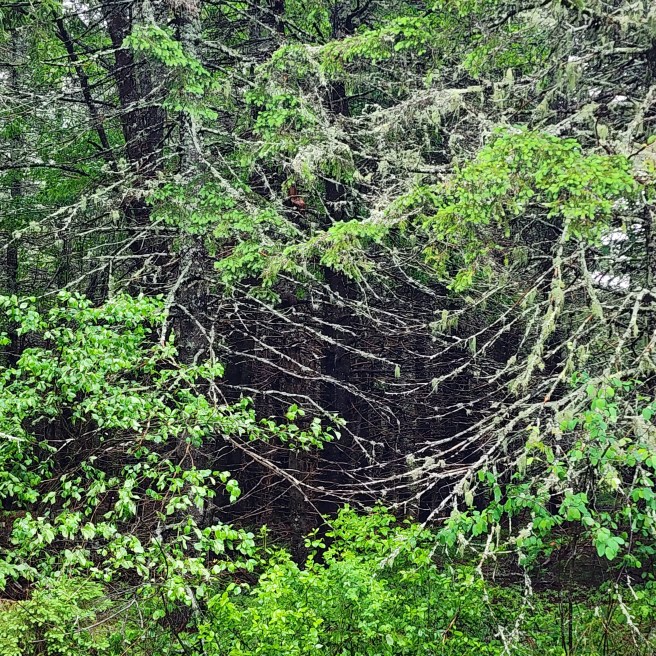
Spanish moss drapes many of our forests. Scenes like these often remind me of Neil Welliver’s large, prized paintings and distinctive palette.
You never know what we'll churn up in cleaning a stall
Spanish moss drapes many of our forests. Scenes like these often remind me of Neil Welliver’s large, prized paintings and distinctive palette.
For me, this is ancient history, back before my second marriage more than two decades ago. Still, I get questioned about my deep past, and sometimes that has me looking at my previous romances and adventures collectively, rather than individually.
Here’s the latest take.
Another of the circle of novelists I treasure who began writing after I graduated from college is Brooklyn-born Lethem.
“Genre bending,” used to describe Lethem, is a new term for me, but hardly a new concept. It’s something I’ve long pursued, if only in resisting genres outright. His multigenerational Dissident Gardens, especially its unconventional structure, even gave me a key for redirecting the material I had been gathering for what emerged as my novel What’s Left.
His essay describing the underground Schemerhorn station in Brooklyn is my nominee for the finest writing about the New York City subway station, period. Remembering, this is coming from the author of Subway Visions.
Some of my friends had resided near his locations in Motherless Brooklyn and The Fortress of Solitude, so the novels had some familiarity for me in addition to his takes on growing up in a hippie environment. I was especially intrigued by his treatment of his father, an outstanding contemporary painter and personal friend, as an eccentric videographer.
Now, to add Lethem’s earlier books to my TBR pile …
was so surprised
in rush between breakfast
and boarding the Peapod for shore trip
to find in my pillbox this wasn’t Tuesday but Wednesday
when did I lose a day?
On Isle au Haut pier

I salute the shopkeeper for thanking
Justice Roberts for Obamacare
and explaining to him
why it was so important to her
to us
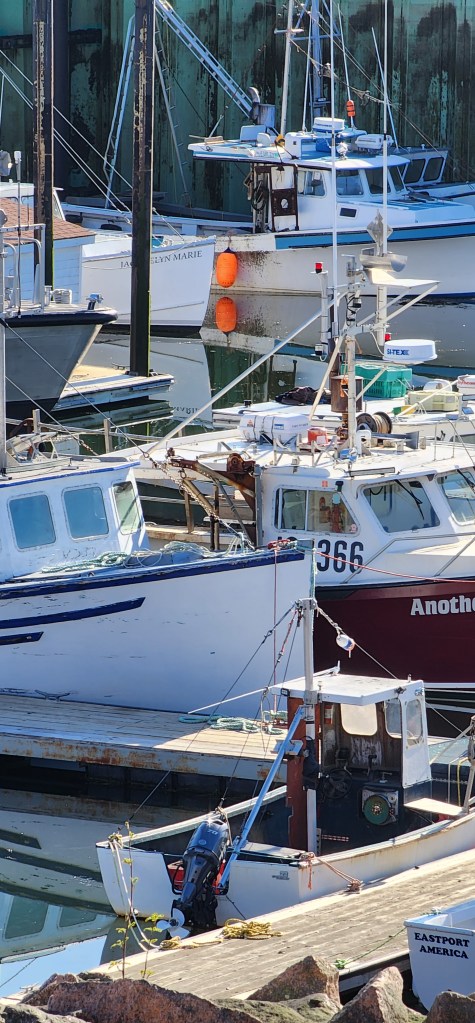
Yes, Eastport is a working waterfront. Especially if you like lobster.
The unexpected complication of discovering that all of the dumpsters in town were tied up until after the big Fourth of July events forced our contractor to delay the demolition of the front half of our upstairs. Our attention turned instead to the back of the house, where a wheelchair-ramp and small deck were seriously deteriorating. Think of it as a safety issue.
The project would fit into the interim.
Unlike a previous owner, we didn’t need the ramp. Basic stairs would do in their place, and that would free up more of our small yard. The existing deck, meanwhile, was too small for our needs, and my coconspirators already had dreamed up designs that included a ground-level apron. For now, we would focus on the upper level just outside the mud room door.
The old deck top and ramp walkway were deposited at the far side of the backyard, where they will serve as a platform for stacking our next firewood delivery, keeping the split wood off the soil itself.
The deck structure itself became more involved than I had imagined. This house renovation is, after all, a vast education for me.
For starters, the new concrete footers were more deeper than the amateur ones and large rocks previously used. Three feet rather than a foot max. No wonder the deck was sagging. I wasn’t surprised there, but I was definitely impressed by seeing the new ones done right.
The underpinnings for the new top were another matter. No 2x4s or X-bracing this time. I wondered if Adam was overbuilding this, but he assured me this was according to code and would support a roof, if we decided at some point in the future to turn this into a screened-in porch. OK, I’m on board.
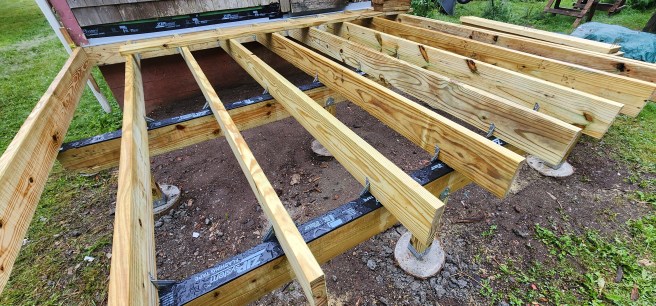
Carpentry really is about building boxes, as I once heard. The framing above became the rigid system below, awaiting the deck top and railing.
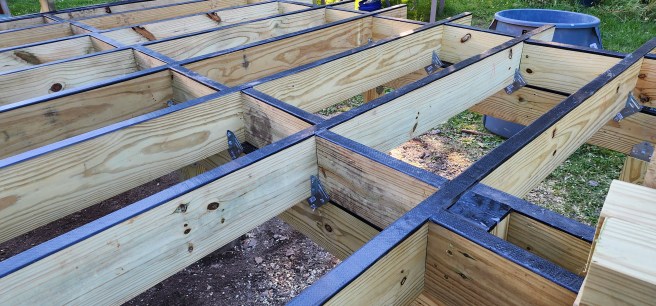
The results so far really are redefining our backyard and its uses. Dining out there without having to consider those nasty fire red ants under your chair is a definite step forward.
Discounted “sale” prices would be used to move a backlog of volumes, either at the bookstore itself or at the publisher’s warehouse. It was rarely a good sign.
With ebooks, there are no stacks of boxes or precious book-shelving problems.
Maybe you remember the “remaindered bin” with its cheapo prices. What you likely don’t remember was that authors didn’t get paid royalties on those.
Still, they got books moving into readers’ hands.
Events like Smashwords’ big July-long ebook sale exist to stir things up a bit.
Check out my four selected entries at my Jnana Hodson author page at Smashwords.com to pick up some real deals.
Through much of my adult life, I’ve spent more time writing and distilling poetry than I did with fiction.
Part of the reason was that poetry fit my once-a-week time for sustained “butt time” addressed to my literary efforts. A novel, in contrast, requires a bigger window, at least for me. I have to admire mothers who put something good together while toddlers and family meals gave little respite.
For me, the practice of poetry, both as a writer and reader, springs from the practice of meditation I took up as a yogi and continued as a Quaker, though now it’s once or twice a week rather than daily.
Prose simply feels more secular and aimed more at a general reader. And even there, I’ve come to see that writing hundreds of thousands of headlines for a living had a poetic component in its brevity. My personal writing was one way of staying sharp there. As for the hundreds of thousands of newspaper pages I designed? They did fall back on that intense visual art training in high school.
Like my fiction, my poetry originated in trying to remember and make sense of what was happening around and within me. Sometimes, when I got around to a manuscript of fiction, I would cannibalize a poem, especially if it hadn’t yet been published in a journal. That was especially true when it came to Nearly Canaan and the Secret Side of Jaya.
I wonder if any of this goes back to my childhood interest in chemistry and then being stymied when I wasn’t taught algebra when I needed it, back in fifth and sixth grades. Freshman year of high school was too late, my line of inquiry had shifted to classical music and visual art.
Poetry is a kind of equation, even geology, rather than the Friday night football game a novel can play.
~*~
My juggling act between the daily journalism that paid my bills and the literary aspirations that I hoped would finally free me did result in what I’ve come to see as literary graffiti – flashes written on the run, even when they then underwent much distillation and refining. I think that’s most obvious in Subway Visions, Nearly Canaan, and the Secret Side of Jaya but also befits everything except What’s Left, and even there may have crept in through the earlier outtakes I wove in.
~*~
Shortly after my books were up at Smashwords, a fine writer I know told me over coffee that I was more of a poet than a novelist. Ouch! He may have even said a better poet than novelist.
I hope I’ve improved since then and have arrived at a better balance in the revised books.
 Jnana's Red Barn