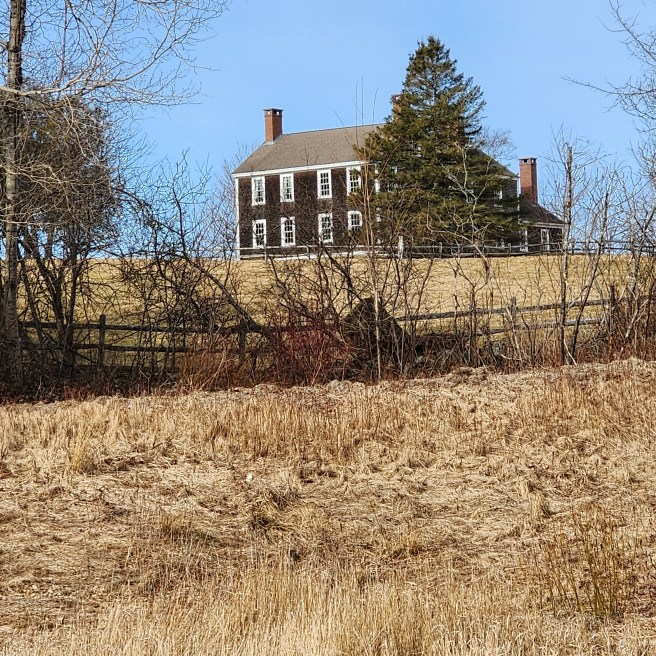
As for getting our old house through future winters?

Ours has long been described as a cold house, at least through winter, even before we discovered how much heat had been leaking into upstairs despite attempts to seal that off. Now that our bedrooms are actually up there, it’s on longer considered a problem.

Or, as our contractor quipped, back then folks believed in letting a house breathe. Uh-huh. They did burn a lot of firewood.

Once we had a wood stove in place, we resolved to see how well that worked in our revamped place and make adjustments from there.

Our existing blown hot-air furnace is definitely inefficient. It even lacks an air filter. Like much of New England, it runs on pricy fuel oil. Beyond that, it’s also vulnerable to Maine’s notorious electrical outages. No electricity, the thermostat’s useless.

An obvious improvement would be turning to a heat exchanger, perhaps one tied into our existing downstairs duct work, though that would still be vulnerable to electrical outages. Or outrages, if you will.

The conversion would also work for cooling the house come summer, as needed. Not that we have many days like that, living on an island as we do.

In addition, we have those rotting downstairs sills to contend with, and the obsolete triple-track often badly out of whack storm windows and screens, plus the front and back doors.

As for cold intrusions? Who can be sure they’re really not ghosts?

We’ll do what we can at each step ahead.

Technology, change, and striking a fair deal

Returning to my working paper, ”Thinking Thru the Future of Publishing” from 50 years ago, I’ll admit much of the material will be ancient history for many readers, but it does reflect some trends that have been amplifying in the aftermath. And don’t laugh at the prices mentioned. Hey, I was still typing away on my IBM Selectric at work and my Olivetti Editor 2 at home – typewriters of the advanced electric sort, kiddos!

~*~

As I wrote then:

There has been a growing situation in recent years concerning the DISTRIBUTION end of circulating ideas. I have seen this in three major areas, as a kind of illustration:

  • Film
  • Publishing
  • Music

We have read of the problem of film directors who have objected to the mutilations imposed by film distributors. Furthermore, many of the directors have voiced opposition to the distributors’ claim that most films are not profitable (there is, for example, a wide discrepancy between the figures given to the producers & directors of a film & the figures given to Variety and other trade publications concerning the actual box office receipts of a given film). So the producers/directors of a film are faced with two problems: getting their film into theaters outside of NYC & a few other large cities, & getting an honest accounting of the return on their investment (artistic & financial).

In music — especially popular music — the situation is much the same. Fewer & fewer broadcasters are playing recordings that are not on the Top 40 — or, increasingly, the top 20 or 30. This means that new groups have little chance of being heard. If they aren’t heard, it is difficult for their records to sell. If their records don’t sell, it is even harder for them to be heard.

In publishing, what is happening is this: more & more publishing houses are becoming parts of large conglomerates, many of which own two or more of the biggest houses. CBS & ITT, for example, have both bought heavily into the established publishing concerns. Their corporate outlook is rarely literary.

As a case in point, when no one else would buy the rights to LBJ’s memoires, one of CBS’ publishing subsidiaries offered a million and a half though the books produced less than $10,000 net return for the company — it seems that LBJ was a good friend of Wm Paley or Frank Stanton, the CBS chiefs, & they didn’t want their friend to be embarrassed by the low offers on his book. But who really paid for this business mistake? Not CBS. The loss undoubtedly came from those underpaid writers who are constantly told that their books don’t make very much from their publishers & who somehow keep working on, despite modest royalties of $500 or so for their novels or investigations.

What happens, then, is that the publishing field is becoming increasingly congested; the turnover of editors at the large houses is reported to be terrible, because the new owners do not & cannot know what their long-term goals are.

The other thing that happens is that, to “maximize profits.” the willingness of houses to experiment, to publish unknown authors, to publish a wide range of work — or to edit sharply — is diminished. Traditionally, publishing houses reflected the tastes or skills of one or two editors. A few volumes would be published each year, for a range of literate readers.

I’m not sure this is the case anymore, esp. with publishing costs the way they are & THE CORPORATE DEMAND FOR PROFIT.

~*~

Returning to the threesome of music, film, & publishing, the big bottleneck appeared to be in the distribution end. Either the artist makes it big, or he doesn’t make it at all. Regional markets in all three have evaporated, altho I have reason to believe that they latently remain.

VO’s books were rejected by big houses because the publishers didn’t think the books would pass the 5,000-circulation point.

~*~

The biggest mark-up in a work of art comes at the circulation level. For books, one-quarter to one-third often goes to the retailer. I’m not sure of what the wholesaler gets, but I do know that the author’s royalty is one of the smallest cuts in the entire cost pie.

~*~

In finally publishing the Intellectual Crisis, VO found that the actual cost of publication was less than one dollar a copy, paperback. However, it should be noted that the volume was put out by a university publisher & may have been done at a cost much lower than by going commercial rate. (IU Publications, by the way, charges about half what any commercial printer would demand.)

~*~

Having thought thru this far, I came upon the editor’s comments recent copy of New Letters in the IU periodicals room. He was discussing J.D. Salinger’s recent protest of the republication of a number of his early short stories, which he did not want to see in general circulation & for which he was receiving no compensation: it was purely the publisher’s profit.

The editor noted that University Microfilms, a Xerox subsidiary, has been illicitly selling microfilms of his own magazine. In fact, he was unable to sell mint sets of early editions of his magazine, because many libraries preferred the microfilm version.

The editor was also republishing some of the writings from the early editions of his magazine, when he received a notice from one large publishing house that he had violated their copyright, even though his magazine had on the work & had published it first. On the other hand, the editor noted that attempts on his part to protect copyrights held by his journal went unheeded by the large corporations.

He noted the frequent plagiarism of small magazines & publishers by the large corporations without any compensation to the little workers who feed them.

~*~

The editor also commented on receiving photocopies of MS from submitters. He lamented the passing of the “personal relationship” between editors & writers, as they used to read the precious typed copies.

But he neglected to mention the high rate of rejection slips sent to writers, who usually submitted at their own cost, with their own self-addressed stamped envelopes, and their own precious time repaid in two or three “free” copies of the journal if successful. All in the name of “building a name.”

At 60 cents a page for typists — or the difficulty of constantly retyping pages for resubmission — the “cost” to the author becomes prohibitive. (The U.S. Postal Service has a magnificent way of mangling MSS in the mail, so that they are returned thoroughly mangled.) Because the odds are so heavily against the writer in terms of acceptance & cost, it pays him to invest five or ten cents for a photocopy, mail that, & keep the master form in case he needs to make additional copies for later submission.

The tradeoff? Technology that hurts royalties can also save labor.

~*~

But the editor complained about the smell of photocopies vs. the good feel of typescript & paper. Ah! The literary life!

~*~

Some editors refuse to read the Xerox copies (or, worse yet, the rubbery, ammoniated imitations), altho more & more writers are submitting Xeroxes. But some writers, knowing the long time lags & heavy rejection rate inherent in the academic/artsy publishing world, use the photocopies as a means of submitting simultaneously to many journals. Hence, the editors are leery of photocopies since they may get stuck setting a piece only to have the author pull the entry in favor of a better offer from another journal. (One way to overcome this is in the proper wording in a decent cover letter, perhaps. Or maybe actual compensation of a competitive nature.)

~*~

New technologies cut two ways: they can increase means to circulate material (a people’s access), but they can also reduce ways to govern compensation to the creators. Especially when we get to the ease of pirate tape recordings, videotape films, or Xerox copies of published work.

~*~

Wow, this does take me back in time. See how it develops in next week’s installment.

You can find my works in the digital platform of your choice at Smashwords, the Apple Store, Barnes & Noble’s Nook, Scribd, Sony’s Kobo, and other fine ebook retailers. You can also ask your public library to obtain them.

Do I really need a suitcase?

I no longer desire to travel many places I haven’t yet been but would rather revisit places where I’ve been, either in person or, in the case of Tibet or Japanese temples, in my thinking and study. I also recognize that could change, given different economic circumstances and an influx of free time.

~*~

In the years since I noted that, the list has shrunk even more. As has the number of favored people who remain.

I am thinking I’d like to travel more intently closer to home. So much is overlooked.

Sharpened light

One of the sensations in watching a full solar eclipse comes as the light seems to become more focused before going into twilight. I skip the discussion of optics and physics. Here’s how it looked in the trees around us in the April 2024 event here in Maine. Something similar happened with shadows.

The dope on soap

Yes, one more thing we take for granted. Or, as I used to think, “granite.”

So here a ten things to consider.

  1. Soap goes way back in antiquity, starting with the boiling of fats with ashes and water, though the Latin word for it originates with “clay.”
  2. It’s been a mark of civilized people and sometimes the upper classes, from Babylon and Rome on.
  3. Over the years, olive, palm, and vegetable oils gave rise to other varieties, including Castille soap.
  4. Today, soap comes either in solid form, liquid, or powdered form, based on their use of sodium hydroxide or potassium hydroxide. Liquid is considered easiest to use.
  5. Bar soaps have a lower environmental impact, according to one study.
  6. It’s sold in a number of specialty applications, including hand, face, shaving, body, dish, laundry, or floor-cleaning applications. Don’t overlook antibacterial, either, although it carries some long-term health concerns. Or the wide range of scents that can be infused.
  7. Ivory, first marketed in 1879, was the first soap that floated. Yeah, and it was 99 and 44/100s percent pure, according to the company’s claims.
  8. Modern synthetics, appearing around 1940 with Tide, also prevented the growth of germs.
  9. Soap can also be used to ease zippers or lubricate squeaky hinges, threading needles, and screws.
  10. The bubbles are incredibly thin and sometimes so much fun. Or even romantic, in a deep bathtub.

Maybe that’s what I’ll be giving everyone this Christmas.

Another round of Proust as a prompt

I recently deleted a file full of personal questions.

Personally, most of them didn’t fit, and besides, now that I’m no longer submitting writing to quarterlies and reviews for publication, I have no need for my own contributor’s notes.

Still, I found these responses from working other sets of questions. I am curious how you’d answer.

  • CREATIVE WORK ENVIRONMENT: Solitary.
  • WHAT COLOR IS YOUR BEDROOM? Pure white with Japanese blue accents
  • OH HAPPY DAY: Sitting in the warm silence after Quaker meeting for worship has settled. Especially when the aches and pains stay away at this age.
  • Or a summer afternoon along our pocket beach of the North Atlantic.
  • Or dining together on our deck in warm weather or sitting beside a wood fire in winter.
  • SPACE JAM: Coming upon the wild rhododendrons in full bloom atop Roan High Knob in North Carolina after a wild of arduous backpacking on the Appalachian Trail as an awakening adolescent.
  • RECENT INSPIRATION: Choral singing.
  • DREAM SUBJECTS: Eagles, osprey, whales, time under sail on the water.
  • DREAM ASSIGNMENTS: The fine arts, spiritual community.
  • WHOLE NEW WORLDS: The many dimensions of life my college girlfriend introduced to me, the life-changing experiences of the ashram, living in the desert orchard in Washington state, New England with the amazing woman in my life.
  • FIRST BRUSH WITH FAME: Sessions with any of the cartoonists and columnists I served as a newspaper syndicate field representative, or was it …
  • WHAT WOULD YOU BE IF YOU WEREN’T A WRITER? Really retired. At this point, the question is better recast, “What would you have been?” – something I never could quite figure out.
  • WHAT COLOR AUTOMATICALLY LIFTS YOUR SPIRITS? Cobalt, indigo, or electric blue.
  • THANKFUL FOR: The three incredible divas in my life, even though they don’t sing, as well as Cobscook Friends Meeting.
  • FLOWERS: Daffodils, rhododendron, lilacs, sunflowers.
  • DESSERT: Crème brule or rich vanilla ice cream.
  • SNACK: Cashews, grilled cheese sandwiches, popcorn.
  • GADGET: A corkscrew, branch loppers, charcoal grill ignition tower.
  • CURRENT HOBBYHORSE: American Illuminist composers, as I term the Romantic-era masters.
  • Also, Quaker Light/Seed/Truth.
  • CLOTHING & DECOR STYLE: Yard sales, touch of Amish. Unpretentious and comfortable.
  • DOMINANT COLOR IN MY WARDROBE: Shades of gray.
  • PROFESSIONAL PEAK (SO FAR): Publication of  the novels.
  • MUSICAL THERAPY: A cappella part-singing
  • RECENT TRIPS: Cruising in the historic schooner Lewis R. French on Penobscot Bay.
  • FAVORITE MOMENT: Sliding into bed next to my wife.
  • MY CARD: The usual MC or Visa.
  • WORST GUILT TRIP: Ahem. (Things I’ve said, over the years.)
  • WHAT WAS YOUR FIRST CRUSH? Both Lutherans, one a year older than me and now deceased.
  • WHAT WAS YOUR FIRST LOVE? Kay, after high school
  • WHAT’S YOUR MOST FEMININE QUALITY? Tears, on the rare occasions when they come.
  • WHAT WOMAN IS YOUR GUILTY FANTASY? Freckles.
  • IS THERE ANYTHING YOU MISS ABOUT BEING UNATTACHED? Well, there was discretionary income.
  • WITH SO MUCH COMPETITION, HOW DO YOU SIZE UP? I’ve largely moved solo, to my own beat, in out-of-the-mainstream circles.
  • YOU ALWAYS NEED MORE: Time. Or is that compassion?
  • EVERYONE COULD ALWAYS DO WITH LESS: Self-absorption.
  • WHY I DO WHAT I DO: To remember, to discover where I’ve been, to look closer at my experience of life, to map the trail of my life, especially when it reflects others.
  • BONA FIDES: BA in political science, Indiana University, working with Vincent Ostrom; extended residency in the Poconos Ashram, Swami Lakshmy-Devi’s hermitage; two published novels
  • GOLD-STAR EXCELLENCE: Eagle Scout in sixth-grade, yes siree
  • AMBITIONS: To develop a widespread readership; to rebuild the Society of Friends.
  • FAVORITE SPOTS: The Bold Coast of Downeast Maine, the sub-Alpine range of Mount Rainier, Music Hall in Cincinnati.
  • WOULD LOVE TO HAVE DINNER WITH: My great-great-great-great-great-great-grandfather, George Hodgson, to confirm the pirate attack in crossing to America and learn the details, including the names of his parents and siblings and his relationship with Moses Harland, whom I presume to be his uncle.
  • YOU CAN NEVER HAVE TOO MANY: True friends.
  • ONE DAY I HAD HOPED TO: Be influential and famous.
  • FAVORITE DISCOVERY: The early Quaker understanding and practice of Light/Seed/Truth.
  • NECESSARY EXTRAVAGANCE: Owning an old house.
  • FAVORITE CHARITY: Dover Friends Meeting. Also, local arts organizations, public radio, American Friends Service Committee, Friends Committee on National Legislation.
  • CAR: An old Chevy Sonic, but my favorite was a very used canary-color BMW 1600 coupe.
  • COCKTAIL: very dry martini (Bombay sapphire, with olives).
  • CREATIVE WORK ENVIRONMENT: solitary at the keyboard beside the north window, with or without classical music.
  • PROFESSIONAL PEAK (AS A JOURNALIST): East Coast field representative for Tribune Media Services newspaper syndicate
  • MOST UNUSUAL GIFT: A slice of rubber Swiss cheese in the mail; blown-glass Galileo weather globes; a bottle of dishwashing detergent and two towels as a wedding present.
  • MOST INTERESTING SOUVENIR: Cow skull and elk vertebrae from the Yakima Valley.
  • WHAT IS YOUR MOST MASCULINE QUALITY? Snoring. Aversion to shopping. Fire-building skills. Sense of direction. Love of the wild outdoors. Immersion in single projects from start to finish. Closing doors, turning off lights. Trapping and transporting squirrels. A readiness to catch bugs and crush them with my fingers.
  • WHAT’S THE ONE THING IN YOUR MEDICINE CABINET YOU WOULDN’T WANT OTHERS TO KNOW ABOUT? All the bottles that have long passed their expiration date.
  • WHAT IS YOUR CURRENT PROJECT? All of this blogging. And cleaning up some earlier collections.
  • BREAKTHROUGH MOMENT: When diagramming sentences began to make sense. Enrolling in my first course with Vincent Ostrom. Taking up yoga. Moving to Yakima. Moving to Baltimore. Undergoing psychotherapy. Moving to New England.
  • THE ROAD NOT TAKEN: Returning to the ashram, when Swami demanded. Dropping my partner before the wedding or in Yakima. Going to work at the Detroit Free Press. Admitting there was no future with the cellist and thus moving directly to New England, rather than Baltimore. Plainness, along the lines of dairy farming in the valley.

Revisiting these exercises, I’m struck by how many other desires not included here have been fulfilled or are no longer applicable. Consider CAN’T WRITE WITHOUT: caffeine. Today my mug’s filled with decaf, per doctor’s orders. Caffeine counteracts one of my meds.

A moment in the life

Late afternoon at the former West Quoddy Coast Guard lifesaving station. The boathouse, lower right, sits at the edge of Lubec Channel, with Campolbello Island, New Brunswick running above it. A bridge, barely visible here, connects Canada to the United States, with the town of Lubec continuing along the water. You may even detect the “sparkplug” lighthouse sitting in the water. The city of Eastport, where we live, can be seen beyond the bridge.