Indiana sometimes shows up as a symbolic state. It’s not just a “crossroads of America,” as it likes to tout itself, a blending of North and South or balancing East versus West. It’s an anomaly even in the Midwest, where it’s the only state not bearing an Indigenous name yet it’s named in supposed homage to the Original Peoples – INDIAN-a.
With a capital called INDIAN-apolis. Or Naptown, as it’s known in other parts of the state.
Not that there are any tribes remaining within its boundaries.
It’s not as industrial as Ohio or Illinois nor as agricultural as, say, Iowa or Minnesota – feel free to counter that with hard data, I’m just running on gut feeling here.
And just what is a Hoosier, anyway? There are theories, but it’s certainly not like a buckeye or hawkeye or badger or the Bluegrass State bordering its south or Prairie State on its west or Great Lakes State on its north. You can get a picture in your mind with those.
In short, it rather strives to appear just average, or maybe a level just below. Somehow, that’s what fuels its role as a symbol of America itself, especially the Bread Basket sprawling largely westward, even though it’s rarely in the spotlight, except for Indy 500 week, and even that reflects an earlier glory.
That wasn’t always the case, though. The place gave birth to some leftist progressives over the years as well as some vital inventors. It also gave us the likes of journalist Ernie Pyle, jazz lyricist Hoagie Carmichael, actor James Dean, radio storyteller Jean Shepherd, basketball great Larry Bird, rocker John Mellencamp, late-night host David Letterman. But no U.S. president.
Early on, it had a heavy Southern influence, especially as Quaker families fled the slaveholding economy of North Carolina, as I learned after taking up genealogy and uncovering my roots.
It also has some distinctly different regions, including the once dominant steelmaking crescent along Lake Michigan adjacent to Chicago; the hardscrabble rolling forests and quarries of southern Indiana; and the flat agricultural belt in the middle.
I got to know it first by family camping trips and Boy Scout overnight hiking excursions. Yes, in the southern tracts of the state. We also had journeys when my great-grandmother decided to visit from Missouri or central Illinois; her son and his wife lived in a dreadful corner of Indianapolis and served as the relay point. Later, I finished college, again in the rustic south, and returned four years after as a political science research associate.
I must admit my angst at what’s been happening politically and socially, even though the Indianapolis Star was always a pretty dreadful archconservative voice, proof for me that “liberal” journalism has always been in the minority.
~*~
Not that the state hasn’t had an artistic presence. Just think of the artist Robert Indiana of the iconic LOVE image (born in New Castle).
Novelist Kurt Vonnegut nailed the state for me, though other writers of note include Booth Tarkington, Theodore Dreiser, Ward Just, New Yorker regular Janet Flanner (from Paris), and young-adult superstar John Green. The poets Clayton Eshelman, with his collection Indiana, and Etheridge Knight also have had strong careers.
For my part, my novels Daffodil Uprising and What’s Left are both based in an imaginative reworking of Bloomington – I do play with geography, making the Ohio River a lot closer to Indianapolis, for one thing. My novel Hometown News could also be placed in the upper half of the state, though its setting is more generalized.
My poetry chapbook Leonard Springs definitely reflects the cave country around Bloomington.
I anticipated remaining there much longer than I did, but fate intervened. And after that, I’ve never been back, except in my memories.

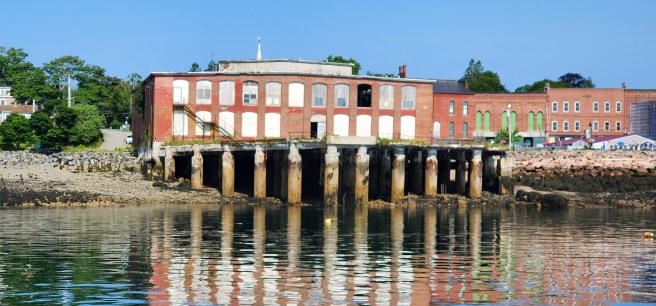 The legs of the former American Can Company factory on the Eastport waterfront are revealed at low tide if you’re out on the water. To see what’s behind them, go to my photo album, Can Factory Caverns, at
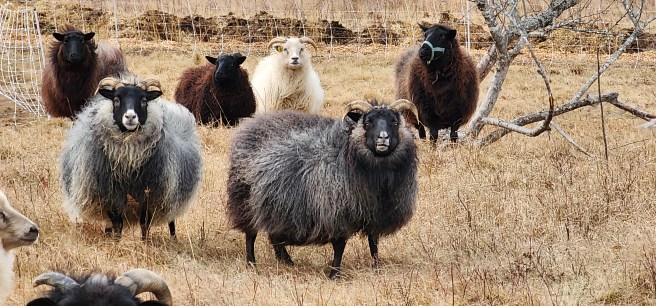 It’s a striking breed, seldom seen outside Scotland.
