MYSTERY SOLVED?

While Dover Friends (Quakers) proclaim that we worship in our third meetinghouse, erected in 1768, our history of the previous two structures becomes a bit foggy. Even so, ours is the oldest house of worship in use in the city.

In his authoritative New England Quaker Meetinghouses (Friends United Press, 2001), Silas Weeks mentions that our first house of worship was built about 1680 on Dover Neck, just south of the present St. Thomas Aquinas High School. Correcting an earlier version of the relocation of the structure to Maine, he writes that in 1769 “the 1680 house from Dover Neck was taken apart and re-erected in Eliot at the corner of what are now State and River Roads. There is a bronze plaque marking the site …” (Alas, there goes the tale of its being skidded by oxen across a frozen Piscataqua River. Taken apart and put on a boat now seems more likely.)

Apparently, when our current house was built, we had no need for the smaller structure. I suspect that until our current meetinghouse was available, Dover Friends met for worship in the two smaller structures and gathered together for business sessions.

The disposition of the second house, though, had eluded his investigation. It had stood at what Silas “believed to be the present corner of Locust and Silver Streets,” but there was no indication it had been incorporated in later buildings on the site.

A publication from the Dover Chamber of Commerce, however, may have the answer. Dover’s Heritage Trails, a guide to historic walking tours through the city, notes this at 3-5 Spring Street: “This old dwelling was Dover’s second Quaker Meeting House, built originally at the corner of Silver and Locust Streets and moved to this location in 1728, before Spring Street existed.”

Silas reported “The second was erected in 1712 on land belonging to Ebenezer Varney. The deed, transferred to Friends in 1735, described the site …” in ways that support the Silver and Locust location. My guess is that the structure was moved in 1828, since the Chamber pamphlet mentions that neighboring houses were built in 1810 and 1811.
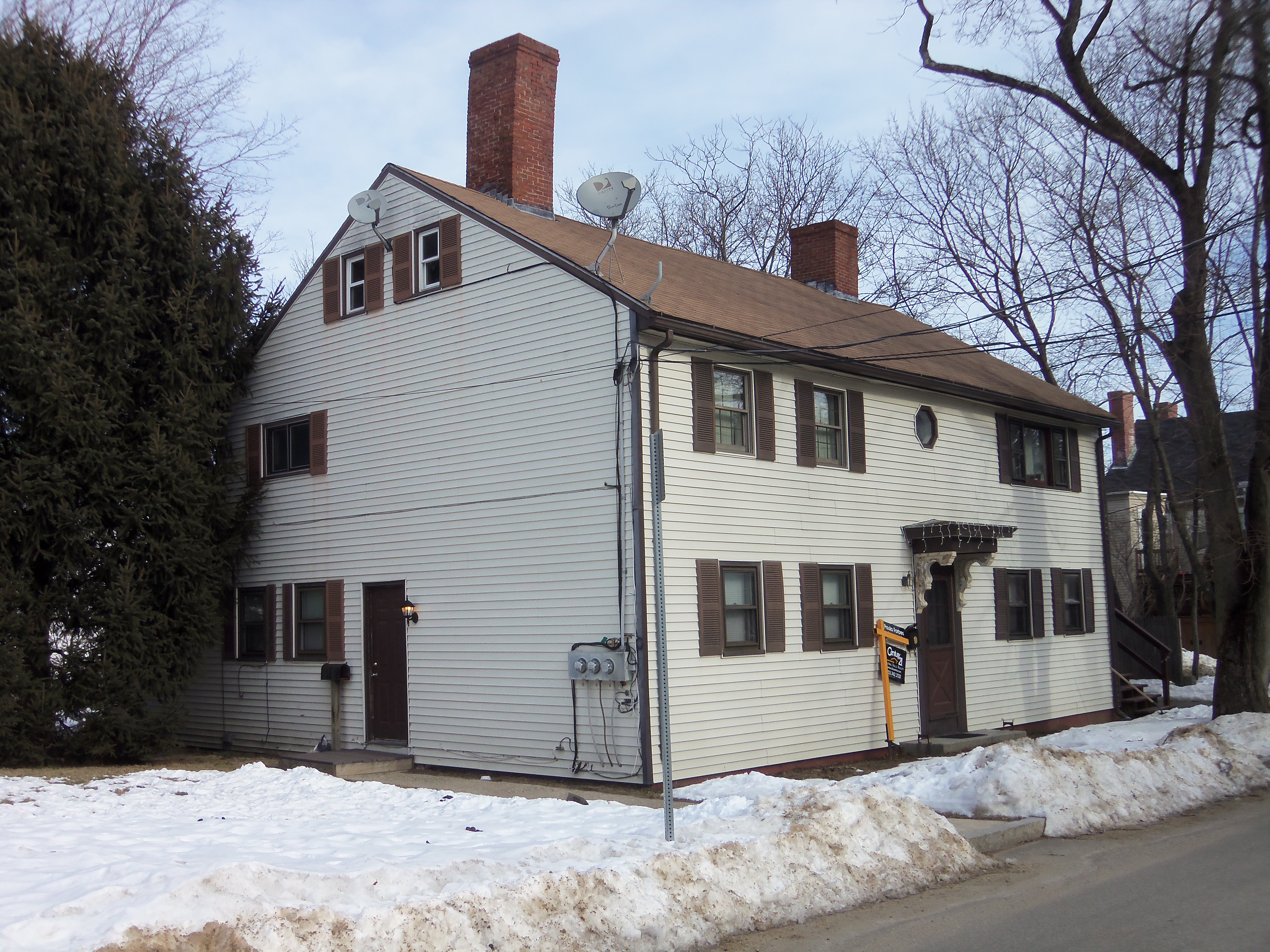
The building has no doubt changed a lot, inside and out, since it was erected three centuries ago -- including the addition of chimneys. But the shape is right for a Friends meetinghouse.
The building has no doubt changed a lot, inside and out, since it was erected three centuries ago — including the addition of chimneys. But the shape is right for a Friends meetinghouse.

As they say, the plot thickens. And to think, the answer to our search may wind up just a bit more than a block up the street from where we gather.

LION’S TOOTH SALAD

Maybe it was simply a day of firsts.

As I was lunching al fresco for the first time this year, having savored our first asparagus of the season (which I’d sautéed with minced garlic leaf in olive oil and then fried two eggs atop the mixture), I realized I was still hungry. So glancing up, I noticed a sprout of dandelion, got up, plucked a leaf, brought it to the table, wiped it in some of the remaining egg yolk, and … it was good. It was very good. Somehow, the yolk overcame whatever bitterness I expected at the end of the bite.

So I harvested the remainder of that cluster (which also doubled as weeding, let’s be candid), went indoors to rinse it and fry another egg to serve with it, covered the resulting salad with salt and coarse-ground fresh pepper … and it was still good. Very good.

So for dinner, another round, this time with a fresh mustard vinaigrette my wife had just made … and it was still good. Very good.

Maybe I’m hooked. Yes, we’ve read some fine food writers who’ve extolled their pleasure in fresh dandelion every spring, before the leaves turn too bitter and too tough. Until now, though, our dandelions were treasured only by our pet rabbits.

Not anymore. Another first.

Now, to see how it works blanched. Or maybe as a spinach substitute, say in a Florentine-style dish.

Not that I have any intention of turning the Red Barn into a food blog. Oh, no. I know my limitations.

ROSES AND THORNS

In any relationship, it is difficult enough to know one’s own actions and thoughts completely or accurately, much less the other’s. Misunderstandings are inevitable – “You promised,” “I never said that,” “Why didn’t you phone?” “I did what?”

The gaps become especially obvious during a breakup. Like a mirror that smashes to the floor, the image comes apart. Spider webs span gaps. The reflection distorts. Here, silences – the interstices of what is unseen or left unsaid – become as important as what is harshly trumped or cruelly enacted. Sometimes, it appears that figures previously hidden by the mirror itself now become visible; even motions that had been observed but dismissed return with ominous significance. Excuses no longer suffice.

Moreover, if one partner has been cheating, the mask itself now drops away. Some misunderstandings, it turns out, were intentional. “I know I said that, but I never meant it.” Stones, then, are finally thrown directly at the looking glass, and through it. A hammer is held in the fist.

“Do you love me?” becomes a meaningless question. Petals fall from long-stem roses given as an expression of passion. In the fractured mirror, even blossoms shatter.

And then there’s the personal complication. As Diane Wakoski of the Motorcycle Betrayal has observed: “I suppose part of my adult fascination with American adolescence is that I didn’t live one, except in very scattered ways. I was, all my life, trying to escape my … background. … Thus my lifelong snobbery about highbrow things.”

But there’s no escape, now, is there.

ALL HAIL THE DETERMINED GARDENER

Although I do my share of the weeding and much of the spading, I’m not the gardener. My wife is the one who studies the varieties of plants, selects and orders, fusses and sows, evaluates soil and sunlight, while I’m more likely to mow, do the composting, construct the raised beds, and transport ferns, Quaker ladies, and ox-eye daisies from the wild. In recent years, our elder daughter has taken delight in getting seedlings started and transplanted, especially, as well as making jams from the fruit we harvest. (The younger one could care less.)

While my dad, mainly, raised vegetables and tomatoes behind the garage when I was growing up, and my mother fussed over flowers that generally failed, and despite my later experiences living on a hippie farm and then the ashram as well as my first wife’s efforts in Ohio, Indiana, and the fertile desert country of Washington state, my perspectives on gardening center on Rachel and her world. Everything before was simply preparation. Little did I suspect, when we set out to buy a house as part of our marriage, how much she was calculating garden opportunities; many of the urban New England properties, surprisingly, have little usable space for raising plants. Only after bidding successfully on the house we now inhabit did we learn that it included not just a small but manageable strip beside the driveway but a half-lot on the other side of the house, as well – the side we’ve come to call the swamp.

But that’s the beginning of another story.

PASSAGE INTO THE QUIET

From my earliest days of practicing meditation, I’ve been aware of an invisible wall of resistance or restlessness before passing into the comforting depth on the other side. For whatever reasons, it reminds me of those early experiences of a sonic boom, when planes overhead would “break through the sound barrier” – not that we sense a loud crack of arrival, but there is a distinct change all the same. Maybe it’s an awareness that the air in the room feels different – heavier, like water, is one description. Maybe it’s not that far removed from the ancient Jewish priests who “passed through the veil” to offer sacrifice in the most holy space in the Temple.

My actual experience of meditative worship has also changed, from the initial goal of getting naturally high or stoned – of transcending out of the world – to the present centering down into the essence of life, but the wall remains. Some weeks it’s more pronounced than others; other weeks it’s quite faint. Even so, coming to that point Bill Taber referred to as “soft eyes” worship, where Friends begin removing their eyeglasses, is delicious. Even the clock stops ticking.

Frequency of practice can make a difference. Sitting in meditation twice a day, for instance, generally allows a deeper session than an every-other-week or once-a-month schedule does. Suitable physical exercise, charitable activity, or spiritual reading may also guide the experience. We speak of preparing for worship, but rarely of the unspoken flow within the hour itself. What I do know is how much easier it is to pass through that barrier when I’m sitting with others. That is, as early Friends sensed, even when two or three gathered in the Name.

BECOMING A CHARACTER

Everyone where she was from said simply, “Oh, that Anna! She’s a character!” But they’d never say why.

I met her long after she’d moved east, and sensed in her a deep spiritual presence.

Still, when it came to opening her memorial service, I couldn’t refrain from mentioning her identity as a character. What emerged in the next hour was quite a lesson.

Afterward, as I drove home from New Jersey, I embraced this mandate: we have the first 40 years of our lives to get our act together – and the next 40 to become a character. If we can. If we’re worthy.

HOT DOG BUNS VERSUS FRANKFURTER ROLLS

Once upon a time, or so it seems now, a girlfriend sent me out with orders to come back with hot dog buns, which is what I did.

But when I handed her the grocery bag, she cried out, “Oh, no! What are these?”

“They’re hot dog buns,” I replied ever so naively.

“No they’re not!” she insisted.

“But they’re what I’ve always had hot dogs on,” and they were.

She would not believe me, so off we went, together, to the supermarket.

“These,” she said, “are hot dog buns.”

Asked to pick out a hot dog bun, which would you choose -- the ones sliced on the top, at left, or on the side, at right?
Asked to pick out a hot dog bun, which would you choose — the ones sliced on the top, at left, or on the side, at right?

They looked like a flattened loaf of bread cut in fat slices. The side of each “bun,” in fact, was without crust – naked, to my taste.

Pointing to another shelf, I looked at the kind I’d always known – the kind, that in fact, came labeled Hot Dog Buns. Hers, in contrast, were labeled Frankfurter Rolls.

Hmm, we both said without satisfaction.

She had, in truth, grown up in New England and lived nowhere else. And her idea of how to serve a hot dog was unique to the region. Not in something she considered a torpedo roll.

Ah, but the plot thickens. As I bought packages of each this time around, there was no Frankfurter label -- and the Hot Dog tag instead went on what my wife confirms are often called Frankfurter buns or rolls around here. As a further complication, we now have the term Coney Island, which confounds my elder daughter while bringing to my mind something completely different, a miniature hot dog where I grew up, often served covered with "chili." But that's a whole other story.
Ah, but the plot thickens. As I bought packages of each this time around, there was no Frankfurter label — and the Hot Dog tag instead went on what my wife confirms are often called Frankfurter buns or rolls around here. As a further complication, we now have the term Coney Island, which confounds my elder daughter while bringing to my mind something completely different, a miniature hot dog where I grew up, often served covered with “chili.” But that’s a whole other story.

This can, in turn, point to a lot of other regional distinctions. Whether you call a device a watercooler, a water fountain, or a bubbler, as we do here. Or whether you order a soda, a pop, or a cola. Feel free to expand the list. It can go on a long time.

Fast forward, then, to lunchtime at a national conference being held in Rhode Island. I sat down and joined a random group that included a handful of teens. One was from North Carolina. I pointed to the hot dog on his neighbor’s plate. He looked bewildered. “What’s it wrapped in?” he asked.

“Would you call it a hot dog bun?” I prompted.

“No way!”

“Oh yes it is,” said the girl from Connecticut. “It’s what we always use.”

You know where the conversation went from there. Yes it is, no it isn’t.

At least the college cafeteria knew to stock both Hot Dog Buns and Frankfurter Rolls.  As we all discovered.

Hmm. Maybe next time we have a crowd over and we’re grilling hot dogs, I’ll get packages of both – and then see which kind goes first.

WATERTOWN AND THE BOSTON MARATHON BOMBING

When I awoke this morning, my wife greeted me with the words, “You missed it last night; all hell broke loose.” I thought she was talking about her board meeting or maybe a big fire, but instead she told me that all of Watertown, Massachusetts, and several surrounding towns were locked down. And then she related the news of the Boston Marathon suspects, the subsequent shootings in Cambridge, the carjacking, the mad police chase down Mount Auburn Street, and all of the activity taking place around the Arsenal Mall.

The developments are still unfolding – and likely will continue to do so for days – and I won’t attempt to relate what’s being reported. What is difficult is trying to imagine the challenges of coping with the shutdown of a very active community. One I’ve been coming to know with some affection.

This year, my Thursdays have wound up in Watertown, where the Revels Singers rehearse for two hours each week in St. John United Methodist Church on Mount Auburn Street. The choir, ranging up to 80 voices, many of them very fine, is led by George Emlen in works from the Renaissance to the present spanning many nationalities and languages. Last night, for instance, we tackled Welsh and French-Canadian as well as English, and the musical experience was exhilarating. No, I’d never even dreamed of being part of such an ensemble.

Rather than getting stuck in rush-hour traffic, I try to arrive early enough to have dinner at one of the inexpensive but excellent restaurants a block or two down the street. (Don’t let looks deceive you: follow your nose instead.) Watertown is an older suburb of Boston, one with substantial houses typically on small lots, and has become a haven of many ethnic cultures. The church where we practice, for instance, also houses a Korean Methodist congregation. Buses pass by frequently, and pedestrians fill the sidewalks. In one block I pass the Greek kabob and gyro emporium I’ve come to habituate, an acclaimed Chinese storefront with tables and takeout (yes, some of it goes back with me to New Hampshire), a Japanese fusion eatery, an Iranian bakery, an Hispanic-focused grocery, several hair and nails salons, a cigar store or two. (I’d planned to make a list someday.)

Yesterday I even arrived in time to tour the Armenian Library and Museum of America,  which incidentally had free admission this week as an offering of a quiet public place for the community to heal from the tragedy on Monday. (The irony of the free admission now comes, of course, in the closing of the town itself.) As the center of Armenian culture in the New World, Watertown has much to say about genocide and suffering over the centuries.

I was still reflecting on that experience as I ate, until noticing the repeated images on the large-screen TV on the restaurant wall as it showed footage of the two suspects shortly before Monday’s bombings. A man at one table got up, pointed to something on the screen, and commented on a detail, which prompted discussion from other tables. People were paying attention.

From there it was on to rehearsal. A magnolia and the daffodils in front of the church were in full bloom. Spring was in the air. Even afterward, as we returned to the street, we wanted to linger.

Who could have anticipated the state of siege that would erupt a few hours later?

Down to Copley Square and the finish line

There’s something wonderfully small-town about Boston, despite all of its world-class amenities. For those of us who love professional sports, classical music, museums of all stripes, theater and ballet, lectures and the like, there’s far more to do than time will ever permit.

But the scale, especially with all of its smaller cities and towns clustered in close at hand, can be wonderfully human. Or think of Fenway, one of Major League Baseball’s smallest parks, and its oldest.

Nowhere have I seen this balance more acutely than in the Boston Marathon.

The first inkling I had was one April Monday when I was driving along 128, the semicircular freeway around the city. With all of its high-tech business headquarters, it’s often called Silicon Valley East. Approaching one overpass, I noticed the side of the highway was thick with (illegally) parked cars, almost as if there’d been an accident. But then I saw the overpass itself was crowded with people. Only when I turned on the radio for the every-10-minute traffic report did I discover this was where the race route crossed on the way toward Copley Square. The station, by the way, was almost exclusively marathon coverage.

Nor was it alone.

The city’s television stations also provided continuous coverage, from 9 a.m. or so at the start in Hopkinton through the awards at 5 p.m. on Copley Square in the Back Bay. Live cameras broadcast from trucks in front of the lead runners and wheelchair contestants, as well as reporters and cameras all along the 26-mile route. The technical planning and execution of such coverage must be incredible.

While the event has more than 20,000 registered participants and 500,000 spectators each year, you’re still likely to know someone or more who have run in it. In fact, if they’ve qualified, you can follow their progress and times online. That’s another incredible aspect, to my eyes. And then there are all of those who jump in afterward, no need to register — you just get to say you’ve run the marathon.

To share in that joy and community spirit combined with the determined efforts of each of the runners is inspiring, even before we add the outdoors release from New England’s long winter. This is what the evil scheming behind yesterday’s bombing targeted. If the perpetrators thought they were somehow reenacting the Shot Heard ‘Round the World that the Patriots’ Day event commemorates, they have it backwards. We celebrate the resolve and victory of the people over tyranny and fear.

While officials are remaining tight-lipped about what’s happened, we’re getting our news from those we know, even when we live more than an hour away from the action. We’re relieved to hear our daughter’s safe and that a friend crossed the finish line hours earlier, but we’re also troubled by the words coming second-hand from the emergency rooms. We’ll learn more in conversations in the weeks ahead. In the small-town character of Boston, these things hit home, one way or another.

With determination, then, here’s looking ahead to the 118th annual marathon running April 21, 2014, God willing.

Social status versus social value

You see the lists from time to time: America’s richest individuals or families.

You also see how proud people are about finding loopholes to cut their own taxes or lobbying for another advantage over the rest of the public.

Seems we’ve had it wrong. We should be according that respect to America’s top taxpayers. Yes, let them compete for the status of being the most generous Americans, the ones who step forward for their country. We could even break this out by occupation, for extra Top Ten lists. I’d even be in favor of having a monument in Washington inscribed with their names.

Let the rest of them be considered shirkers.