… my great-great-great-great-great-great-grandfather, George Hodgson, to confirm the pirate attack in crossing to America and learn the details, including the names of his parents and siblings and his relationship with Moses Harland, whom I presume to be his uncle.
In the world of visual art, crafts have a place

This time of the year gets her creative juices flowing. Not that she’s alone on that front.
Important people linked to the Gem City
In this case, they weren’t necessary born in Dayton, but the city did play a role in their success.
- Wright Brothers, inventors of the airplane
- Charles F. Kettering, prolific inventor
- John Henry Patterson, founder of the National Cash Register Company
- Thomas Watson Jr., of IBM fame after being fired – twice – by Patterson
- James Cox, Democratic presidential nominee and newspaper publisher
- Paul Lawrence Dunbar, Black poet
- Scotty Reston, editor of the New York Times
- Frank Stanton, head of Columbia Broadcasting Company (CBS)
- Milton Caniff, master cartoonist
- Mike Peters, freewheeling cartoonist
I should also mention Larry Flint, pornographer, who established Hustler magazine, named after his bar.
Bank Square alight

The Waco Diner’s looking quite festive. A nearly full moon adds to the effect.
Acid test novelist: Virginia Woolf (1882-1941)
Maybe I was intrigued by the title of the 1962 play, “Who’s Afraid of Virginia Woolf,” but when I finally got around to reading her, in the novel The Waves, it was epiphany. While I had heard of stream-of-thought writing, but what overwhelmed me was the utter beauty of the prose and its observations. What poured forth was a stream, period.
I do get caught up in style more than content. Perhaps that reflects much of my career as a copy editor having to clean up a news story on a tight deadline.
Still, returning to her is always refreshing.
Kinisi 239
get free any hour
Jib sails and rigging
clusters of sails
how do you know how to mix
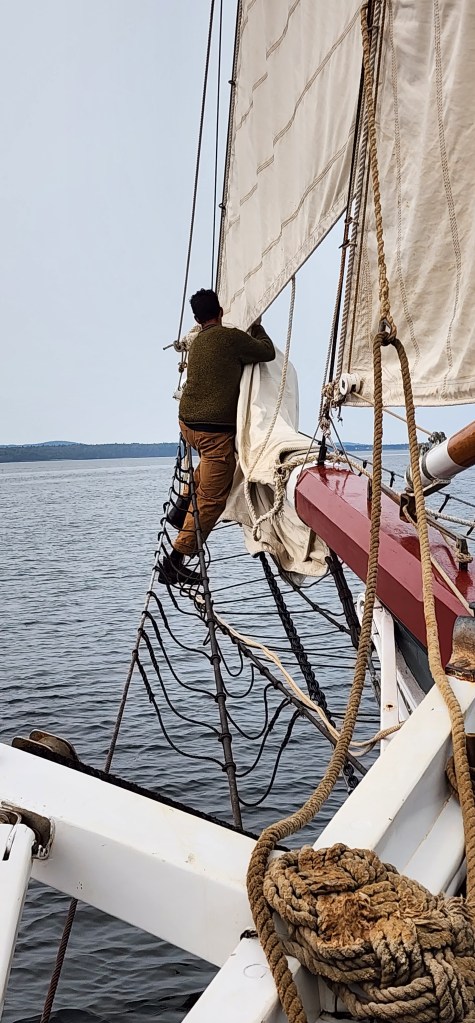
rolling waters as the pulse of the earth
a breathing
we ride
Stuck once again
Now that we had the history of our old house back a century-and-a-half, there was still a 20-year gap of getting from Lucy M. Hooper, Anne Dodge, and Mary Roberts, who were named in the 1875 deed transfer, and the Shackford Est of the 1855 Eastport map.
Which Shackford was the Est, presumably for Estate, in the 1855 map?
It was a prolific family in town at the time.
Shackford is a name existing as three places in Eastport: a cove just south of the downtown, a head of land occupied today by a state park, and a residential street.
Just who were they?
I was already working this line from the earliest materials and trying to see if I could connect someone to the material you’ve already seen.
The central question, remember, was how far back did this house go?
It was time to take Captain John Shackford senior seriously.
The matter of naming those characters
I’d love to hear other novelists and short story writers discuss their reasons for selecting the names they apply to the figures in their stories.
For that matter, I’d love to hear readers’ reactions. Like what’s your favorite connection there?
I’ve avoided using names of people I’ve known well. Surprisingly, it became a problem especially in my ashram novel where the best Sanskrit names had already been given to my fellow residents. Elsewhere, it eliminates a wide swath of common names, starting with John, James, Robert, Thomas, and William for males. Or Jack, Jimmy, Bobby, Tommy, and Billy, more colorfully.
Had I known they wouldn’t be reading my work anyway, maybe I should have used the names and left people guessing. I’ve tried to be gentle, though, and perhaps that’s a weakness.
Though I’m not one to apply nicknames in everyday life, I have found them useful in my fiction. As examples, I’ll offer “Big Pumpkin” and “Elvis” for the swami in Yoga Bootcamp.
~*~
There’s also the matter of which figures get named and which ones can pass through unnamed. We don’t want to tangle a reader, do we?
A major consideration in revising my output was an attempt to reduce the number of named characters. For a big book, like the five-generation span of What’s Left or the four-year college life of Daffodil Uprising or the burgeoning social life of Kenzie in Pit-a-Pat High Jinks, this was a challenge.
I did find myself shading Greek tradition in What’s Left: repetition of a name within a family is common but would have been utterly confusing here.
As an alternative, I tried to limit some to a single chapter, treating it like a short story; when it was done, so were they.
Behind the separation of powers
Should abuses creep into one part, they are reformed by those that remain sound.
James Madison in Federalist No. 43, citing Montesquieu
 Jnana's Red Barn