PRIMARY CAMPAIGN TRAIL NOTES

Last weekend, at our town’s annual Apple Harvest Day festival, as I passed the Democratic Party booth in the array along Central Avenue downtown, someone mentioned that Rick Santorum was in the crowd.

“I’m not sure I’d recognize him if I saw him,” I confessed. Not having a television does limit my awareness in some ways.

“Oh, you’d know him if you saw him. He’s taller than me,” my informant said.

As it turned out, I did catch glimpses of the former U.S. senator from Pennsylvania moving through pedestrian jam. It was his blue sports coat and khaki pants, mostly, that said GOP hopeful – or possibly, staff. Still, he was talking to an aide, rather than shaking hands and greeting potential voters. Could it be? What would I say? Or ask, pointedly? Besides, we were being carried along in opposite directions.

Later in the afternoon, at a booth where I was volunteering, I was given a business card at the end of a pleasurable bit of small talk. The next day, reading the news, I learned that this was Santorum’s host for the event. Little did I know that over breakfast just downstream, the candidate had received an earful from two Planned Parenthood supporters.

Maybe he’d had enough for the day?

~*~

As I’ve mentioned, our telephone’s been ringing with presidential primary campaign pitches. Some of them are robo-calls we promptly ignore. Talk to us in person, or else!

And then there are the surveys, sometimes several a day. Some of them are legitimately neutral, but others, well … let’s just say it’s quickly obvious who’s paying the bill.

Sometimes it’s a bit amusing, like the one from a first-time questioner working for the Carson camp. She stumbled through her script but had our sympathy. It’s how you learn the process, after all.

But then there was one that started asking if we were “strongly likely,” “somewhat likely,” “somewhat not likely,” or “strongly not likely” to vote for Trump, Carson, Bush, Kasich … and then suddenly turned to questions solely about Bush. Wait a minute! You claimed to be an independent research firm! What about the dozen or so other hopefuls on the GOP ticket?

At least this one wasn’t turning to a pitch for donations.

~*~

Considering the number of phone calls we’re getting from so-called opinion research outfits, I am concerned about the validity of the results. If a few people are getting the equivalent of “voting early and often” in the opinion sampling, what’s to preclude toying with the results? Why not say something that spins the outrage or anxiety? Why not boost a marginal candidate? Why not jump on a hot-air balloon for a short ride? Or try to deflate it?

More to the point: the only result I truly care about takes place in the election booth. Why can’t we concentrate on the issues until then, rather than the artificial horse race? (Or, in this case, elephant race, for the most part?)

MONET AT THE WINDOW

I’ve often joked (or was it boasted?) that we have the best stained glass windows in town. And not just at this time of year. Actually, there’s something basic in the Quaker practice of having clear windows, whether the view opens to the city jail next door or a busy highway or a placid burial ground – we’re not isolating ourselves from reality when we worship.

Sitting on the clerk’s bench one morning one May, I found myself looking out at a Monet. Well, the spring green for three-quarters of the hour fit the tones he used, until it turned metallic in the last quarter-hour when the sunlight turned harsh. Most weeks after that, I tried to identify which painter the view brought to mind – a sequence of Corot, Diebenkorn, Mitchell, Twombly, Klimt, Pollack, even the Zen painting of six persimmons (ours, however, had about twice that amount of fruit), and maybe a bit of Chagall or Hopper. (What was I saying about our Meeting not being blue-collar? Here I am, expecting most Dover Friends to know most of these artists!) Occasionally, even a Kaufmann, as Dick and Jane’s heads appeared in the lower corner while they walked up the ramp to the door. Sometimes the dogwood tree presented a flat image; other times it had holes, opening to the depth behind it; eventually, come winter, it was only sketches in front of a more distant landscape, and etchings, rather than paintings, came to mind. Expecting the Monet to return the next May, it didn’t, for whatever combination of reasons, although there was one week when it was adorned with pale stars – its flowers.

Not that any of this is essentially profound, other than as a recognition of the play of light – just as we encounter various presentations of Light within the room and ourselves through the hour. But I do consider ways our perceptions and expressions differ from the earliest Friends who sat in the room. These artists, for one thing, came after them, except for the 12th century persimmons (and those were off in China, anyway); the now familiar language from science or psychology, too, to say nothing of sports jargon and even military expressions. Did those Friends ever have a bagpiper playing at the edge of the yard, or some equivalent to our sirens on the street or music from a neighboring church? How did they see the world, in ways that we don’t? Somehow, all kinds of differing eras come together when we, too, sit together. So just how do we see each other through all of these seasons and ages?

~*~

This piece originally appeared in Types and Shadows, the newsletter of the Fellowship of Quaker Artists.

ONE MORE NOTABLE FAMILY

Boston's Back Bay is viewed from the stone tower in Mount Auburn Cemetery. The Fullers are buried nearby.
Boston’s Back Bay is viewed from the stone tower in Mount Auburn Cemetery. The Fullers are buried nearby.

Mount Auburn Cemetery, at the edge of Cambridge and Watertown in Greater Boston, not only lays claim to being the first garden cemetery in America but also boasts some of the most notable names in the nation’s history.

This small family plot, for instance, holds the remains of Transcendentalist leader Margaret Fuller and pioneering architect Buckminister Fuller.

100_2346
Margaret Fuller Ossoli’s inscription reads, in part: By birth a child of New England, By adoption a citizen of Rome, By genius belonging to the world.


100_2341


WHERE ARE THE CANDIDATES’ OFFICES?

In remarking about the failure of the presidential candidates to get out and do the ground-level face-to-face meet-and-greets that are the foundation of New Hampshire’s first-in-the-nation primary, I’ve failed to notice a conspicuous change in this particular campaign. I live in a county seat, one of ten in New Hampshire, and usually by this point in the campaign, we’d have prominent campaign headquarters downtown.

Not this time.

No, it finally dawned on me. Nada!

(Well, since drafting this, we got a phone call saying Hillary just opened an office here, just not downtown. Still, something’s akimbo.)

In fact the Republicans, who ought to be the most active in staking out territory, had only eight offices across New Hampshire by mid-September – all in Manchester, the largest city, an hour away from where I live. Much more from the further reaches of the state.

Contrast that to the Democrats: eight offices for Hillary Clinton alone, at the time, four for Bernie Sanders, and two for Martin O’Malley. Fourteen in all. And Joe Biden’s still waiting in the wings.

The local office is where a candidate’s organization offers literature and answers questions to passers-by, does its phone-banking, encourages supporters to meet, plans canvassing and visibility events. It’s where each candidate gains visibility – and credibility – every time a driver or pedestrian comes past.

Maybe the Republicans think advertising will fill the gap. It won’t. Each region of my adopted state is different. I’ll leave it at that.

I’ve also mentioned the lack of living room meetings and am surprised to see the only ones listed on the Republican side are all in Scott Brown’s Rye home – that is, the former U.S. Senator from Massachusetts. Hardly bread-and-butter invitations to the faithful, right?

AN ABOLITIONIST NEXUS

Coming upon Moses Brown Square in Newburyport, Massachusetts, one evening threw me for a loop. The plaque said this Moses, 1742-1827, was a prominent shipbuilder and merchant active in the slave trade. (Not to be confused with a Capt. Moses Brown, 1742-1802, a privateer – that is, a licensed pirate living nearby — also on the wrong side of my moral compass.)

The ringer, as I read, was that Newburyport, with all its wealth based on the rum, sugar, slave trade triangle, was hostile to abolitionists, and its Moses had soon become its wealthiest resident. So that was the funding for those glorious houses on High Street, not the whaling trade? I hadn’t suspect this turn.

What a contrast to the more famous Moses Brown (1738-1836), a Rhode Island Quaker convert who became both an avid abolitionist and a pioneer of the Industrial Revolution in America – himself quite wealthy and a founder of what’s now the prestigious Moses Brown School in Providence, adjacent to Brown University.

I’m guessing they were all cousins, given the naming patterns and wealth.

What further intrigues, though, is the other statue in the square, this one for William Lloyd Garrison, an abolitionist who was also from Newburyport. There you learn of the depths of the town’s virulent support of slavery and their collaboration with its institution.

Curiously, Garrison “the Great Liberator” found two important colleagues from upstream on the Merrimack River.

The first was John Greenleaf Whittier, the Quaker poet living in neighboring Amesbury, Massachusetts, kitty-corner upstream.

And the other was the journalist Horace Greeley, born in Amherst, New Hampshire, further upriver.

What I see in all this is a hint at the hot pockets, pro and con, on a contentious issue of the time – sometimes within a stretch of the map, sometimes with a family. Not that things are always any different today.

TOMBSTONE: THE PREMISE

One late October afternoon, after most of the foliage had fallen, Randy Kezar and I simultaneously looked up from our pathway and beheld a large red maple fully aflame in sunlight as we strolled through the burial ground behind our Quaker meetinghouse. It was the embodiment of the single detail that says everything, the flash of perfection; this individual tree expressed the season as much as all of the previous color change and shifting light we had savored in the previous weeks. “I suppose if we were Japanese, we’d sit down and write a haiku on the spot, in celebration,” he said. Later, I took up the challenge and came up with a few lines I hope come close:

Somehow each New England autumn
comes down to boughs in a graveyard

– a common of stone and bone –

But my provocation and observations kept ranging wider, invoking a calendar not just of the place across  a year but also the epochs that fill what went from a boneyard and burial ground to a Victorian cemetery to the present, as well.

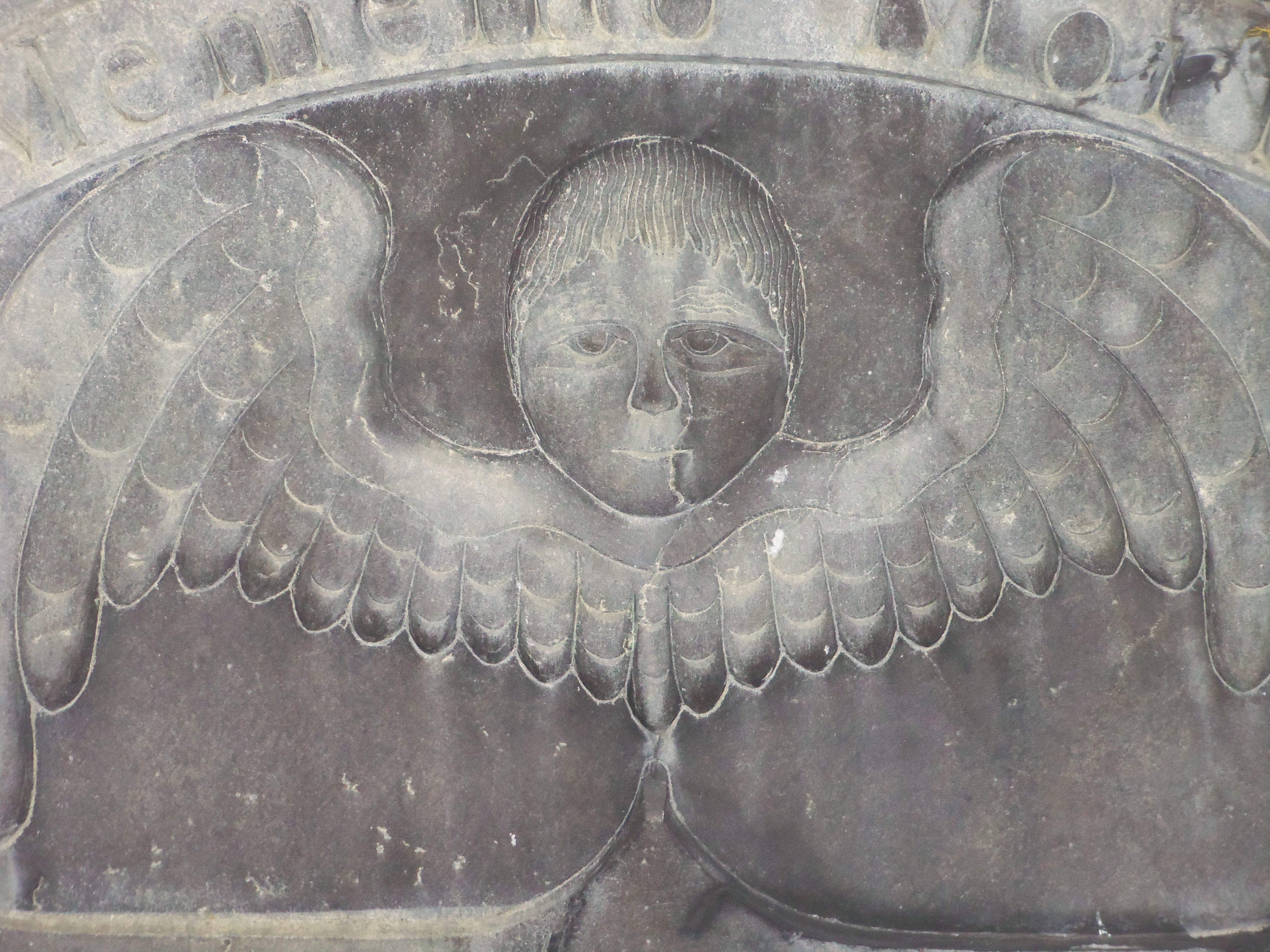
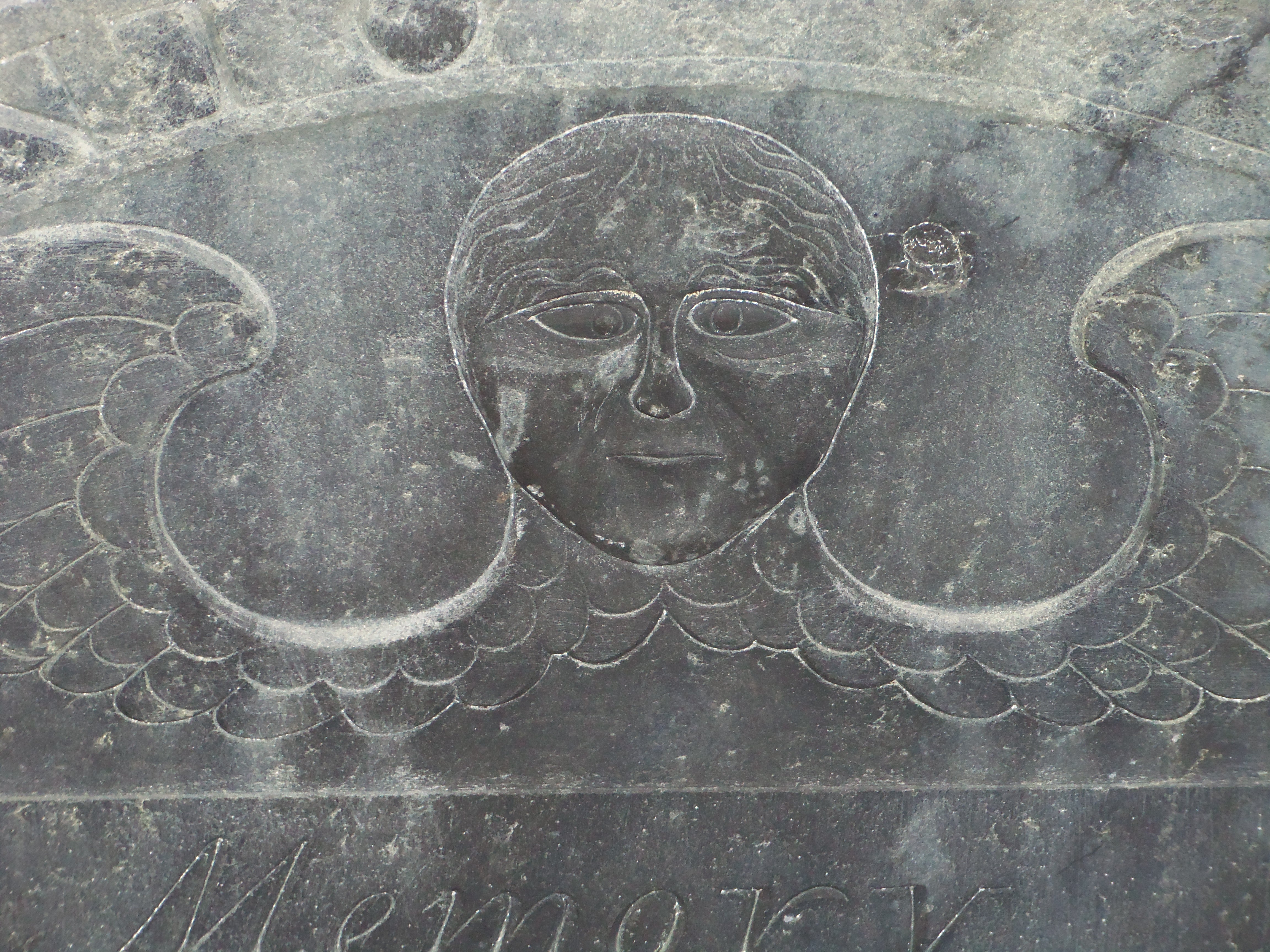
The winged death's head is a common gravestone motif in New England. This example is in Watertown, Massachusetts.
The winged death’s head is a common gravestone motif in New England. This example is in Watertown, Massachusetts.

The poems that resulted have one foot in Portsmouth and Dover, New Hampshire, and another in Portsmouth and Newport, Rhode Island, where I quote from the 1664 will of Alice Shotten Cowland and some of the activities of her son-in-law, Robert Hodgson – sometimes spelled Hodson, as well as Hutchin. (I detail what is known of their lives in my genealogy blog, The Orphan George Chronicles.) She was part of the early dissent against Puritan authority, first with Samuel Gorton and then as one of the first Quakers in the New World. I love Robert’s memorial minute, which calls him “an ancient traveler in the Truth.” He arrived in America on the historic voyage of  the tiny Woodhouse, causing turmoil in Manhattan and Long Island before heading on to Boston. As far as I can determine, he was no relation to my line, no matter how much many have tried to find the link.

~*~

Winged Death 1To see more, click here.

LOOKING AT THE GOP WHITE HOUSE HOPEFULS

Looking at the pack, I wonder how many voters can even say something about each of the names on the full slate. Even in simply determining each candidate’s state, as a starter, or the major offices he or she’s held.

That’s even before the question of finding some significant way one stands out from the rest.

I’m even asking if they’d make a decent Cabinet, put together.

Here’s hoping things start to get lively. Let us see who they are. Really are.

ABANDONED MILLWORKS AND REDEVELOPMENT

In many communities across the Northeast, the once neglected mills along the running waters have found new life as commercial real estate. Often, high-tech firms and other startups find them to be flexible incubators. Other times, floors are occupied by stylish residential condos or office suites.

The small city where I live proves that, three decades after the boarded up windows were once again open the light and the spaces within refurbished. The new tenants were the key to a revitalized downtown, especially.

Before relocating to New Hampshire, though, I envisioned something similar while drafting my novel, Big Inca Versus a New Pony Express Rider. Actually, I had no idea that was about the same time the mills were being restored one by one by developers like Joseph Sawtelle. Not that he was anything like Bill’s mysterious Boss.

Oh, how I love the mills – even before we get to the intrigue in my novel.

Inca 1