Do I miss the goddess Caffeina?

Mugs of coffee laced with sugar and cream have accompanied me from high school on, especially while sitting at a desk writing or editing. Cutting back from my five or so big mugs a day did become an annual health goal, not that I ever pressed that hard. Working the night shift didn’t help, either.

Alas, since retiring from the newsroom, I’ve had to eliminate caffeine altogether from my diet. Doctor’s orders. My favorite drug of choice, it turns out, counteracts a daily medicine prescribed to me.

Here are a few related considerations.

  1. Tea may be the first caffeinated beverage, from 2737 B.C.E., according to one line of argument, but I’ve never found it satisfying. Sorry if you feel a need to object.
  2. Coffee beans are not really beans but the pit of a red or purple Coffea fruit. The leading producers are Brazil, Colombia, Vietnam, and Venuzuela.
  3. Was the first usage of coffee by an Ethiopian goat herder named Kaldi in 850 C.E. after he noticed his goats had extra energy after eating the fruits?
  4. Today an estimated 80 percent of the world’s population imbibes a caffeinated product daily – a number that rises to 90 percent of adults in North America.
  5. It’s also found in some soft drinks and in chocolate.
  6. Add to that cold, allergy, pain, and weight-control medications.
  7. One study found that two to three cups of caffeine coffee linked to a 45 percent drop in suicides.
  8. Significant daily consumption of caffeine in coffee or tea may also greatly reduce the likelihood of Alzheimer’s and Parkinson’s diseases. Other health benefits are reported.
  9. The United States is the leading consumer of coffee. I doubt, though, that we can blame that on the Boston Tea Party, which was a tax protest.
  10. Decaf does contain a residual amount of caffeine. Not enough, apparently, to keep me awake.

It’s not like I’m suffering, though. I must say I’ve found some good decafs for my morning ritual, sometimes abetted by French chicory. Still, there are some dull days I would really like that jolt of bitter stimulant to the nervous system.

How relative is time, anyway?

Let’s consider fourth place, as far as length in time. That is, realizing that I’ve been dwelling in Eastport four years now strikes me as a bit of a shock. I’m finding it difficult to make sense of the fact, at least in light of earlier landings.

Quite simply, I’m still settling in here, even if it’s in my so-called sunset years. And, yes, I’m still feeling this is it, a very suitable end of my road, even if I am being greeted by name by people I don’t recall knowing, this is in sharp contrast to earlier locales.

For perspective, those shorter spans were in my early adulthood: Bloomington, Indiana (four years in two parts); Binghamton, New York (1½ years, in two parts and three addresses); the Poconos of Pennsylvania (1½ years); the town in northwest Ohio I call Prairie Depot (1½ years); Yakima, Washington (four years); a Mississippi River landing in Iowa (six months); Rust Belt in the northeast corner of Ohio (3½ years); and Baltimore, my big-city turn and turning point (three years). You’ve likely met many of them in my novels and poems.

Looking back, each of those addresses was filled with challenging turmoil and discovery, soul-searching yearning as well as glimmers of something more concrete and fulfilling just ahead.

In contrast, my longest period of living anywhere was Dover, New Hampshire (21 years), my native Dayton, Ohio (20 years), and Manchester, New Hampshire (13 years).

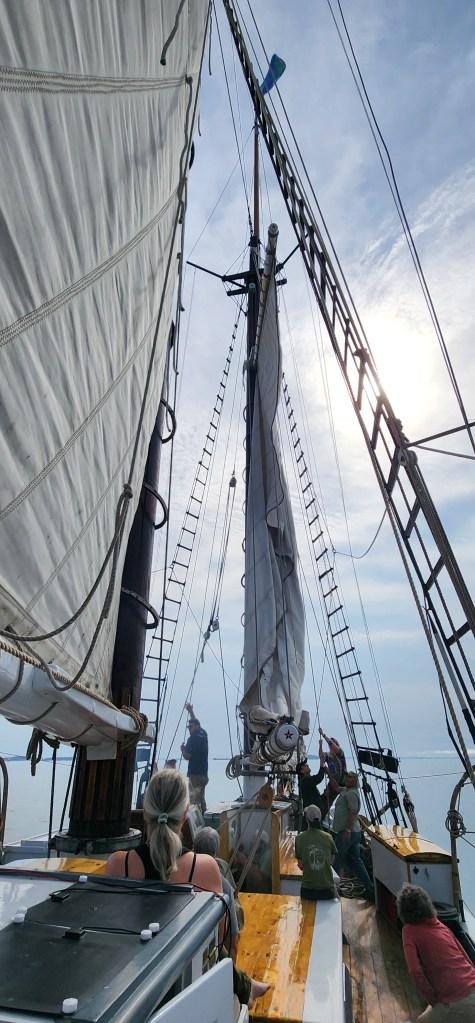
Another taste of the shipmaster role

Among the many vessels in Eastport by the 1820s, according to historian Jonathan D. Weston, John Shackford senior was one of possibly two residents owning ships of “suitable size and equipment to perform voyages at a distance.”

Captain John’s schooner was the Delesdernier, named after an Eastport family owning the tract just south of his own.

Lewis Frederick Delesdernier was the town’s first customs officer, in fact, and Weston’s grandfather. Note the “D” for the middle name.

Was the naming of the ship an inside joke? I’ll take it that way. He may have also been an investor in shares, another common practice.

The remaining ships of note in Eastport, incidentally, were “owned by inhabitants of other parts of the country.”

All of it, of course, has relevance on the house we bought.

For better or for verse, here are more lodes I’ve also mined  

By the standards of many, I’ve been a prolific poet, though if you consider that just one new poem a week would come to more than three thousand now.

Sounds about right, even with the arduous revisions they underwent, pressing the original inspiration into something quite different, always in an “experimental” rather than traditional vein. Add in all the hours of submitting the results to journals and small press openings, and all the rejection slips that followed, it was an obsessive amount of time – I had been warned that even “successful” poets averaged 20 rejections for every published poem. And beyond that, simply preparing a “clean” page for those submissions back in the days of typewriters pressed the limits of patience.

Still, poetry could be done in shorter spurts than fiction in my free days and nights while I was engaged working fulltime in a newsroom. As a minus, it did divert my attention from the local news scene and related gossip, but it did sharpen my editing and writing skills, both of which chafed at the limitations of newspaper style.

Many of my early poems sprang from my journals, something that changed over the years, especially as I got into Deep Image and related techniques. While more than a thousand of my poems were published in journals around the globe, book-length collections remained elusive. Now, however, some are available as ebooks, allowing you a chance to sample my evolution over six decades.

Here’s a lineup:

American Olympus: This longpoem is also a mythopoem set in a single week of camping on the Olympic Peninsula of Washington state. The book came close to being published by a prestigious letterpress imprint but fate intervened, sending me spiraling back eastward. Many other nature and landscape poems reflecting my experiences from one end of the continent to the other and back in my early adult years await full collection. Please stay tuned for future appearances of those works.

The volume has a new cover, one that’s a departure from my usual design style. I do find the leap rather exciting, and suitably unconventional.

Braided Double-Cross: Intense attraction, sexual ecstasy, and long-term dreams ignite this set of contemporary American love sonnets that reflect the conflicting emotions and unspoken expectations that surface in the eruption of breakdown and breakup. The set, my first run of poems composed as a series, explores passions that sugarcoat realities and betrayals. Sometimes something so truly hot leaves a lover branded for life.

Blue Rock: Continuing in the conflicted passions line, these poems reflect attraction, romance, and the aftermath in today’s society. Just groove to their beat.

Trumpet of the Coming Storm: Admittedly polemic, these are brimming with buried anger erupting at last. Sometimes you just can’t ignore politics, even in a historical perspective.

Hamlet, a Village of Gargoyles: This playful investigation of human identities alternates between gossipy and confessional, set within the context of close community. The collection now hits me as somehow prescient, considering that I’m now living in a real village with characters I hadn’t considered. The tone is contemporary with nods to Shakespeare and Chaucer.

Ebook formatting does limit the visual array of what you would otherwise find on a defined page of paper, but it does make my daring work available inexpensively around the world. I can live with that and so can you, especially if you’re reading on a smart phone.

I promise, there will be more.

You can find these in the digital platform of your choice at Smashwords, the Apple Store, Barnes & Noble’s Nook, Scribd, Sony’s Kobo, and other fine ebook retailers. Or you can ask your local library to obtain them.

About neighboring Campobello Island

It’s less than two miles away from our house. We even see it from our upstairs windows. But it’s in New Brunswick, Canada, and we’re in Maine, USA, separated by some serious ocean currents. As I proclaim when fog kicks and obliterates that view, “We lost Canada again.”

Before the border restrictions that resulted from 9/11 in 2001, visitation both ways was common. Just hop in a boat and land over there or over here. Families, employment, and shopping often spread across both sides of the border. At least one previous owner of our house was born on Campobello, a long time before Covid really shut things down.

Here are some details.

  1. The international bridge to Lubec, Maine, is Campobello’s only direct route to the mainland. Tiny Lubec then serves as their closest retail center. You need a passport to go either way. Before the bridge opened in 1962, much of the traffic went by ferry connecting to Eastport, Maine.
  2. The island is 8.7 miles long and 3.1 wide, covers 15.3 square miles, and has a population of 949. Half of the island runs along the spectacular Bay of Fundy. In fact, it’s the second-largest of the Fundy Islands.
  3. The island has one school, which serves all grades.
  4. At the end of the 1800s, the island became a summer resort colony for wealthy Canadian and Americans, including the parents of Franklin Delano Roosevelt. At their summer home, the future president learned to sail and explored the wild and, later, as an adult, tragically contracted polio. For Eleanor, the cottage was her favorite place to be, and she returned often, usually through Eastport. Today the residences are the core of Roosevelt Campobello International Park, with tours and programs administered jointly by Canadian and U.S. authorities.
  5. Combining its 2,800-acre natural preserve with an adjacent provincial park, the attraction extends to pristine cobble beaches, trails for hiking and cycling, breathtaking panoramas, rocky headlands, and several garden-like Arctic sphagnum moss peat bogs, one with an extensive interpretive boardwalk. The interior roads are, by the way, unpaved.
  6. Also within the park is Friar’s Head and its related trails, one down to a beach. On the Maine-facing side of the island, its views present the lower stretch of Passamaquoddy Bay and the beginning of Cobscook Bay. The highland sits above a landmark monolith outcropping dubbed the Old Friar for a presumed resemblance that has apparently faded, in part due to artillery practice from nearby crews in time of war. The waterway between Campobello and Eastport is known as Friar’s Road. (Now you know.)
  7. A small car-and-truck ferry connects Campobello and one end of Deer Island; from the other end, a second ferry runs to mainland New Brunswick.
  8. Campobello’s mail delivery comes through the U.S. There have been controversies over U.S. Border Patrol searches of the posts.
  9. Harbour Head Light, first built in 1829, is perhaps the most photographed lighthouse in Canada. Pedestrians who wish to climb to its beacon room can visit it only at low tide, but it is visible from other points.
  10. The island shelters us from heavy surf of the open Atlantic in Fundy Bay, as well as its fierce storm winds.
The Old Friar stands above the tide at the Roosevelt Campobello International Park in Canada.


Suicides along my trail

I’m reflecting on the list – a best friend ever, a lover who was more passionate about me than I was of her, a woman I dated once and then backed off, the leading anthrax researcher who stayed with us for a weekend or week, the PhD naturalist from my high school (and brother of my first real girlfriend), even my ex- fiancée’s scarred wrists. Add to that the LSD physicist attending our Quaker Meeting or the French-Canadian Catholic up the road in Gonic, and the list of suicides along my life pathway has more examples than I would have expected even without getting into the many people I’ve known along the way but who vanished after.

It’s a dark side that’s usually overlooked but probably more common than anyone admits.

More and more my curiosity involves the question of life itself rather than matters after death.

I’m taking one mystery at a time, as it happens.