As the first-in-the-nation presidential primary comes to a head here in New Hampshire, I keep reflecting on Donald Trump’s “business” as a casino owner. The gaming industry is, after all, a con game. And it’s based on taking money from losers. (I’ll spare you the religious and ethical and personal finance reasons for avoiding gambling, this round.) The fact remains that when it comes to lotteries and casinos, losers far outweigh winners. If it only stopped there …
Listen to the interviews from the folks flocking to his rallies, though, and you’re likely to apply the “losers” label to them, too — not that I’m blaming the general economy on them, they’re just hurting from its consequences. No, Bernie Sanders has been telling that reality like it is — take aim at the hedge-fund operators, not illegal workers, if you’re looking for a source of trouble. I share their sense of desperation, but I believe it can also be channeled into meaningful change. (I’ll spare you the economics lesson, at the moment.)
Now that the Iowa caucuses are in, another factoid keeps bouncing around in my head. Jeb Bush spent $2,800 for every vote he received there. And he dares claim he can control government spending? How many retirees are living on less in a month? More than he’d ever guess. For that matter, it’s more than the monthly earnings of a full-time worker if Bernie manages to raise the minimum wage to $15 an hour. Think about that! Jeb says America can’t afford it! Given to non-profits, that money could have made a big difference in individuals’ lives. Think of children who could use dental work or homeless veterans. Well, somebody’s taking the dough to produce the attacks that arrive daily in our mail or the commercials filling the airwaves. Just how much is Jeb going to ramp up his spending as he gets desperate?
Traditionally, the value of the New Hampshire primary has been that it gives candidates who don’t have huge bankrolls and opportunity to be heard and considered. I’m hoping that function comes to the rescue once again. We’ll know it a week. In the meantime, things here are likely to be quite the whirlwind, even with all that big money.
No matter how trippy the narrative, With a passing freight train of 119 cars and twin cabooses is sounding more realistic than some of the political candidates.
Some of the profiles in circulation are concluding that Donald Trump is skilled not as a negotiator, despite his claims, but in his ability to read an individual or entire audience he’s addressing – and then tune his presentation to their psyche and cater to their dreams.
That has me seeing Trump as a chameleon. Just look at how easily he changes colors to match the environment.
In many of his big deals, he may have gotten his way – but the financial consequences have often been disastrous. Plaza Hotel, anyone?
Joe McQuaid, publisher of the New Hampshire Union Leader, caught that in the headline to his front-page editorial yesterday: “Con man Trump.”
He then sees another twist: “Nothing he says or does will bother his most committed followers. But if they thought about it, they might realize that Trump is insulting them just as he insults everyone else.” As for the anti-politician role? “Trump is as slick and oily a pol as any we have seen. But when he doesn’t get his way, as with [last night’s] TV debate, he reveals the real Trump.
“He is a schoolyard, rich-kid bully who thinks he can push around networks, newspapers, and opponents while conning voters at the same time. We have seen that con before …”
So, we put the two impressions and what do we get? A con-meleon?
Decades ago, after hearing mention that my family had Quaker roots in North Carolina, I began the genealogical detective work that now fills my Orphan George Chronicles. Although I’d independently come to the Society of Friends and become a formal member, I was surprised to hear that my family had been Quaker and that there were Quakers in North Carolina – my, have my eyes been opened!
In the genealogical work, I chose to begin with my great-grandparents – people I’d never met in the flesh.
But when my father died, the focus shifted. I realized only one person remained who might be able to fill me in on questions of his childhood and parents, and that was his “baby sister.” That would mean getting to know her – and her parents – without all of the filters that had always been applied by my mother, who had issues of her own. (Oh, for these family dynamics!)
It became a rich and fascinating project, given all the more incentive when we met my aunt and her husband, a retired university dean, at the airport. It was a first-time encounter for them and my brood, yet he swept up my younger one in his arms and proclaimed, “It’s so good to have another Democrat in the Hodson family!” The party activist suddenly had a favorite uncle. Make it great-uncle-by-marriage if you will, he got the crown.
At that point, my aunt remarked that Grandpa’s slogan, painted on all of his trucks and on the calendars he mailed out each year, was “Dayton’s Leading Republican Plumber.” She promised to send a photo of the vans all lined up on the street. “You didn’t know that? It was even on his stationery and bills.” This was something I’d never known, although he did sign one of his last notes to me as “formerly Dayton’s leading Republican plumber,” a comment that long puzzled me. Through much of the spring and summer I wound up following up on her reactions and insights to her childhood and adolescence, which to my surprise (the word of the day) paralleled my own, especially in regards to their now-Methodist church, the denomination I grew up in. At last, I could finally look directly at my grandparents through all the memories and scattered bits of data I could assemble, as well as all the material I already had, doing genealogy. It was like being given a key, at last.
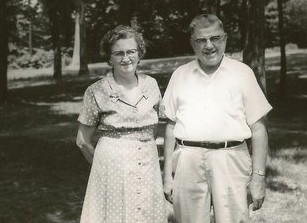
Grandma and Grandpa at family reunion
My aunt suggested I correspond with a surviving first-cousin Dad’s age, who wound up also contributing memories, and the result was a remarkable project, not quite memoir but more a realization of finally knowing my grandparents, pro and con, for the first time – years after their deaths – as well as questioning many of our ingrained expectations: just what are grandparents supposed to be, do, or look like, for instance. Unexpectedly, I reconnected to more feelings/memories from their house on McOwen Street than to the house I grew up in on Oakdale Avenue. Some of the stories that turned up, like my dad’s desire to be a sports writer or a big chicken dinner Grandpa arranged to help pay medical bills for one of Mom’s best friends, are priceless. From an intellectual perspective, the project also illuminates the difficulty of knowing – it often meant triangulating something in the middle of three often contradictory sets of perceptions. More importantly, to some extent, I’ve finally been able to reconnect with more than a few fragments of my childhood.
From my end, there’s little I’d say was happy in all of that childhood. But there are things I can finally claim and appreciate, and even rework or rewire. Much of my adult life, as I’ve found in Dad’s genealogy (Mom’s is entirely different, and far more gothic than she ever would have admitted) has been a matter of reclaiming many of the values and practices Grandma and Grandpa rejected in their move to the up-and-coming industrial city. I never knew that my Hodson ancestors were Quaker or that Grandma’s were Dunker (Church of the Brethren), very close to Amish and oh-so Pennsylvania Dutch. But they rejected all that, with some values somehow surviving, however invisibly.
Some discoveries still amaze me. The fact that Grandpa accomplished all he did with nothing more than a grade-school education, for one thing.
Or that his two best friends in adulthood were both a decade older than himself, and both died within a year – one of ALS, the other in a car collision. Since he was the youngest of three sons, I wonder about the dynamics.
There’s much, much more I’ve uncovered along the way. As you can guess, it’s a long story. Today would have been his birthday.
Today’s mail delivered six big political campaign cards of the kind I’ve previously described — the stiff ones that are at least eight-and-a-half by eleven, although one was closer to nine by fourteen inches.
In a switch, only one is funded by Jeb Bush’s deeply bankrolled Right to Rise USA super PAC, and that’s an attack on both John Kasich and Marco Rubio. (You’re surprised I’ve come to the conclusion Jeb’s really in Donald Trump’s camp. Why else would you ignore the front runner?)
Rubio’s Conservative Solutions super PAC, meanwhile, rushes forth with a “Don’t trust Ted” assault on Cruz. Which has me wondering why Rubio, like Bush, is afraid to go after the Donald. Has this really devolved into a race for vice president? If it has, we can safely assume none of the GOP candidates in the race has a chance for either spot on the national ticket.
Meanwhile, Chris Christie is fighting back with a claim he’s “vetoed more tax hikes than any other governor in modern American history” and four talking points in his favor.
And I’m perplexed by two we got from America Needs Leadership, which opposes amnesty for illegal immigrants. No idea who’s funding it, but it’s clear its backers oppose President Obama. The fact the fliers quote the Moonie right-wing Washington Times says volumes.
Only one of the mailings takes aim at Trump — along with the rest of his GOP field — and that’s Hillary Clinton’s “They would all defund Planned Parenthood.” It’s not the first time we’ve seen her go after the Donald. Is it true that it takes a woman to do a man’s job, or whatever the joke is? I’m wondering.
What’s happening in our household is that as the campaigns and surveys keep calling us to see where we stand, I’m examining their campaign mailings for something similar. Do you have a plan you’re willing to stand behind or are you out and out negative? We already have too many right-wing politicians who haven’t done anything positive to speak of. You can decide not to spend anything, after all, and let the house fall apart or have the family go hungry. I wouldn’t brag about that, and apparently neither are they.
From the Republican side, the only one I’m seeing toeing a positive course is John Kasich, and his mailings are smaller in format and more modest. I like that. In fact, that’s truly conservative. The only one? I’m beginning to think so.
On the Democratic side, the tone’s altogether positive. For all of the Ronald Reagan shadow, if you’re looking for fresh ideas, look there.
And we still have a bit under two weeks to the primary election. Things are beginning to heat up in New Hampshire.
One place where the Bush family might claim a legacy in American politics is in its reliance on casting an opponent in a negative light rather than advancing what one member called “the vision thing.” Not just a rival’s record, either, but spouses and children have been targeted as well. Just ask John McCain about the gossip spread in South Carolina back in 2000.
So here we are, 16 years later with another Bush in the running and our mailbox keeps getting attacks on his GOP opponents, most of them funded by his Right to Rise USA super PAC. Well, in one flyer, it was just three of them – Donald Trump somehow keeps going unnoticed. In the flyer, a photo shows Gov. Chris Christie from behind, to emphasize his obesity – while conversing closely with President Obama, a touch intended to inflame the hate-Obama core of the Republican base. It’s rather heavy-handed, actually.
The brochure does try to say something positive about its candidate: JEB, Tough, Tested, Ready. As we watch him in action, though, we have reason to doubt anyone in the field sees him that way.
As I view the waves of negativity, I keep thinking of individuals who are fountains of gossip – mostly dirty stuff, or at least juicy. Not what you’d want to hear about yourself. But then, when you mention this person to a mutual acquaintance, the response is something along the lines of “You should hear what they say about you.”
And that’s how I’m feeling about Jeb. Just what is he saying about US, behind our backs? Or worse yet, what would he do?
The negative approach just doesn’t build trust, does it?



 Jnana's Red Barn