I remember when he had a Willy’s Jeep
cool, like a square dance
You never know what we'll churn up in cleaning a stall
I remember when he had a Willy’s Jeep
cool, like a square dance

Pleasure boats are everywhere in Camden Harbor at the height of summer. It’s iconic Maine, after all. This detail was noted aboard the historic schooner Louis R. French last summer as we set out for five days of prime sailing.
For more schooner sailing experiences, take a look at my Under Sail photo album at Thistle Finch editions.
People looked skeptical when they heard that we were living in the house during all of the renovation.
It’s not like our budget had enough of an edge for us to lease quarters elsewhere. Were we just more daring or more tolerant than others?
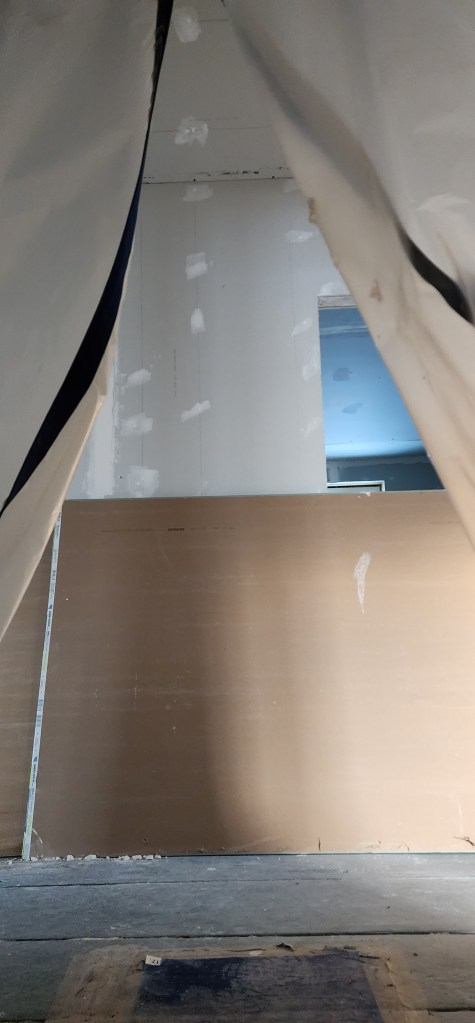
A key to the project turned out to be the translucent plastic “door” created at the top of the stairwell at the beginning of the work, the one with the zipper. It reduced the amount of dust that escaped from the construction and also kept much of our heat down on the first floor.
The sound of that zipper became a fact of life for us. All three zippers we had over the course of the project.
~*~
What awaited us on the other side of that veil went through a progression.
At first it faced a crowded set of shelves set in under the sloping roof, along with sliding doors to two makeshift closets and a narrow hallway running to each side.
After that came the demolition that revealed charred rafters and sheathing.
We briefly had a stretch of open sky followed by the raised roof and then the framing for the bathroom and laundry room.
What caught us by surprise, though, was the blank wall when the sheetrock went up. The stairs didn’t lead straight to another door. What would we put there? A large painting? A bookcase? A settee?
One of the coconspirators in our planning insisted on having a wide hallway, or perhaps more accurately, a landing – 6-by-16 feet, it turns out – conjoining the doors for the four bedrooms, the bathroom, and the laundry room. As a practical matter, this would make moving large items much easier, but aesthetically, the space feels wonderful, especially when we decided to keep the ceiling there running all the way to the crown of the house rather than having a low flat one.
No photo would get you a sense of that.
~*~
Somehow, Adam managed to keep the stairwell in place through all of the demolition and rebuilding. It did have that hand-cut oak lathing that predated 1830, for one thing, and the period molding.
For months, it stood like a dark ark at the center of all the action.
Once the new upstairs walls and details were in place, he turned to repairing the stressed stairwell walls and ceiling. One alteration we had envisioned was an interior window for natural light from the bedroom nook. Minor touch, but satisfying. Alas, one that was cut, in part for budget considerations.
We also gained storage space above in a kind of mini-attic accessed from a bedroom. It’s perfect for seasonal decorations that are needed just once a year. Easter, Halloween, Christmas, mostly.
~*~
As I had to confess by this point, the project was much more complicated than I had expected. I could now see why one contractor had just wanted to gut everything from the get-go, while another wanted to rip the top off and replace it with a gambrel roof. But I’m confident neither of those routes would have led to what’s emerged.
Assuming that you’re an active reader, let me ask where you’re obtaining your books of interest. With a thousand or more new novels every week, you can’t possibly keep up there. As for bookstores, there are only so many shelves. Ditto, public libraries.
Some of those stores and libraries do have sections where their employees recommend new volumes, and I applaud that, even while physical bookstores fight for survival.
Goodreads is another option, though also quite crowded.
For commercially released works, the New York Times reviews and a few other sites are key to the latest.
But my interest – and work – falls outside of that realm, and I do believe the real action takes place at the fringe.
Quite simply, I see opportunity for a dedicated reader – especially a recent graduate in literature – to set up shop online as an informed critic in a specific vein. What I’ve seen too often among the bloggers who review is gushing froth about stuff they like, akin to movie fanzines, rather than any critical detailing of why something soars above the pack or even why others fail. They don’t say what makes the piece they’re praising truly stand out.
The ideal I’ll acknowledge is the French film magazine Cahiers du Cinema, founded in 1951, which ran only pieces extolling new work of merit, rather than all new movies. It gave rise to a new wave of cinema, one based on daring directors rather than the film actors aka “stars.”
~*~
Real change originates at the fringe of society, not at the center. It typically develops in obscurity, sometimes flashing into widespread recognition and acceptance, and that’s been true in literature over the years.
Rarely will truly adventurous pages be found through the bestseller lists, but when one does break through, then everyone – writers, readers, publishers, and booksellers – will be in pursuit. Imitations will abound, as well as new labels and genres for marketing.
So how do you find fresh books and their writers, the kind who turn you on, fill you with a sense of discovery and make you want to tell everybody you know what they’re missing?
The history of novels is filled with instances of canon masterpieces that were rescued from oblivion by a single critic, either in a pivotal review or by sustained championship. And nothing beats word-of-mouth by a few fans.
So here we are, in a remarkable period of access for both readers and writers, thanks to digital advances. The problem is that there’s so much, there’s no way to keep up.
That’s where a few celebrity critics could step in.
~*~
Sometimes I regret writing novels that are “out there.”
It could be fun writing sharp reviews of many lousy books if I weren’t facing retaliation. (By idiots.)
Still, I feel it’s an opportunity well worth examining for an enterprising young English major graduate: sorting through the eruption of new writing and signaling what might be worthy of further examination.
By the way, online I usually don’t click the button on “pages” or “posts” that have more than 20 “likes.”
Like what is this, a popularity contest?
Still, on the receiving end, it is nice knowing that some folks are at least seeing this. Better yet is when you know that someone else “gets it.” Or, as I originally wrote, “Digs it.”
~*~
So back to the opening question, How are you finding the writing that excites you?
Are there any websites you would especially recommend?
Here’s your chance to give a shoutout.
The machine doesn’t know
fear
or love
or loyalty
or betrayal
or any of the gut-level
or off-the-cuff range of thinking and action
much less revolution
I’m coming to suspect that ambiguity
such as the simple “maybe”
will be the downfall of so-called
“artificial intelligence”
and its blatant plagiarism.
“Maybe” and related ambiguity may be the nemesis of AI.

Officially, Treat Island is part of the city of Eastport, Maine, and once had its own thriving fishing village, school, and post office.
Today, though, nobody lives there. Instead, it’s one of the many preservations of the state’s coastline now held by the Maine Coastal Heritage Trust.
At low tide, it’s connected by a rocky breakwater to Dudley Island, which is officially in the town of Lubec.
The only way to get there, do note, is by water.
To take a quick tour upon landing, including its 7,000 feet of shoreline at the mouth of Cobscook Bay, check out the free photo album at my Thistle Finch blog.
As a child, foggy mornings frightened me, and attempts to comfort me by calling them “fallen clouds” only thickened my anxiety. It was quite simply abnormal. Get me outa here!
Where I now live, I wouldn’t be surprised to see that we have more than a hundred foggy days a year. Many of those, it burns off early, but on others, we are caught in gray for what can extend for weeks. Maybe I need to start counting.
Still, as one Navy commander exclaimed, “You don’t have your share of fog. You have everyone’s!”
That said, let’s get more specific.
Wherever you are, look for the fog bow, too, like a rainbow within a cloud.
The thought hit me while scrolling through old posts on this blog.
Does anyone you know actually maintain a tightly focused life?
You know, someone who proclaims, ”These are my goals and I’m sticking to them”?
Or is it more a matter of steering between the many things that just pop up, like they do on the merry-go-round here at the Red Barn?
Or more like a pinball machine, for those of us of a certain age?
In the end you just have to patch together whatever you can from the pieces, even while trying to fit them to the other folks around you?
BEAN
HOLE
HELL
. . .
BEAN
HILL
SWELL
 On a clear day, the North Atlantic turns this incredible blue color.
This was seen aboard the historic schooner Louis R. French last summer while plying Maine’s Penobscot Bay.
For more schooner sailing experiences, take a look at my Under Sail photo album at Thistle Finch editions. You won’t get wet.

