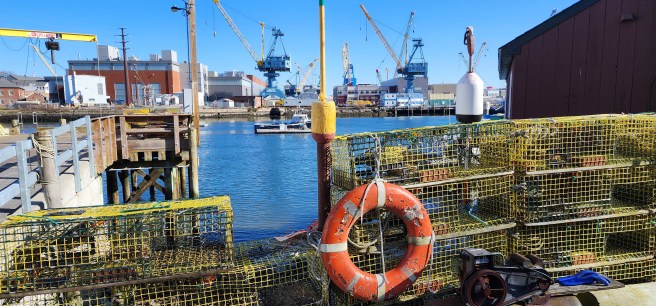
The historic boatyard, now a booming submarine maintenance facility, is situated on an island across the Piscataqua River from New Hampshire’s Seacoast city of Portsmouth. It’s seen here from Kittery Foreside, the town with the military base gates.
You never know what we'll churn up in cleaning a stall
The historic boatyard, now a booming submarine maintenance facility, is situated on an island across the Piscataqua River from New Hampshire’s Seacoast city of Portsmouth. It’s seen here from Kittery Foreside, the town with the military base gates.
As I’ve related in other posts here, ours is widely known around town as the Anna M. Baskerville house.
For a writer and editor like me, though, Baskerville was also an important typeface in the advancement of printing.
It was the body type of the first newspaper I edited, the Belmont Hilltopper. Yup, back in high school. Our headlines were mostly Bodoni, another classic that’s mostly vanished in the internet era.
Here’s an introduction to its founder and a bit more.
So here goes for this week’s dive into arcane wonders.
Sex or food?
Is that what desires ultimately come down to?

I would have called it a lifeboat, but it does get used for excursions to shore during a typical cruise aboard the schooner Louis R. French.
For more schooner sailing experiences, take a look at my Under Sail photo album at Thistle Finch editions.
A traditional New England home comes without closets, or perhaps has some quirky ones that were added later but inefficiently. It’s an unanticipated jolt for those of us who grew up elsewhere.
That tradition was something our renovation sought to rectify. Indeed, maximizing storage space was a pivotal consideration in our planning. As I’ve noted, our present home is smaller than the previous one, not that its closets were notable, even before considering all the storage capacity we had in the red barn. Yes, the barn that inspired this blog. The garden shed we added here is much, much smaller.
A few locals have been surprised by the results – what they see as closets everywhere in the newly redesigned upstairs. Each bedroom has one. Although these are shallower than a full-sized walk-in closet, they are deep enough for hanging clothes, which is our primary need.
The key in adding these came in realizing that the distance between the gable windows was two feet, enough to run narrow closets along the dividing line between the front and back bedrooms. Our original plan had those closets alternating, half for one bedroom and the other half for its neighbor. But that changed when we decided to give all of that opening to the back bedrooms, which were also smaller.
In compensation, the two front bedrooms got a shallow loft running atop those closets, as well as their own closets elsewhere in the reconfigured rooms.
Quite simply, the closet in each bedroom is unique.
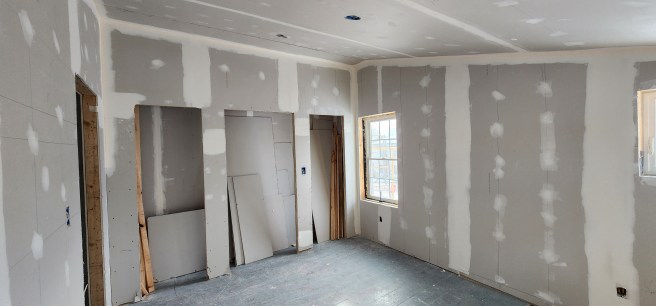
Additional storage space appears in the laundry room as well as a small hallway broom closet. Yes, even a place to stash the vacuum cleaner.
In support of that statement, let me offer Long-Stem Roses in a Shattered Mirror, my collection of poems released to the public today.
Think what happens when a hot relationship goes belly up and everything you trusted turns painful.
These poems arise in a brutally honest reevaluation of those interactions, as one of the lovers insisted on at the time, as well as the larger hopes and desires.
Many of the poems appeared in small-press literary magazines around the globe, but this is their first outing complete.
I have come a long, long way since, perhaps because of lessons I learned in these earlier relationships. The poems remain intense, vivid, and powerfully moving, even at my age.

For my series of passionate roses, check out my collection in the digital platform of your choice at Smashwords.com and its affiliated online retailers. Or ask your public library to obtain it.
That is, on buildings and other places that were largely funded by the public?
Where I grew up, though, the NCR Auditorium was totally private and yet open for community groups and events.
And there’s more than sea glass, too.
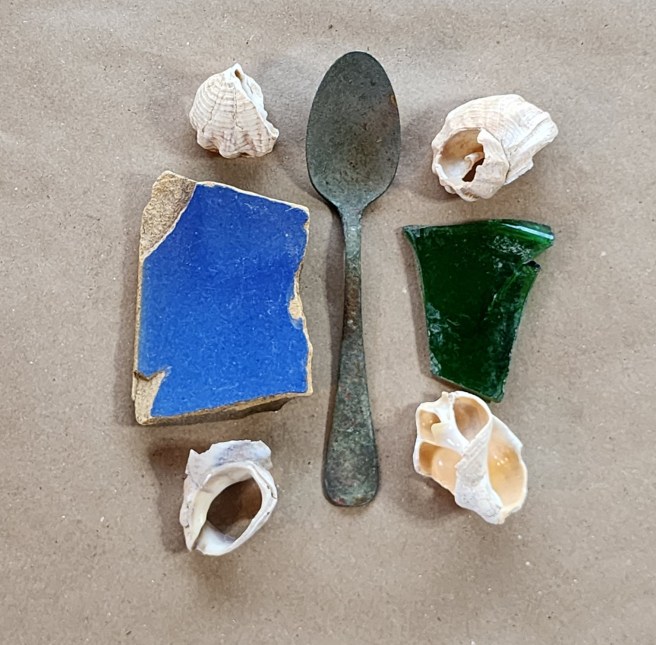
Sometimes it’s fun to play with what you tote home, creating whimsical designs like the ones you’ll find in the Shore Things free photo album at my Thistle Finch blog.
Living around big waters, as I do now, means hearing a number of new terms to identify boats big and small. When you merely read about them, say in a history book, you can usually skim over the word and move on.
Not so when you’re trying to describe what you just saw.
Today we won’t attempt to get into the array of mostly motorized vessels. Not even a Bayliner versus a Boston Whaler. Naval ships alone would require a long list.
Instead, let’s look at a general overview of boats originally powered by the wind. (Admittedly, today many of them will have an internal engine for additional power.) These can range from small sailboats to majestic tall ships.

