
They’re a landmark for much of Penobscot Bay. Sometimes, though, they appear more distinctly than they do as one broad outline.
For more schooner sailing experiences, take a look at my Under Sail photo album at Thistle Finch editions.
You never know what we'll churn up in cleaning a stall
They’re a landmark for much of Penobscot Bay. Sometimes, though, they appear more distinctly than they do as one broad outline.
For more schooner sailing experiences, take a look at my Under Sail photo album at Thistle Finch editions.
Let’s start with the timetable, which fell far behind our goal. Delays included weather, materials (we couldn’t just run down the street when a need popped up, and deliveries were at least a day away, or often more), crew availability, the plumber and fixtures, and our own attempts to make decisions with a key player living at the other end of the state.
By late spring, we were making headway again but were also reaching toward the bottom of the pot when it came to finances.
And then the big whammy came, when Trump and his cronies decided to freeze already approved grant money, meaning my wife would soon be unemployed.
We tapped the brakes, meaning the modest kitchen remake would be on hold, along with the new upstairs bathroom and laundry room and an upgrade of the downstairs bathroom. The lower apron deck in the back, an L around the newly replaced upper deck, was also now on hold.
Drawing on our remaining available funds, we decided to go ahead with new outdoor lighting front and back, some final touches in the front bedrooms and stairway/hallway, insertion of doorhandles upstairs, and a scaled down job on the mudroom, eliminating rainwater leakage, replacing the peeling paneling with drywall, and the addition of electrical outlets and lighting – a revamp of the hip roof with an more efficient shed line, has moved off to the future.
It all adds up. The new freezer in the mudroom is quickly filling with garden produce and marked-down groceries.
A few other projects, especially a heat-pump system to counter our fuel-oil furnace, are now further off on the horizon.
Emotionally, I’m feeling conflicted. I don’t like letting up this far from the finish line. We still have much to do in settling into what’s already been accomplished. We need to empty a storage unit at the other end of the state and fit the contents into our place here – or cull much of the rest.
But I’m also proud of what we’ve accomplished to date, and of our luck in landing the contractor we did.
If you haven’t already looked at the Before/After album at my Thistle Finch site, please do. It’s also available there for printout.
Home, Money, Design, Life, Maine, Downeast, Eastport,
Some writers manage to follow a detailed outline, but that’s never worked for me. Sometimes I’ve had a vague timeline or trajectory or anticipated structure, but then the piece started going its own way.
Technically, that makes me a “pantser” – someone writing by the seat of his or her pants.
I do write to discover as well as remember, or as another artist once said, “What’s the use of sticking to an outline if you already know how it will end?”
Point taken.
An artwork in progress can become a living organism. It will be seen differently by readers and editors differently than from you do. What you would cut, they might love. What you love, they see as sore thumb.
I’d love to hear from songwriters and filmmakers and playwrights and painters along those lines.
There’s also the potential of becoming so rarified we lose all connection to others.
~*~
I suppose that rigidity can extend to the way we work. Do we keep a tight schedule – so many hours a day, putting in what Bukowski called “butt time,” or do we slack off and then explode in a two-week frenzy the way Kerouac would?
Again, we all differ.
Me? I used to prefer the wee hours around midnight. And then somewhere it switched over to early morning.
I had imagined having three books published each year – one of poetry, one of Quaker practice, and one of fiction or memoir/genealogy. (They were already written.)
The rest of the time would be correspondence and basic living, including a social life, with concerts/plays/etc. filling the evenings.
My wife rather scoffed at that, seeing so much I was overlooking. Alas.
As I once noted: Trying to catch up but constantly behind – the modern mind. The motor mind. As for your visions in the night?
~*~
Another shift has come in my appreciation of slang. It can truly enliven a passage.
The words don’t always continue with the same meaning, either, which is an additional live wire.
But listening to kids today or even athletes and pop musicians I’m finding I have no idea what they’re saying, not even the sentence construction.
~*~
When I first began reading contemporary poetry (for pleasure, independent of classroom assignment), I sensed that often the poem existed as a single line or two, with the rest of the work as window dressing. Now I read the Psalms much the same way, for the poem within the poem, or at least the nugget I’m to wrestle with on this occasion. Psalm 81, for instance, has both “voice in thunder” and “honey from rock.” How wondrous!
Also: Revise, revise, revise, and be alert for the flash out of nowhere.
I translated the motto inside a friend’s harpsichord as “Who sings once, speaks twice.” The original quotation, from Augustine, was “He who sings prays twice.” Maybe out of need?
Good poetry, I’ll insist, also sings. Or perhaps drums, I’ll take either. Even when it doesn’t fit traditional scanning.
Let me repeat the challenge that bad religion can be overcome only by good religion. Ignoring that only allows it to fester.
For me, the act of writing – especially poetry – becomes a form of prayer. Not that you will necessarily see that.
Does that work for any other writer? I’m all ears.
~*~
Remember, you can find my novels in the digital platform of your choice at Smashwords, the Apple Store, Barnes & Noble’s Nook, Scribd, Sony’s Kobo, and other fine ebook retailers. They’re also available in paper and Kindle at Amazon, or you can ask your local library to obtain them.
Art Newlin rose in Meeting and told of driving two- or twelve-hitch rigs as a young man. Once he hitched two strawberry roans to a tongue, and while they’d worked a rig before, they’d always followed and never really felt the bit or anything. Nonetheless, they performed well, even backing on command. Only later did he realize the risk he’d taken. “They could’ve become runaways. They could’ve killed me.”
He credited faith for protecting him.
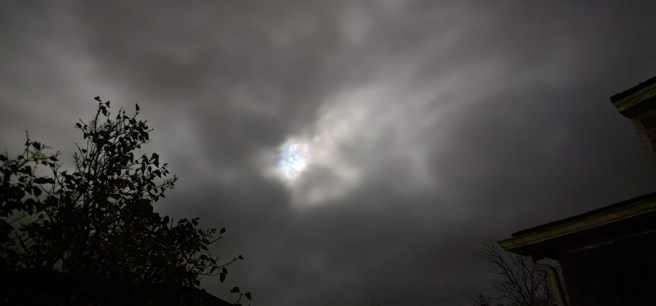 Playing around with the night setting on my Galaxy cell phone has produced some surprises, beginning with the aurora borealis.
Here is a full moon that looks like a sun in the breaking storm clouds. Zoom in and you’ll see that the moon’s round. Cameras see a moon as being much smaller than our eyes do.
Any photo that shows otherwise has been manipulated. Care to discuss?
If you’re among those of us who have some reticence or even dread about attending social gatherings where you have to engage in small talk – with strangers, no less – I’m offering this. Admittedly, mostly for my own reference, as needed. Please, please, add to the list when it comes to comments.
Get ready to tell an offending bore:
If your slicing and dicing of their mental lack of ability doesn’t do the trick, you can turn to their vanity or birth origins.
I really do regret not having these when the character of Cassia was emerging in my novel What’s Left, they’re right up her alley. To continue in what’s becoming my first-ever Triple Tendrils:
I suspect this just touches the surface of what’s exchanged on the scrimmage line of professional football games.
Besides, please remember, when somebody says, “Where have I seen you before?,” just reply, “I’m a porn star.” Or at least, “Was.”
When she said she wasn’t good enough for me, it turned out she was right.
Oh, my, the things I uncovered later.
I really was so green.
Others can say the same of me.
Cardboard
Catbird
 Yes, autumn is in the air.
Here it’s seen on Penobscot Bay from a cruise aboard the historic schooner Louis R. French.
For more schooner sailing experiences, take a look at my Under Sail photo album at Thistle Finch editions.
You may have guessed we’ve taken tons of photos of the renovations in our historic home. You’ve been viewing some as progress reports in this weekly series, but those show steps along the way.
Sometimes it’s helpful to skip over those, going straight from how things looked at the beginning and then leaping to what the work delivered in the upstairs phase of renovations.
Should you be interested in that comparison, I’ve assembled a gallery of before-and-after contrasts in a free photo album, one I’m making available to you, should you be interested.
As I’ll explain next week, we’re hardly as far along as we had hoped. So I’m calling the album “Before & Midway After.”
In assembling the photographs, I was emotionally overrun in seeing how dramatic some of the advances have been. It’s helpful in facing the remaining work ahead.
~*~
That said, check out the free tour at Thistle Finch editions.
You’ll also find the history of the house and its previous residents in another booklet, should you be curious.
 Jnana's Red Barn