If you’re dreaming of  a vacation in Maine, please consider …

The weather can be iffy, even in summer. Your week by the beach may be mostly rain and or fog. Plan accordingly. There’s nothing wrong with hunkering down with a good novel when you’re away from everyday distractions.

Where I live the ocean is too cold for swimming. Period. Even before factoring for the currents. Further south and west, this can be iffy.

Black flies. They’re early summer, to mid-July. Inland, especially. You’ve been warned. They’re even worse than swarms of mosquitoes.

As for your expectations? A more laid-back lifestyle perhaps with antiquing is one thing. If you have kids in tow? That’s another. Hope they enjoy the outdoors.

If you go for a whale-watch anywhere, what you wind up seeing is what you are given that day. The best part may be simply the cruise out and back from the prime ocean. There are no other guarantees.

In many destination locations, retailers are faced with a six-week business model. Restaurants, lodgings,  and stores have to cover most of their year’s expenses in those few intense weeks and then hold on through the rest of the year, if they stay open at all. Prices will be higher than you might like.

Nightlife may very well mean looking at stars.

She did have quite the tongue

In the official statement marking the death of Alice Roosevelt Longworth, President Jimmy Carter observed, “She had style, she had grace, and she had a sense of humor that kept generations of political newcomers to Washington wondering which was worse – to be skewered by her wit or to be ignored by her.”

Just listen.

  1. When her father was governor of New York, he and her stepmother planned to send her to a conservative school for girls in New York City. Curtly, Alice responded, “If you send me, I will humiliate you. I will do something that will shame you. I tell you I will.”
  2. When her father became president after the 1901 assassination of William McKinley in Buffalo, she greeted the event with “sheer rapture.”
  3. She later said of her father, “He wants to be the bride at every wedding, the corpse at every funeral, and the baby at every christening.”
  4. When a prominent Washington senator was discovered having an affair with a young woman less than half his age, Alice quipped, “You can’t make a souffle rise twice.”
  5. Most famously, “If you haven’t got anything nice to say about anybody, come sit next to me.” She had that one embroidered on a pillow kept in her living room.
  6. On Calvin Coolidge: “He sprang from the grass roots of the country clubs of America.”
  7. Another quick character sketch: “He looks as though he’s been weaned on a pickle.”
  8. And one more: “Never trust a man who combs his hair straight from his left armpit.”
  9. As for Washington, D.C: “A town of successful men and the women they married before they were successful.”
  10. Through it all: “I’ve always believed that if you’ve got a good sense of humor, you can get through anything.”

Do note, her father was quoted: “I can either run the country or I can attend to Alice, but I cannot possibly do both.”

A feel for the water and wind

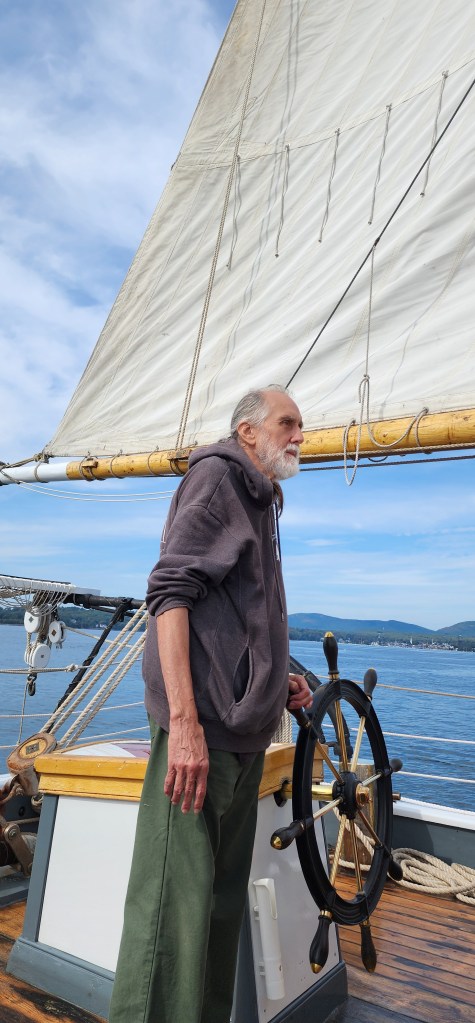
On cruises aboard the historic schooner Louis R. French, passengers get opportunities to pitch in with the work. We help raise the anchor and the sails in the morning and we wash our own dishes. Sometimes, when the water’s calm, we even get a spell at the wheel, where you do get a feel for the interaction of the wind and water as well as the delay in the boat’s response to a change in the course. Here I am at the end of last summer.

For poems related to the sea, check out my collection Ocean Motion at Smashwords.com.

Jacob Shackford’s line

Captain John senior and Esther’s son Jacob commanded the steam brig New York, the first steam vessel to enter the harbor of Eastport.

He followed the sea up to 1832, when he and his brother established W.& J. Shackford & Company. Independently, Jacob did build ships, including four brigs in a few years in the 1850s. One of them was noted for riding out the devastating gale of 1854. He also dealt in real estate, as his running advertisements in the Eastport Sentinel of 1865 illustrate: “House lots on Shackford and Water streets. Also two lots. For sale on reasonable terms by Jacob Shackford.”

Jacob’s son, shipmaster George, died August 1, 1863, age 39, during the Civil War. I’m left wondering whether his death resulted from civilian or military seafaring.

Jacob’s son William did serve, from 1863 to 1865, aboard the USS Home, USS Winona, and USS Nahant.  In 1870 his residence was in Eastport; in 1880, Philadelphia; and 1890, New York, reflecting a successful shipmaster’s social mobility. His summer vacations at Cape May, New Jersey made the society pages of newspapers.  The August 2, 1897, New York Tribune reported the arrival of Mrs. William Shackford and Miss Carrie N. Shackford. An August 29, 1897, article in the Philadelphia Inquirer noted that Captain William Shackford joined his wife at the Congress Hotel to recover from “an attack of isthmus fever to regain his health.”

Back in Eastport, as Weston noted that Captain Jacob Shackford’s will, written on September 2, 1868, named his beloved wife Elisa D., his homestead on the corner of Water and Key Streets, a daughter Eliza A. Shackford, a son William Shackford, and another daughter Matilda, the wife of Charles B. Paine. It also left part of the estate to his son Henry Nevis Shackford, if known to be living at the death of his wife [Eliza]. Henry had left on a ship and never returned.

Son-in-law, C.B. Paine, husband of Matilda, had constructed the home on the corner of Water and Third streets, across from us, in 1841.

Jacob died June 19, 1869, age 79.

Over time, Jacob’s house at 4 Key Street grew from a federal style house and narrowly averted the devastating 1886 downtown fire. At some point, at his wife’s urging, the structure was turned 90 degrees, from facing the waterfront, to its present orientation, facing north, and drastically restyled.

When Eliza died on February 17, 1879, age 85, she was no longer residing in the house, as far as I can tell.

Remember, Jacob grew up in the house we now own.

The hardest prompt: a love letter

You’d think these would be the easiest, most natural thing on earth, except that they usually wind up being 99 percent cliché and hot air.

Besides, how many times and ways can you express the dirty stuff, if you dare?

(And be prepared to back it all up in person.)

Really!

In addition, the audience of one can be the world’s most demanding, no matter how fond of you they are.

Even more difficult, add to the assignment something I heard a writing prof say, quoting another one: Never revise a love letter.

Nope, let it gush forth.

~*~

For further humiliation, there was an instance when I was living in the ashram and writing a reply to a beloved’s epistle when several of my fellow yogi residents came up and grabbed my effort, grimaced, and declared, “If I received that, it would be the end of the relationship.”

Those girls were so full of helpful insights, as you’ll find in my novel Yoga Bootcamp.

~*~

Well, I’ve never been good at pickup lines, either.

~*~

About a dozen years ago, I had a spree in the loft of our old barn when I went through the remaining letters to me from girlfriends and lovers over the years.

Earlier ones had been helpful when I was drafting my novels Daffodil Uprising and Nearly Canaan. What jumped out at me in this round was their underlying unhappiness apart from me. It didn’t make for a good give-and-take in a relationship. No wonder things didn’t work out in the long run.

The time for the ritual burning was way overdue. It took longer than I would have guessed.

~*~

More recently I came across some surviving letters written on computer, some of them that were then sent by the postal service and others that went by email.

The ones I wrote now embarrass me. As for theirs? A gentleman won’t say, though they reflect a long search for a fitting relationship that never panned out, like panning for gold. My, all the hours I spent writing those and reading the responses!

Once more, though, a purge is overdue.

We could get into a discussion regarding the intimacy of handwritten letters versus legibly typed ones, though that’s largely moot now that the exchanges have shifted to emails and cell phone texts. That topic deserves its own conversation. For now, let me say that the playful back-and-forth with my now wife via America Online when we were getting to know each other is woven into my Prelude & Fugues poems available at Thistle Finch editions.

~*~

Back to the advice about never revising a love letter. I find it useful as an ideal for other kinds of personal writing, too. Just let it pour out, best as you can. Not that it usually proves so easy.

Yeah, yeah, I fall back heavily on the revise-revise-revise emphasis elsewhere, along with the adage, “Talent goes into the first draft; genius comes in the revisions.”

Still, some of those love letters gave rise to the poems in my collections Braided Double-Cross, Blue Rock, and Long-Stem Roses in a Shattered Mirror (upcoming).

Let me add to that the only time – well, just about – that I face the dreaded writer’s block is when having to come up with something spiffy on, say, a get-well card. Like the ones they used to pass around the office. I know of a truly major writer who agrees with me there. Maybe sympathy cards are even worse. You can’t go with “Miss you” there, and nearly everything else is so trite.

~*~

One final concern I’ll raise while we’re circling around the topic involves what would we say to each other now, all these years later. At one time, I tried to find out, thanks to Facebook. It wasn’t encouraging. Some who had been hot on my end barely remembered me.

And while I had tried to be conscious of their objections or potential feelings of hurt in reading the fictional accounts of our lives, I finally had to realize they never read what I had written after our breakups or differing directions.

Ouch! Most of them I missed more than they did of me.

Sound familiar?

~*~

You can find Braided Double-Cross in the digital platform of your choice at Smashwords, the Apple Store, Barnes & Noble’s Nook, Scribd, Sony’s Kobo, and other fine ebook retailers. You can also ask your local library to obtain it.
Recalling an obscure West Coast vinyl record operation

Its albums stood apart from many of the others I borrowed from Dayton’s public library, with its fine record collection and its guardian.

Contemporary Records was the name of the company, founded in Los Angeles in 1951 by Lester Koenig and soon a leading advocate of what became known as West Coast jazz, including Chet Baker, Shelly Manne, Art Pepper, Sonny Rollins, Bud Shank, and Andre Previn. It was even the first jazz label to record in stereo.

It also ventured into classical, including guitarist Pepe Romero, perhaps joined later by his brothers and father, all of whom soon became famous.

The company also offered a Good Time Jazz label focusing on Dixieland, plus the Society for Forgotten Music in a classical vein, and a contemporary composers’ series.

I had thought one of its founders was American songbook master Vernon Duke – aka Vladimir Dukelsky, his Ukrainian name, used for his 12-tone pieces – but I seem to be wrong. I vaguely recall that one of the disks presented his work as played by the Hollywood String Quartet, but find no support for that now, either.

I have no idea what brought all of this to mind, all these years later. What I am seeing now is how easily so much falls into oblivion.