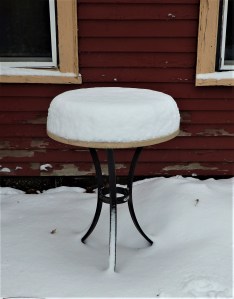
Snow measure
You never know what we'll churn up in cleaning a stall
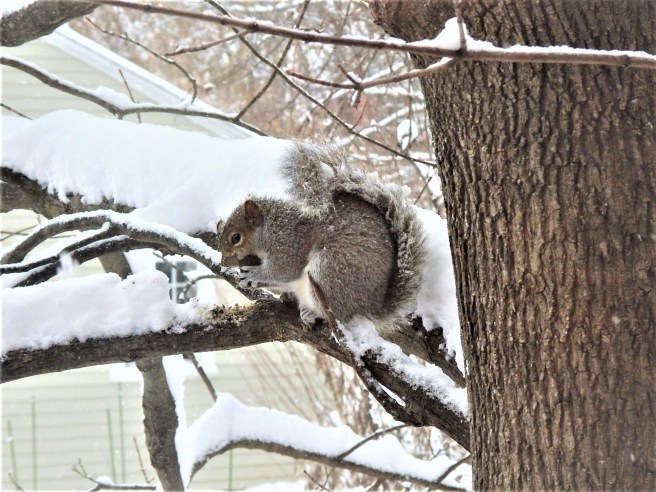
Yesterday was not only the first day of December, it was also the first day of Advent.
(Make that Advent in the Western Christian calender, which runs between 21 and 27 days before Christmas, depending. The Eastern Orthodox faithful, in contrast, observe it as a 40-day fast that began November 15 this year.)
For us, our first snowfall of the year also began yesterday, and it’s already delivered seven inches, a bit under half of what’s expected by tomorrow morning.
My wife was pleased to have all of this also fall into the extended Thanksgiving Day weekend, a welcome break in what’s been a chaotic schedule.
How’s the month kicking off for you?
As he said: “It has to be raw and sophisticated at the same time.”
He often revised by looking at models in a mirror … would see the flaw … like looking through a camera, framing?

The Divorce Culture, by Barbara Dafoe Whitehead (New York, Alfred A. Knopf, 1997, 224 pages, $24) – reviewed by Jean E. Milofsky, The Colorado Review, fall 1997:
“Whatever else divorce is, it is fundamentally a loss. As a writer friend of mine once said, ‘It’s like death except no one says nice things about you.’ In divorce one loses not only the relationship with one’s spouse, but also one’s location in the social fabric. Friends fade away, and families are thrown into turmoil. Then there are the inevitable economic losses, which Barbara Dafoe Whitehead rightly claims fall disproportionately on women. Nowhere in her polemic against divorce, however, does Whitehead conceptualize divorce as a loss. Rather, with increasing insistence as the book goes on, she views it as an expression of individual freedom in a highly libertarian age.” …
“Whitehead’s concept of divorce as an expression of unfettered liberty ignores what every divorcing individual realizes – no choice is without consequence, no decision is without obligation or work, and adult freedom never really comes from throwing off chains.”
~*~
Counter with James Dobson’s insistence that “love at first sight” is really just infatuation and therefore selfish, while love is other-focused.

In the final revision of my novel What’s Left, her aunt Nita becomes an active instigator of the project that leads the adolescent girl to closely examine her father’s photographs. Another change is that Cassia’s best friend and cousin, Sandra, joins in with second opinions.
Here are some passages that were no longer needed like this in that final edition:
What happens in that process flips our usual pattern of interacting. Strengthens our bond. Forget Theos Barney and Theos Tito – they’re usually too busy to answer my inquiries, but after listening closely to Thea Nita, I have a sense they just don’t know as much detail as she does. Not just the Baba years, either. She’s filled me in on Ari and Perry and Athina and Dida and Ilias and Maria and Stavros and Bella. She knew them all, and was old enough to see much. Even so, she’s anxious to uncover as much about them as much as I do, which adds to our working together as a team.
~*~
She was particularly close to Dimitri, too. When they were apart, from college on, they corresponded in long weekly letters that often included newspaper clippings, and she’s promised to let me examine that collection when I’m ready. There’s so much on my plate already.
~*~
Bit by bit, the puzzles fit together enough to hint at the bigger picture, even around huge gaps that remain.
~*~
Always the news hound, Thea Nita confides to me the difficulty she’s had in digging up the few details she passes on, and, as she emphasizes, some of the conclusions remain conjectural. Add to that a few documents passed down in the family and some letters we still need to translate. A timeline takes shape.
~*~
So much of what I’m telling you comes down through Papou Ilias, Thea Nita tells me, explaining how many times they’d sit down together and his observations would flow on and on in response to her questions. As she says, he obviously admired Ari and Perry – and as a philosopher, he had to be true to the line of questioning, no matter how discomforting the conclusions may seem.
Oh, I’m so glad she stopped talking like this! In the final version, she’s pretty snippy.
~*~
In assembling these family pictures, then, Cassia comes to appreciate how important the word pictures are in giving life to the visual images. Both are essential for what she’s pursuing.
~*~
As a child, I never really understood the definitions of aunts, uncles, cousins, much less how we fit together. But we weren’t close, either, and had very little in common. Do you think Cassia’s loss make her more attentive to her family connections? Does she just know too much for her age?
Many of these are between the government and rebels or differing religions.

