SUCCESSFUL
STRESSFUL
You never know what we'll churn up in cleaning a stall
SUCCESSFUL
STRESSFUL
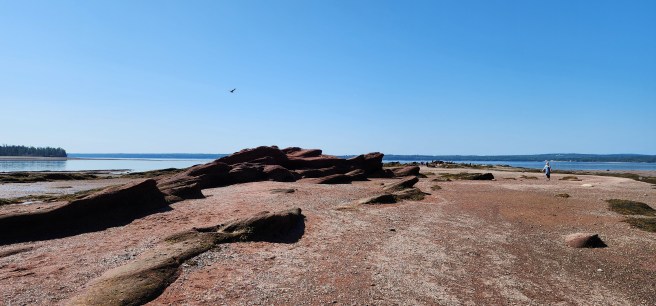
St. Andrews, New Brunswick, is an hour-and-a-half drive from our home, but it does strike us as a Providence, Cape Cod, kind of place in a somewhat more respectable vein. Get away from the tourist strip downtown and you’ll find this at low tide.
The land beyond is Maine, USA.
I never suspected our humble cottage would hold so many stories and twists. A sea captain’s home should have a widow’s watch, right?
Ours, as you’ve noticed, doesn’t.
Still, a single house like ours can be a miniature version of the whole island’s history.
There are still so many unanswered questions to work around in this puzzle, along with points that will require clarification and correction. Consider this, like the house itself, a work in progress.
Besides, we’re living out the next chapter, including the renovations and restructuring that’s occurring as I write this.
Prodded by a crusty newspaper editor-in-chief to keep a personal journal, I started the practice 55 years ago using spiral-bound notebooks. At the time, I was largely in quest of exploring “my problem,” meaning the deep depression and loneliness that followed the breakup with my first lover and my inability in social circles to find another. Long story to pick up later.
What I found instead was the manic upside in my funky settings during the hippie outbreak. Many of those entries, some of them in my favored 8½-by-14-inch notebooks – an option that disappeared all too soon from the market – found their way into my eventual fiction and poetry, though much of the rest is dross. At their best, they do have a sense of Richard Brautigan. Look him up, if you must.
As for the banal run of most of the entries, people who snooped into my journals and then voiced their disappointment in what they found told me as much. Note to those of you who consider doing something similar, it is an invasion of privacy and will likely bruise your relationship. It is an abuse.
Entries were rarely a daily thing for me, more likely weekly or, of late, even monthly. When I sat down to do so, I was more likely to record what was going on around me than I was to delve into my emotions or underlying perceptions. Those latter elements might appear whenever I had more time at the project. The big lesson was that my life was much richer than I had suspected, and I was too prone to lose the connecting threads without these times of reflection. In some ways, they were like Lewis and Clark’s explorations across the continent, I suppose. Who knows who might need the maps later.
In earlier returns to these, I did find I had duly noted details of unfaithfulness and other impending disasters that I was denying to myself, yet there they are in clear daylight when we return.
Among my goals this year is a thorough revisiting of the 200-plus volumes to date, the latter half mostly in hardbound 8½-by-11 artist sketchbooks. Most of what I review will be discarded, harsh as that sounds, but I the act will release emotional burdens as well. My novels and poems distill and carry much of that journey, thank you.
The ones beginning in 2000, though, retain so many details of my current situation, I really can use the reminders of things I don’t recall when they’re raised by others. I’ll let you guess who, especially.
~*~
My practice has definitely changed since I began blogging. Much of the recording of events, personal observations, and reflections has deflected from the hardbound journals to these online entries. Well, so has much of what would have gone into long letters to friends and colleagues now has vanished online as well. Emails and texts fall far short of real correspondence, OK?
The journaling on paper continues, though at my age, life feels more routine, less worthy of intense recording. So much of it I’ve already said, even to myself. Still, as a practice, it’s one more thing I can see as prayer, too.
You’ll likely be seeing more of what I turn up in those yellowing pages.
It’s called “My Music,” a Saturday morning staple on the CBC Music FM radio network.
For two hours each week, a notable Canadian classical musician is invited to share his or her favorite music. Not all of it’s classical, either. Sometimes it’s a pianist or a violinist or even a conductor or composer. Some are quite famous in musical circles, while others are fairly obscure. Organ, clarinet, harp, percussion, and varied ethnic instrumentalists have hosted as well. And there are some amazing singers, not all of them opera.
Sometimes they stick to their particular niche, but I especially enjoy the ones who venture far beyond that.
It’s quite touching when they honor their parents, siblings, teachers, and friends with their selections, and quite enlightening why they explain what makes someone they admire stand out. As I said, it’s not always classical. Canadian jazz pianist Oscar Peterson turns out to be a huge influence.
I do wish classical stations in the U.S. had a similar program. To attempt this on a national level would be too overwhelming. Part of its joy is a small-town feel. Basing one in Boston or Los Angeles or Chicago might even be too big.
Bloomington, Indiana, would be a natural, or San Francisco, or even a whole state like Minnesota.
Whaddya think?

Our rocky shoreline includes sporadic pocket beaches, too. This one faces tiny Dog Island, shown below.

In researching the history of our house, I learned about many of its earlier neighbors as well. Of note to the south was one with a rather exotic surname. Turns out he was a rather influential figure in the establishment of Eastport.
Here are a few points about him.
a shower to a bath, but indulge in hot tubs.
a hot tub to a sauna in the snow, not that I haven’t delighted in the latter.
religion that relies on questions more than answers.
discovery to fabrication. Accuracy more than cleverness.
Chocolate or candy?
White chocolate. Or dark, bittersweet.
Waffles or pancakes?
Either one, awash in melted real butter and local maple syrup. Better yet, a classic cheese omelet. Or baked pears or baked French toast.

It’s rather modest, actually, but so classy all the same, befitting the schooner Louis R. French. It was at the top of the ladder from my quarters below.
For more schooner sailing experiences, take a look at my Under Sail photo album at Thistle Finch editions.
 Jnana's Red Barn