
Two rhythms, 1962
You never know what we'll churn up in cleaning a stall
In my novel What’s Left, Cassia’s aunt Nita writes a daily newspaper column focusing on local people and their real interests. It’s not all that different from CeCe Cobb’s in my earlier novel Hometown News, but Nita’s is far less corny and far newsier.
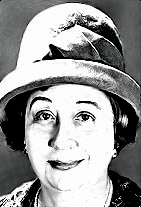
In Dayton, where I grew up, it was Marj Heyduck of the Journal Herald. Her mug shot on her daily column featured a new hat each week as a signature touch. And in Cincinnati, it was TV host Sally Flowers.
But I can think of others who just seem to know everybody.
Does your community have a local voice? A minor celebrity or just a naturally curious friend of all?
yack-yack-yack
yack-yack
escape

so pleased entering my apartment to see everything tight, still in place, no vandals, though the temperature was 89 degrees, apparently the maintenance crew had come in and set the thermostat at 80 to get the radiators going and then left while ignoring repairs to one of those single joy-stick faucets that takes an eight-dollar washer kit to repair, I know, because the three-dollar one I bought had the wrong kinds of springs and plugs and doodads, and none fit
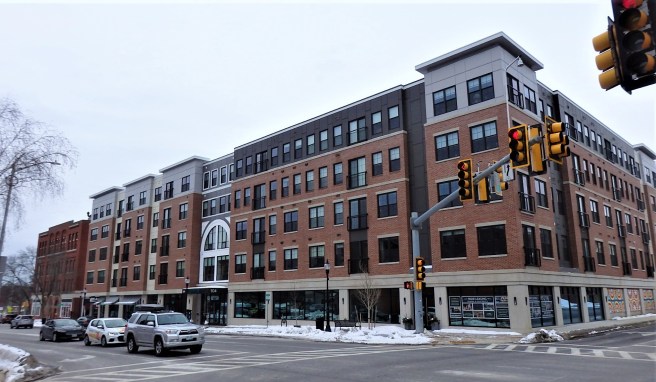
I can’t tell you how relieved I was when I got the phone call asking if I wanted to move my appointment for my first Covid shot up from April 23 to February 12. I didn’t mind that the call came just a day before, when I was 311 miles away. I was overjoyed.
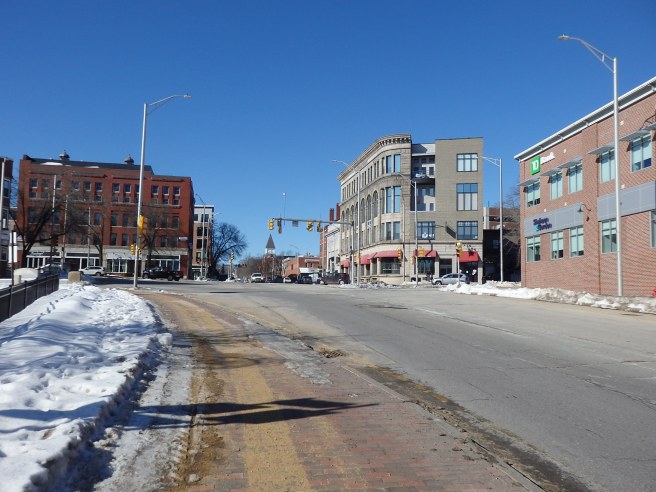
Besides, I had already planned to be back in Dover that day, I just had to be sure I got an early start and didn’t get delayed by weather or the like.
Better yet, it would eliminate the complications of one more trip later, likely after we’d sold the house.
Mine was the Moderna vaccine, and it went very smoothly. Yes, my shoulder was pretty painful that night, at least when I rolled over, as well as the next day. As for achiness, much could be blamed on all the packing and cleaning and a few runs to the city recycling center we were already doing. We’ll see how the second shot goes, though I am bracing myself.
The idea of being out from under that cloud by the beginning of April rather than early June is exhilarating. Here we’ve been under what one Friend who lives beside a lake in Connecticut calls Covid cabin fever, and I’ve been pretty much hunkered down through most of the duration, apart from the month-and-a-half I was a Census enumerator.
Still, there’s so much we don’t yet know. How long is it good for? What continuing precautions should we take? When will we all be able to move out and about freely, if ever?
How about you? Had the vaccination? Which one? How did it go?
I heard it twice, miles apart: “I have retailing in my blood.”
Both headed family businesses – one, a supermarket chain, the other a small-town restaurant.
The grocer worked with three of his brothers and a brother-in-law, though another brother instead became a respected physician.
The restaurateur worked alongside his only brother and their wives.
Both enterprises were founded by their fathers.
It’s a lot like the family enterprise in my novel, founded a few generations earlier.
Do you know anyone like that?
~*~
My novel is available at the Apple Store, Barnes & Noble’s Nook, Scribd, Smashwords, Sony’s Kobo, and other fine ebook distributors and at Amazon in both Kindle and paperback.

By the end of ’68, the counterculture phenomenon was metastasizing from San Francisco’s Haight-Ashbury and nearby Berkeley into pockets across most of the country and even Europe. As August of ’69 proved, it was sufficiently established in the East to draw together the unanticipated throng at Woodstock.
Much of the transplanted activity existed at the fringes of college campuses, as I experienced in Bloomington, Indiana, and later Binghamton, New York. For me, growing up in Ohio, I would have rather attended hip, beat Antioch in Yellow Springs, but the finances were way out of our consideration. So a state school was my destination, and at the time, Indiana as an out-of-state student was nearly as reasonable as in-state for me in Ohio. And a bit later, to my surprise, how yesterday Antioch began to appear once I was near the East Coast.
The searing experiences shape what I describe in Daffodil Uprising and then Pit-a-Pat High Jinks. And as I continue to repeat, hippies came in all varieties – and still do. There was no standard-issue, card-carrying member, but each was one to some degree or another. Nobody completely fit the hippie image.
As someone who became addicted at the onset of adolescence to classical, opera, and folk music, I was already passionate about an alternative to commercial entertainment, which was what rock at the time really was. I was one who lamented deeply when Bob Dylan went electric. Sold out, so it seemed. I had the long hair and blue jeans and bell bottoms. I was against the war, tried a few hallucinations, loved sex when I could get it, which wasn’t often.
And then I encountered yoga, which led me to give up meat, alcohol and drugs, and sex for the life I detail in Yoga Bootcamp – and yet, curiously, this was when I felt the most hippie in all of my awareness.

