ASPARAGUS
KITCHEN MESS
SO PLEASURED
You never know what we'll churn up in cleaning a stall
ASPARAGUS
KITCHEN MESS
SO PLEASURED
Yes, we’ve admired madmen, especially those of a tragic sort via what I see as often incestuous works of art. You know, celebrations of other works of art or, especially, their creators.
In effect, there’s a question. Other works based on mythology, classical or Nordic, typically, face immortals who are still caught in some dimension of time – how else could they spawn children?
Turning the focus from flawed gods to the Immortal Artist, then, implicitly asks: Are madmen closer to God? Or filled with demons to be cast out, perhaps as artworks?
You know, the cliché history of poet suicides or pianist-composers who die at an early age or libertine actresses, that sort of tragedy, not always as a consequence of defying the gods, either. Think of all the poets in the core opera librettos – a shorthand for the librettist himself or the social commentator – as well as the composers or singers. It’s a long list.
Remember, too, in many Native cultures, there’s a special place for the madman as gateway to ancient wisdom or healing or a netherworld.
Admired madmen but also feared them. Just don’t get too close, even with a morbid curiosity.
Like the artist, they exist at the fringe of the village.
It’s implicit even in hymns about hymns and the raising of voices.
And also my speaking here as a fellow poet and novelist.
~*~
It’s hard to look beyond our own boundaries and explore the greater world beyond.
This is crucial, if we’re to engage others, in light of murder, rape, warfare, and other oppression and injustice around us. Is art really far from fostering imitation in life itself? Or is it rather for escape from any reality? Do we desire encounter or flight?
Earlier, I admired dazzling tricks and outward style, derring-do, and jests with fancy footwork. Shining surfaces and surreal images.
Over time, that’s changed.
My heroes have become more human and flawed, as well.
~*~
Throughout much of Friends’ history, many of the fine arts were offensive to the faithful; most painting, drawing, sculpture, fiction, theater, music, and opera were seen as superfluous vanities, engagements that took our attention away from worship. “We Quakers only read true things” is how one Friend expressed the matter when returning an unread novel to a neighbor. For a people who refused even gravestones, worldly adornments detracted from loving a heavenly Father with all their heart, mind, and soul, as well as loving one another as Christ had loved his/its followers.
Tertullian issued a related warning, in De Spectaculis, Latin circa 200 CE. Essentially: “The Author of truth loves no falsehood: all that is feigned is adultery in His sight. The man who counterfeits voice, sex or age, who makes a show of false love, anger, sighs and tears He will not approve, for He condemns all hypocrisy. … Why should it be lawful to see what it is a crime to do?” (Translation by Kenneth Morse)
As was recognized in Zen some centuries ago, when people started writing and singing and painting and acting from their spiritual practice, the flowering is already past its zenith. Nonetheless, we also know the power of the Zen-suffused works as they extended on to pottery, architecture, tea ceremony, even martial arts.
When I view Japanese and Chinese art, the Zen/Chan pieces jump out in their freshness from the well-schooled stream of traditional art.
Thus, with poetry or musical performance that knows living silence: a whole higher dimension. Necessity for revolution here. Transformation. Transfiguration. Transcendence. Transparency, too.
Is this a matter of like recognizing like spirit?
~*~
My real distrust of the celebration of the artist as a demigod comes in a plea for greater humility.
Yes, we work – as the poem Toltecatl, translated as “The Artist” by Denise Leverov details lovingly before countering with “The carrion artist: works at random, sneers at the people, / makes things opaque, brushes across the surface of things, / works without care, defrauds people, is a thief.”
The contrast is telling.
We’re hardly alone in work. Plumbers work, paying the price in their knees. Farmers work. Teachers work. Mothers, especially, work. Go on down the line, and admire all who do so with developed skill and intelligence and service. Who can say one field is truly superior the others?
~*~
I’m left wondering about a crossover identity of artist and priest, an expectation that the artist is expected to guide others into love or even the natural wonder around us.
It’s a fine line, between being a priest and a demigod. An inflated ego is a constant temptation, among others.
Still, how can I not love the movie “Amadeus”?
Who do you look to for inspiration?
three sessions dancing in a mental field followed by crisis in prayer life and practice of the sexual nature, followed by money and possessions Must run . Will walk later . because I hadn’t thought they’d be so closely related will you scratch the cat for me . every grub feeds on stage fright . with all encouragement, Woodchuck . birds are singing and carpenter ants invade the bathroom my brain goes ever into these leaps, as long as we’re at it at, beginning of the year we received a pay raise under the new contract, finally
In my novel What’s Left, there are hints that Cassia’s father was becoming interested in similarities between his line of Buddhism and the Greek traditions of his wife’s religious roots.
Here are ten things he might have observed.

I still don’t know why I chose to end the earlier version of Subway Visions as I did, but it was an intuitive leap. In backtracking as he does, our hippie photographer lands in the embrace of his guardian angel’s family. Who they are gave me the foundation for my novel What’s Left.
Of course, the family influence can be largely positive or largely negative, most likely a mixture of both.
How has your family shaped who you are today?
And how do you depart from those roots?
~*~
My novels are available at the Apple Store, Barnes & Noble’s Nook, Scribd, Smashwords, Sony’s Kobo, and other fine ebook distributors and at Amazon in both Kindle and paperback.


I really didn’t use this online, but it did give me a focus:
But now I’ve packed up and relocated. The way this Red Barn blog functions, though, Dover will continue to be a big part of the lineup. It’s a happenin’ place, for one thing, and my next book is a unique history aimed at the community’s 400th anniversary, which takes place in 2023.
As I refocus, I’m open to suggestions. Officially, the heading’s subtitle used to proclaim “a space for work and reflection.” Somewhere along the line, it became “come view the world from my loft,” but now even that is, no pun intended, up in the air.
This blend of here and there has me thinking of dreams, which have one foot in the present and one in the past, or so I’ve heard. From previous moves, I know that my previous home will be part of my awareness for a long time ahead.
Thanks for the memories. And for the new adventures.
Now, though, how should I define my new reality?
Apart from a short spur to the Portsmouth Naval Shipyard, all of the railroad traffic to and from Maine and the rest of the United States runs through Dover. (I’m not sure how much, if any, goes through Canada.)
When we first moved into the house, our younger one started complaining about all the train noises in the night as sand and gravel moved to Boston’s Big Dig construction.
More recently, one my my regrets about the Covid shutdown has been that a number of Amtrak trips I’d hoped to take – to museums and the Boston Symphony’s Friday matinee concerts, especially – instead got scrubbed. And since the Amtrak station was in walking distance of our house, I loved joking about walking to Boston. Ha-ha.
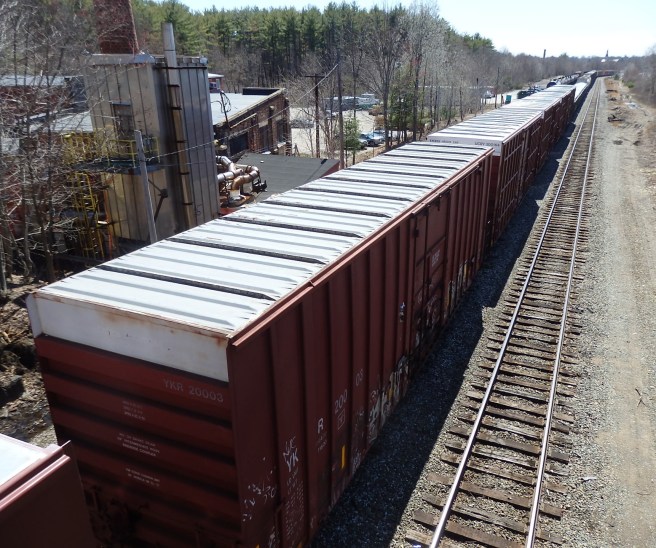
On the other hand, it can be annoying when you get stuck at a railroad crossing downtown while a long freight train passes. I usually lose count somewhere around 120 cars.
Here’s one I managed to shoot from the Oak Street bridge as it waited for the all-clear to continue rolling. Rail traffic, I’ve heard, doesn’t go north-south but rather east-west. Well, Portland’s north of us and Boston’s south. Make of it what you will.

Can’t see the engines up front, can you?