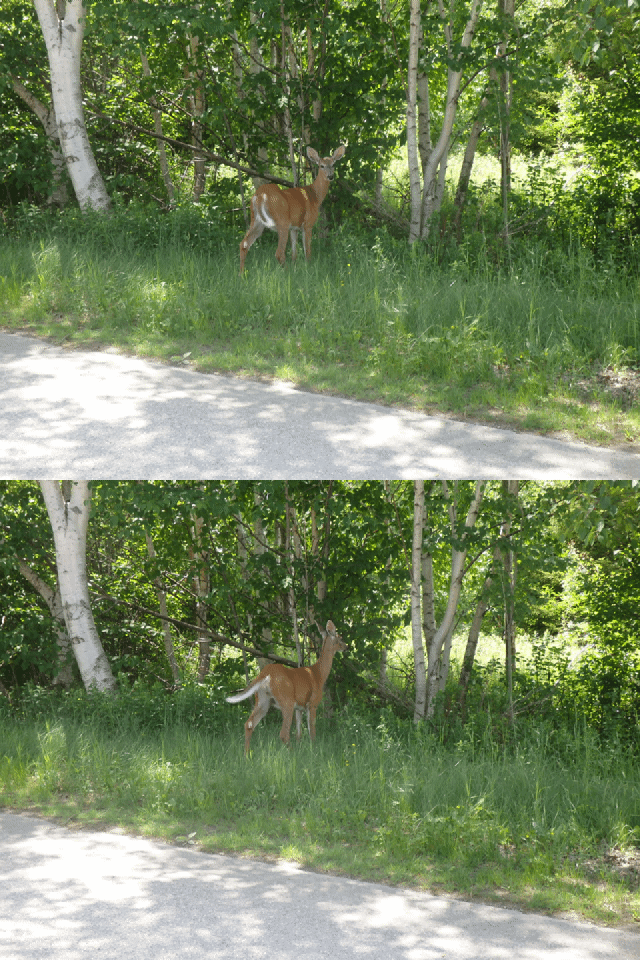
she grew fat with lies that vined around the very door
I’d slipped through
You never know what we'll churn up in cleaning a stall
she grew fat with lies that vined around the very door
I’d slipped through
A revolutionary ideal
one God, one Truth
rather than this or that, by whim or willy-nilly
~*~
The mystery of the big bang, something out of nothing, a scientific paradox, all leading to human consciousness. A honeybee cannot be an accident, nor can a human.
Only a divinity could create such a mishap!
you no doubt recall a cheery visit in Rhode Island or a ferry trip to Block Island an hour-and-a-half each way in gray eight-foot swells (we, too, rent a Mo-Ped to zip around on while out there) or a smoky Cog Railroad to the top of Mount Washington, a strategy that beats hiking to the 6,288-foot-elevation’s windy sub-alpine summit
In my novel Nearly Canaan, Joshua and Jaya settle into a place unlike anything they would have imagined. It’s desert, for one thing, where nearly everything has to be irrigated, for another. Quite simply, it’s a lot like Yakima, in the middle of Washington state. But it’s also close to fresh Dungeness crab, a shellfish with a heavenly taste all its own.
What you should know.


These days some of my favorite daily encounters come at our city’s indoor pool, where I swim laps. In addition to the familiar faces of fellow swimmers, there are the interactions with the lifeguards, many of them still in high school. When they’re not actively watching us in the water, they have rounds manning the front desk, where they might also be doing their physics homework or working on a paper. In other words, they were the right age to help me with my novel What’s Left, not that I’m ever that direct. No, just a wild question or subtle ear’s enough to keep me grounded in their direction.
In revising a manuscript, I sometimes chance upon a “zipper” that seems to run along the entire piece and releases something trapped within it. Tugging along page after page is an amazing experience, when it happens, which is not nearly as often as I’d hope. Mercifully, that’s what’s happened in the ninth revision of What’s Left, my novel thanks to comments from some of the early readers. The key this round came in having her talking to her father throughout, at least in her head and often in the midst of other people, rather than simply about him. It gives the work a whole new dimension and makes the story far more intimate, especially when she makes irrational leaps that match her emotions.
This, in turn, allowed her to relate much of her investigation as it happened as a young teen, rather than looking back on it from her early twenties, and had her aunt Nita and her best friend, cousin Sandra, present as co-conspirators.
Note that none of these revisions changed the way I saw the novel as an author — I knew how it begins, develops, and ends — but they change it entirely for the reader.
Yes, the changes were extensive. When one of the lifeguards remarked, “What? You’re not done yet?” I came back the next week with two pages from the hardcopy I was working from — half of the sentences containing crossed-out words and phrases, several moved to new locations, and a taped-on flap of new notes to add in, all needing to be keyboarded. It’s typical professional work, as you’ll discover reading the Paris Review or any number of writer-oriented magazines.
Still, they were astonished. I doubt they’ll look at a 500-word assignment quite the same again.
The point is that all of these changes are for the reader. Curiously, the very shift of having Cassia speak directly to her father throughout soon has the reader stepping into his shoes, hearing through his ears in a new intimacy.
And now I trust the story’s ready for you, as its reader.
~*~
It’s not always simply a coincidence, is it?
Have you ever started out on your way to one place and wound up somewhere quite different? Somewhere that turned out to be right? Tell us about what happened.
~*~

Samuel Johnson and his baroque constructions gave a big push to my literary ambitions after high school. Let me just say I’ve loved the clarity of Mozart from my adolescence on, and Bach and Handel have risen in my estimation in the years since. The brash English master fell right into that, though I now see again just how irreverent he was, despite all of his professed orthodoxy.
What it means it that I’m comfortable reading and writing certain kinds of complex sentences that are foreign to modern readers. Perhaps I should apologize? At least it’s not the only way I put sentences in line. Still, there’s a richness that’s missing in Hemingway and his progeny.
And here I am, drilled in the newspaper journalism Papa Ernie claimed was his inspiration. Think again. (Ernie? Makes me think of Pyle, and his big desk at the Indiana Daily Student, where I once worked.)
My wife has noted the dichotomy between my fondness for many Old Ways and the rule-breaking, experimental edge of my writing and thinking. She can point, for instance, to my fascination with the fiery writings of early Quakers in the mid-1660s placed in contrast to wild hippie extremes.
Are they really that different, though? I feel they enrich and deepen each other.