First Lady Dolley Madison cut quite a character

Dolley Payne (1768-1849) was the widow of prominent Philadelphia lawyer John Todd when she married the future fourth president of the United States, James Madison from Virginia. She was a colorful character, even apart from her extravagant fashion sense (which I see as a rebellion against the Quaker Plain constraints of her youth), a charming hostess who can be viewed as a founder of bipartisanship in American politics thanks to her dinners. Pleasurable food does enhance conversation, no? Dolley’s legendary social gatherings, known as “squeezes,” were attended by influential figures such as politicians, foreign dignitaries, and intellectuals, making her a central figure in American society.

Or, as a North Carolina Quaker minute book wistfully records her, “Formerly of our society,” meaning the Society of Friends. She was also the first president’s wife to be called First Lady.

Today, we have a Double Tendrils. The first set of quotes reflects her time in the White House and her flight during the War of 1812 when she saved the iconic portrait of George Washington in the throes of the attack that burned the new White House, which she had furnished and decorated.

First, things she said as First Lady.

  1. Two messengers covered with dust come to bid me fly, but I wait for him. … I am accordingly ready; I have pressed as many Cabinet papers into trunks as to fill one carriage; our private property must be sacrificed, as it is impossible to procure wagons for its transportation. … It is done… the precious portrait placed in the hands of the gentlemen for safe keeping. … And now, dear sister, I must leave this house or the retreating army will make me a prisoner in it by filling up the road I am directed to take.
  2. I have always considered my husband my partner and equal, and have valued his opinions and ideas greatly.
  3. In times of crisis, it is important to remain calm and focused, and to make decisions based on reason rather than emotion.
  4. Leadership is not about wielding power, but about serving others with humility and compassion.
  5. You may imagine me the very shadow of my husband.
  6. A good leader listens to the voices of those they serve, and seeks to understand and address their needs.
  7. History is shaped by the actions of individuals, and we all have the power to make a difference.
  8. I believe in the importance of standing up for what is right, even if it means going against popular opinion.
  9. I have never been afraid to speak my mind and advocate for causes that I believe in.
  10. I believe in the power of collaboration and teamwork, and the strength that comes from working together towards a common goal.

The second set of quotes frame a larger perspective.

  1. It is one of my sources of happiness never to desire a knowledge of other people’s business.
  2. I believe in the power of education and the importance of women’s access to knowledge.
  3. I believe in the importance of preserving and protecting our natural environment for future generations.
  4. True strength lies in the ability to admit mistakes and learn from them. … Honesty and integrity are the foundations of a strong and lasting legacy.
  5. A strong woman is one who can support and lift others up, even in the face of adversity. … Women have the capacity to be leaders and agents of change, and should be given equal opportunities in all areas of society.
  6. Life is too short to hold grudges or dwell on the past.
  7. Excellence should be pursued in all aspects of life, whether it be in relationships, work, or personal growth.
  8. Everyone deserves to be treated with respect and dignity, regardless of their background or social status. … The true measure of a person’s character is how they treat others, especially those who are less fortunate.
  9. Kindness is not a sign of weakness, but a reflection of strength and compassion. … I believe in the power of forgiveness and the strength that comes from letting go of anger and resentment.
  10. I would rather fight with my hands than my tongue.

Watching the rooms take shape was especially exciting

There were moments when we wondered about leaving all of that space open – just one big room. Maybe something like an artsy loft apartment. But then we returned to our projected needs and the plan at hand.

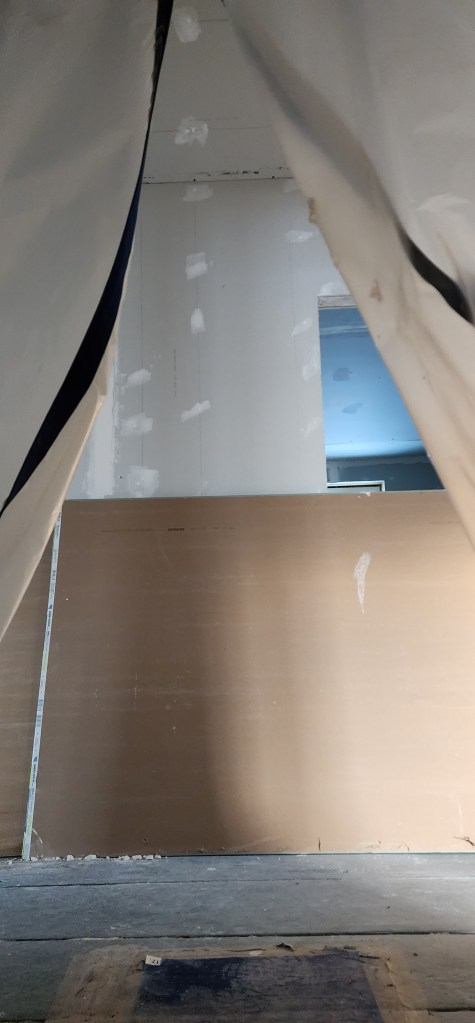
As the framing and wiring and flooring moved along, as well as the drywall itself, our hopes of painting the interior in the weeks between Thanksgiving and Christmas got pushed back till after New Year’s. Still, we were able to sleep some of our visiting family up there in primitive conditions as the drywall taping and mudding dried, thanks to a flurry of action just before Christmas.

The two front bedrooms are nearly twice as large as ones in the back. No surprise there, since the back half also has a small hallway and the bathroom and the laundry room.

Altogether, we have twice as many electrical outlets up there than we do on the first floor. And twice as much natural light.

As for the views? Sometimes breathtaking.

The good news is that the upper level, which prompted all of this work and expense to date, is largely complete.

Yay! Yes, Phase One is in place. The part that demanded we do something, or at least have it done.

~*~

Not surprisingly, this first phase cost about three times what we budgeted and took at least three times as long as we planned. Sadly, it is a rule of thumb in these undertakings. We have arranged refinancing to assure the work will be finished in the months ahead while we have our beloved contractor, rather than trying to reschedule later, but other projects we intended were reconsidered.

Working solo, as many of the carpenters do around here, meant our contractor was moving along at a slower pace. The good news came in the appearance of an enthusiastic apprentice two or three days a week, along with a helper as needed.

Immediately ahead of us was painting the ceiling, walls, and floors and then moving our stuff out of storage and up from downstairs.

In the coming weeks, we’ll be looking at specific areas of the work inside.

At this point, we did take time to review our budget and resources, and consider modifying our direction as needed. Just getting the upstairs under control was a huge relief and accomplishment, one much larger than I had anticipated.

~*~

The most maddening item involved moving the wood-burning stove from one corner of the front parlor (aka living room) to another. It made sense for several reasons, safety for one, but also straightening out the stainless-steel chimney pipe to allow for more room in the kitchen and bedrooms above. Getting a subcontractor back to finish the job was another matter, one not uncommon problem around here, as we’re finding.

That stove is an important factor for us when it comes to the frequent electrical outages in Maine, at least in all but the summer months. And it is a major improvement in heating the house through our cold winters.

Maybe if we had decided on the emergency generator back when?

There are tradeoffs, after all.

As for the placement of electrical light switches or which way the doors opened?

Right-handed or left? Have you ever considered that? You just reach and hope, right?

~*~

We were far from finished, of course. The kitchen remained a priority, along with the adjoining mudroom. And the downstairs windows, with all of their rotting, did need to be replaced. The small downstairs bathroom and tweaks to the other rooms could, if necessary, be put on hold. Not that we’d prefer.

In the bigger picture, we’re hoping the extensive renovation of our old house assures its continuance for another 200 years or more.

Shakespeare as the dreaded elephant in the room

In being held aloft as the epitome of English language and arguably world theater, too, the Bard of Stratford on Avon stands as an overbearing, even oppressive, figure.

Any writer since has faced the reality that by definition no one else can measure up, period. The fact that others have managed to carve out niches in the field in the centuries since is remarkable, considering.

Still, William’s presence was the reason I didn’t major in English when I transferred to Indiana University in mid-sophomore year. The department required a Shakespeare course predicated on memorization, something that’s not high in my skillset.

Beyond that, my focus has been on contemporary literature, at the time fiction and non-fiction but soon turning to poetry as well.

As a contrarian, I see no value in iambic pentameter, which we don’t speak, OK, and when I wrote in the form, the lines were always needlessly wordy. I like tight, direct, distilled, edgy. Later, the more flexible lines on Japanese poetry fit my ear as more reflective of American speech, at least as it was being applied by some West Coast poets. Count me in.

Not to deflate the Great Bard myth, but long ago I came independently to debunk William Shakespeare’s authorship of the plays. Nobody could have such an acclaimed vocabulary, for one thing, especially in the days before a thesaurus or dictionary. As for such a wide panorama of human values and foibles? Maybe it was a committee or at least a collaboration of greats – you know, a circle of improvisers whose takes were dutifully taken down as dictation – I was willing to accept that much. Sir Walter Raleigh has his backers as the likely author, and his poetry is more vernacular than his contemporaries, more akin to what we were doing in America in the 20th century.

Emelia Bassano

Remember, though, having to memorize his plays, or at least the great moments, was the swing factor in why I majored in political science instead. Otherwise, I would have continually been trying to rewrite it. Instead, avoiding the Bard, I was still able to minor in English abetted by the Comparative Literature department.

More recently I’ve embraced the argument that Emelia Bassano Lanier was the actual playwright. From the existing evidence, she was better read and had a wider command of foreign languages. She likely had more time for composition, considering all the time Billy Boy would have been tied up as a theater manager, director, and actor. To pursue the fuller case, you can start by looking her up online.

~*~

For my own quirky entry here, I’ll remind you of my own Hamlet, a collection of poems spread over five two-scene acts with intermissions and intermezzos.

You might say it has more in common with Chaucer, though, with a rock ‘em, shock ‘em beat.

You can find it and more in the digital platform of your choice at Smashwords, the Apple Store, Barnes & Noble’s Nook, Scribd, Sony’s Kobo, and other fine ebook retailers. You can also ask your public library to obtain it.

The backstory’s beginning to look presciently ominous for today

In my revisions of the novel Daffodil Sunrise into a more sweeping Daffodil Uprising, I added backstory involving Indiana politics and efforts to extract personal wealth from one of its state universities.

Considering the current effort of the governor to seize control of the school’s board of trustees has me realizing my dark imaginings were all too naïve.

We know what one-party rule did in Germany and also in the Soviet Union.

In my book, the administration had little interest in listening to the students, much less in responding to their needs.

You can bet that will be a renewed breakdown ahead.

As for my spiritual quest from yoga (or before) to here

As I reflect on the many facets of my life to this point – including the zig-zag route that has led me to here – I realize what draws them together is the two central metaphors I’ve found in the early Quaker movement: divine Light and the corresponding Seed. One, as spirit, draws forth; the other, as physical matter, responds. These two, however abstractly, are embodied in both my writing and spiritual practice.

Not that anything’s been quite that easy or direct, even before our current dark times.

At least I haven’t been alone.

~*~

In my fiction, they’re most prominent in Kenzie’s Tibetan Buddhist discoveries in the novels Pit-a-Pat High Jacks and Subway Visions and in Jaya’s practices in Yoga Bootcamp, Nearly Canaan, and the Secret Side of Jaya.

Not to be dogmatic in any of this. What I have now is what I found missing in both the Protestant circles where I grew up and the Eastern practices later. The second, as the ashram, was a step that taught me to sit in silent meditation as well as to live in community, lessons that flowered in relation to my Quaker, Mennonite, and Brethren circles that followed.

Trying to live in the “real world” of employment and a partner and family definitely thickened the plot as these have unfolded. As I’ll concede, a spiritual life needs to be grounded. That is, the gritty realities.

~*~

Trying to be faithful to the Way as it has opened before me was hardly the path I would have expected. It has, though, been blessed with mutual irradiation, in Douglas Steere’s brilliant term, including a Greek Orthodox infusion.

More recently, attempting to get back to some of the basic hatha yoga exercises, has inflicted the humbling blunt recognition of what 50 years of neglect can do to the physical body.

And cutting through the platitudes and BS of the literature remains a challenge.

~*~

These elements drive the essays of my book Light Seed Truth, examining the three central metaphors of Quaker Christianity. It really becomes a different way of thinking.

Here are some of the things I’ve noted along the way.

I’ve been a Quaker for nearly four decades now, coming to the faith of my ancestors by chance after living and working on a yoga farm in Pennsylvania. Lately, I’ve been uncovering a revolutionary understanding of Christ and Christianity – one the early Quakers could not fully proclaim in face of the existing blasphemy laws but experiences they couched in metaphors of the Light, Seed, and Truth. As I systematically connect the dots 3½ centuries later, I’m finding a vibrant alternative to conventional religion, one full of opportunities to engage contemporary intellectual frontiers, individual spiritual practice, and societal crises. As an established writer – a professional journalist, poet, and novelist – I’ve organized these insights into a book-length manuscript. Would you like you to see it?

What I’ve found is an astonishing course of religious thought no one else has previously presented systematically. Reconstructed, their interwoven metaphors of the Light, the Seed, and the Truth provide a challenging alternative to conventional Christianity, one full of opportunities to engage current intellectual frontiers ranging from quantum physics and Asian spiritual teachings to psychology and contemporary poetry.

Embedded under the conventional interpretation of the scriptures and teachings about Jesus is an alternative definition of Christ and Christianity.

When early Quakers in mid-1600s Britain experienced this as their “primitive Christianity revived,” they were forbidden by the blasphemy laws from proclaiming their understanding openly. Instead, they couched it in overlapping metaphors of the Light, the Seed, and the Truth.

Embracing holy mystery, I’ve found the Hidden Path emerges.

Forget everything you’ve heard about Christianity. Let me show you an alternative portrait of Christ, and a much different practice that results. It can change your life. For starters, you need to realize that Christ is bigger than Jesus.

I can introduce you to the Universal Christ, which is quite distinct from Jesus. It can transform your spiritual understanding and make your life deeper and richer.

This can revolutionize your experience of Christ and what it means to be Christian.

This is not simply an intellectual exercise, but a visceral awareness

The results will startle and provoke, not just across the spectrum of today’s Society of Friends, but among Christians everywhere.

Sometimes I experience the act of writing as prayer. Neither is done for outward compensation, much less any guarantee of results, but rather to open one’s heart and mind to what is eternal and true – and attune oneself to that, regardless.

Culling my collection of photography and tearsheets, I’ve recognized I no longer desire to travel many places I haven’t been, but would rather revisit places I have. Either in person or, in the case of Tibet or Japanese temples, in my thinking and study. I also recognize that could change, given different economic circumstances and an influx of free time.

I now seethe early Quaker vagabonds were Dharma bums, too. The itinerant ministry proffers its own humor.

Quakers are still around, all right. And more relevant than ever. Just listen.

You can find it in the digital platform of your choice at Smashwords, the Apple Store, Barnes & Noble’s Nook, Scribd, Sony’s Kobo, and other fine ebook retailers. You can also ask your public library to obtain it.

Among the advances in human society, don’t overlook toilets

Ever wonder how they work? No electricity, motors, or anything like that? Flush toilets are taken for granted by half of the world’s population, except when there’s a malfunction.

For perspective, check this roll. Well, actually two rolls today – it’s a Double Tendrils occasion.

  1. You visit a toilet about 2,500 times a year. And that’s under normal conditions.
  2. The bathroom is a leading cause of arguments among couples. As for other family members or housemates?
  3. In a public restroom, the first toilet cubicle in a row is the least used and thus the cleanest of all. Not the last one?
  4. The more features your smart phone has, the longer you sit on the can.
  5. More than 7 million people in the U.S. admit to dropping their cell phones in the bowl.
  6. The average kitchen chopping board has twice as the fecal bacteria than a toilet seat. And mobile phones have 18 times more bacteria than do toilet handles.
  7. When it comes to replacing the toilet paper, three out of four people put the flap in front, away from the wall.
  8. For the latest in modern comforts, high-tech toilets can lift their lids when they sense you approaching or instantly warm the seat to your body temperature. Some will wash your rear and blow warm air to dry it, a feature of note for mobility-limited people.
  9. Some high-tech toilets even clean themselves. I assume that would ease some of those arguments back in item 2.
  10. Much of the other half of the world population relies on dry privies such as outhouses, pit latrines, port-a-potties, composting or incinerating toilets, and “treebogs” surrounded by nutrient-absorbing plants.

Now, for some historical and global angles.

  1. The ancestor of the modern porcelain john was created by Sir John Harington, a godson of Queen Elizabeth I. Banished from the court on account of his bawdy verses and humor (how appropriate), he wound up in Bath in southwest England and devised a flushing toilet in 1596. Its system of handles emptied water from a tank at the same time the user opened levers to flush the toilet contents down the drain to who knows where. Allegedly, the contraption brought him back into the queen’s good graces.
  2. The modern household throne typically relies on two developments. The first is the ballcock, the bobbing mechanism inside a toilet tank, which prevents water from overflowing in a storage tank. Invented by Mexican priest and scientist Jose Antonio de Alzate y Ramirez around 1790 and early applied to steam engines, it eventually provided toilets with the flush of water that generates a siphon that sucks the toilet bowl contents up and over a trap and then away. Thus, the second breakthrough development, the S trap by Scottish mechanic Alexander Cumming in 1775, collects water in the bowl and prevents sewer gases from escaping into the bathroom. Further advances soon followed, largely in England.
  3. Contrary to legend, plumber and businessman Thomas Crapper did not invent the flush toilet. Versions of that were already widespread in water-closets in middle-class homes, especially in London once a sewage system was constructed. He did refine the throne and obtained appropriate patents but is best known for popularizing toilets in Victorian England. In 1870, he opened the first showroom and even allowed customers to try out the merchandise before purchase. With his name emblazoned on the overhead tanks, he soon became synonymous with the product. For the record, though, the slang term “crap” traces back to Middle English.
  4. Flushing toilets appear as early as settlements in the Indus Valley of 2,500 B.C.E., though antecedents have been found back to the Neolithic period. For that matter, the oldest toilet is still functioning about 4,000 years after it was built. It’s Knossos, Greece, in a small castle.
  5. Toilet paper may have been invented in China in the 6th Other early wipes included pebbles carried in a sponge on a stick common among ancient Romans; a small bag of pebbles carried by Jews; wool, lace, or hemp for the wealthy or – catch your breath – rags, wood shavings, leaves, dry grass, moss, sand, ferns, plant husks, seashells, corncobs, and, of course, water, by the general populace.
  6. Modern commercial toilet paper originated in the 1800s, although Joseph Gayetty is widely credited with introducing the product in the United States in 1857 Gayetty’s Medicated Paper was sold in packages of flat sheets, watermarked with the inventor’s name.
  7. A patent for roll-based dispensers was awarded in 1883, and its application extended to toilet paper in 1890 the Scot Paper Company was the first to manufacture what would become the long strips of perforated paper wrapped around a paperboard core found within reach of the majority of toilets.
  8. Toilet paper also comes folded as interleaved sheets in boxes, or in bulk for use in dispensers.
  9. Colored toilet paper, popular from the 1960s, has largely faded from the marketplace, replaced largely by embossed patterns or color designs. And, as a selling point, “softness” or “fluffiness” is a bonus.
  10. The average American uses 141 rolls a year, double the rate in other Western countries or Japan. One factor for the difference is that folks elsewhere use bidets or spray hoses to clean themselves.