The hippie movement opened Cassia’s father’s horizons. He wound up trekking through the Himalayas. Many others hitchhiked through Europe.
What’s the most exotic place you’ve been?
You never know what we'll churn up in cleaning a stall
The hippie movement opened Cassia’s father’s horizons. He wound up trekking through the Himalayas. Many others hitchhiked through Europe.
What’s the most exotic place you’ve been?
me, cast as existentialist Zen poet, circa 1999
just before being swept up in love

A MURDER OF CROWS (collectively)
a hundred crows a minute
according to a professional counter
over Owings Mills
as I stood on my deck, transfixed
maybe a half-hour
yes, you know what they say of bread and roses (well, that gilt-edged smoked gouda’s still in the refrigerator, a rare indulgence from last week’s after-inquest) and legitimate French bread (the stuff in this town only is regular dough inside; what a delight to know immediately with the first knife stroke that THIS was the genuine crusty article) (dinner tonight onion soup with gobs of cheese toasted under the broiler, leafy salad, and baguette slices heaped with Vermont butter. if she’d only been with me) Parbleu, this is weird!
Random notes in no particular order:
I thought I’d left all this behind me.
After high school commencement, most of my buddies headed off to campuses elsewhere, while I was stuck living at home and attending a local commuter school while working part-time. I didn’t even have a car of my own, unlike the assumption of so many kids these days. Well, after I graduated there was a hot round of romance with someone a year behind me, but then she, too, headed off before I finally made my own escape. I’ve always missed her, though my biggest regret was in not responding to her desire for me earlier. Yes, too late, as it turns out. Always turns out?
Eventually, my zig-zag career across the continent put all of that far behind me. So I thought.
Even so, I did ponder attending the 50th anniversary reunion, maybe just to brag, but complications came up. It would have involved a long drive or costly flight, and then a bunch of embarrassing pictures with old people who were nothing like me. As well as a high probability of a fatal heart attack, as I learned later. End of the book, right?
Except that in the past year I heard from someone I’d emailed a dozen or more years ago but never heard back. Maybe a good thing, considering how gushy it likely was.
And now? It’s opened an emotional can of worms, as well as some conversations we should have had then but didn’t. Or should I say couldn’t? We were so uptight. Period.
Ours was a largely middle- and working-class, all-white, high school, and in retrospect I’ve realized how whitewashed our indoctrination was. In my innocence or ignorance, I had no sense of how many pregnancies happened, even in our college-prep circles, just for starters. Not that I had any clue how to interact with a girl or any life in the other levels of our classmates, even in our homeroom, which was never exactly homey.
The new communications have sent me back to the yearbooks, where I see half of our classmates already probably never had a chance. Let’s be honest, breeding starts to show, or maybe the dull look in front of the camera, in contrast to the good-lookin’ ones, who also have all kinds of activities behind their names. I suspect I was walking a fine line between the two camps, not really belonging to either. As for the in-crowd, we never would have gone into the secrets of their home lives, although all of that becomes more suspect today.
Naturally, you know who I avoided or maybe never, ever, really saw or considered. It was a fine line we never explored. Besides, I was being told I belonged in the big city, far from where I was growing up. Now I see that as another way of saying I didn’t fit in, not fully. Still, I tried. Oh, my, did I.

That seemingly out-of-the-blue phone call and then emails led to Facebook, a platform I usually avoid, though this time with a raft of new contacts. A blast from the past, as we would have said back then.
So this is where they are now? But where are how many others? WTF have we done with our lives? All of that, and more.
The biggest kick in the gut came from an FB public figure page called the Disillusioned Bell-Ette, outrageously funny and caustically humorous. It quickly spun me into a depression.
You have to understand that the Bell-Ettes were our high school’s elite girls, a marching corps perhaps modeled on the Rockettes in Manhattan and sexier in general than our wholesome cheerleaders, not that I would have discounted any of them. For full disclosure, I even took one to the prom.
The anonymous Disillusioned Bell-Ette displays a prodigious talent in montaging images of the corps’ members and our school mascot, a bison – here I had been wondering if it even had a nickname, though she insists it was Bucky, uh-huh. Not so sure on this end, which makes it even funnier. Especially when she has a special, uh, affinity for him. I’m impressed by the sheer labor in putting these together, as if anyone’s actually watching. Or is she venting?
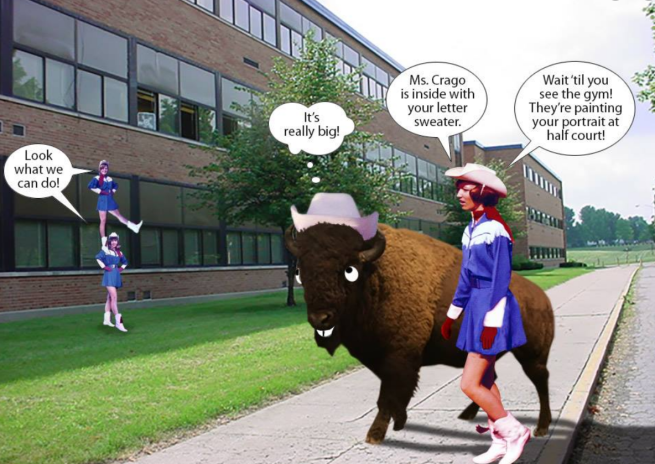
Beyond that, there’s the candor of being disillusioned after being at the top of the social pyramid, the destructively adolescent structure.
More to the point, what about the innuendoes regarding a faculty member’s sexual proclivities?
How provocative!
And I had already been wondering about that. Coincidence?
And I had also already been wondering about one Bell-Ette, two years older than me and the editor-in-chief of the school newspaper as well as a member of our church, who was engaged to be married after she graduated. Was she the disillusioned but very talented host of the site? For now, I’m inclined to say not. But don’t rule it out altogether.
Missing is the wonder of how we ever came to have a buffalo as a mascot in the first place or how our drill marching team came to be widely known as cowgirls. We were in an industrial city so far from the Wild West. How weird!

All of this had me recalling some dreams – literally, visions in the night – where upon awakening I imagined how I would have redone the Hilltopper, the school newspaper, to include everyone. I would have condensed the club stuff to an Eye or Ear on the Hill column, with snarky comments. And then had a focus for each edition: Food, Transportation, Personal Style, Jobs/Working, Free Time, Survival (advice to the underlings and to the future), Favorite Teachers (a sly way of suggesting who to avoid, if you could), Engaging the Arts & Entertainment, Electives, Dating & Relationships, Personal Style, Living with Siblings, Prepping for Summer, Graduation and Moving Up. That sort of thing, inviting entries for the next issue, too, open to all. The focus would have been on the whole possibility of having fun rather than trying to meet the standards imposed from elsewhere, including in the paper’s case, a remote scholastic press association and its judges, who misplaced our entries for a whole year, anyway, thus failing to give us any useful guidance or feedback along the way. So much for my failings as ed-in-chief, not that I would have had any backing in attempting such a revolution.
Oh, well, a few more missed opportunities in my life. And a few more letdowns from those who were supposed to support us.

Living in New England, I’ve found many people have ghost stories to tell, especially if they’ve inhabited an old house.
Maybe that’s why I found it so natural to see her family in that vein when it comes to my novel What’s Left. So what if hers takes place out in Indiana?
~*~
Have you ever experienced apparitions or something else that might be described as haunted? Have you heard others tell about their encounters? What do you think?
~*~


