Here’s a collection of captivating money quips, should you want to showcase your success and financial flair. Better yet, as I suggest in the Talking Money category at my Chicken Farmer blog, use these and others you come across as prompts for personal examination and study-group discussion. They’re more loaded than you likely expect.
Money can’t buy happiness, but it can buy freedom.
The best investment you can make is in yourself.
Money isn’t everything, but it sure does help.
The only way to have more is to make more.
Money makes the world go round.
The key to success is financial intelligence. (And what, dare we ask, is success?)
Making money is hard work, but it’s worth it.
Focus on making money and the money will follow.
The more you learn, the more you earn.
Wealth isn’t measured by money, but by the impact you make.
Judith seemed very happy to see me today. Very warm, smiling, affectionate but once her eyes tightened, like those in Children of the Damned, her voice turned shrill, terrifying. So strange, she.
I’m smiling easier, more naturally than back in January. Am more on personal salvation than on social action as I was a year ago.
Want someone but see how birdy the girls I’ve met are: seek strength/entertainment for their man.
Marj’s sister Hana talks-talks-talks, of her problems, her shrink, anything and nothing, she won’t shut up. She runs to new things, won’t finish. [And yet, I must confess decades later, I really desired to fuck her. Jail bait notwithstanding.]
My first trip into Susquehanna PA.
Marj’s stuff litters the kitchen: typewriter, textbooks, notebooks; sink filled with dishes from Monday, at the least
Ran into Judith on my way to swim (which then didn’t happen). Did take her through the car wash, “I haven’t had so much fun in years,” and then to Ross Park, where the animals looked shaggy, sad, bored – awaiting children. Repeated the Susquehanna route, with the barren tree hillsides resembling female pheasants. The river was sparkling turquoise aflame.
Judith insisted on picking ferns, “I’m such a naturalist. They look so sick with these spoors.” And she nearly fell in the river.
Back at my apartment, she climbed into my bed. Skin feels so nice, and sex on a friendship-only basis isn’t so bad – not enough, but better than none.
Running into Judith on campus again, she’s tense. Wants to get involved with Carl. That’s her trip. Read Springhill Mine Disaster, which Judith dislikes. She’s really afraid to feel, keeps cutting me off. Bad noos!
~*~
I was investigating some pretty arcane sides of English language and literature:
~*~
With another Tuesday off, I stayed up till 1:30 or 2 – reading Snyder. Very peaceful, like nights at IU.
Picked up a hitchhiker, it was Judith, so crunched uptight. [Am surprised she would stick her thumb out, big city girl that she was.]
This reaction of not writing: a reaction to five years of primarily writing?
Swam a length in butterfly, a must stroke now: great for back muscles and arms.
T.J. said I’m an ascetic. At first, it pissed me, but as his sister insisted, it’s an honor.
Feeling much better, free from hassles, but still miss a woman.
But then Hana showed up, yakking about her neuroses but doing nothing …
Leaving lights on and cleaning up nothing. Small pride?
Ajax got a job at the Chinese restaurant.
Molly/Polly/and him: talky, talky.
Hana, Marj’s sister, wants to know if I’m keeping the apartment over the summer, she’s hoping to stay but drives me up the wall. “Yesterday was the first time in three days I’d been outdoors,” “What was the weather like?,” “I dunno.” She’s like a three-year-old, needs to be led by the hand; offered to help me take the garbage down but left it at the first landing. Makes messes, doesn’t clean up. Flipped out because this guy she liked danced with every girl at the party but her.
She enjoys the sick little girl role. The simplest yoga poses are beyond her concentration.
Esperanza was really beautiful and sexy at the Latino concert, but she and Len are arguing too much.
Somewhere by now, Polly had remarked on how schizoid my life was, torn between the demands of journalism and what she thought should be grad-school for me. I was living as a grad student, essentially, hanging out on campus and among a college crowd.
[Incinerated]
~*~
From Spiralbound Hippies, with commentary from now.
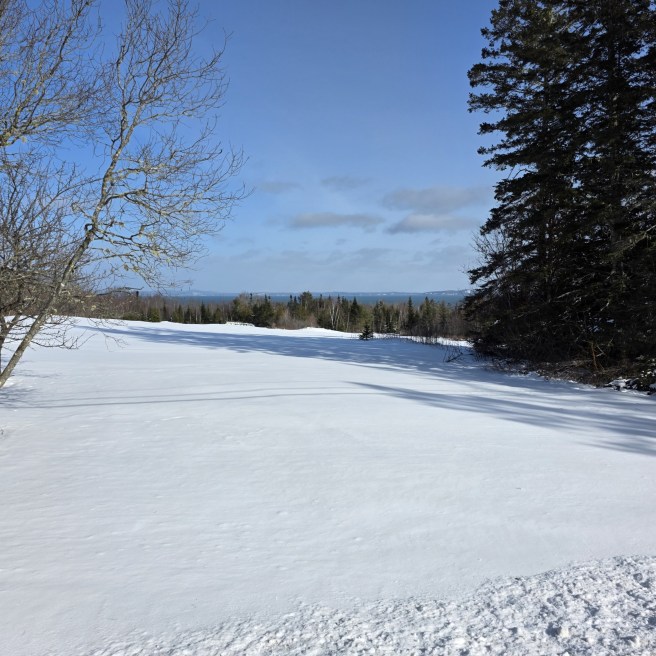
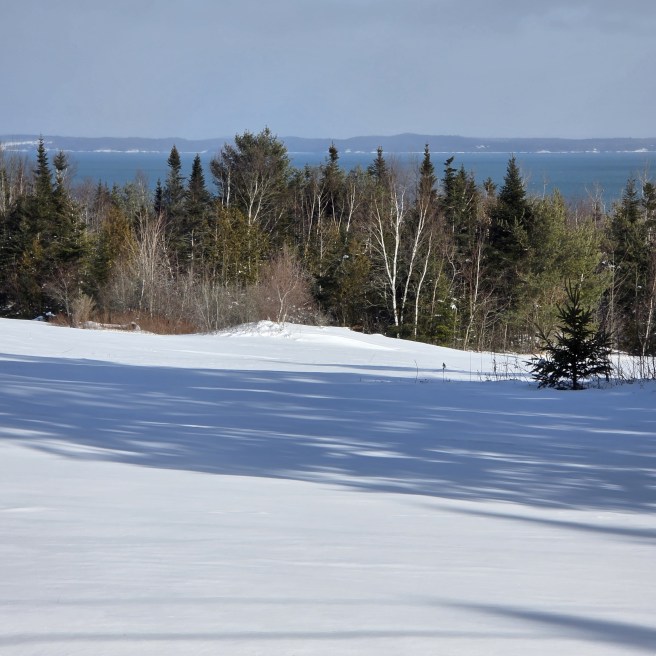
A snowy winter like the one we’re having reminds me of Upstate New York and the Poconos back then. The season’s longer and more intense than what I had growing up in southern Ohio and later in college in southern Indiana.
Here, though, I also have the Atlantic, as Passamaquoddy Bay, and Canada beyond it in the mix.
St. Pat’s Day, everybody in Binghamton turns Celtic. Just look at the high school marching band.
Pebble’s staying: too many dishes pile up, and trashy living room
After I went to bed, Pebble and Marj began whispering in the living room, just outside my door. Pebble’s so loud anyway, and then they started giggling and I heard cloth rustling, snaps, and a zipper, followed by heavy breathing, oohs, and aahs. When I awoke, they were sleeping in Marj’s room.
Pebble’s stuff is strewn all over the place, and the dishes are piling up very high. They have been leaving them for me.
~*~
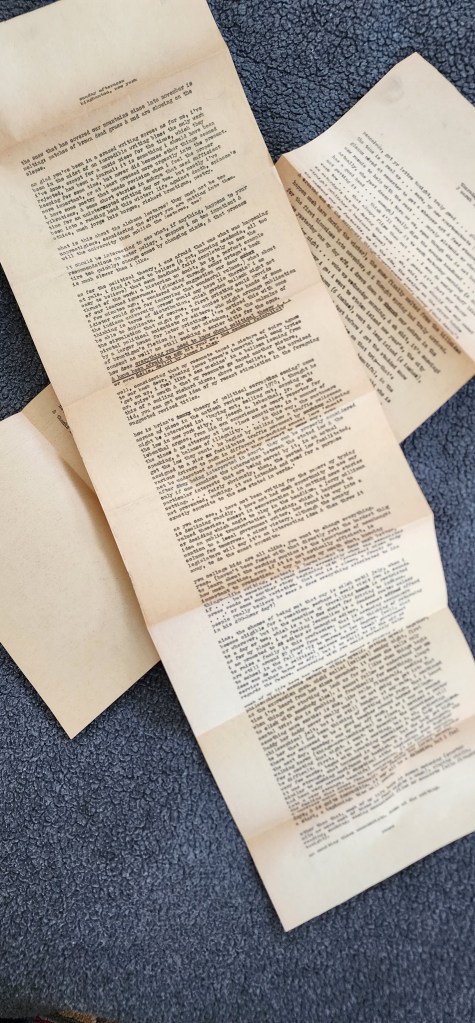
As for my typing, a la Kerouac, on long strips of teletype paper, which I had in abundance from the newsroom. It served me for both correspondence and my own drafts at literature.
~*~
Last day of winter: 2 inches new snow.
First day of spring: sunny and warm.
Getting my knee to touch the ground, closer to lotus. My body is a joy; it does some things I want now, like playing, standing on one foot and “flying.” My balance is improving. This trip started out on a downer.
~*~
From Spiralbound Hippies, with commentary from now.
Pain is the only powerful motivating force. With its variants of hatred, jealously, anger, etc., an individual can tap a strong reservoir of energy to push forward, either to reduce or eliminate the pain or to share it. That is, if the person is not incapacitated under their weight.
Can love or peace be as powerful? Or do they lull one?
By this point, I was getting addicted to the weekly hatha yoga sessions and had even visited Swami’s ashram in the Poconos. I’ll save those details for a more focused presentation later. Or you can read my novel, Yoga Bootcamp.
For now, here are some more mundane activities and thoughts from that period.
~*~
From Borges’ “Anxieties”: “Now that I have the secret, I could explain it a hundred different and even contradictory ways … Compared to it, science – our science – seems not so much more than a trifle … The secret, I should tell you, is not as valuable as the steps that brought me to it. Those steps have to be taken, not told.”
In my readings of the Inca: “In 440 years we have failed to eliminate the savage in music of language: Spanish remains the secondary tongue: the West has been defeated: the flute solo sounds strangely like jazz or Xanakis: there is hope for u.”
[Esperanza was originally from Ecuador!]
~*~
Headline writer
Poet of gossip
[Robert Katzman]
~*~
Meditation revelation: I was trained and conditioned to be a technician: me, the artist, a technician! Frightening thought! A technician knows the surface, not the heart or subjective substance
Swami: “Do not do the exercises on your own. You destroy your cells, they don’t have time to regenerate. Once a week will be much stronger.”
Two I may do, though:
Contemplate a candle flame.
Prepare for lotus.
~*~
Snow follows me wherever I go these days: here in the Poconos, also Staten and Long islands trips.
~*~
Surprised to get a letter from Fay and wrote a reply. Noted mine “sound manic but it’s not. How does one write about happiness? Or yoga, the Protestant atheist discovering God within himself, and Spinoza and a Quaker?” The latter item comes out of the blue, considering how little I knew of Friends. Once again …
Also wrote to Nicki.
Blue jeans, desert boots.
And Betty Ann said something like, “Hey, that’s a tough outfit you’re wearing,” and I answered, “Yeah,” She’s been mostly pouting, probably because I haven’t asked her out yet. She was dressing in a brown bibbed pantsuit.
With all the yoga, am going through such mind changes, perhaps the biggest in my life.
~*~
From Spiralbound Hippies, with commentary from now.
“Always carry a note-book. And I mean always. The short-term memory only retains information for three minutes; unless it is committed to paper you can lose an idea for ever.” – Will Self
“[F]ocus on your own journey, and try not to worry about what’s going on in the lane next to you. I know it’s hard, because it feels natural to compare. And sometimes it’s important, to know what barriers exist and how they impact marginalized writers. But from a productivity standpoint, the comparisons tend to do more harm than good. Because everyone’s publishing journey is different.” – Akemi Dawn Bowman
“Everyone has ups and downs at different moments, and paying too much attention to what other people are getting is only going to slow you down. Focus on the page, and the words, and do what you do best—write.” – Akemi Dawn Bowman
“We’re all students of the craft and every book we read is another chance to learn. Read voraciously. And write exactly the kinds of books you like best.” – Mindy Mejia
“Always stop while you are going good and don’t worry about it until you start to write the next day. That way your subconscious will work on it all the time. But if you think about it consciously or worry about it, you will kill it and your brain will be tired before you start.” – Ernest Hemingway
“Words have extraordinary power—their definitions and colloquial meanings, the way they evolve, and where they come from. Be deliberate and selective about the words you choose. Be voracious about collecting new words for your authorial toolkit. Always look up words you’ve never met before. And above all, wield your words for good, for creativity, and for the cultivation of knowledge.” – Jeff Zafarris
“You’re most likely going to spend a long time writing a book, and then more time promoting it, so make it something you’re passionate about so that even when you collapse into bed exhausted at the end of the day (or fall asleep on your couch with your laptop open, as I’m prone to do), you’ll feel fulfilled.” – Haley Shapley
“A successful career in writing typically takes too long to achieve to be writing something you’re not passionate about. Write from your heart, and write what gets you excited to sit at your computer every day. Most of all, make sure you have a life while doing it—exercise, teach, build, vote, explore, learn, grow, fellowship, and most of all, love. It will not only inform your writing but you’ll also be a healthier person for it, mentally and physically.” – Christopher J. Moore
“Write often. I won’t go so far as to say you have to write every day, but I do think you need to make this a part of the texture of your life, something that you do on a regular basis, like a workout schedule.” – Leslie Lutz
“Then, learn to let go. Let go of old drafts that aren’t going anywhere, or scenes that don’t work. Don’t spend months tweaking a fundamentally flawed project when you can move on to the wonderful new projects that are percolating in your head. The ‘you must start what you finish’ attitude—although admirable—can actually be a pitfall, because it prevents you from taking a necessary course correction when you need it.” – Leslie Lutz
Polly’s hometown on north shore of Long Island … Oyster Bay … her grandmother’s house Mully Hill … there’s no hill, the area a lot like Lexington horse country or Palm Beach. A little gardener’s house next door. Polly’s smoking Parliaments …
Sez she: “Your journal seems written with an audience in mind.” [Quite the opposite. And I should have been appalled by the invasion of my privacy.]
She calls her grandfather Chief. A terribly strong man. We heard from his duck blind the blom-blom of a shotgun …
Favorite words? Polly “far out,” Nicki “yuck,” Len “dig” or “stomp shit.”
I feel there’s this stranger inside me, the real me. The other self, the one I know, is an external shell, the intellectual/jokester/speaker/writer/observer/participant/moralist. The inner self is a pearl, an essence within a dark cave, surrounded by space. It is tormented by demons, driven by fears, seeks sexual release and union. One is rational; the other, irrational. Which is closer to God, I know not.
Marj or Judith, either or both: I’m afraid of a relationship, platonic or passionate.
Headlines? When top French radio show offers advice, astrologer is a big star.
Judith called to say she’d received an “A” in voice, it surprised her, though she’s one of the few operatic voices at Harpur. Her prof gives an “A” only to the elite.
Polly called to see if I’d join them for a movie. “Can’t, I just put a pot pie in the oven,” but she erupted, “Pot pies and onion soup, nothing changes.” That made me angry, why should I cook for solo mio? Now, if we go Zen macro?
Fay signed her postcard from Bloomington, “See ya!” I wondered how to take that. What was she doing there, anyway, rather than West Lafayette?
Ann [whoever] told of her new roommate who talks only of her boyfriend who has a girlfriend …
Started reading Gary Snyder last night: fine stuff. His entries seem to follow weekends: was this a journal, day-off work thing?
Nikki called, collect (2:30 now). Strange conversation, distant, she didn’t know why she called [repeated several times], too much to write: something about a 25-member commune, maybe Sufi, but soul searching, reaching, suicidal.
Somehow, I had expected her to call. Things are looking up. She would bring me down. I couldn’t follow her orbit.
[This was the moment, though, when I mentioned considering yoga and then chancing upon the notice the next afternoon. As I noted on the last page of my journal, “yoga – Steve, 723-7226, 7:30, 131 Clinton St,” a rather fateful commitment.
Of course, we believed there were little men inside our television.
~*~
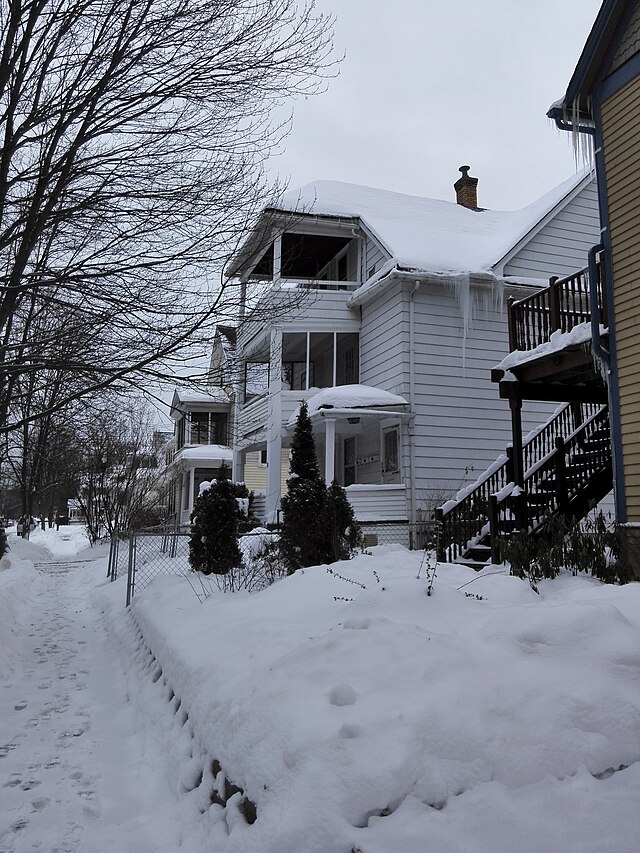
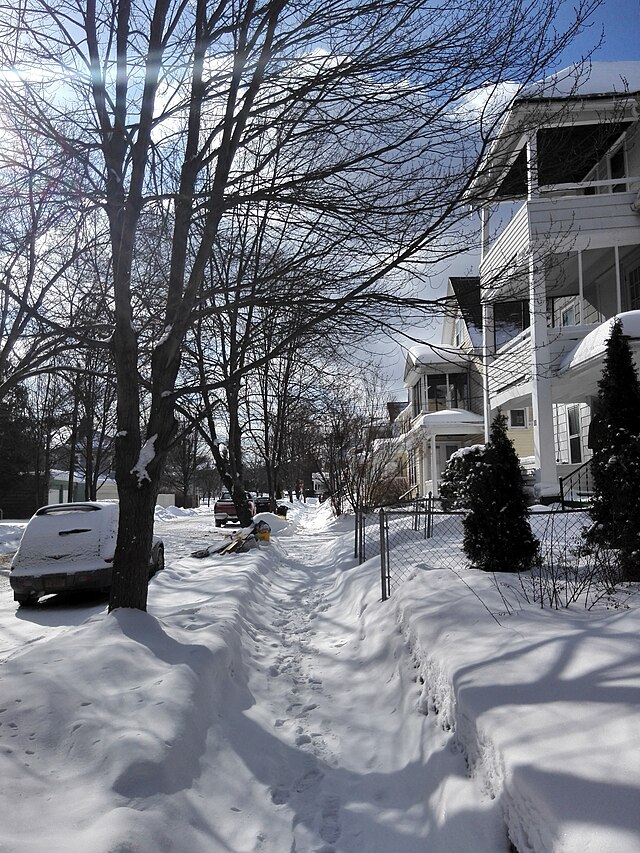
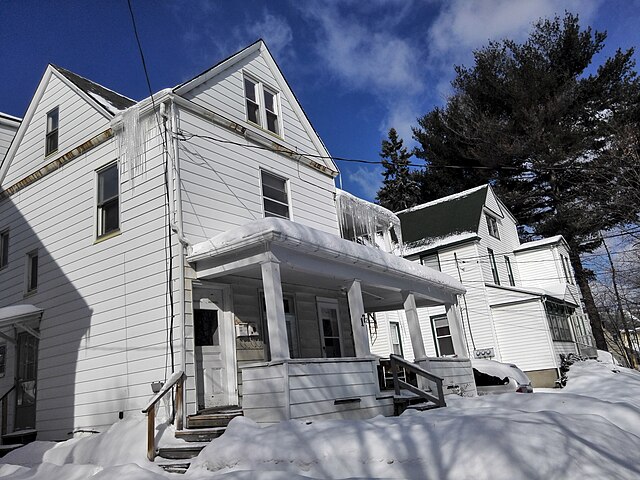
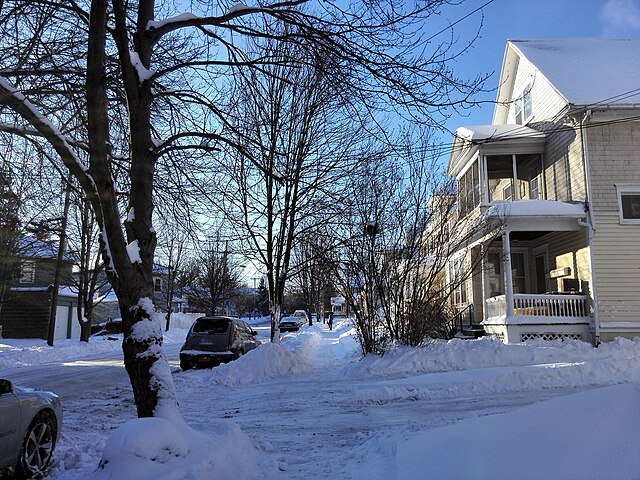
Although I had three summers in Binghamton, including a college internship, my only winter there had snow cover from Thanksgiving to nearly Palm Sunday, sometimes several feet deep. There was no place to pile it, either. January’s cold was brutal. Global warming lessened the Snow Belt lock by the time I revisited the region a dozen years later. These photos, from the milder winters, convey none of the exhaustion we experienced. Even so, it could be breathtakingly beautiful.
Photos by Liyuhanrenli at Wikimedia Commons.
Just about every time we thought it was going away, we got hit with a fresh round. The storms seemed to hit us twice a week. As I recall, the heaviest hit in March: a 24-incher followed by 30 inches and then a 36-incher. Our parking was already packed in on the street.
~*~
In the meantime …
Read Marj some of my Corinthian Columns: very fine shit but my arrangement of words is shifting: my prose style: how awful.
Reading piles around my mattress: self-imposed obligations and duties.
When I came home, wanted to play violin but Marj was studying but Marj was studying so I cooked noodles with mushrooms and broccoli while she watched.
How great it is to say that Sunday has been one of the most beautiful days of my life (had I gone to the Byrd tonight, probably would have overloaded my circuits.)
What shit I put up with from Nicki! Standup, standoff: why don’t I do that with others?
Snidely jumped out Molly’s kitchen window and ran away: dumb cat!
The Inca was king!
In revisiting these, I’m finding my Dark Age was quite fertile.
~*~
I could probably try to reconstruct the time sequence by weeks, but I did suspect the volume covered more than the two months between the holidays and the end of February, when the next volume begins. A lot was happening in the midst of seemingly nothing.
My updated perspective now accepts that I did, indeed, fill 150 to 210 pages in a little over two months. It was the cusp of a life-changing turning point.
~*~
Misc. loose slip of small notated paper: Doctors Bonebroke, Sickler, Dieman, and Hazard. As for Thelonious Panter? The small slip of paper was printed with Date, Instr., Period, Class, Absentees, and Tardy as the header and two columns to list the offenders. A school attendance document! Did I really find that floating, blank, on the street?
[Incinerated]
~*~
From Spiralbound Hippies, with commentary from now.
Sometimes, in blogging, an intended post gets caught unposted. Here one of those finally appears. My, it was drafted long before I lived this close to the sea.
however elegant, talisman bowsprits
cast gelatinous shadows
along shoreline and then blackened wharf
grappling irons of the hull or side gateway
expertly, the customs master inspects
postgraduate credentials in each captain’s script
and assesses the excise due
the crew, returning well-off in some dividend
of dexterity, superstition, and chance
fathoms contempt at the helm
some hauled fishing mesh or harpooned leviathans
or transposed merchandise from Shanghai or Liverpool
while privateers or warships are porcupines passing by
while on the other hand, coming downstream
through melting forest ignorance
deadly as any rip current, as any metropolis
with charts, rudimentary as
a canoe or kayak
traverse bitter
names for the same stars
argument or laughter, depending
on the embrace
in all that I found welcome
still, you know seasoned voyageurs
who will fear water
 Jnana's Red Barn