Looking around on social media:
Where has everyone gone?
You never know what we'll churn up in cleaning a stall
Looking around on social media:
Where has everyone gone?
 A Penobscot Bay windjammer cruise typically includes a lobster bake, though technically the crustaceans are boiled or steamed with corn on the cob. The event takes place on any of a number of uninhabited islands along the way.
It does mean going ashore, of course.

For the record, last summer I ate 3½ lobsters – hey, they were small chix – but a shipmate managed 6½, just shy of the Louis R. French record of seven. Had she known, I would have cheered her on.
For those of a more squeamish nature, hot dogs and other hot goodies are offered, along with gooey s’mores, as long as the wood fire continues.
For more schooner sailing experiences, take a look at my Under Sail photo album at Thistle Finch editions.
Thanks to my poetry and fiction enterprises in my supposedly free hours – well, they’ve rarely paid me, unlike my career in the newspaper office – the idea of having workspace at home has been a given all the way back to the mid-‘70s.
For other members of our household, though, it’s something that’s certainly taken hold since, well, before Covid.
When the downstairs became crowded once the renovation overhead got going, we soon felt cramped. That big printer provided by an employer, for instance, took up some prime tabletop real estate and a precious electrical outlet. We still had a smaller one for our own use. Then there were other things, like a traveling table for presentations, a ream of printing paper, hand-out literature, and it all adds up.
The kitchen table typically became overrun with two or three laptops, stacks of documents and notes, and perhaps a few groceries for one coconspirator. Just what would happen when we were joined full-time by the second, who has her own online ventures? We needed to plan for those.
What became obvious was that each of us could use a second room of our own for these labors. Or at least a room that could do dual service. One where we could even close the door on a project without having to pick it up and put it away for the night.
The smaller front parlor, once cleared of “temporary” storage, would return to use as one office and conference room and, as needed, overnight guests.
The back parlor, which had been my bedroom, studio, and laundry room, would become a dining and crafts room, likely also dedicated to the other coconspirator’s business. And, yes, some of those crafts.
The new guestroom upstairs held the potential of also accommodating some of my overflow. It would also need a desk for our son-in-law in his visits. His company had obliterated its own offices long ago, and he was almost always on call.
And you were wondering what we were going to do with all of that new space? Oh, my.
We still had two storage units to empty, too.
If you’re not a booklover but still think your story would interest tons of readers, let me tell you, Forget it.
An editor can tell immediately when somebody’s manuscript is from a non-reader.
~*~
For other wannabes, the big test comes in submission of a manuscript. Typically, the first step is in approaching small literary journals, but be warned the rejection rate is steep. When I began, it ran to about 20 rejections for each piece accepted. And that went for just one of the three to five poems that went out in each submission. And that was for established, recognized poets.
Another place to start is as a contributor to a local newspaper, covering local public meetings and the like. At least your work will appear in print or the equivalent.
Still, when I was submitting poetry this way, I managed to get more than a thousand acceptances. I have deep gratitude for the devoted editors and publishers who encouraged me, back when. We need more, should you want to step up.
I think, too, of all of the envelopes, clean photocopies (once that was acceptable), postage stamps, time involved researching addresses. It got pricy.
When I was actively submitting to the journals, I could never predict who would accept what, no matter how long I’d known a publisher or how carefully I had examined the publication.
It was a quirky process, this exercise of seeking homes for personal work. The reactions of editors and readers is so idiosyncratic and varied that the same poem could be considered too intense, by one, and not raw and bloody enough, by another.
~*~
The bigger step came in trying to land full-book publication. More was at stake, considering the costs, especially in a marginal niche like poetry.
As for fiction?
Approaching literary agents was generally a black hole. Few even bothered to return the self-addressed stamped envelopes. Book publishers, ditto.
I had some nibbles, even so.
Even with a few non-literary manuscripts, I was repeatedly running full force into brick walls.
And then ebook opportunities came along. It still requires self-promotion in search of a readership. So here we are.
~*~
At this point in my life, I’m backing off from the cutting edge, wherever that is. Hate to admit I’m also out of the loop and haven’t kept up with literary journals. As for the hot celebrated novelists? I don’t recognize their names. Of course, they don’t recognize mine, either.
The real challenge for both of us is encouraging others to read as an essential part of human understanding. Since you’re reading this already, I’m assuming you’re already active in that commonwealth.
Stay the course, please!
Am recognizing I don’t walk the way I used to – those long meditative strolls through Bolton Hill, Owings Mills, the North End of Manchester, or around the hill or along the irrigation canal. Maybe some of it is a lack of leisure time or a heightened sense of focus on other projects or just having my own estate to explore. One or all or in-between.
But Kurt, the long-distance runner, has become the mountain hiker instead.
~*~
The above notes came from perhaps 20 years ago.
What I see now is that many of those walks were to work out nervous jitters.
These days I’m far more content to just sit.
And, I hate to add, I’m slower now, too.
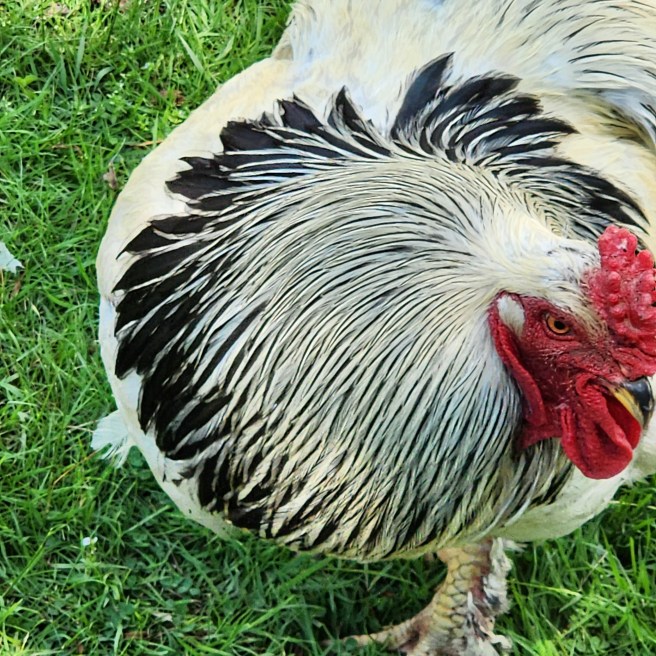
He doesn’t know who’s the true boss. That would be the Chicken Farmer in our family, and, yes, I still love her. She really does tend to some gorgeous chickens and their colorful eggs.
Even this far north, we’ve had our moments. Among the things to consider:
Upon graduation from college, in my social-activist period, I wondered how American society could possibly afford High Art while so many went hungry and homeless – domestically as well as internationally. Then I began to see everywhere a desire for expressiveness – in every ghetto, the ghetto-blasters and Playboy, spreads, graffiti and blues bands. To say nothing of the influence of professional sport, to which nearly every ghetto youth seems to aspire. (And more than a few others.)
So opera and museums and other “Establishment” operations came to lose their exclusivity in my vision. Extravagant expenditures in those realms are overshadowed by big-league athletics sports for similar reasons and then by military budgets across much of the globe.
See how much each person needs to reach into the realms of thought and imagination – the spirit; anything less reduces our existence to nothing more than economics, impoverishing everyone in the society.
So I noted.
By the way, Versailles still offends me.
You hate to lose.
Even diet.
Makes you see paying your bills
as a pain.

Not everybody on North Haven island has a basement, as we saw on a jaunt ashore. Think of it as local color, as seen from a cruise aboard the historic schooner Louis R. French last summer.
For more schooner sailing experiences, take a look at my Under Sail photo album at Thistle Finch editions.
 Jnana's Red Barn