When the icebreaker Thunder Bay visited Eastport last summer, I wondered why the Northeast would need one. And then I learned about the Penobscot and Kennebec rivers this time of year, as well as the mighty Hudson. Yes, they ice up even in the navigable tidal stretches.
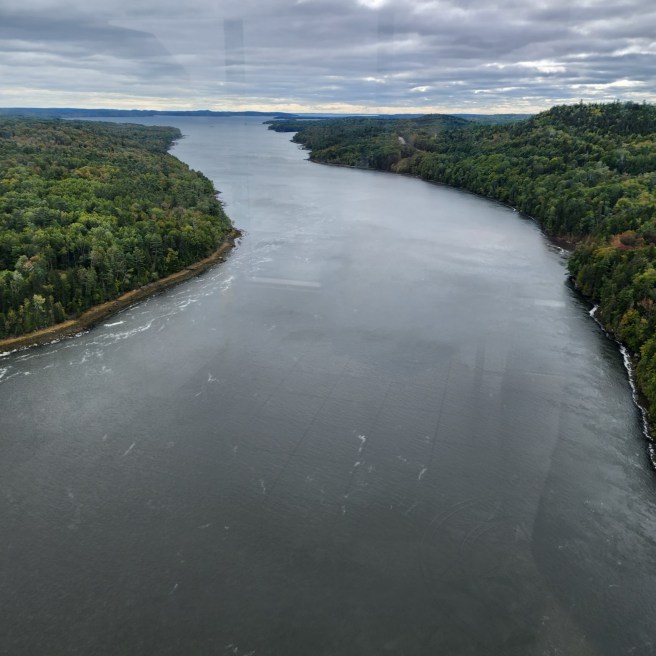
Here’s how the Penobscot Narrows look from the observatory atop the Fort Knox bridge:
Yeah, this is the big day for roses and chocolate and those mood-drenched candlelight dinners. Let’s put it all in some perspective.
Historically, it overlaps an ancient three-day Roman festival that included drunkenness, nudity, sacrifices of dogs and goats, and slapping by goatskins intended to heighten fertility. It was something the early church tried to deflect by invoking Saint V.
As for the saint? The bio gets mysterious. Did the man really exist? Or was it eight?
The oldest printed card, 1797, cited a day the sender desired to “be your Valentine.” Whatever that meant.
The Quaker Cadbury chocolate company introduced the Valentine’s Day heart-shaped box in 1861 but failed to register the design. Copycats soon piled on.
About a billion cards are sent for Valentine’s Day every year, second only to the 2½ billion at Christmas.
Nasty cards have also been part of the tradition. Ever get a “vinegar Valentine”? Anyone else intrigued?
It’s big business – by one count, $27 billion pre-Covid, with candy – mostly chocolate? – the biggest gift, followed by cards, roses, romantic dinners, and, for ten percent of recipients, jewelry. Not that you’re limited to just one category. And I’m not sure if the ranking is by the quantity of each one or by the amount spent.
As for that jewelry? Much of it takes the shape of engagement rings – with six million being presented on the day every year.
In Japan, women are expected to give the chocolate.
Teachers receive the most cards, maybe because children age six to ten, exchange the three-fifths of the cards overall.
So far, I haven’t found perfumes, love potions, or aphrodisiacs on the list.
Yeah, a big Seven Five. Amazed I’ve survived so long, considering much of the stress and upheaval earlier.
The achievement comes with a burden of feeling I’ve failed to accomplish so much of what was expected of me – even without appropriate resources or support – as well as an amazement at the twists my life has taken along the way.
Perhaps that’s a generational issue many of my peers feel. Please weigh in.
Meanwhile, the serious political crisis in America’s future leaves me feeling utterly terrified. Quite simply, we failed to preserve the republic, with the assault coming not from a Commie left but rather by the know-nothing, no-saying, me-first, destroy-it-all right – those who would conserve nothing, despite the label they cling to. Along with their superrich allies.
Let me admit that at one point in my development I would have claimed to have been a Goldwater Republican. These folks are way to the right of that, like the hoards that destroyed Rome. Yes, ready to sack and ravage. Could they be the dreaded zombie hoards awaiting in the ultra-wacko wing?
I was amused recently by a Project Runway Junior’s challenge that had the teens trying to define themselves (blame my beloved elder stepdaughter for my even watching the streamed series). How would I have seen my core at age 14 or even 17? Quite simply, I’d say we were all so confused.
So here I am, once again pondering how we ever wound up in this state.
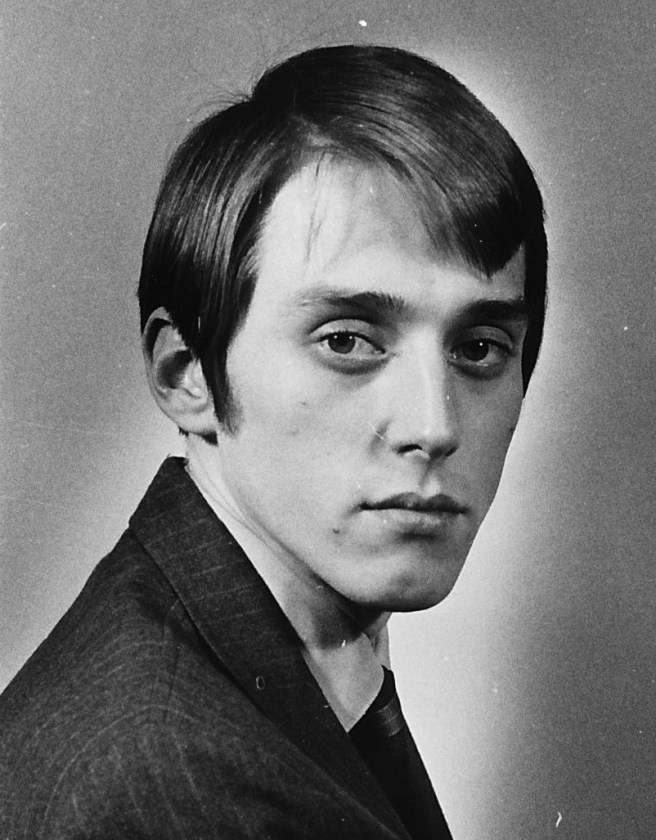
Me, back as a cub reporter.
Personally, it’s been what I’ve seen as a zig-zag journey, building from what I heard in a poetry reading by John Logan in the very early ‘70s.
Much of what evolved in my encounters can now be found in my novels and poems, though my last third – and most fulfilling – years are yet to be expressed, apart from flashes here at the Red Barn.
In short, I’ve moved far beyond my expectations of things like Paris Review and the haute literary scene or some upper middle-class comfort.
There were 25 years in my native Ohio, most of them early but with two returns to other corners, one in my 20s and another a decade later. But they ended in ashes.
To my surprise, there are 42 years in the Northeast, 36 of them in New England. Well, technically Maryland isn’t quite Northeast but as Eastern Seaboard, I’ll include it.
Throw in four years in the interior Pacific Northwest, four in southern Indiana, and a season in eastern Iowa.
Plus a childhood I’m finally admitting was dutiful, not “happy.”
Two years later, between southern Indiana and Upstate New York,
Many people my age find themselves living more and more in the past. I, in contrast, want to live more and more in the present – having dug out through so much of what has guided me here, to the easternmost sliver of the continental U.S.
When I’m 80, I will have lived half of my life in the Northeast.
Unless another twist pops up before then.
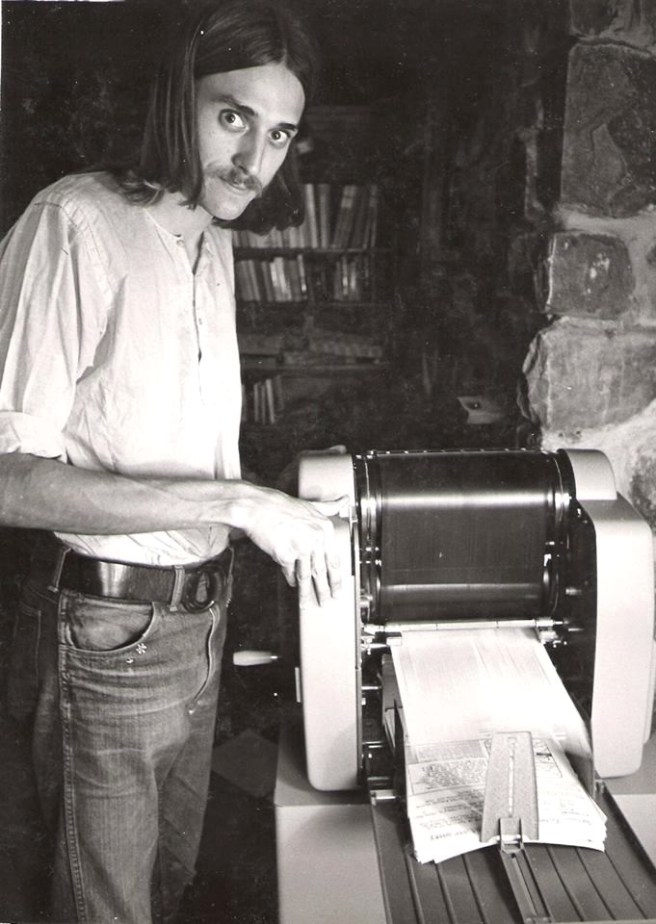
And two years after that, as a young yogi running a mimeograph printer.
Quite simply, to make truth subjective muddies the water and likely denies the existence of any external standard of measurement. Or, from another perspective, to impose “my truth” will quickly make everything unreal. End of argument, if you must.
Or, for perspective, Donald Trump manages to negate the rest of us and all science. The world becomes flat, OK? And insanity rules.
In contrast, the concept of a universal Truth exists as a perfection outside of our individual perceptions. It’s something to reach for. You know, the way one and one is two, no matter what. (Except, maybe, in some higher mathematics that nevertheless remain rigorous.) It’s the basis of logic, so without it, everything is illogical. You know, one Truth. As in either/or.
I do wonder if that imposes a monotheism, even when coming from Greek philosophers. One God rather than some chaotic, even neurotic, confusion.
To say, however, “It’s my reality” is far more on target.
Yes, “My reality” in contrast to “My truth.” I can buy that. Now we can talk. After all, feelings are real, even when they’re wacko. And dreams, however fleeting, are another reality.
Through that, too, I have come to recognize times when both sides in an argument are right as well as when both sides are wrong. Forget Aristotle here.
For now, let me point you to my booklet Seeking After Truth, available for free on my Thistle/Finch blog.
Seeing this photo of the painted rock along the state highway in Newbury, New Hampshire, had me doing a doubletake. Twice.
First, I realized I have never seen it in winter. Even in summer, it’s easy to miss, and I can’t recall any reason I would have been up that way other than August.
Second, though, I slowly noticed the lettering is different. It’s obviously been repainted, which is supposed to always be done on the sly, and this time the lettering is thicker, bolder.
The slogan and its history did inspire a blog related to the Red Barn, and if you haven’t visited there, please take a tour. It can be an enriching experience.
There were no banks and you couldn’t write checks.
Were dried fish and lumber so valuable in Britain and the Continent that you could still make a fat profit shipping them across the ocean? Furs, I can understand, as well as the hunger for gold and silver, which may have fueled speculators who were inevitably disappointed. Plus fish, likely dried.
As for paying your workers? A daily portion of rum or the like was apparently often part of the deal.
By the way, Quakers were in the forefront of developing banks and insurance and even packet shipping in time.
The early colonies had layers of ownership, starting with those demanding annual quitrents for the land you would clear and build on or have “purchased” with any improvements. Then there were the chartered investors, like Lord Saye and Sele and Lord Brooke in New Hampshire’s case, who somehow expected to make a profit overseeing the place. They still had obligations to other investors, like the Council for New England. I’m really unclear how all of that worked in practice or what they got from “selling” their charter to Massachusetts.
The best I can come up with is that it was a kind of private enterprise tax, though I’m not sure what was offered in return. Like Mafia “protection” or layers of graft?
And that’s even before getting to England’s heavy mercantile system that hampered American entrepreneurial opportunities. The colonists were expected to provide raw materials for manufacture in England before being sold at hefty markups in the New World, too.
How did the colonists ever thrive, all their hard work aside?




 Jnana's Red Barn