The collapse of NBC

I don’t mean the cracker company, either, the one known as Nabisco, for National Biscuit Company. Or was that Baking?

No, I’m thinking of what was once the broadcasting monolith, first in radio and then in television, the one that projected a peacock logo at the onset of color programming.

The financial struggles for traditional mass media in the digital age are well-known, but broadcasting has been hit perhaps even more drastically than newspapers.

As a child of the ‘50s and ‘60s, I’m still shocked at the disappearance of AM radio, especially its powerhouse clear-channel signals. My daughters, savvy as they are in tech matters, don’t even know what AM is. These were coveted media, and getting a license for even a daytime frequency in a metropolitan market could be a coup. Think of WKRP in Cincinnati for the insider view. Instead, though, owners have allowed many of these to go silent. As for FM? The real competition is from streaming and satellite.

We gave up our TV years ago after realizing that whatever we wanted to watch was available online. Still, I was stunned the other day to discover that NBC no longer has an on-the-air outlet in Boston. That was unthinkable. Nobody would give up a network affiliation and go independent. Yet, as I learned, it isn’t anymore.

The trigger came the other morning when I was gazing at my Yahoo news feed and clicked on the latest Patriots football gossip from NBC Sports Boston, one of the primary regional sources. Wait, I thought. Why isn’t this identifying a station? Or at least a channel?

And that’s when I went down the proverbial online rabbit hole and found out that the once mighty network exists solely on cable in the nation’s tenth largest media market. Even the Tonight Show.

As for its entertainment lineup?

There are good reasons we’re turning to the new seasons at Amazon, Netflix, Hulu, etc. Besides, we can watch those shows at our convenience, not the network’s.

I must admit finding it hard to keep up with all of these changes. How about you?
Given a unique identity and purpose

SHOPPING FOR A PRESENT TO GIVE ME, she winds up in an antiques store, where the clerk finally sells her a Quaker Mixing Bowl from the 1800s – a slight crack, with QUAKER embossed on the side.

How delightful! Quaker style is, after all, distinctive … and part of me.


I’M CONTRADANCING IN WINONA. Turns out it’s Sunday morning and I’ve missed Meeting. (Fun versus the Old Folks.) Later I’m trying to help a Jewish group use the meetinghouse for their worship … a place we can share.


WITH A MALE COMPANION EXPLORING around the Beltway in Baltimore County. (Picks up on another dream, a year earlier.) This time I’m trying to locate a former Quaker stone meetinghouse and burial ground. A burial ground I find behind a motel is not the right one; another effort, and the road ends abruptly in a golf course.


IN A PARK-LIKE GLEN, MIXED FIELDS AND TREES … from a hilltop looking down toward a small stream and a black steel shed – a fieldhouse with bleachers – run into a few other people and we enter for Quaker worship … my suggestion of circling together countered by “No, others will come,” and soon both halves of the building are full – mostly young people – a solid worship.

Somehow feels like my ancestral Hodgson dreams with the New Jersey twist. Looking back, I seem to also recall a Poconos/abandoned steel mill feeling.

Exploring the park later, find lots of sleeping bags available for borrowing – REST! – so that’s where everyone came from?

Soon I’m in a white-walled plain room – under a fairgrounds grandstand or a livestock auction? At a long table, one of maybe a half-dozen, old-order Brethren or Mennonites – I’m their guest, eating very tasty sirloin tips, which my host pushes away from me before I’m finished, and everyone else pushes their dishes away – we all slip into prayer, a worship service with testimony, and while my host keeps trying to prompt me to speak, I wait and defer – even when we get down to time “for one more,” I yield to two women. “I came to listen,” I explain later.

In both, a sense of rich worship. So much so that real Meeting for Worship felt like the third one that morning.

A sense, too, of Elijah’s 8,000 remnant or the cloud of witnesses or the circle of elders in Revelation:

WE’RE NOT ALONE

If you’re a self-published author, how do you stack up?

Yeah, we want folks to read our work, but we do dream of fame and riches, right?

Now, for a splash of cold reality.

  1. Even though a lot of authors are turning to self-publishing their own books, most don’t sell many copies. The typical self-published author sells about five copies, according to one report, while another has the average at 250. I’m guessing that some really hot sellers pull the average way up over the mean, kinda like winning the lottery.
  2. Another report has the average book now selling fewer than 200 copies a year and under a thousand copies over its lifetime. At the bottom, 90 percent of self-published books sell under a hundred copies. Not a lot to crow about, is it?
  3. On the other hand, self-published books account for a $1.25 billion annual market. At Amazon, that comes to $520 million in royalties. (As a self-published author, my royalties on an ebook rival what I get for a paper edition.)
  4. At Amazon, more than 1,000 self-published authors made $100,000 a year. Well, there goes a fifth of those royalties.
  5. For many authors, one secret to success is in having a lineup of titles rather than relying on just one. In that light, the average self-published author makes $1,000 a year in royalties, according to one account.
  6. But, back to the mean, a third of self-published authors make less than $500 a year and a fifth report making no income.
  7. New book sales don’t account for library patrons or the used book market. Used books? I don’t see ebooks showing up at yard sales. Consider that an advantage.
  8. The average American adult reads just 15 minutes a day, according to one survey that apparently doesn’t considering texting. On the other hand, just what are the others looking at on their phones?
  9. Still, if you’re an author, don’t quit your day job, OK?
  10. Only 1 percent of audiobooks on Audible are self-published.

Sometimes a little curiosity falls into place

You know, you drive past a thousand times and finally decide to explore a side street.

That’s what happened in Dover when I had a half-hour to spare before my presentation at the public library.

Upper Factory Road off Tollend was the excursion in question, and I was curious to see if I could actually get a glimpse of Kimball Falls in the Cochecho River through somebody’s back yard.

Yeah, suburban-style sprawl.

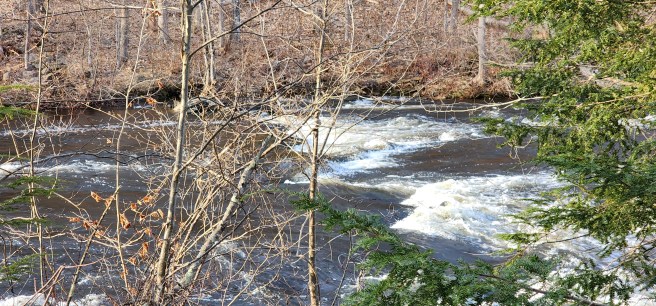
What first appeared was this falls, or rapids, at the foot of the trail. It’s the fourth of six falls as the river runs through Dover, though some of them are more accurately rapids. (I’m guessing there’s a nuance of meaning I hadn’t gotten previously – a waterfall seems to be a more clearly defined kind of “falls,” in contrast to fast-running streams like Jones Falls and Gunpowder Falls in Maryland as well as the Salmon Falls River abutting Dover.)

This one would have been the site of the Dover Cotton Factory, which bought the land before 1820, erected a dam, mills, and housing, and sold it in 1830, when the operation moved downstream to the first falls, now the heart of downtown.

Whittier Falls, which are discussed in my book Quaking Dover, were the second set going upstream.

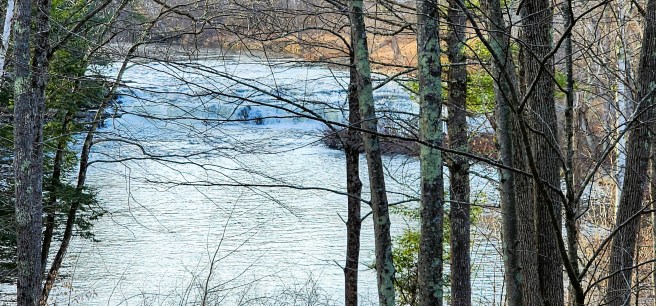
To my surprise, Upper Factory Road actually leads to a small trail down to the water, along with a twist along the riverbank to a definite waterfall. Alas, that part was too wet to use at the time, but it is on my list for a future trip.

Upstream I could see an actual waterfall, where water pours vertically from a lip into a pool
The water level was up, thanks to recent rain and melting.

Checking the aerial map when I got home, I realized I had frequently passed the falls on the community trail on the other side of the river, but the path had veered too far inland for a direct view. But you can definitely hear them, as I recall.

It’s rather surprising how much you can find in what’s essentially your own back yard when you look. Or, perhaps more accurately, know what you’re looking for. I lived in Dover 21 years and found this 2½ years after I left.

By the way, there’s no Lower Factory Road.

What is it that makes a waterfall so appealing?

Did you know about the war between the U.S. and Canada?

More officially, it’s the Aroostook War a.k.a. the Pork and Beans War or Madawaska War of 1838-39 over the international boundary between Maine and the British province of New Brunswick.

Although militia units were called out, no actual fighting took place.

Well, there was a skirmish between armed lumbermen, the Battle of Caribou, in 1838.

The dispute was settled by negotiations by British diplomat Baron Ashburton and U.S. Secretary of State Daniel Webster in an 1842 treaty.

Without getting into the myriad details, it is how the Aroostook County towns of Fort Kent and Fort Fairfield got their full names. And most but not all of the disputed territory wound up in the USA, with Aroostook County being formed in 1840.

Reported casualties came from accidents and disease rather than actual combat.