Getting acquainted at our dock in Camden
Safety talk
And everybody gets to pitch in
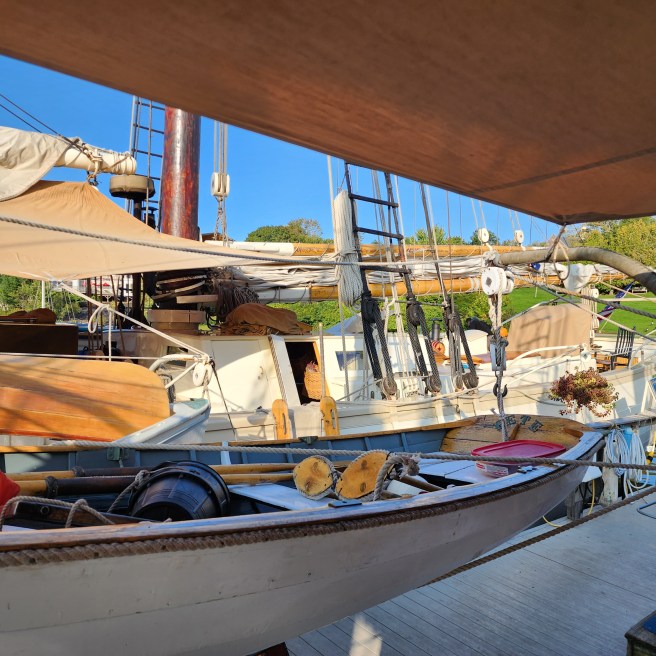
14 passengers, short of 21 max
(few of the double beds have two booked this trip)
crew of four plus cook
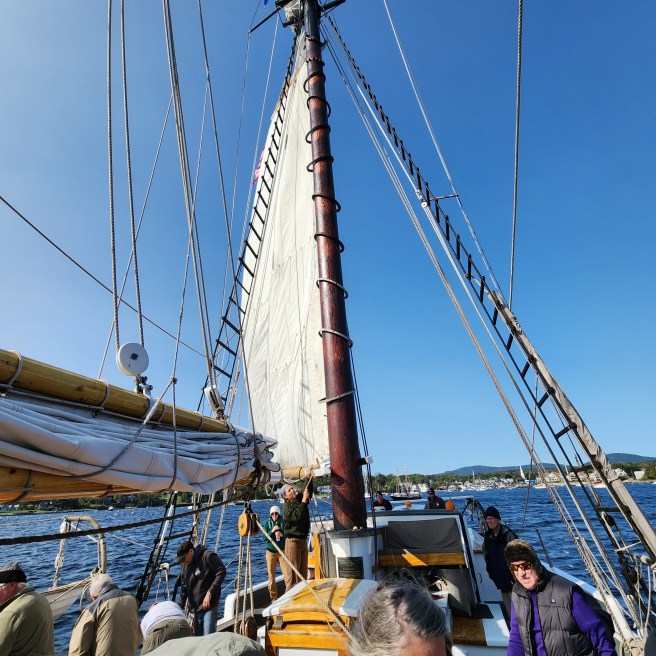
and we scoot off
You never know what we'll churn up in cleaning a stall
Getting acquainted at our dock in Camden
Safety talk
And everybody gets to pitch in
14 passengers, short of 21 max
(few of the double beds have two booked this trip)
crew of four plus cook
and we scoot off
Starting this project was like being buckled into a big roller coaster, say the legendary Son of Beast just north of Cincinnati, or finding yourself pregnant, or so I’ll presume, either way resigning yourself to going along for the ride, wherever. Well, in either of those examples there is a destination, and we’re assuming there’s a fine outcome here, too.
I had no idea how much I didn’t know the morning Adam showed up with his tools.
Let me relate how relieved I was to learn that we could still live in our house during the renovations. Stories circulated of people who not only arranged for accommodations where their crew could live during big renovation projects but also had to clear out themselves for the duration.
Look, our financial pockets aren’t deep. We’re addressing my lifetime savings, unless my novels somehow turn out to become blockbuster bestsellers, even at this late date.
Taking more than a few deep breaths, then?
Adam hit the ground running.
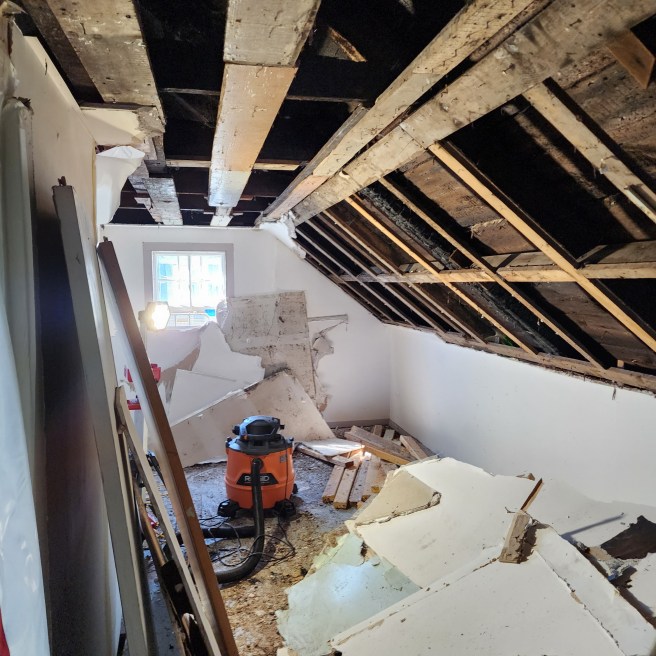
At the end of Day One.
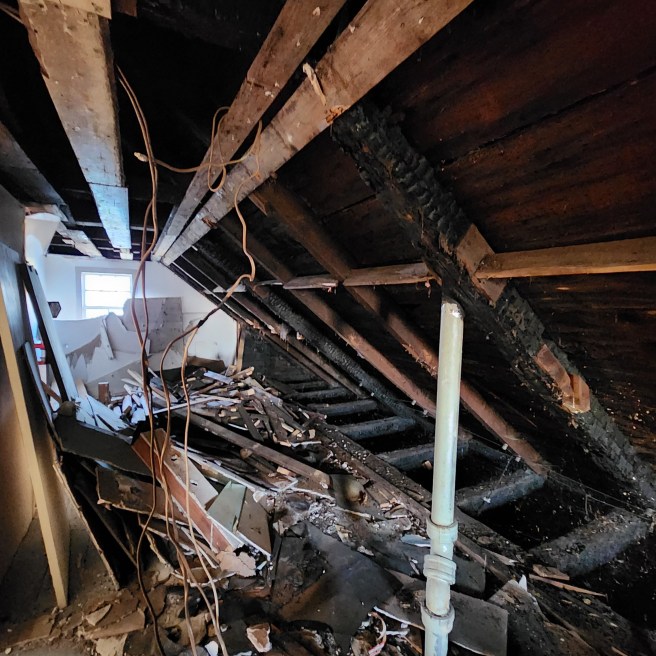
And Day Two.
Once we were underway, I was impressed by the measures that were taken to minimalize the spread of dust and debris and I would like to acknowledge those.
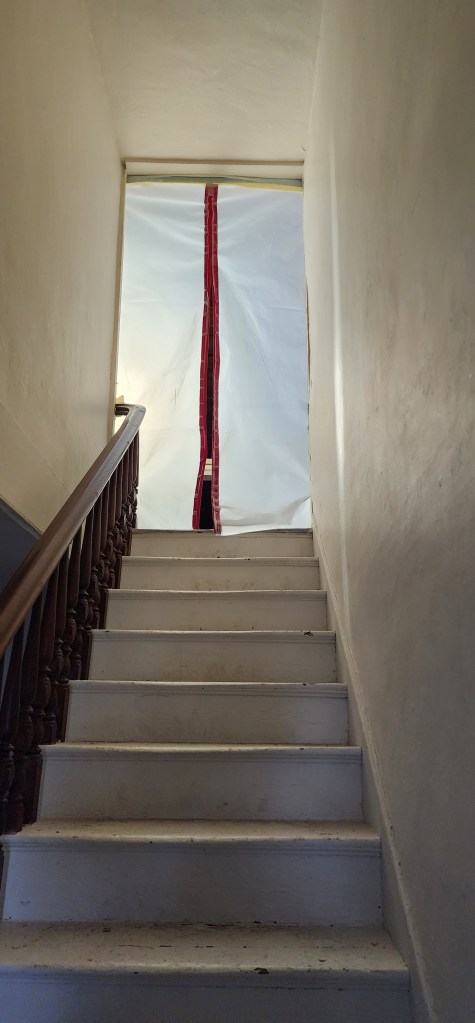
The zipper doorway to the second floor was the first step. And when working on the main floor, Adam erected clear-plastic envelopes he could work within. Made me think of the so-called “state rooms” on the historic schooner I sailed on last summer, where every inch was treasured. Adam’s power vac became a familiar sound.
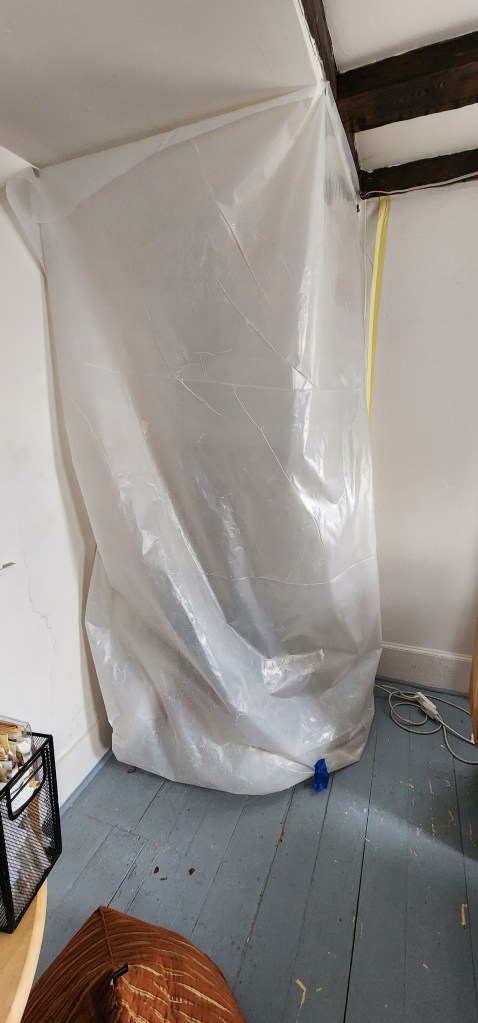
It wasn’t the only place he was fastidious. I would never get my sawing accurate to 1/16 of an inch, especially not when dealing with an old beam underneath that was a half-inch shorter on one side.
Do note, a lot of unsung artistry goes on in projects like this. As well as a lot of weird shit, done by rank amateurs, those whose weird decisions you discover along the way. Long ago, on projects on our little city farm back in Dover, we realized there are many, many very good reasons for modern building codes and for the inspectors who ensure they’re followed.
Also appreciated were the health measures of venting the upstairs or wearing earplugs and a face mask. Our previous carpenter, back in Dover, discovered the hard way about the alternative, hearing loss, and maybe the lungs, too. I don’t know what to advise about plumber’s knees, either.
By being able to be present when all this was happening, I did get to follow the action. I’ll hope you, too, finding that entertaining.
A LAW by the very meaning of the term includes supremacy. It is a rule which those to whom it is prescribed are bound to observe.
Alexander Hamilton in Federalist No. 33

Edmunds Township
It’s one of those days when I can’t put two and two together as one.
The random notes in no particular order continue:

I get to sample the results of many experiments around here.

My first encounter with concrete and minimalist poetry came as an art exhibit in the late ‘60s. Maybe I already knew of otherwise traditional verse presented typographically to represent a visual image on a page – a vase or bird, perchance – but this time, the words themselves took on an independent visual wonder. Think of Robert Indiana’s famous LOVE as a cube of giant building blocks.
The writer I most appreciate in this field is Aram Saroyan, the son of a famed Depression-era novelist. Aram came to fame at age 20 with a one-word poem:
which became a source for right-wing scandal when it won a $750 award from the National Endowment of the Arts. As conservatives charged, it wasn’t spelled right and it wasn’t a real poem anyway. Things got ugly.
Others, me included, find it a vibrating both in the thought and the image. If that silent “gh” adds something to the sense of the word, either as illumination or as featherweight or even carefree, why shouldn’t two intensify the sensation?
It revives that wonder and puzzlement we’ve all felt, but many writers, I think, more keenly, when we first encounter many quirks of the English language but then later glaze past.
In this vein, Saroyan also has a playful
as another entry.
His small collection, Pages, has traveled from one side of the continent to another with me. A downside of these works is that they don’t work at an open mic or featured reading. They really do belong to the page.
For my own ventures along these lines, check out Sun Spots and Drumming at my Thistle Finch blog as well as the weekly Kinisi entries here at the Red Barn.
Where do fruit flies come from
even in the dead of winter?
So who was Louis Robbins French?
Father of the three sons
who built this in South Bristol, Maine

The French is 101 feet overall, 65 feet on deck, with 19 feet of beam, as the brochure proclaims. She draws 7.5 feet with a full keel. A proven vessel in all conditions, she is a nifty and quick sailor, having won the Great Schooner Race many times. The French has also participated in recent Tall Ships gatherings in Boston. It spent part of its life based out of Lubec just south of Eastport.

the French was largely stripped and gutted
and rebuilt for passengers
what’s left?
As my buddy Peter grinned at me at the end of our week:
“Your first love. You never forget.”
 Jnana's Red Barn