What do you mean, how do I write?

Isn’t it obvious, one word at a time? Except it’s more complicated than that, and every writer approaches the deed differently.

I would like to approach a writing project the way Neal Welliver did his large-scale paintings, starting in the upper left-hand corner and finishing in the lower right. He worked with a tightly defined palate, too. Instead, I wind up more like Mark Rothko, painting over earlier parts, adding or scraping off layers – what’s known as “painterly.”

For novelists, the difference is posed as “outliner,” meaning someone who starts out with an outline and pretty much sticks with it, versus a “pantser,” going by the seat-of-the-pants with perhaps a vague sense of a destination, which may very well change en route.

You can guess which camp I’m in. As another artist put it, what’s the point of putting all that work in if you already know the ending?

For the record, I hated outlining when it was assigned as school homework. It seemed redundant.

~*~

I don’t like formal prompts, by the way. Instead, I often start with something that keeps nagging at me, the way the flash of a trackside worker in Brooklyn – a gandy dancer – turned into a subway line hitchhiker. (Maybe that third element, the unique word, turned the trick.)

As a project percolates, so do related ideas during the rest of my day, leading to piles of scribbled notes to weave in. When I lived in New Hampshire’s seacoast region and worked in Manchester, I had an hour commute in each direction, largely through rural country. I kept a notebook and pen at hand as I drove. Likewise, some of my favorite lines in What’s Left came to mind while swimming laps in the city’s indoor pool. As soon as I was back in the locker room, I was scribbling. Getting up from the keyboard every hour or so, sometimes adding a short walk, also works wonders. As a journalist, some of my best headlines came on my way to the men’s room or back.

Much of my writing then becomes the way of connecting two thoughts or flashes.

Outtakes from other projects also get recycled, though they rarely wind up quite how they began. I’ve drawn heavily from correspondence, maps, and photos as well, as well as silent meditation. As has been said, some of the best barns in New England were designed in Quaker Meeting, and it is amazing how many problems get worked out by stepping away from them.

~*~

As much as I’ve longed for an editor or a partner truly in sync with what I’m about, that hasn’t been the case, not since my first lover, back in college. Instead, I’ve been a lone ranger. It’s meant putting big projects aside for several months or even years before coming back to them afresh.

~*~

There are also the epiphanies when a character starts dictating the story, as well as the times of slogging through mud.

I should also mention learning from other writers, especially by example.

~*~

Determining when a work is finished is usually a mystery. My high school art teacher used to say I either stopped too so or else overworked a piece. I’d prefer too soon, since my usual taste leans toward austere. Think Quaker, Shaker, or Zen.

Another answer would be that I stop when I have nothing more to say on the project, for now. Or, as I’ve heard elsewhere, when the writer just gets tired of it.

As a newsman, a more common answer was the arrival of a deadline.
No time for extended deliberation

Of all the cares or concerns of government, the direction of war most particularly demands those qualities which distinguish the exercise of power by a single hand. The direction of war implies the direction of the common strength; and the power of directing and employing the common strength, forms an unusual and essential part in the definition of the executive authority.

Alexander Hamilton in Federalist No. 74

In making public presentations about my book

I came to love the question-and-answer period, but there would typically be one that threw me for a loop. Yes, the ones I wish I had answered better.

For example:

How could you sleep after writing some of the sections?

I did quip that a martini before bedtime helped. I could have mentioned the realities of working as a newspaper editor and having to face daily atrocities abroad and close at hand.

You developed ways of putting it behind a plexiglass shield, so to speak. Not that it always worked.

What was it about Quakers coming back for more trouble?

They had a lot more in common with the Puritans than we’d like to admit and no doubt saw them as falling far short of the goal they proclaimed.

The Puritans of Massachusetts Bay and Connecticut weren’t the worst, by the way. Historian John Carroll suggests colonial Virginia may have been even more severe but undocumented.

I wish I had mentioned that the concept of a loyal opposition springs from the Quaker Peace Testimony, and that the two-party system originated in Pennsylvania.

Do you need to be a protester to be a Quaker?

Nope.

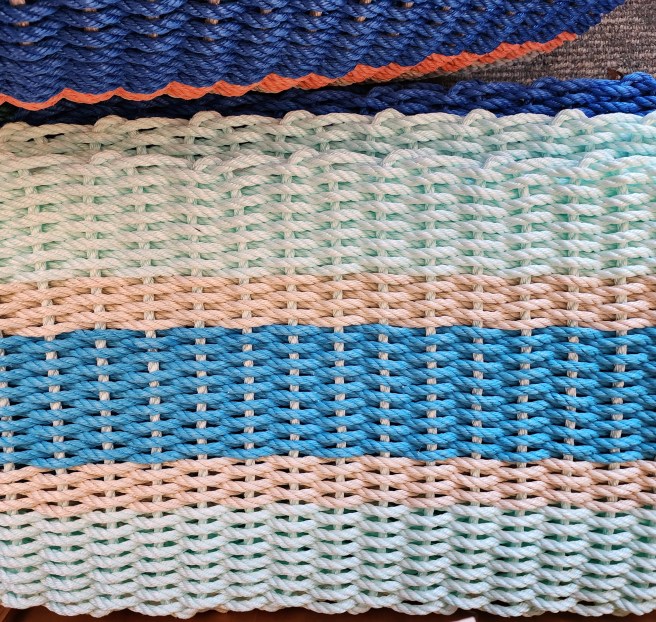
Lobster rope doormat

Colorful, hardy, distinct, and local. I am surprised by how much they’re going for online, compared to what our galleries and boutiques are charging here.

Once used to tether lobster traps to their buoys, the polypropylene or polysteel rope has many other nautical uses, where it’s touted as “marine-grade commercial fishing line.”

It shows up in creative baskets and other woven items, too.

Some disturbing trends about suicides

In my March 19 post noting the arrival of spring, I noted that the months of April, May, and June are generally the leading time of the year for suicides.

Among other trends in the United States, consider:

  1. Males are almost four times more likely to kill themselves than are females.
  2. Guns are the most common form of suicide, accounting for more than half of the deaths. Suffocation is second, at one-quarter, and poisoning at 12 percent.
  3. Between 2001-2020, suicide rates rose roughly 36 percent.
  4. It’s the tenth leading cause of death overall.
  5. By age groupings, people 85 and older have the highest rate (22.4 per 100,00), followed by 75-84 (19.6) and 25-34 (19.4). For 35- to 54-year-olds, it’s the fourth leading cause of death; for 10- to-34-year-olds, it’s the second highest cause.
  6. It’s now the leading cause of death for 13- and 14-year-olds, having doubled in the decade of 2008 to 2018. Bullying, school stress, and use of social media are considered potential causes. Higher rates are also reported among young people who identify as lesbian, gay, or bisexual compared to their peers who identify as heterosexual.
  7. Among racial/ethnic groupings, non-Hispanic American Indian/Alaska natives have the highest rate (28.1), followed by non-Hispanic white (17.4). Non-Hispanic Asian has the lowest (6.8).
  8. The American Psychological Association notes that suicides have increased most sharply in rural communities, where loss of farming and manufacturing jobs has led to economic declines over the past quarter century. Economists Anne Case and Angus Deaton, examining the steep rise in deaths from suicide, drugs and alcohol among white, middle-aged Americans in that period, argue these “deaths of despair” are linked to a deterioration of economic and social well-being among the white working class.
  9. Others with higher-than-average rates of suicide are veterans as well as workers in certain industries and occupations like mining and construction.
  10. For every suicide death, there were another three hospitalizations, eight emergency room visits, and 38 self-reported suicide attempts.

Acid test poet and essayist: Gary Snyder (1930- )

It’s pure coincidence that he should appear in this series on Earth Day, but it’s totally fitting.

The tumultuous spring of 1970, when the first Earth Day was observed, was also when I first saw someone sitting in deep meditation. The figure was in lotus position under a beech tree totally motionless for perhaps a half hour while I waited for my girlfriend at the street corner nearby. My inner reaction was hostile, wondering how anybody could withdraw from the world amid all of the conflict around us at the time. Only later did I put the events together – Gary Snyder, just back from years of Zen practice in Japan, was giving a reading on campus. I even admired some of his calligraphy in a display in the Student Union. And, as I would discover, he was a leading activist on progressive fronts.

About a year later, when I took up yoga and its meditation, I had already begun reading his poetry and was struck by what seemed wild construction. What I eventually detected was how precisely it fit an American voice yet moved on Asian meters with utmost economy and, in his case, clarity.

About a year later, I was living in a yoga ashram, a monastic community not that different from the Zen monasteries he had known in Japan. In addition, one of his essays told of visiting the ashram of our teacher’s teacher in India. It was perhaps the best portrayal of Sivananda I’ve yet read, free of the usual guru adoration.

Similar flashes continued as I returned to Indiana, where he had done graduate studies, and then on to his native Washington state, where he had long been a much better mountaineer than I ever would be. Still, the high country he celebrated was both real and transcendental, even in my briefer experiences. His familiarity with Indigenous tribes also informed my own encounters while living at the edge of the Yakama reservation.

I relate more of this in a poem in my Elders Hold chapbook, should you be interested.

Or, for a thinly veiled biography of him before he left for Japan, there’s Japhy Ryder in Jack Kerouac’s Dharma Bums.

Much of my writing, poetry and fiction, has concentrated on place itself, and that’s been something Snyder, too, has done. While I have moved independently of his example, I have been indebted and inspired.

Hari Om Tat Sat!

Full sail!

The evolution of the surviving coasting schooners from freight to a summer vacation platform where people could get a taste of what had previously been available only aboard the yachts of the rich is largely credited to Captain Frank Swift and his efforts from 1936 to create what he saw as a kind of dude ranch escape on the waters of Penobscot Bay.

In time, other owners joined in.

Notably, in 1973 Captain John Foss purchased the Louis R. French and removed her from the freight trade. He spent three years restoring the vessel to her original sailing condition and outfitting her hold for passengers. Oh, my, did he!

In 1986, he sold the schooner to his brother-in-law, who sailed and captained the French out of Rockland and then Camden until she was purchased from by Captain Garth Wells in 2003, who in turn sold to Captain Becky Wright and Nathan Sigouin. Maybe “passed her on” would be a more apt description.

Meanwhile, the already legendary Foss turned his attention to renovating the American Eagle, which he purchased in 1984. It’s now one of the few schooners that undertake longer voyages to places like Grand Manan Island near me or down to Gloucester on Cape Ann, Massachusetts, in addition to venturing offshore looking for whales.

At first, those names meant little to me. Now, however, I understand why they’re often uttered in reverential tones.

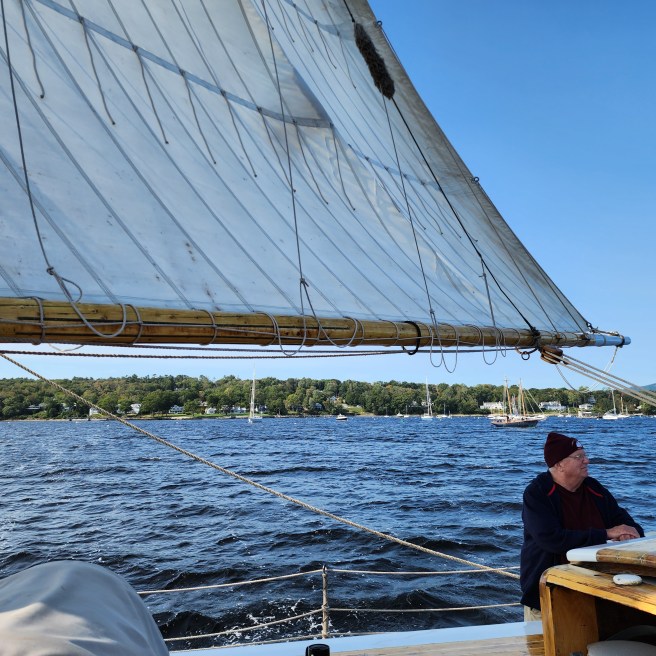
first, flapping fabric as wind kicks in
then a surge at my seat and flooring
like riding a stallion
muscular under the saddle