Somehow assuming that my father’s family had been in our corner of Ohio from its earliest settlement, I grew up believing my roots were essentially homogenized Midwestern American. Only after extensive genealogy research did I learn that my dad’s forerunners had, until my grandparents’ generation, come from much more distinctive and radical traditions – and all were in America by the time of the Revolution.
From another perspective, none of them came by way of Ellis Island, either.
For starters, the Hodsons (who would also spell the name Hodgin and Hodgson) had been Quaker from the very beginning of the movement and, for six generations, been part of the North Carolina Friends communities in Guilford County.

If my tentative research holds true, they first appear as yeomen in the 1530s in Cumbria, England, become Quaker in the 1650s, and go by way of Ireland to Pennsylvania, with most of my family perishing as a consequence of capture by French privateers while crossing the Atlantic. The one son, George, arrived as an orphan. Over time, he settled in Chester and what’s now Adams counties, Pennsylvania, before heading south, where his descendants even owned a gold mine. My branch moved from North Carolina to Ohio and Indiana after the Civil War.
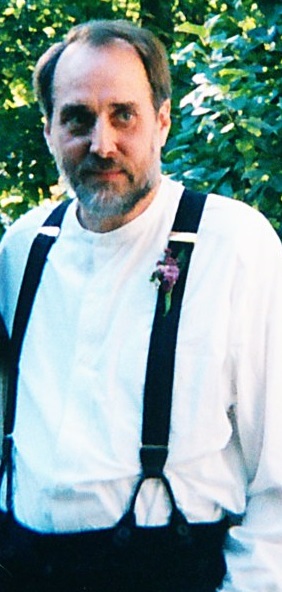
The Quaker faith included a distinctive lifestyle. The traditional braces, as suspenders are also called, and the collarless shirt are what many of my male ancestors would have worn as emblems of faith.
The maternal lines are equally as fascinating. My grandmother’s lineage on Dad’s side, for instance, turns out to be Pennsylvania Dutch, largely Dunker (German Baptist Brethren, the origins of today’s Church of the Brethren), and they were indeed among the earliest settlers in Ohio. Like the Quakers, they were pacifists, abolitionists, and wore the plain clothing we associate with the Amish. Even one great-grandmother’s ostensibly Irish Catholic line proved to be mostly Pennsylvania Dutch, including a large percentage of Mennonites and Lutherans.
My mother’s roots present a much different model. Coming together in Missouri, they were Scottish (by way of Canada), urban Germans, Swamp Yankees, Long Islanders, and both subsistence-farmer and plantation slave-owning Virginians and Kentuckians – lines that fought on both sides in the Civil War.
In genealogy I see these intensely personal histories of common people often counter the standard chronologies of politicians, generals, and, especially, wars.
I find the detective-work puzzles of their real-life stories take turns a novelist would never anticipate. I believe it is important to neither lionize nor demonize them, but to accept them for who they were – good and not so good.
In my case, I am surprised to discover that none of my ancestors arrived by way of Ellis Island. But after all, growing up, I had no clue.
Some of my research has been presented in the journals The Guilford Genealogist and Brethren Roots.
I offer my fuller findings at The Orphan George Chronicles.
 Jnana's Red Barn
I’m interested in the Pleasant Garden, MD or PA, comments. I live in Pleasant Garden, Guilford County, NC, not far from Hodgins and Centre Friends Mtg.
The name Hendrix appears in my genealogy. Where did you find the comments about James Hendrix migrating to NC.
After visiting MD, I decided there was a chance the name “Pleasant Garden” for our Methodist Church founded in 1788 may have come from a member’s former home in MD. The Hendrixes were among the early members.
I’m glad I’m not the only person curious about the naming of the Methodist church.
In the bits I picked up, the later movements of James Hendricks (or Hendrix, in your variant) were, shall we say, less than clear, and I’d welcome something definitive, including a continuing religious affiliation. But moving on down the Great Wagon Road would fit the pattern for both Quaker and Brethren families. In turn, Quakers who left the Society of Friends were likely to join with the Methodists, so the influences could be intertwined.
As you probably know, the Pennsylvania/Maryland border at the time was not yet firmly established. Wills and the like for the family of Robert Hodgson of the Pleasant Garden estate in Chester County often show up in neighboring Cecil County, Maryland.
I’m now curious how common the Pleasant Garden name might have been or whether one individual influenced another — especially when you consider that Hodgson and Hendricks were business partners in the Lancaster County purchase.
The Hollingsworths who moved early to Guilford County were also neighbors of Hodgson’s estate.
I’m still hoping the naming riddle holds a key for some of my genealogy puzzles.
Never heard or read “Swamp Yankee” before. Thanks. Always something new to learn!
As a genealogist, I enjoyed reading your family lineage. As a writer, i promise myself that I will write about my ancestors. I keep putting them aside for other writing projects and I don’t think they are happy with that. Yet, they are on my list.
Best of luck with the project. As I find in casual conversations, these family perspectives are important histories. They need to be preserved before another generation is lost.
I am a Hodson by birth and have my paternal line traced to Martin Hodson, a steward to the Duke of Bedfordshire in the 1700’s. He was born in Navenby in Lincolnshire. Does that line up with any information you might have? Now, on a fixed income, due to disability, I don’t have the money to spend at genealogy sites and have to plod along as best I may. Cheers!
Sorry, no connection. The Orphan George line comes out of Cumbria in the northwest corner of England.
Our spelling is a variant of Hodgson, a very common name across northern England even by the 1500s.
Thank you for your reply! It was very kind of you! Have a Happy New Year!
Thank-you for all your great information concerning the Hodson/Hodgin line. I have been researching my own Hodgin genealogy (Robert Hodgin/Theodate Hussey) line and was so excited to discover a rich history within the Quaker religion.
I suspect that line is intertwined with mine. They certainly move in parallel. Will love to hear what new insights you’re uncovering.