What you should know about Dungeness crab

In my novel Nearly Canaan, Joshua and Jaya settle into a place unlike anything they would have imagined. It’s desert, for one thing, where nearly everything has to be irrigated, for another. Quite simply, it’s a lot like Yakima, in the middle of Washington state. But it’s also close to fresh Dungeness crab, a shellfish with a heavenly taste all its own.

What you should know.

  1. It draws its name from Dungeness, Washington, on the Olympic Peninsula.
  2. It’s not King Crab, mind you, an Alaska specialty, but it is threatened by ocean acidification.
  3. It has five pairs of legs. (I haven’t counted the ones on a lobster.)
  4. It is found largely between Alaska’s Aleutian Islands and Santa Barbara, California. But don’t overlook that Washington state connection, right in the middle.
  5. About one-quarter of the crab’s weight is meat. One crab usually satisfies one person, though sometimes it will be shared by two.
  6. It has a delicate flavor and a slightly sweet taste. Don’t ask me to compare it to chicken or anything else. Not even lobster. It’s as different as cod is from salmon.
  7. It’s the State Crustacean of Oregon. What else do they have?
  8. If you go out at night trying to find one with a strong light focused in the water, you can likely rake up one right next to a decaying starfish.
  9. You really can’t get it here, wherever that is, outside of the Pacific Northwest.
  10. If you haven’t guessed, I really do miss them. They don’t travel well.

Mottoes to live by

Dunno if this counts as a motto, but I still like it: “Duma Luma!” From a private cartoon to me, evolving into an earlier incarnation of my novel Subway Visions. Here are ten more.

  1. “I hope for nothing. I fear nothing. I am free” – Nikos Kazantzakis, “Japan, China,” 1963
  2. “Abide in me”– Jesus of Nazareth
  3. “Jesus is the unseen guest in this house” – as inscribed over a Quaker family’s doorway in Belmont County, Ohio, followed by, “He listens to every conversation.”
  4. “The closer we get to our hopes, the closer we get to our fears” – artist Lita Albuquerque
  5. “Be ashamed to die until you have won some victory for mankind” – Horace Mann
  6. “Mind the Light” – old Quaker counsel
  7. “I make dreams … I don’t see clothes, I see the world” – Ralph Lauren
  8. “Everyone wants to reach for something a little higher. … Part of Ralph’s genius is he understood life’s aspirational”  – Michael Gould, Bloomingdale’s buyer
  9. “Randomness invites the universe to speak” – James Bartolino
  10. “You better be good to toads,” Cassia in What’s Left

~*~

Yay!

We’re all ears for any you might want to share.


A few facts about the cruise boat Mount Washington

For 149 years, a New Hampshire vacation tradition has been the big cruise boat that plies scenic Lake Winnipesauke in the mountains in the middle of the state.

Here’s the dope.

  1. It started out as a paddle steamer in 1872, built by the Boston & Maine Railroad Company to transport passengers and cargo around the lake.
  2. It soon became a tourist attraction, drawing 60,000 passengers a year, a figure that continues.
  3. That vessel burned in 1939 while tied up at dock and a fire spread from a train station.
  4. The current incarnation of the M/S Mount Washington is 230-feet long and has four decks. Maximum capacity is 1,250.
  5. The current vessel started out in 1888 as an iron-hulled sidewheeler on Lake Champlain. In 1940, it was cut apart in Vermont and shipped by rail to Lakeport, New Hampshire, where the hull was reassembled in a new twin-screw vessel design. It was powered by two steam engines (since replaced by diesel) taken from an ocean-going yacht.
  6. There are three dance floors. It seats 500 for dining or serves one thousand for a reception. Two-hour dinner-dance cruises are popular.
  7. It has five ports of call – Weirs Beach, Wolfeboro, Center Harbor, Meredith, and Alton.
  8. The M/S stands for motor ship.
  9. The views include the summer homes of many billionaires as well as mountains and at least 264 islands.
  10. The line also runs two smaller vessels, one of them a mail boat where the envelopes are actually sorted en route.

Ever eaten elk or Dungeness crab?

In my novel Nearly Canaan, Joshua and Jaya settle into a place unlike anything they would have imagined. It’s desert, for one thing, where nearly everything has to be irrigated, for another. Quite simply, it’s a lot like Yakima, in the middle of Washington state.

  1. Dungeness crab. I really miss this. It doesn’t travel well. You have to go to the source. Someplace like Ivar’s on the waterfront in Seattle. One crab per person is fine.
  2. Salmon. How many varieties do you know? Sport fishermen will tell you their favorite.
  3. Tillamook cheddar. An Oregon coop.
  4. Beer. Must be all those local hops and barley. My favorite was Rainier.
  5. Geoducks. (Pronounced gooey-ducks). A large razor clam species.
  6. Those chewy apple, peach, or ‘cot bars. A sweet and chewy candy. Used to get ’em up around Wenatchee. Wish I could remember the brand name.
  7. Rainier cherries. Definitely distinctive.
  8. Chanterelle mushrooms. Had ’em once, and it was a treat. You really have to trust your source when it comes to picking wild ‘shrooms.
  9. Elk. Helps if you know someone who wins a license in the annual hunting lottery. Seriously.
  10. Walla Walla onions. OK, I hate onions. Or they hate me. So I’m just passing this along, based on the praise by cooks I respect.

~*~

What food is special where you live?

Dungeness crab, a specialty in the Pacific Northwest.


A few things that are factually untrue in my novels

Naturally, you invent some things when you’re writing a novel, and you bend some others to improve the fit.

But some other elements deliberately stretch reality, hopefully with good reason. Besides, that’s why it’s called fiction.

For example:

  1. There were no elders in my dorm, they just didn’t care. Or in most hippie circles. The ones who tried to be leaders are a whole other disaster.
  2. Swami wasn’t a guy in my experience, but readers couldn’t accept a woman in the role. Besides, I couldn’t nickname her Big Pumpkin, could I?
  3. No boat trips in a commercially open Arkansas cave. Maybe someday?
  4. No place on the Ohio River in Indiana is only an hour away from Naptown. I applied a bit of fantastical geography to better match the feel.
  5. No hitchhiking in any subway system I know of. Subway surfing is another matter.
  6. Kokopelli never left the Southwest, and I doubt he was in trouble the way Coyote would have been.
  7. Goodwin didn’t open up the family purse as liberally when it came to upgrading the paper.
  8. Kenzie’s sex life wasn’t this good. He had only one Summer of Love.
  9. I can’t actually prove or disprove what was going on in the university president’s bedroom.
  10. Small-town newspaper columnists don’t have contracts. Or anyone acting as their agent.

With a nod and a bow to Proust

Readers of Vanity Fair magazine may be catching a similarity between its back-of-the-issue Proust Questionnaire each month and many of my Tendrils postings this year. One difference is that when interviewing a chosen celebrity figure, each question gets a single answer, while Tendrils, with its listings of ten items, demands a full count on both hands, one-two-three on to one-zero.

The questionnaire itself, attributed to French author Marcel Proust (1871-1922), became a popular “confession album,” a kind of Victorian parlor game. When published by his son-in-law, the French president, it was subtitled “an album to record thoughts, feelings, etc.”

Frankly, they’re usually difficult for me to tackle. More personal than I usually navigate. But doing them as an exercise for Tendrils has had me reviewing much of my life from a fresh perspective, and maybe also is giving you a better idea of what makes me tick.

Still, some of them haven’t prompted a full ten responses from me. Here are some examples.

  1. What do you consider the lowest depth of misery? Being utterly alone. Quite distinct from blessed solitude.
  2. When and where were you happiest? Meeting Lady R and courting her.
  3. Where would you like to live? Where I am now, though we’re also dreaming of moving up the coast, soon as we can.
  4. What is your favorite occupation? Writing.
  5. What are your most marked characteristics? Let’s start with quirkiness.
  6. If you were to die and come back as a person or thing, what do you think it would be? I’ve long admired hawks, but now eagles and osprey, more so.
  7. What do you most value in your friends? Reliability.
  8. If you could change one thing about your family, what would it be? They’re incredible. If I could, I’d leave each of them with a billion to do with as they wish. The world would be much better for it.
  9. How would you like to die? With the least inconvenience to those around me.
  10. On what occasions do you lie? Half-truths, since I’m conflict-averse. That is, omissions, rather than commissions

~*~

Anyone up to answering one or all of these now?


Take a look at tricksters

They cross boundaries and break rules but have strong intellects. You need them but also need to be wary of them, especially when it comes to your wife or daughter.

In mythology, they appear across cultures, and not always as an animal or immortal. And we’re not talking about trick-or-treat night.

Take a look, here are ten.

  1. Coyote, largely among western Native cultures in North America, has been at the forefront of a new consciousness about tricksters. His tales were recorded by early ethnologists, who shifted to Latin when the stories turned randy.
  2. Kokopelli, the hunchback piper from the American Southwest, has become especially popular as an image, though not yet his stories.
  3. The rabbit or hare in West Africa and its transport into the Americas via the slave trade. Leads us to Br’er Rabbit.
  4. The spider. Just don’t get caught in the web.
  5. Froggy the gremlin on the early TV show “Andy’s Gang.” Not that we got it as kids, Froggy was just weird. And maybe perverted.
  6. The clown as an archetype. Well, I do know a professional firefighter who’s frightened of them.
  7. A figure in fairy tales who tests the status quo. He frequently changes hats. Or even genders.
  8. The fairy Puck. Or a leprechaun. Or even Robin Hood.
  9. Lilith, in Babylonian cultures.
  10. Jesus.

Among my most treasured possessions

Yes, I’ve always had a penchant for history.

  1. A hand-scrawled letter by my great-grandfather on scratch paper. (You can view it and my analysis on my Orphan George blog.) And the small autograph book he carried in Indiana his first years after leaving North Carolina. (Again, see the blog.)
  2. A stone breastplate pendant from an ancient burial mound in northwest Ohio. Plus, flint arrowheads.
  3. My Eagle Scout award, reflecting lessons in self-reliance, natural wonder, wilderness, and the outdoors in general.
  4. My Max Rudolf LPs. Working largely out of the spotlight, the conductor shaped the Cincinnati Symphony into a precise, glowing musical machine. Each performance was a revelation.
  5. James Nayler’s collected works, the second-oldest of the books in my personal library. Warped and hard to use as it is, with the ink bleeding through on many pages, it was published in 1829 in Cincinnati. He’s still my favorite writer from the emerging Quaker period. Also on my shelf are John Gough’s History of the People Called Quakers, in a four-volume set published in 1790 in Dublin. And then there’s Fernando G. Cartland’s Southern Heroes or The Friends in a Time of War (1897, Poukeepsie, New York), which details many of the travails of my ancestors under the repressive Confederate regime.
  6. A bone-handled antique fork, which I often used when visiting my grandparents. I wonder how far back in the family it really goes, but it’s still quite elegant in its primitive simplicity.
  7. An 1840s cherry table made in Ohio. Wobbly and warped, the wood itself is gorgeous.
  8. My journals, now numbering around 200 volumes. It’s what I often have rather than photos as a prompt to my memories. For the most part, I’d say the pages are more an outline of what happened, rarely of my inner thoughts and feelings, often tedious in their surface reporting, but they can still take me deeper into so much that’s otherwise slipped from my mind.
  9. Our copper cod weather vane. The one on the roof of the barn.
  10. A perfect trilobite, collected as a young rock hound in southwest Ohio.

~*~

Tellingly, many of these items are irreplaceable, unlike many other treasures that would still have replacements.

Which of your possessions do you most treasure?


What I’ve learned about the ocean

We’re talking North Atlantic, though I had earlier exposure to the North Pacific in Washington state as well as the Atlantic in Florida, Maryland, New Jersey, and Long Island.

New England really is different. Here’s why.

  1. The water’s always restless, don’t be fooled. Those slow swells can get you seasick, too.
  2. The current in the water can push you one direction while the wind twists you toward the other. As I learned the first time I took the helm of a sailboat and tried to steer by the compass.
  3. Tidepooling presents an amazing crystalline world of miniature color in its unique range of flora and fauna. It’s well worth exploring in the rockweed at low tide.
  4. At night, the ocean can be terrifying. It’s utterly dark, surrounded by swirling and slapping sounds in unseen places. The stars – and distant beacons – are icy comfort.
  5. As for those romantic walks along the beach in moonlight? Most nights of the year are too cloudy and too cold. Maybe you need to book a flight to a Caribbean island.
  6. It’s dangerous. You think you’re standing sufficiently far back on a rock outcropping overlooking the water, but don’t be surprised if a big wave somehow crashes up behind you, threatening to sweep you out to sea. January and March add their own complications.
  7. I love bodysurfing in some big waves, come summer, meaning after the Fourth of July. Here we go! Whee!
  8. Whales! The tour captains know where to find them. But their blow spray stinks. Meaning the big leviathans, not the skippers, as far as I know.
  9. And seals! (And sharks, which go after them at Chatham, down on the Cape.) And lighthouses!
  10. The tides themselves are heightened here because of a fluke in the global streaming. They’re really impressive up in Fundy Bay and the easternmost flank of Maine. (Twenty-five feet change every six hours at Eastport, Maine, for example. It’s like draining and quickly refilling a lake.) Less than half of that where I live in New Hampshire, but still impressive.
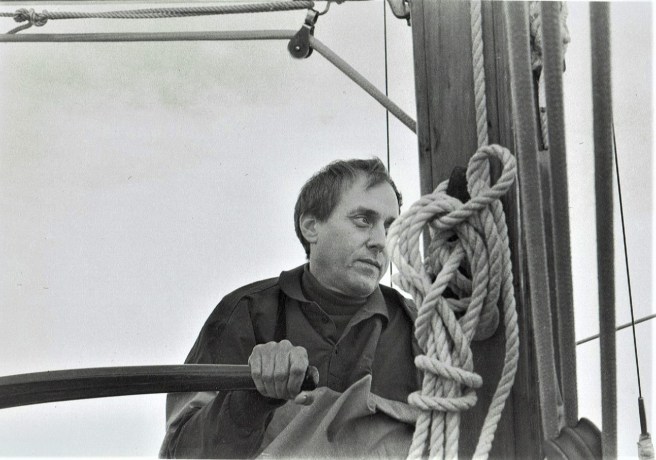
Me at the helm of a 32-foot sailboat back in the late ’80s. It didn’t want to go where we were supposed to be headed, and I was worried the wind might tip us over.   

As a footnote, there are only a few places you can swim in Chesapeake Bay without being stung by jellyfish.

And I love the way you really can see the curvature of the earth when you get an open panorama.

Ways to define a family

It’s a major theme in my novel What’s Left, not that these are the answers there.

  1. Husband, wife, and kids under one roof. Often traditionally recast as a breadwinner and dependents.
  2. A mother and all who turn to her.
  3. Two romantic partners in their own place, with or without other relations nearby.
  4. Those connected by genetics and blood line. Say siblings or cousins.
  5. A shared last name. Or address.
  6. Those who join together as in-laws through brothers and sisters and so on.
  7. Grandparents and grandchildren.
  8. Inheritance.
  9. Memories, good or bad.
  10. Home of last resort.

~*~

In the novel, there’s also a shared business and an ethnic identity.

How else do you see a family in real practice? Or even as an ideal?