SOJOURNING

One question facing many Quaker meetings is what to do about members who have moved away but want to retain membership. Their reasons may be sentimental or a family connection, the reality that they reside at a distance from the nearest Friends circle, or some discomfort they have regarding the meeting where they are. The fact remains that being Quaker requires face-to-face encounters with Friends.

Related to this is the concept of sojourning, with its sense in the Hebrew Bible of passing through a land on the way to another. Some of the references mention sojourning in Egypt; others speak of welcoming strangers who sojourn among you. Readers of Sojourners magazine see its application in our own time. In contemporary American society, sojourning is a widespread fact of life.

Quakers offer a form of affiliation known as a Sojourning Member, extended temporarily from the meeting where one is a member to a meeting where one is residing. I found myself using it formally in one of my relocations, where I didn’t sense full unity with (or from) the closest meetings and I held a job that was likely transitory in my career path. Informally, however, I found myself sojourning among Mennonites and, to a lesser degree, Brethren, who were theologically closer to my meeting of membership and my practice. Crucially, in a sojourning situation, one remains in communication with one’s “home” meeting. During this period, this meant attending its yearly meeting sessions and providing written responses to the sets of monthly queries.

Only after moving to New Hampshire and visiting among the nearest meetings did I feel clear to join with Dover, and even then there was a period before I felt free to transfer my certificate of membership. As it’s turned out, this is the land where I’ve settled – and my own turn to welcome sojourners amongst us.
MEMBERSHIP

In the first decades of the Quaker outbreak, any questions of membership soon pivoted on the reality of persecution. Friends wanted to make sure which people accused of being Quakers were actually part of the movement, unlike others who were hoping for an easy handout during their imprisonment. Membership meant providing aid and comfort to those who were suffering as a consequence of holding to the faith, rather than just anyone incarcerated for heinous actions.

Within a few decades however, the concept of “birthright” membership took hold, as the values of the faith were increasingly handed down within families that were living under Quaker discipline. Soon, there would be a hundred reasons to be read out of Meeting, but few guidelines for joining. In fairness, being disowned was not the same as being excommunicated from other denominations – and many of these individuals and families continued to attend Meeting, even if they were no longer part in running it.

Today we no longer live “under discipline,” and we have a fuzzy distinction between “members” and the active non-members we call “attenders.” Yes, there are formal steps into membership and the accompanying records, but it is a bit difficult to say just what one is joining. We have no creed to affirm, and no outward tests to pass. Sometimes it seems easier to say what we are not more than what we are. A Quaker lifestyle, perhaps with a little yoga and vegetarianism thrown in? Middle-class professional with a peace/justice political agenda? A fine philanthropy?

Still, the best metaphor I’ve come across is that of marriage. There, two people commit to an unknown future. It’s more than a common lifestyle and leads into many unanticipated turns. As they say, it’s a matter of “settling down,” with an array of mutual giving and support. To compare membership and marriage, however, simply points to deeper discussion – of both. But I think it puts us on the right track.

When I think of marriage, I see a lifetime commitment. Similarly, engaging with Friends is more than an annual renewable subscription. Maybe the basis of membership today comes when one no longer wants to stand at the rim, but wants to jump fully into the action.

BEING LED BY A PILLAR OF FIRE

Quakers love the image of Light. What we observe, though, is not the light itself but rather the objects it reveals, at least within the visible portion of the spectrum. Sources of light – a star, a fire, the flash of a strobe – may be somewhat different, but the lingering afterimage when we close our eyes suggests the perception may be in large part a reaction within ourselves – and not just some intense chemical or physical transformation in the originating body.

This time of year, I begin regarding fire again – we rely on a wood stove to heat part of our house, and the upcoming holidays bring out an array of candles, seriously beginning with the Advent wreath. I’m mesmerized by the flames of a wood fire – the movement of flames and coals takes on its own pathway, no matter what you predict; their flickering dances, and the warmth is, well, captivating, especially in the midnight hours when I come home from the office. Stars, too, are more pronounced in the lengthened nights and sharpened air.

These are reminders, too, of those times in our lives when we’re on fire or given new direction – swept up in new love, the arrival of a baby, religious enthusiasm, a social cause – as well as those times when we sense contentment and comfort. We need both.

In the end, there’s something mysterious about fire, especially. Fire, after all, is a gift to humanity, as endless myths attest. As such, it demands care on our part. I think, too, of the flight of Israelites from captivity in Egypt, how they were responding to a pillar of fire by night and a pillar of cloud by day as they were led into the desert and out of bondage – what a contrast those images offer! Was the cloud dark and stormy, or even glowing from within or against the sun? To be liberated, by following both cooling moisture and drying flames – to be guided toward our true destination, and be comforted along the way. Mind the Light, then, as we go, toward a new Bethlehem, perchance.

DRESSING FOR LOGISTICS

It didn’t take very long for my philosophy class in college to realize our professor was wearing the same outfit all the time – suit coat, tie, pants, and Hush Puppies. We wondered about the white shirt, his socks, and underwear, and presumed he was changing those. The second semester, he did the same thing, but with a different outfit. (This was the same teacher whose final the previous year had a single question, “Why?” – which led most students to write profusely in their blue books, hoping to somehow hit the answer by accident. A succinct “Why not?” turned out to be the B+ answer, while “Because” earned the A.) Maybe he was just too lost in thought to be concerned about attire. On the other hand, some in the class repeated rumors that he had a girlfriend in Sweden and was spending most of his income on long-distance bills. (Why not?)

When I’m grabbing the same set of clothes for, say, the third day in a row while getting ready to dash off to the office, that recollection flits through my mind. Sometimes the thought connects with the concept of Plain dress, too, and how we’ve made things more complicated by switching to the less tightly defined “simplicity.” For old Quakers, the question of “What will I wear today?” was much easier than it is for us.

Of course, Plain dress was also a uniform – a symbol of belonging, and belonging to a cause, at that. There are all kinds of uniforms, and not just for the military – mail carriers, retail clerks, priests, mechanics, utility workers, many of them today wearing embossed T-shirts. You know what to expect from them.

There are many reasons I’m not suggesting we return to Plain dress. For one thing, such a move would have to express a unified community; otherwise, we would just appear to be quirky along the lines of my philosophy prof. In addition, putting the focus on the outward appearance ignores what exists within. Still, such a move would be a public rejection of the fashion industry. And it was said that Friends who had taken up Plain dress became more aware of individuals at the fringes of society – and more responsive to their needs.

As for the philosophy prof, I guess the biggest lesson he taught me was the importance of questions in the logic of life. The dressing’s purely secondary.

THE MANY MEANINGS OF MEETING

Quakers use the word meeting in many ways. Originating in the mid-1600s in England, Friends understood that church meant the body of believers – not the building, not the denomination, not the structure of hierarchy. Thus, you didn’t go to church – you gathered with the church. And so, the church (that is, people) met. The gathering of the faithful, and their time of worship, quickly became known as a meeting. Within it, we meet with each other and with God – early Friends proclaimed Christ had come to teach his people himself, and they sat in what became known as expectant waiting for his presence. Modern Friends may prefer other terms to describe the experience, even while retaining an awareness of Spirit-led worship. (I might add that in today’s frenetic world, an individual also meets with himself or herself, especially at the beginning of the hour, personally collecting scattered experiences of the week and renewing one’s sense of inner direction.) When we have a building set apart for worship, it is called, logically, a meetinghouse – here, we meet. In addition to the meanings of meeting as the people and as the worship service, Quakers also began to apply  the term to congregations and organization; this is based, curiously, on the frequency of each group’s gathering for the conduct of its business and discipline, or what we now usually call faith and practice. The local congregation is typically known as a monthly meeting. Neighboring monthly meetings participate in a quarterly meeting, four times a year. And the quarterly meetings come together as a regional yearly meeting, which has sessions once a year. (There are some variations within this, but in terms of decision-making authority, the monthly/quarterly/yearly connection holds). Thus, my congregation, Dover Monthly Meeting, is part of Dover Quarterly Meeting and New England Yearly Meeting.

All of this originated in response to the open worship and the desire to strengthen and deepen it. Early Friends soon perceived themselves as a people of faith, rather than as motley individuals, and that vision has left a treasured legacy of social change that is taken for granted by most people today. Again, I’ll leave that discussion to a number of excellent Quaker history volumes.

Even so, as we begin to participate within our spiritual community, we realize that when we’re faithful, the whole is greater than the sum of its parts. Here in Dover, I’m constantly surprised to find how far our activities extend, within the meeting itself (in all of its meanings) and throughout the surrounding towns and various networks of concern. Surprised, too, at the range of talent and skill in our midst. In the history of Friends, we have somehow come to rely on committees to meet our common organizational needs. I’m not sure when this emerged, and believe that early on, many of the tasks were performed within extended families, but today’s Quaker meetings depend on Friends’ service on various committees – everything from Ministry and Worship or Pastoral Care to Finance or Trustees to Religious Education or Building and Grounds to Hospitality or Peace and Justice Concerns. In practice, what I’ve observed is that these never all function smoothly at the same time. Even so, they extend our understanding of waiting from one of expectation to one of service, a meaning we see in language through terms such as waiter or waitress or lady in waiting. As I’ve said, in practice, sustaining a weekly hour of silence is not easy, individually or as a group. Nonetheless, I still find it’s essential, both ways.

BACK FROM SESSIONS

The 353rd annual sessions of New England Yearly Meeting of Friends were held last week, and it was wonderful to be among the hundreds of Quakers of all ages who gathered at Bryant University in Rhode Island for the six-day gathering.

Since the regional yearly meetings are the top level of the Quaker system of church government, their decisions affect all of their constituent local congregations – in New England, that’s about 100, ranging from rural or small to large and urban. And since our group decisions are reached without ever taking a vote, resolving our differences when it comes to joint action can be quite an exercise. (We had several of those.)

One of the issues we did unite on was to publicly renounce what’s known as the Doctrine of Discovery, which originated in papal pronouncements that lands held by native non-Christian peoples could be claimed by Christians – a perspective that was later extended into American law. Native peoples of New England told us our support is important in their attempts to change current policies for more just outcomes, and we agreed to continue working with them on this concern.

The Bible half-hours each morning were led by Michael Birkel of Earlham College who used quotations from early Quakers to show how scriptural language shaped their thinking and tender communications to each other. What emerged was an awareness of the depth and intimacy of their experiences in times of great turmoil, even before they speak to us as well. His loving and often humorous examination of the texts and their wider meanings earns him my nomination to be the leading Quaker rabbi, if we acknowledged such.

There’s much more to yearly meeting than the sessions each summer. Throughout the year, committees meet and work, special programs are presented, youth retreats (especially) are conducted, and local meetings are visited.

But it’s always delightful to be among so many kindred souls, reconnecting with people I’ve known for decades and establishing new friendships, too. We get to meet and know visiting Friends from around the world – this time including Bolivians, Cubans, and Kenyans, who add much to our worship and global awareness. I suspect that much of the most important business occurs in informal one-on-one conversations over meals, while just sitting along the pathways through the campus, or during late nights in the dorm lounges. We’re also surrounded by children and teens, many of them zooming around on scooters or bicycles in their free time. It’s all high-energy.

Parting is always sweet sorrow, but we’re already anticipating next year’s sessions, which will be held in Vermont.

FREQUENCY OF ATTENDANCE

Every week? Every other week? Once a month? How often do you come to worship?

It’s a question that’s nagged at me ever since participating in my first Friends community. There I noticed a number of people who seemed to come every other week, meaning in practice we had two largely separate circles of people. A few years earlier, as part of a monastic practice, I had experienced what group mediation twice every day could do, how the energy would build up and the experience, deepen.

Early Quakers were much more insistent on attendance, including the Midweek Meeting. The Amish, on the other hand, gather every other week, using the off week to visit at a distance. In fairness, on many weekends we do have multiple activities scheduled, and three or four hours in the meetinghouse on Sunday is not uncommon.

Still, we must wonder. Are our lives so busy we haven’t enough time for worship? Or do we need a Sabbath from the labors of Meeting? My views have changed over the years. Yes, Sunday often becomes a time of catching up. But miss worship for a few weeks straight, and getting back into the rhythm and focus of Meeting becomes difficult – it’s easy to slip away. What I do know, often more in theory than practice, is the importance of Sabbath rest – especially the kind that helps us rediscover family and joyous playfulness. Something that’s quite distinct from leisure. Or even thank you and please come again. “There remains, then, a Sabbath-rest for the people of God; for anyone who enters God’s rest also rests from his own work.” Let that remain our invitation and refreshment.

PARTISAN PERSPECTIVES

As I said at the time, a question raised in a Quaker Life letter-to-the-editor a while back keeps nagging at me (the magazine, not the cereal). It said, essentially, that in light of all he keeps hearing and reading, he wonders if there’s still a place for a Republican like himself in the Society of Friends. (Obviously, he hasn’t seen the bumper sticker, either: Real Friends don’t let Friends vote for Republicans.)

It’s troubling on many fronts. For all of our claims of “seeing that of God in all people,” we can be pretty one-sided in our public views. Ditto for our proclamations of “inclusiveness” – we do carry a number of exclusionary issues, often subtle, and not just political. And we do know that many Friends are  involved in party politics – to the best of my knowledge, all on one side of the political spectrum. In support of the letter writer, let me point out that Friends were instrumental in founding the Republican Party, and I believe the last two Quakers in Congress were GOP members. In addition, the Friends Committee on National Legislation makes an effort to cite individuals on both sides of the aisle when their votes coincide with Quaker values – for the record, you’ll see New Hampshire’s congressional members sometimes named there. I certainly don’t want us to be blind to the fact that saints and sinners can be found in all parties. To say nothing of the principle of the separation of church and state.

Besides, I’ve heard it said – not just of my Meeting – “I know what they believe in politically. I just don’t know what they believe in” – meaning religiously. That part really troubles me. I would hope that our faith experience is guiding our individual social activism, rather than being limited within it. Maybe we need to be more vocal about our spiritual roots and motivation in our witness, too. I would also like to hear more from the letter writer for his reasons for deciding to stand where he does.

I also keeping remembering a newspaper column a while back that argued an apocalyptic faith – one that believes in the immediacy of Christ – demands social activism. Thy kingdom come, as the prayer goes. And peace on earth. In these little newsletter essays, I’ve tried to steer clear of straight-out theology, but sometimes there’s no way of avoiding it. I really do believe ours is an apocalyptic faith, no matter how we define our individual religious convictions. Maybe the real reason that “politics and religion” are so avoided in polite conversation is because they are so intertwined and so vital, tapping into some of our deepest emotions. How many of our own hot buttons have been pushed already in this brief discourse? Maybe the letter writer also hints that the Republican Party needs more Friends, as witnesses or agents of change. Hey, has anybody noticed I got all the way down to this point without using the word Democrat?

HAS THEE BEEN REFRESHED?

It’s an ancient question after the hour of worship, along with “Has thee been fruitful?” or “How has Truth prospered?” A related question would ask just what draws each of us to sit in the communal quiet in the first place. On the one hand, there’s a need for relief from the conflicts of daily life – a desire for a time of lightness and joy. But ours is not a religion of escape, and I’ve become quite aware that the quest for social justice is also a central Biblical theme. Some weeks, in fact, we come quite close to “praying the newspaper,” as our hearts carry a world of suffering to the invisible altar.

While we reflect on the world, on one hand, we also examine ourselves in our worship. Maybe it’s impossible, if not just difficult, to be as thoroughly honest with ourselves at the deepest levels as we’d like. A therapist, after all, keeps redirecting the client back to the questions being skirted. Still, it’s important we try. Salvation, including being saved from our own negative thoughts and actions, has a root word related to healing. As I’ve been sitting on a succession of Psalms week after week, I’ve come to appreciate the authors’ growing candor – first, to admit the array of enemies, something many of us might have difficulty addressing – and then, in asking that they be smited or the petitioner be sheltered from their assault, which becomes an act of distancing and handing over the desire for revenge; it’s not, after all, no longer, “Let me smite them!” As we survey the realm of struggle around us, let me suggest that saving the world has a direct connection to saving ourselves, in all senses of the meaning. (I’ve always liked the bumper sticker, SAVE THE WHALES.)

Placing the question “Has thee been refreshed?” within this framework has a dimension of renewal and recharging for the work at hand. It’s for more than an hour, then, isn’t it.

MYSTERY SOLVED?

While Dover Friends (Quakers) proclaim that we worship in our third meetinghouse, erected in 1768, our history of the previous two structures becomes a bit foggy. Even so, ours is the oldest house of worship in use in the city.

In his authoritative New England Quaker Meetinghouses (Friends United Press, 2001), Silas Weeks mentions that our first house of worship was built about 1680 on Dover Neck, just south of the present St. Thomas Aquinas High School. Correcting an earlier version of the relocation of the structure to Maine, he writes that in 1769 “the 1680 house from Dover Neck was taken apart and re-erected in Eliot at the corner of what are now State and River Roads. There is a bronze plaque marking the site …” (Alas, there goes the tale of its being skidded by oxen across a frozen Piscataqua River. Taken apart and put on a boat now seems more likely.)

Apparently, when our current house was built, we had no need for the smaller structure. I suspect that until our current meetinghouse was available, Dover Friends met for worship in the two smaller structures and gathered together for business sessions.

The disposition of the second house, though, had eluded his investigation. It had stood at what Silas “believed to be the present corner of Locust and Silver Streets,” but there was no indication it had been incorporated in later buildings on the site.

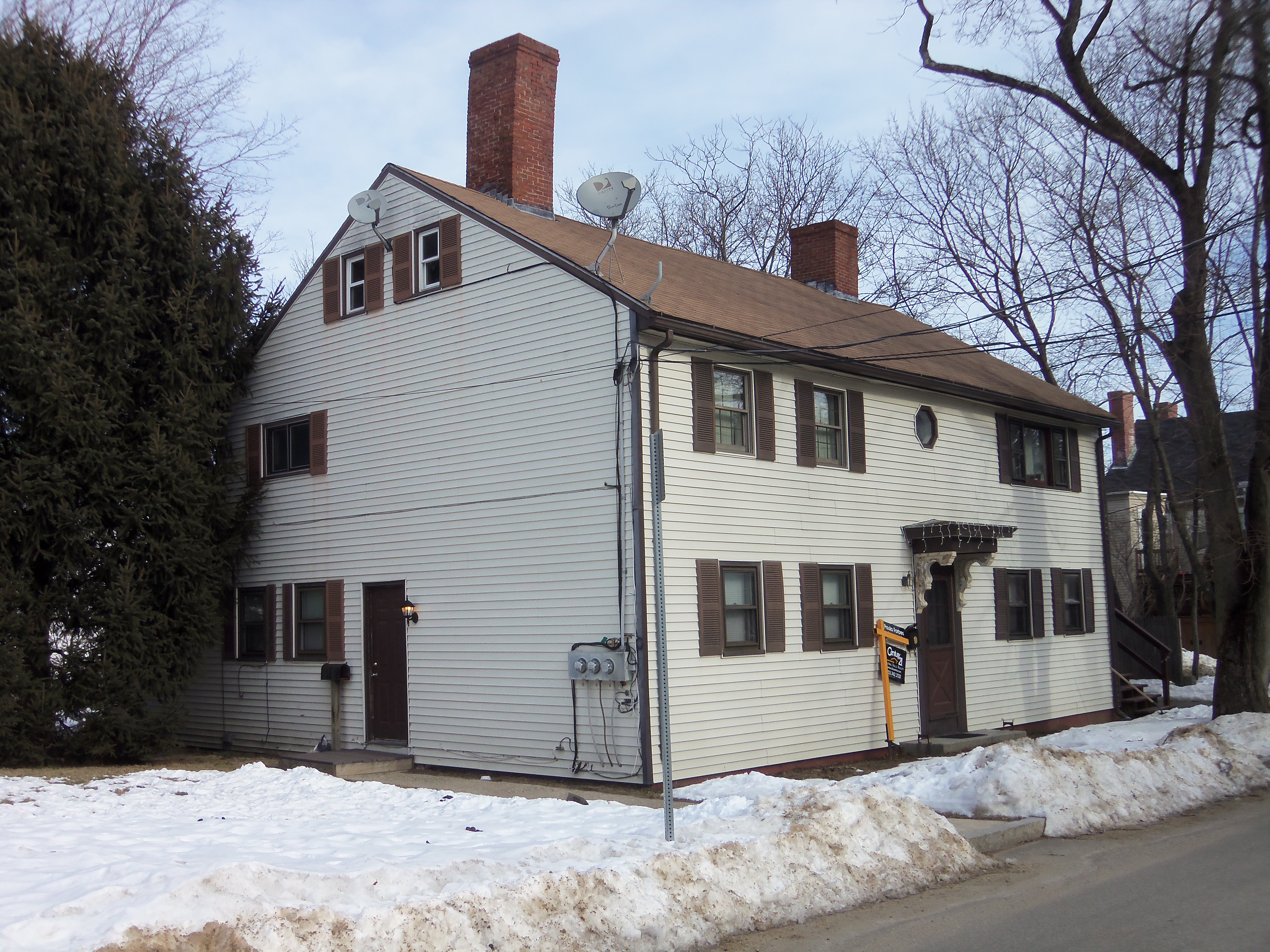
A publication from the Dover Chamber of Commerce, however, may have the answer. Dover’s Heritage Trails, a guide to historic walking tours through the city, notes this at 3-5 Spring Street: “This old dwelling was Dover’s second Quaker Meeting House, built originally at the corner of Silver and Locust Streets and moved to this location in 1728, before Spring Street existed.”

Silas reported “The second was erected in 1712 on land belonging to Ebenezer Varney. The deed, transferred to Friends in 1735, described the site …” in ways that support the Silver and Locust location. My guess is that the structure was moved in 1828, since the Chamber pamphlet mentions that neighboring houses were built in 1810 and 1811.

The building has no doubt changed a lot, inside and out, since it was erected three centuries ago -- including the addition of chimneys. But the shape is right for a Friends meetinghouse.
The building has no doubt changed a lot, inside and out, since it was erected three centuries ago — including the addition of chimneys. But the shape is right for a Friends meetinghouse.

As they say, the plot thickens. And to think, the answer to our search may wind up just a bit more than a block up the street from where we gather.