REMEMBERING SILAS

Sometimes an image says everything. I remember sitting on the green at Bowdoin College one afternoon during Yearly Meeting sessions and looking out to see a line of boys marching along the far sidewalk. Four or five, maybe six of them, ages somewhere between eight and 12, and determined with a destination. In tow, perhaps twice their height, was another, hunched forward in his gait, a man obviously grinning to be part of such a mystery – Silas Weeks, of course. Who knows what they had to reveal to him? Only that it must have been important – very important, in ways that remain veiled or part of that precise moment.

The fact that they were leading him, rather than the other way around, says a great deal about trust and openness, in both directions. Even the role of affirmation. Everything so natural and rare.

Silas was one of those “old Quakes” who had managed to become A Character, in the best sense of the meaning. He was already well into retirement by the time I relocated to New Hampshire, and remained a force in Dover Meeting for much of the next two decades, despite his growing deafness. He was one of the handful of Friends who reopened the meetinghouse to weekly worship in the 1950s, after its use had become irregular for several decades, and he faithfully served it in many capacities, including clerk, over the years. That’s not to say he couldn’t be stubborn or cranky, but he did manage to get Friends moving on a project. Thus, his passing at 94, though not unexpectedly, brought a deep sense of loss to the meeting.

“Silas tells funny jokes,” is what Eli Abbott, 13, remembered.

Silas stories were bountiful, within and without the meeting, and there’s no way I could begin to tell them all.

When majoring in community development at the University of New Hampshire, however, one of our friends had Silas for her academic advisor. She remembers being honored to be part of a group of students invited to a social gathering out at the farm, until he announced on their arrival that it was time for potato planting – and then pointed to the spades. For them, it was an awkward situation where nobody could say no freely. The next semester brought another invitation, this time accompanied by the revelation that it was now harvest time for the spuds.

Apparently, there was no ill will. After learning that they shared the same birthday, however many years apart, these two begin meeting for a dinner each year to celebrate together – not always on the exact day, but as close as they could manage – a tradition that spanned three decades. And she still keeps a garden, in response to his lessons.
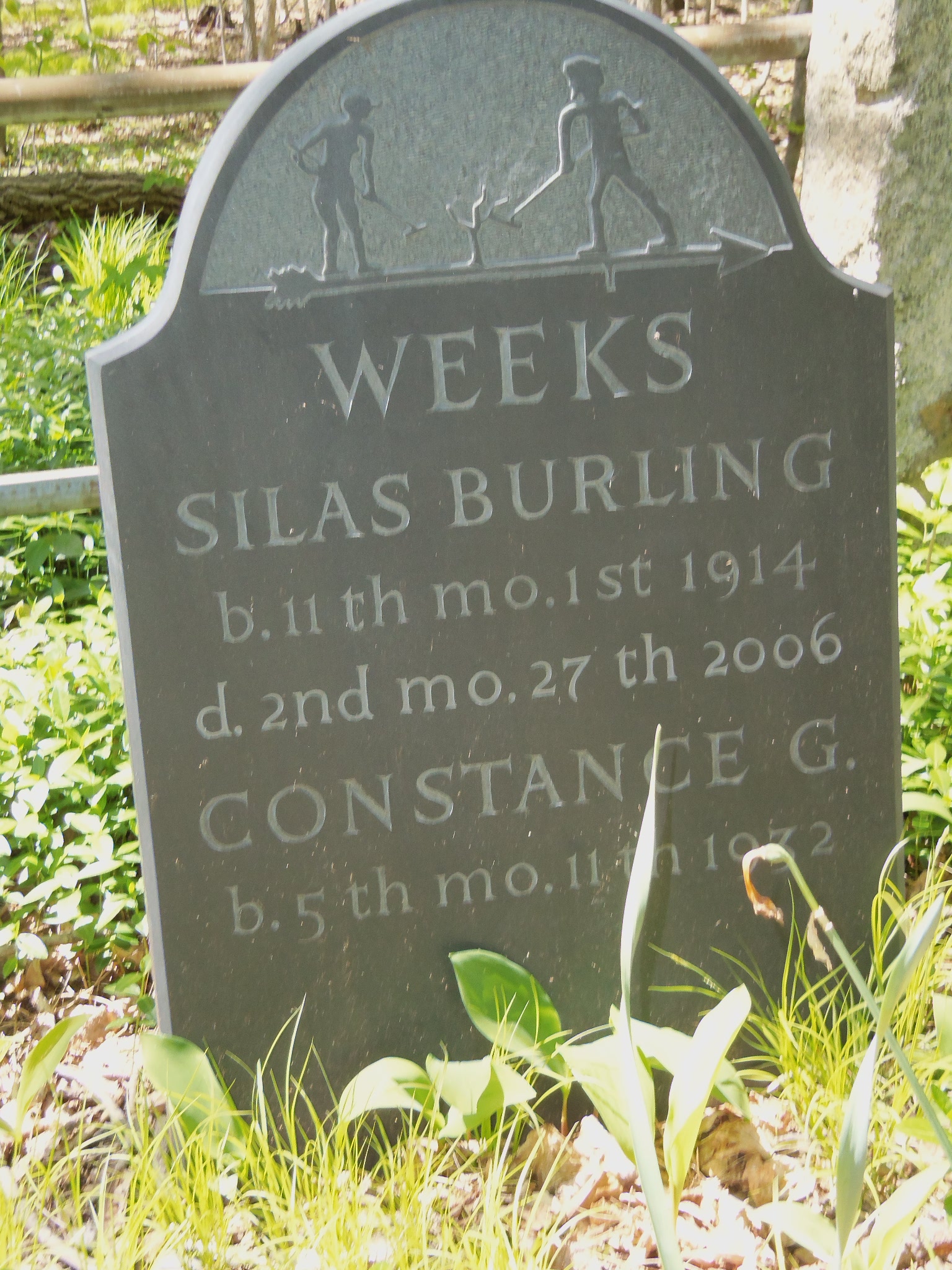
He chose to be buried in an existing burial plot on the farm, rather than in the meeting's cemetery. The engraving atop his stone is one designed as their emblem.
He chose to be buried in an existing burial plot on the farm, rather than in the meeting’s cemetery. The engraving atop his stone is one designed as their emblem.

Kodak9 033

QUERIES IN THE SOCIAL HOUR

Some of the most profound and lasting messages I’ve received among Friends have come outside of the Meeting for Worship – and often as questions. It may surprise many of you to learn that in my first years with Quakers, I was generally pretty hostile to anything smacking of Christianity. And yet seeds were planted. I recall, for instance, Norris Wentworth’s observation while giving me a lift in his car – something to the effect that because America has an underlying Christian mindset, Eastern religions would have trouble taking root here.

Or “What do you think of Jesus?” during my clearness session for membership in what turns out to be one of the most universalist meetings in America. (Our preparative meeting was about 150 miles away in the desert of Washington state.) Followed by a remark to me, “I fear that we’re losing our Christian connection.”

A few years later: “What do you think of the Bible?” as an elderly Wilburite Friend in Whittier, Iowa, drilled her eyes in my direction. I doubt my analogy of a sharpening-stone wheel satisfied her.

Or, a year or two later: “And just what spirit was thee speaking of?” Mary Hawkins, an elder at Middleton Meeting in Ohio, before adding. “there are many spirits – anger, envy …” Since then, I have since been careful to say, Holy Spirit or Spirit of Christ.

The most influential Friend, though, was Myrtle Bailey, a recorded minister at Winona, Ohio. I’ve been thinking a lot lately about her asking me what I considered the perfect meeting, and my response, which seemed to surprise both of us. Rather than looking at meeting as the experience of worship, I looked at it as a community – a woodpile, in fact. We need good pieces of seasoned wood, as well as kindling; but also green wood, to begin seasoning. Here at Dover, we seem to be falling behind on the green wood supply. Which leads us to the next question.

A STRANGER AT THE DOOR

No Friends Meeting is ever the same – whether with the same body of people, in the same location, or while visiting around the world. This awareness casts a new light on the concept of expectant worship, in that you never know exactly what to predict, other than the possibility of being blessed by something wondrous and remarkable.

Traveling among different strands of Friends expands that concept.

In one pastoral Meeting, for instance, I encountered “silent singing” – no, they did sing from a hymnal, but the room was awfully quiet. Maybe all of their best voices were away in Philadelphia that weekend.

In one Evangelical Friends Meeting, as the pastor told me the following week, the Holy Spirit had been so powerful he had to put his sermon aside; I’m sure he wasn’t expecting that!

Or I was introduced to karaoke, of a contemporary Christian vein, in a midweek Meeting in central Pennsylvania. Who’d a’thunk.

So what do you say, greeting the stranger at our meetinghouse door, ready to sample Quaker worship for the first time? This is what not to expect?

“Maybe we’ll have a rare, totally silent worship,” seems to be as good as any. You never know.

SNOBBERY, ALL THE SAME

To see the old meetinghouse at China, Maine, as it’s been turned into a Friends Camp arts studio (a messy one, at that) is a pointed symbol of the tensions many of us encounter as we attempt to live out our faith – and not just on the cultural front. (For the record, I am, after all, a published poet and novelist, a professional journalist, an avid contradancer, gallery-goer, foreign film buff, occasional violinist and harmony singer, and a lover of opera and classical music – all of which can raise eyebrows in various spiritual circles, and most of which would have been forbidden in traditional Quaker discipline – all this even before we turn to the struggles of the workplace, families, neighbors, or politics. Call me a snob, if you will.) The fact remains that the Society of Friends today is filled with many artists pursuing every imaginable medium. Dover Meeting is not alone in its range of talent.

A while back, I spoke of practice as something that’s ongoing and never finished, in contrast, say, to a performance or even a rehearsal. Practice as something done more for its own exploration and pursuit of a discipline than for any finished product. Practice as being part of a bigger encounter: the practice of prayer, practice of poetry, practicing musical scales, play practice, football practice, even medical practice. Something done with care, and if freedom follows in critical situations, as we often hear in interviews after a Patriots’ game, then all the better. Weeding and composting, I suppose, are part of the practice of gardening, apart from any harvest.

When I think about qualities that mark Quaker artists, I would tentatively suggest: placing the ongoing work ahead of themselves; “cool” rather than “hot”; a sense of experience and discovery rather than make-believe or escape; honesty rather than pretense; wonder rather than irony; humility rather than egotism or arrogance; candor rather than flamboyance; a preference for simplicity over complexity; directness rather than confusion; economy rather than extravagance; calmness rather than shrillness; curiosity and listening rather than dogma or bombast.

We might also turn the old Quaker views toward a critique of today’s cult of celebrities (almost universally entertainment/professional sports figures) and their exorbitant incomes – a situation that I believe accompanies a lessening of power within our communities. To that we could add the ways the arts are often used as a secular religion to sanctify public occasions. As for the Oscars?

But maybe that’s just another part of our unfolding spiritual awareness.

OF BIRKENSTOCKS AND USED VOLVOS … OR MORE RECENTLY, PRIUS

As I said at the time …

A rather telling article in Pennsylvania Mennonite Heritage was by a woman who admitted she never felt that she fit in with the others in her home congregation. Never mind she was the preacher’s daughter. I sometimes feel the same way in Quaker circles, especially when everybody else is wearing Birkenstocks or has a used Volvo parked in the lot or carries any number of postgraduate degrees behind her name. Once, addressing a group of about forty Friends in Philadelphia, I mentioned the predominance of blue eyes in our circles – and about six other people nodded vigorously. The six who had brown or hazel eyes, like mine; the rest of the group seemed thoroughly bewildered.

It’s all about this sense of not being fully embraced by the circle.

I wonder how we would react if a soldier in uniform showed up to worship with us, or a woman wearing a great deal of makeup, or a man straight off a lobster boat. Yes, we would tolerate them (I hope). But would we feel awkward – to say nothing of them? Would we be able to truly extend a welcome? How would we all feel, in the end?

Our possessions and style extend subtle signals reflecting our places in a larger society. Dover Friends Meeting is not a blue-collar community. Our vocal ministry often relies on “big words” and metaphors – something we seem to prefer, rather than pointed messages that drive home an unmistakable point. Even so, while we stand apart from the larger society in many ways, perhaps we engage ourselves in it too much. These are ultimately matters to consider when striking a balance between inclusion and identity, nurture and welcome, growth or decline.

To be accurate, Birkenstocks and Volvos aren’t the indicators anymore – they’ve been replaced by Teva and Prius or some other brand name I don’t even recognize. What I do suspect is that whatever the current “humble” status item is, I won’t have it, except by accident. Whatever that means in the context of belonging.

ON THE ROAD AGAIN

We’ve entered vacation season (not that we Friends don’t travel widely throughout the year). While it also means that our attendance is likely to be down through the summer, it also means we’re likely to have visitors from, well, just about everywhere – people I expect we’ll welcome warmly.

It also means we’ll have the opportunity in our own travels to attend other Meetings, something I strongly encourage. For the truly adventurous, worshiping with Friends in the “other” streams can be stimulating and thought-provoking. A pastor? A choir? Hymnals? I always learn something. Last time, it was silent singing. Another time, that the Evangelical Friends can have just as much of a cat-herding condition as we do. Memories of a humorous exchange with the baritone sitting next to me in the choir.

There’s also a curiosity about us, too. “Why did you choose us?” – that, in the pastoral meeting style, rather than the unprogrammed worship a dozen miles away. I could have given any of a dozen reasons, but eventually got down to the part, “Besides, I have the book” – meaning a collection of historic essays and oral histories made before the village was flooded by a Corps of Engineers dam, and the new meetinghouse built out along the highway. And then, in the give-and-take of quick conversation, receiving that priceless look and gentle reply, “It’s all fiction.” As a writer, I had to laugh, knowing all too well how difficult it is to get any story right. The quick exchange followed by some suggestions of sites to poke about afterward, if I had time.

I come home with a renewed appreciation for every visitor who ventures through our doorway. With a little more flexibility in our own open worship. With my own additional chapter to a well-used book on the shelf behind me. And with an expanded awareness of our body as a Society of Friends.

THIS OLD (MEETING) HOUSE

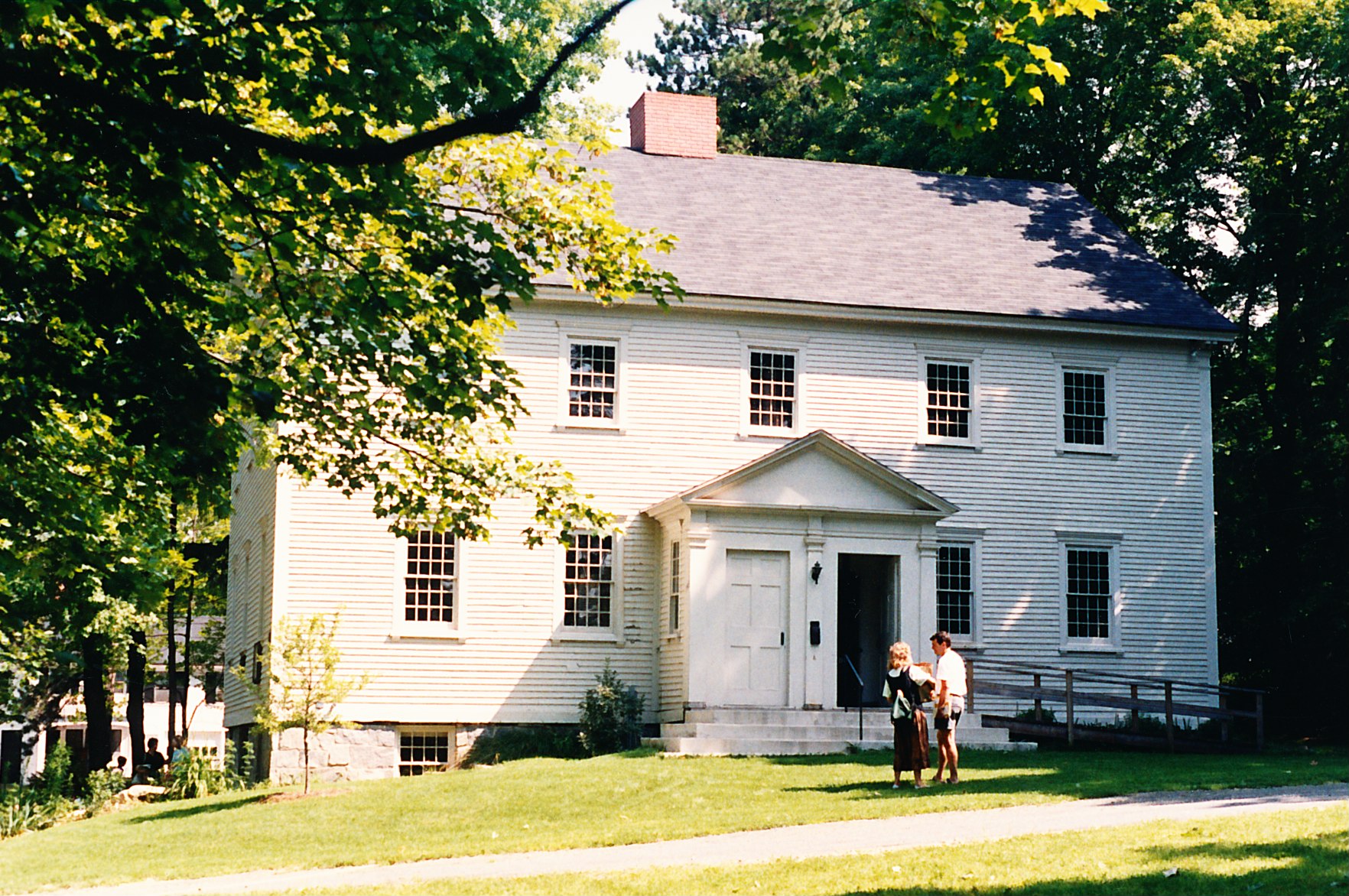
Today commemorates the 247th anniversary of the erection of our meetinghouse. And to think, this was Dover Friends’ third house of worship, coming a little more than a century after the first Quaker convincements along the Cocheco River. The structure covers a lot of history, as we would see if we created timelines of those years – the entire life of our nation, for starters. Add to that science, the arts and leisure, religion, education, economics … the overlays become mind-boggling.

It’s hard for us to envision that day, with its swarm of activity, everyone seemingly knowing the tasks to be done. Cookbook writer Marcia Adams says it takes at least 100 to 150 men to raise an Amish barn, and then recites a menu that fed 175 men in the 1800s. Oxen and strong horses or mules would have been part of the scene, with pulleys and poles lifting the posts and beams into place. Many of the skills used have likely been lost to antiquity. A similar number of women would have busily arranged the accompanying feast, and children would have been assisting everywhere. Today, Jehovah’s Witnesses do something similar when they construct a new Kingdom Hall, which like the Amish barn or our meetinghouse, goes up in a single day.

Settling into worship, I once again regard our Quaker ancestors’ application of classical proportions, pleasing to the eye. The additional touches others have added across the years. Plumbing, heating, wiring, the classrooms upstairs and down. I also realize how much my own perception of the building has changed, now that I’ve become a New England homeowner. How much responsibility we carry for the upkeep of this legacy or how difficult it would be to replace what we have.

In the background, I hear an echo of an old Friend in Iowa, viewing the beautiful curly maple shutters in a meetinghouse about to be shipped by rail car to another part of the state. “It will be a good thing if they be not too proud of it,” she said, with a curious balance of humility and admiration. The advice, of course, extends to us, as well. The fact remains that Friends do not worship in a temple but a house, with all of its Biblical sense of extended family and even their domestic animals. Welcome to our house.

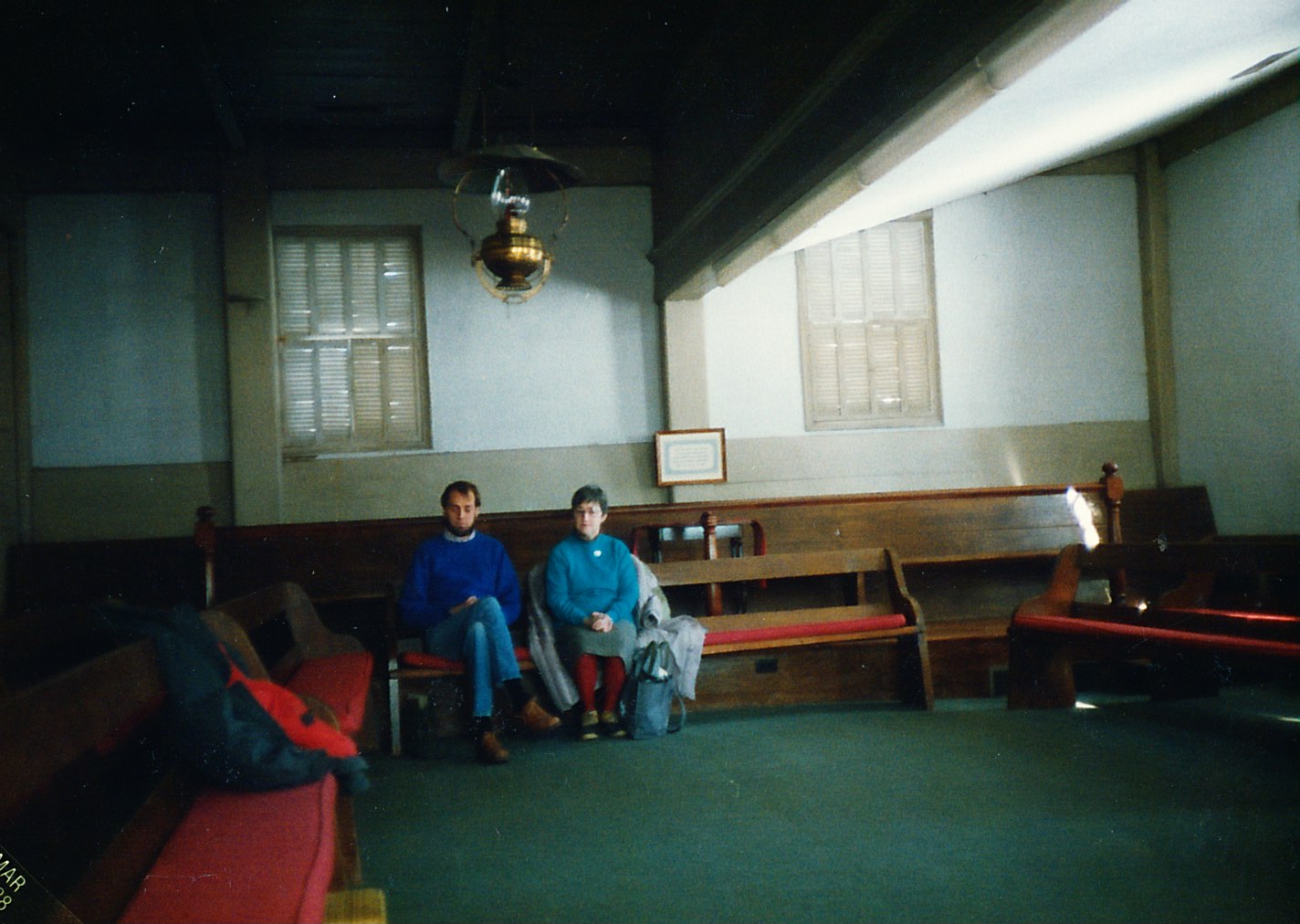
Barbara Sturrock and me on the "facing bench" inside. This is the room where we worship, seated in a "hollow square" facing each other.
Barbara Sturrock and me (years ago) on the “facing bench” inside. This is the room where we worship, seated in a “hollow square” facing each other.

SCN_0070

AT THE HEART OF AN UNDERLYING TENSION

As I said at the time …

In these reflections on Quaker practice, I’ve tried to avoid overt theology. Leave that for messages in worship or for “nuts and bolts” workshops. My focus has been largely on ways our faith comes together in community and some of the quirky sides to that.

This time, though, I want to remind us that the foundation of Meeting is our experience with the Divine – by whatever name we use, or however personal or transcendent the relationship. What is often seen as a tension between peace-action Friends and contemplative ones – or universalist and Christocentric, depending on the particular discussion – can be turned on its head: in Beyond Majority Rule, Jesuit Michael J. Sheeran argued “the real cleavage among Friends is between those who experience the gathered or covered condition and those who do not.” How astute!

There’s a difference between Quaker culture and Quaker faith itself. Since most of us in Dover Meeting weren’t raised Quaker, we’re not steeped in the culture, but we’ve adopted it, to whatever degree, in our own lives all the same. (Or at least like to think we have.) It’s more subtle than it was in the days of Plain speech and dress, but it’s there all the same. The faith part, of course, is at the heart of our worship.

We can ask ourselves if we were led to Meeting more by the culture or by the faith, and then ask how one activates the other. Jim Wallis, the evangelical editor of Sojourner, sees social action arising from the faith as an imperative. In a similar vein, one might see how central the Peace Testimony is in the teachings of Jesus, and how hollow the Christian message is without it. One lights up the other when the culture and faith move together.

Using the language that’s come to represent my experience, this is what happens with Christ amongst us. How do you express it?

THE CUSTOM OF QUAKER JOURNALS

The custom of publishing the journals of influential Friends was no doubt intended to encourage others to strive for exemplary service. The journals themselves form a curious genre – part diary, part autobiography, part memoir viewed from the vantage of advanced age, part travelogue (often tediously so, unless you’re looking for individuals and places being visited), part glimmers of spiritual brilliance – often published after the specific Friend’s death and at the direction of a yearly meeting. Closely related is our custom of memorial minutes.

Best known are the journals of George Fox, spanning the initial decades of the Quaker movement, and John Woolman, whose lifelong mission essentially ended the ownership of slaves among Friends before the Revolutionary War. Both works are in our meeting library and highly recommended.

But there’s a host of others, as you’ll find digging around.

Like the journals themselves, collections of writings or of journal excepts serve as similar prophetic inspiration. For instance, Terry S. Wallace’s A Sincere and Constant Love: an Introduction to the Work of Margaret Fell allows us to look into the remarkable thinking of the woman who became George Fox’s wife and confidant and did much to shape the emerging Friends organization. (How I wish we had a similar cache of material for Elizabeth Hooten, who mothered Quakerism from its very beginning! No such records, unfortunately, are known to have survived.)

For now, let me name one other volume in our collection: Wilt Thou Go on My Errand? Three 18th Century Journals of Quaker Women Ministers edited by Margaret Hope Bacon.

There’s also a host of books and pamphlets that put the lives of Fox, Fell, and Woolman in context or add to their outpouring – too many, in fact, to detail here.

SAVORING THE OPENNESS

When we view our mostly quiet worship in contrast to pastoral meetings, we make silence the measure while conveniently overlooking the focus of our practice. William Penn may have been critical of both styles of worship when he wrote:

“When you come to your meetings … Do you gather bodily only, and kindle a fire, compassing yourselves about the sparks of your own kindling, and so please yourselves, and walk in the light of your own fire, and in the sparks which you have kindled? … Or rather, do you sit down in True Silence, resting from your own Will and Workings, and waiting upon the Lord fixed with your minds in the Light wherewith Christ has enlightened you, refreshes you, and prepares you and your spirits and souls to make you fit for his service, that you may offer unto him a pure and spiritual sacrifice.”

An awareness of this focus also places in context this passage from Penn’s Advice to His Children (chapter II, section 27):

“Love silence even in the mind; for thoughts are to that, as words to the body, troublesome; much speaking, as much thinking, spends, and in many thoughts, as well as words, there is sin. True silence is the rest of the mind, and is to the spirit what sleep is to the body, nourishment and refreshment. It is a great virtue; it covers folly, keeps secrets, avoids disputes, and prevents sin.”

“Rest,” I might add, can also be recast as “centering.” In Biblical use, the word often also indicates freedom from oppression by the enemy, as well as peace of spirit. There is even a sense of gathering of strength. That is, I see nothing simpleminded in Penn’s concept of True Silence. Indeed, as I’ve noted, entering it can prove surprising elusive until its refreshment pours over us.