I’ve previously posted on the Quaker tradition of recording memorial minutes for “public Friends,” meaning those whose service extended beyond their local Meeting.
I have even posted some of those as examples.
As I’ve noted, a memorial minute differs from either an obituary or a eulogy. Its intent is to recognize ways the Divine has found service through the individual’s faithfulness.
After the minute is approved by the local Meeting, it is forwarded to the Quarterly Meeting, essentially a district of neighboring Quakers, and once endorsed there, sent on to the Yearly Meeting, where it may be included in a collection of similar minutes.
Here’s the draft for Charlotte Fardelmann, 1928-2023.
~*~
Deeply grounded in her faith of God and angels, Charlotte Fardelmann heeded spiritual nudges that bubbled up within her, an inner life we glimpsed in her warm smile and sparkling eyes, especially when accompanied by lively hand motions as she voiced a holy leading.
Many fondly remember her hospitality at her pink home on Little Harbor in Portsmouth, New Hampshire, the scene of Meeting picnics, multiday silence retreats, or more mundane committee deliberations. From childhood on, she loved the water and wordlessly shared with us her sense of its wonder and renewal.
A quiet, gentle, self-effacing manner accompanied her nurturing presence amidst us, opening her to listen closely and actively in private conversations.
Raised in a family with two brothers in Minneapolis that enjoyed sailing in international waters, Charlotte experienced the privileges and discomforts of wealth. She did, for instance, sail her father’s 32-foot sloop around the Baltic Sea and later around Greece.
In college, Charlotte underwent a religious awakening, along with service in inner city neighborhoods of major cities, to the consternation of her agnostic father. She also took a spring break on Nantucket Island, where she was part of a circle from Wellesley who met a group of men from Yale who had access to a sailboat. With its occupancy limited, they decided to draw straws on who could go, and Charlotte’s led to Dale Fardelmann, who shared a sailing passion.
Charlotte and Dale married and had four children in Hanover, New Hampshire, while he served his medical residency. By the time they moved to Portsmouth, where he established a urology practice, she was worshipping as an Episcopalian, a faith shared with her mother-in-law.
Her family had experienced mental illness and other dark struggles, which she would continue to address.
In the adversity of divorce, she discovered an opportunity to be something more than a devoted mother and a supportive housewife. With her four children raised and headed in separate directions, she found liberation to pursue new interests, including professional photography and writing that led to her published books “Islands Down East: A Visitor’s Guide”; “Illuminations: Holding Our Life Stories Up to the Light”; “Sink Down to the Seed”; “Nudged by the Spirit: Stories of People Responding to the Still, Small Voice, of God”; and “Create in Me a Clean Heart.” Her freelancing appearances included a Boston Globe story that fronted its Sunday travel section, “Mom, You’re Not Hiking That Alone, Are You,” her account of backpacking the New Hampshire Presidential Range of mountains solo.
In the midst of the Vietnam conflict, she searched for a faith community that pursued peace rather than military programs and that functioned free of an implicit patriarchy. Peace and women’s rights mattered deeply to her. Ultimately, that brought her to Dover Friends Meeting.
A decade later, she undertook a nine-month residency at Pendle Hill, a Quaker retreat and studies center near Philadelphia, to deepen her spiritual focus. It was a life-changing experience. After returning to Portsmouth, though she was reluctant to appear as a public speaker, she created a photographic slide show about the center and presented it to Quakers around New England. That step opened other opportunities for her to share her spiritual insights, in addition to classes she taught at Pendle Hill itself. She also established ongoing close relationships of mutual spiritual support, including a prayer partner she spoke monthly for forty years. In her prayers, her style was boldly specific.
She served Dover Friends Meeting as a sensitive presiding clerk, as well as through many other positions, including its longstanding representative to the Ministry and Counsel committee of New England Yearly Meeting. She presented many workshops during its annual sessions over the years.
One of her practices was to set aside a day each week to listen to God. She nurtured a childlike delight in life, likely a response to the dark night journey of the soul she also knew.
A central discipline was journaling, often involving black ink or color sketching rather than words, as well as a midday gathering at Dover where all were free to similarly engage and share with the others, if so moved.
Add to that her delight in music, including participation in a 200-member women’s chorus in Portsmouth, Voices of the Heart.
Frugal and self-effacing, her one indulgence was travel, which included participation in Servas, a program that had her staying in homes around the world in exchange for welcoming those families to her home in Portsmouth. Other travel connections included her experiencing the Eastern Orthodox midnight celebration of Easter in the then Soviet Union, with its congregational exclamations, “He is risen! Truly, He is risen!,” a resonance that moved her deeply. She also went to Central America as a witness for peace during the Iran-Contra conflict, putting herself at physical risk, and to Hiroshima, Japan, among her other appearances on behalf of global peace. Additional trips took her to Friends in Cuba and Kenya, prompting Dover Friends to support a unique AIDS orphan.
She was not immune to tragedy and endured the loss of a beloved grandson and then, in roughly a year-and-a-half span, the deaths of both of her daughters and a cherished son-in-law.
The fortune she inherited came with her father’s instruction, “Keep it in the family,” meaning its principal, placing it in tension with many needs she saw in the world around her. With counsel from several other Friends from similar backgrounds, Charlotte found resolution in redefining family itself and, with the approval of her brothers and children, established the Lyman Fund to assist individuals and groups in following their unique spiritual leadings by helping them overcome financial obstacles in taking their next step. Carrying her maiden name, the fund had granted more than a million dollars to some 800 recipients by the time of her passing and is poised to continue its mission.




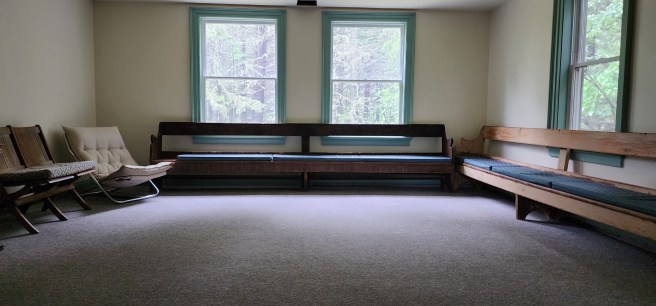 If you meditate in some practice, you’ll fit right in – and if that seems foreign, it’s still a great time for personal reflection. I always find it renewing.
 Jnana's Red Barn