THOSE FIRST BLUSHES OF AUTUMN COLOR

Last weekend, we got away to the Northwest corner of Vermont for a lovely, make that magical, gallivant enhanced by a Friend’s gracious hospitality.

The jaunt began with a long overdue stop at the Saint-Gaudens National Historic Site in Cornish, New Hampshire. Admittedly, sculpture – especially public statuary – has taken a lower rung on my visual awareness to painting, drawing, and printmaking. Let me say simply that this visit to the home – originally summer residence – of the American genius Augustus Saint-Gaudens was a revelation. The National Park Service has done a remarkable job in preserving not just his house and studio but in displaying his studies and castings of his memorable monuments. The glade devoted to the “Shaw Memorial” alone was worth the visit. And, let me add, the floral displays in the gardens at this time of year, when relatively little is blooming, were delightful. As for his work designing American currency, at the invitation of Teddy Roosevelt? The short take is we’re ready to return, soon.

That was followed by a late afternoon jaunt across the Cornish-Windsor covered bridge spanning the woefully low Connecticut River, due to an ongoing drought, into Vermont and eventually through the Green Mountains, taking a questionable route our host suggested through Rochester Gap and Middlebury Gap, one I doubt we would have found via GPS but altogether perfect. This was the real Vermont, not just twee but also working-class hanging in there, apparently happily so. We’re still wondering how many of these folks get to work through the winter.

Not much later we were sitting on his deck, sipping hard cider we’d brought from the Granite State and munching some amazing cheese from his locale. Oh, yes, while watching a feathery sunset stretching toward us from the New York State’s jagged Adirondack mountain range. Does life get any better than this?

The next morning brought my reason for being here, a committee meeting an hour to the north, and the first of two breath-taking mornings with a drive that included Adirondacks in the distance on one side of the highland farm country I traversed (with its seemingly contented dairy cows and huge barns), and the Green Mountains, a wall on the other side, along with glimpses of long Lake Champlain far below to the west.

Still, we weren’t seeing what we’d anticipated: signs of frost. Not all that long ago, northern New England – especially this far north – would have had a killing frost by mid-September. Instead, where we live, we’ve been able to get to the end of October with an occasional throwing blankets over the garden. In other words, global warming is real. And that frost, by tradition, is essential to the famed New England fall foliage.

Leap to Sunday morning, when we ventured off to Appalachian Gap in a second crisp, dewy morning with the mountains veiled in a haze – breathlessly, as it were. What surprised us the most was how quickly some trees were already in prime foliage, albeit surrounded by green. The color comes in waves, actually, and much of the glory depends on the ephemeral angle and quality of light more than the leaves themselves. So the autumn foliage was beginning to arrive. Just like that.

In the week since, it’s starting to appear where we live, too. And, to heighten our awareness, we know all too well what will follow, just a month hence.

~*~

My essays and photographic slide shows on New England autumn foliage are available in the archives of my Chicken Farmer I Still Love You blog. Take a peek!
A FINE EQUATION

Simplicity = enough = balance.

Or we could start with an unbalanced state, where many if not most of us seem to be, and work backward. How much is enough, after all? And so you simplify.

I also like the aesthetic equation (when it’s all in balance):

Elegance = simplicity = beauty.

It all adds up. Satisfaction.

When you’re ready.

TRACING THE MILL RUNS ALONG THE RIVER

The seed was planted back when I lived along the Susquehanna River and was introduced to the trail that twisted through a wooded strip between the water and the freeway.

The site included a bridge now closed to vehicular traffic and a low dam that once diverted water to power cigar factories along the shore. The mill trace remained, filling with moody water after a heavy rainfall.

As I imagined the vanished mills as they might have been in their prime, Big Inca Versus a New Pony Express Rider began to take shape. The town where I lived, after all, was in economic decline and would have welcomed an infusion of investment.

That wasn’t a singular site, even along that particular river. As I would later observe, the opportunity was repeated throughout the Northeast – and many of the communities still had the old buildings, usually in boarded up condition.

As the intervening decades have demonstrated, I wasn’t completely off-mark.

Come along, then, and see where it leads. Just click here.

Inca 1


GLEANING THE MEMORIES

As I said at the time …

From those last surviving aunts, piece together what you can from what memories, photos, and documents you can collect. Maternal sides, especially, can fade from sight, even within the recent past. These personal histories can be far more revealing than those of public figures we usually hear. Especially important is recording the negative findings, as well as the positive.

Look, too, for medical markers. The depression, for example, could arise in genetics or social patterning. For what it’s worth, I suspect there’s a strand of it in my Dunker ancestry. The Hodgson/Hodson/Hodgin males, meanwhile, seem to die largely of heart diseases, probably a consequence of a high cholesterol North Carolina-style diet.

The past lives on, one way or another. It helps to discern its presence in defining your own values and actions.

UNTANGLING THE ROOTS AND THEIR RICHES

As I said at the time …

Your memories of your father’s side of your family are vital. His parting ways, in effect, holds G-d to account for its half of the Covenant in the face of the pogrom.

Fair enough. And it’s a history that must never be forgotten.

After Dad’s funeral, I spent a lot of time in a similar project with his “baby sister” and one of their first cousins as a consequence of a mention, “You know your grandpa’s slogan was ‘Dayton’s Leading Republican Plumber.’ It was on all of his advertising and even the trucks.” I didn’t remember that, but added to what she saw as my grandparents’ hypocrisy, along with their entire church circle, I had something to start with; even though I’d spent a lot of time with them, I never really felt I knew them – it was mostly through my mother’s rather resentful eyes. Up to this point, my genealogy research had leapt over them to get to the roots they rejected. Now there’s (one more) book-length manuscript, probably my one with the most commercial potential, at that. One of the things that intrigues me is the number of times each of us remembers an event or issue differently, or not at all. My advice? Rather than aiming for consistency in the narrative, embrace the variations. Thicken the plot and the possibilities. You’ll rarely know for certain, anyway. Sometimes more details make everything more mysterious. For instance, my aunt finally found the picture of all the trucks and sent me a copy. There was no slogan, though I do have a greeting card where he includes it. Come to think of it, this would have been Grandpa and Grandma’s anniversary – yes, they were married on Lincoln’s birthday, in Uncle Leroy and Aunt Anna’s parlor (I have the photo). Talk about Republican?

At the other end of the string, I found someone online whose explanations took my Hodgson line back across northern Ireland to a still-remote corner of northwest England around 1530. More writing to clean up and eventually submit!

Considering that growing up, I had really no sense of roots or cultural identity, and only much later discovered how much of my ancestry had been in radical religious practices – Quaker and Dunker (a.k.a., German Baptist Brethren and then Church of the Brethren) – has been a real mind-blower. Even though all of my dad’s lines were here before the American Revolution, most of them were pacifists, meaning there are only two ancestors whose actions would allow my sister to join the DAR, if she desired (fortunately, the answer’s no). On Mom’s side, though, there was an aunt who wanted to join, but the lines all get too blurry going across Kentucky – where a number of them were slave-owners, nasty and small-mined people, from the fragments I see.

Obviously, Dad’s side, up to his parents, is what I identify with and cherish. When you speak of the difficulty most people have with understanding the matter of continuing to be Jewish while being, as the term goes, nonobservant, I can point to similar strands on both the Quaker and Dunker sides – essentially, a culture rather than the faith. In the genealogy and broader history, I’ve been interested in seeing what values an individual keeps or discards after leaving the practice, especially across generations. By the time I reached college, I was essentially agnostic or logical positivist, yet I knew, in my bones, I could not fight in Vietnam – this, without any outward religious support and even though my father had served in World War II. Knowing its depth in my ancestry would have been very comforting and strengthening.

ON THE HILL

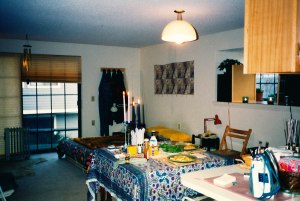
With its large windows and cathedral ceiling, this was my ideal studio.
With its large windows and cathedral ceiling, this was my ideal studio. Amazing how dated all that high-tech equipment is these days. Floppy discs? Line printer? Oh, my!

For a decade, I lived on the highest point in the city of Manchester. Sometimes I called the development Yuppieville on the Mountain, but its views of sunsets could be stupendous. There was even a city-run ski lift on the other side of the freeway.

Using the bedroom as a studio meant a more Zen-like arrangement on the ground floor.

SCN_0047


LABORING TOGETHER

In his book of essays, Life Work, Donald Hall divides our labors as jobs, chores, and work. Jobs, of course, are done for income; chores, the things that must be done to keep a household running, are gratis; but work, he says, is done out of passion, and if we’re really lucky, it even pays our bills. In other words, work energizes us.

Another poet, Gary Snyder, uses the term, The Real Work, which is also the title for a book of his own essays and interviews. There, he argues that real work is a matter of attention and focus, as well as finding our unique place in the universe of the moment.

From the Shakers’ “hands for work, hearts for God” practice, I would add that real work is not rushed, but rather proceeds at a sensible pace, without too much concern for “productivity”; real work includes times for reflection and play. Otherwise, you’d never conceive and create things like a circular saw or clothespin. And, increasingly, such work is rarely found in the workplace. (Job-place?)

From a conference representing three different strands of Quakerism, a statement from one of the Evangelical Friends has stayed with me. She differentiated between “church work” and “God’s work.” One, she explained, was agreeing to teach First-Day School because an adult body was needed; the other was a response to something deeper and fully engaging. In Hall’s view, one was a chore, while the other was work.

Nominations time will approach all too shortly. Yes, our pool of available bodies is shrinking and aging. Still, I’ll ask that you search your heart for the ways you might respond to God’s work in our midst. (As clerk, I was more and more amazed by the range of skills needed to keep this building and its activities running!) Look especially at the little ways this might play into your own larger Life Work – and for ways we might engage playfulness into our labors, transforming chores into the real work.

I’ve spoken of what I call the parable of the geese – the image of our clerks, rotating in the lead so that none get exhausted. My turn, your turn, his turn, her turn. And to think, the birds fly almost as fast as cars on the freeway. Maybe it’s another image of the perfect Meeting. In one of the first quarterly meetings I clerked, as I looked out from small table at the high bench in the Henniker meetinghouse, I thought, Look at all those former clerks! It was my turn, and I felt comforted to know I could trust their guidance.

So who’s leading the geese? And how do they decide in their lineup? I can’t decide if they’re barking or laughing as they fly, but they sure sound like they’re having fun – coming or going.

ALONG THE MERRIMACK

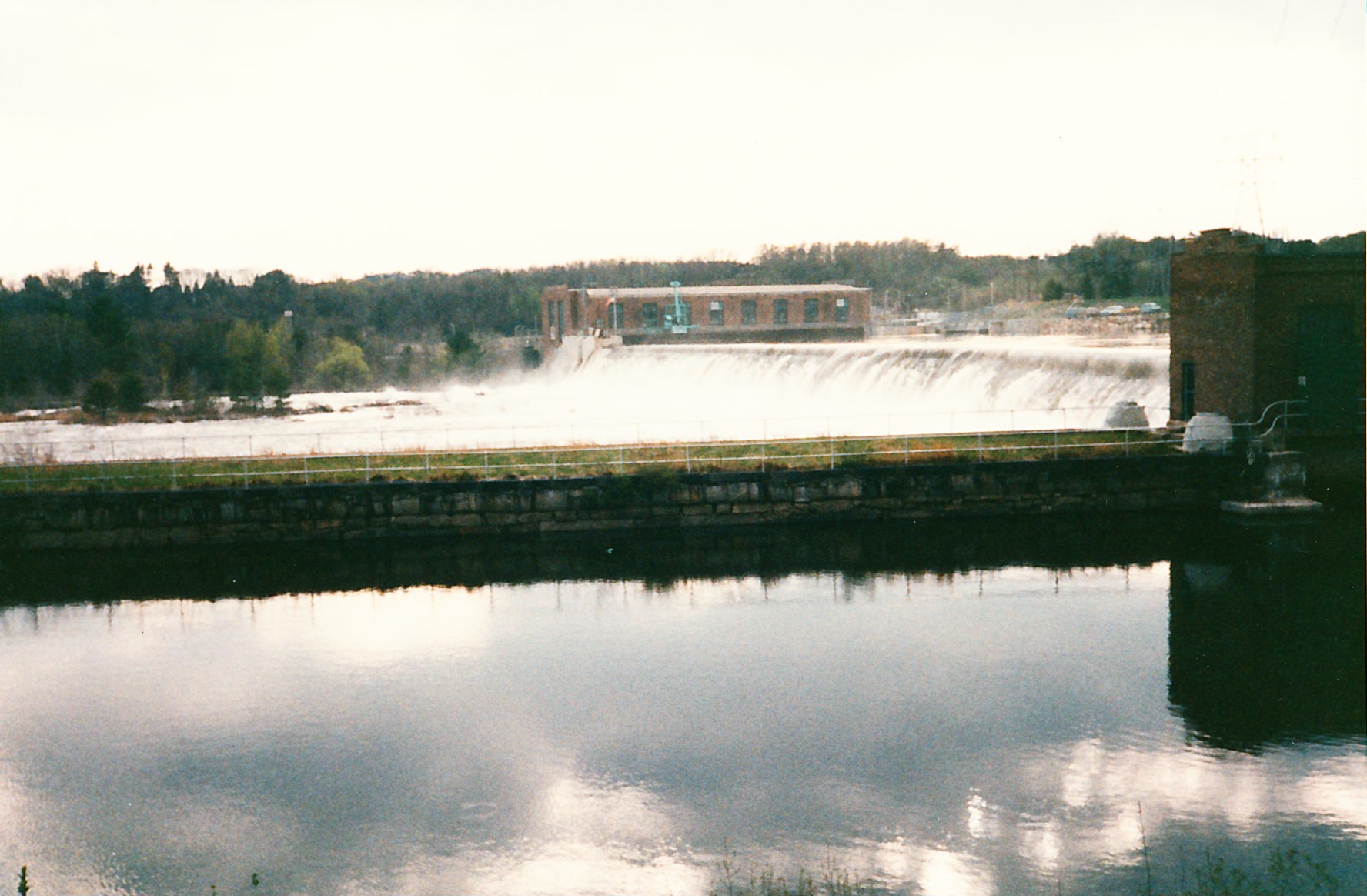
The Amoskeag dam sits atop a waterfall. I lived just upstream.
The Amoskeag dam sits atop a waterfall. My apartment was just upstream.
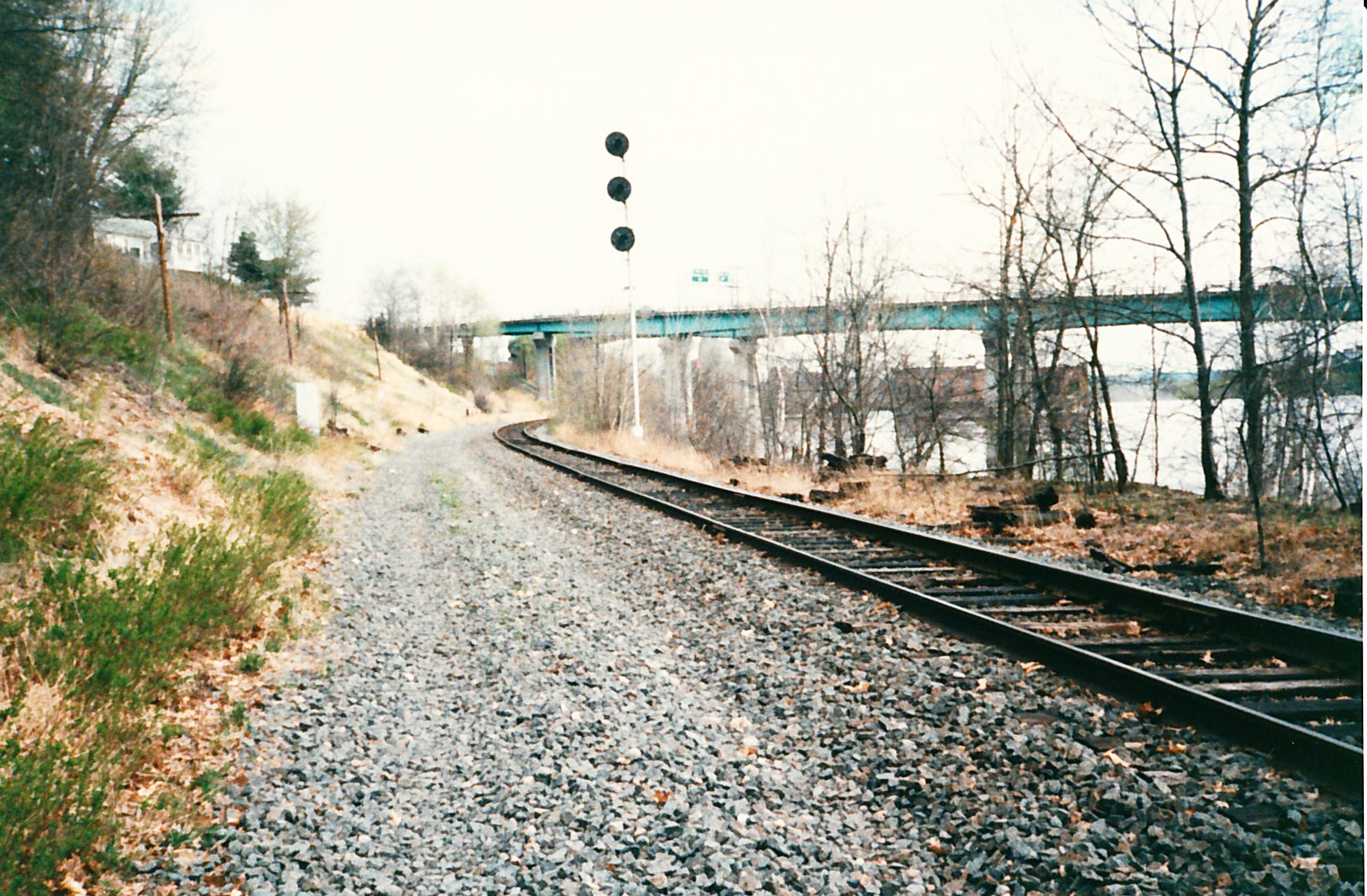
The creaky Boston & Maine tracks paralleled the river.

For three years I lived along the banks of the Merrimack River, a primary energy source for 19th century New England industry.

Wouldn't have minded living in the old North Station, now converted to private residence.
Wouldn’t have minded calling the old North Station, now converted to private residence, my home.


AS IN EYE, FLOWER, AND GODDESS OF THE RAINBOW

As I said at the time …

Yes, your substantial, thought-filled, and most welcome letter arrived. You fire off in so many facets I’m tempted to send off separate replies, one in each envelope. Or maybe try subheads instead, to be read in any order you desire. But that would appear too formal for this ongoing conversation.

Yes, one insight or comment stirs a dozen others – I’ve been talking to you in my daily commute, and now maybe some of that ought to reach paper and then your mailbox.

All these years later!