DAYTON’S LEADING REPUBLICAN PLUMBER

Decades ago, after hearing mention that my family had Quaker roots in North Carolina, I began the genealogical detective work that now fills my Orphan George Chronicles. Although I’d independently come to the Society of Friends and become a formal member, I was surprised to hear that my family had been Quaker and that there were Quakers in North Carolina – my, have my eyes been opened!

In the genealogical work, I chose to begin with my great-grandparents – people I’d never met in the flesh.

But when my father died, the focus shifted. I realized only one person remained who might be able to fill me in on questions of his childhood and parents, and that was his “baby sister.” That would mean getting to know her – and her parents – without all of the filters that had always been applied by my mother, who had issues of her own. (Oh, for these family dynamics!)

It became a rich and fascinating project, given all the more incentive when we met my aunt and her husband, a retired university dean, at the airport. It was a first-time encounter for them and my brood, yet he swept up my younger one in his arms and proclaimed, “It’s so good to have another Democrat in the Hodson family!” The party activist suddenly had a favorite uncle. Make it great-uncle-by-marriage if you will, he got the crown.

At that point, my aunt remarked that Grandpa’s slogan, painted on all of his trucks and on the calendars he mailed out each year, was “Dayton’s Leading Republican Plumber.” She promised to send a photo of the vans all lined up on the street. “You didn’t know that? It was even on his stationery and bills.” This was something I’d never known, although he did sign one of his last notes to me as “formerly Dayton’s leading Republican plumber,” a comment that long puzzled me. Through much of the spring and summer I wound up following up on her reactions and insights to her childhood and adolescence, which to my surprise (the word of the day) paralleled my own, especially in regards to their now-Methodist church, the denomination I grew up in. At last, I could finally look directly at my grandparents through all the memories and scattered bits of data I could assemble, as well as all the material I already had, doing genealogy. It was like being given a key, at last.
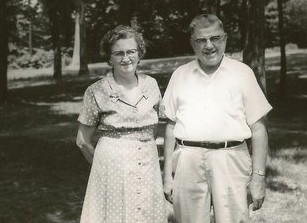
Grandma and Grandpa at family reunion & Aunt Irma Hodson
Grandma and Grandpa at family reunion

My aunt suggested I correspond with a surviving first-cousin Dad’s age, who wound up also contributing memories, and the result was a remarkable project, not quite memoir but more a realization of finally knowing my grandparents, pro and con, for the first time – years after their deaths – as well as questioning many of our ingrained expectations: just what are grandparents supposed to be, do, or look like, for instance. Unexpectedly, I reconnected to more feelings/memories from their house on McOwen Street than to the house I grew up in on Oakdale Avenue. Some of the stories that turned up, like my dad’s desire to be a sports writer or a big chicken dinner Grandpa arranged to help pay medical bills for one of Mom’s best friends, are priceless. From an intellectual perspective, the project also illuminates the difficulty of knowing – it often meant triangulating something in the middle of three often contradictory sets of perceptions. More importantly, to some extent, I’ve finally been able to reconnect with more than a few fragments of my childhood.

From my end, there’s little I’d say was happy in all of that childhood. But there are things I can finally claim and appreciate, and even rework or rewire. Much of my adult life, as I’ve found in Dad’s genealogy (Mom’s is entirely different, and far more gothic than she ever would have admitted) has been a matter of reclaiming many of the values and practices Grandma and Grandpa rejected in their move to the up-and-coming industrial city. I never knew that my Hodson ancestors were Quaker or that Grandma’s were Dunker (Church of the Brethren), very close to Amish and oh-so Pennsylvania Dutch. But they rejected all that, with some values somehow surviving, however invisibly.

Some discoveries still amaze me. The fact that Grandpa accomplished all he did with nothing more than a grade-school education, for one thing.

Or that his two best friends in adulthood were both a decade older than himself, and both died within a year – one of ALS, the other in a car collision. Since he was the youngest of three sons, I wonder about the dynamics.

There’s much, much more I’ve uncovered along the way. As you can guess, it’s a long story. Today would have been his birthday.

SOMETHING IN PARTICULAR I’VE LEARNED IN SWIMMING LAPS

A year into swimming in Dover’s indoor pool most weekdays, I’ve settled into a routine. For each length of the pool, I engage a different stroke in a sequence of freestyle, breaststroke, sidestroke (my left side going in one direction and right on the return), and backstroke – in part to help me keep count of how many laps I’ve completed and in part because I find my freestyle – or Australian crawl, as it was called back at the Y of childhood – is my most exhausting and thus wouldn’t get me very far in a session. These days, by the way, the glorious butterfly stroke is out of the question, except for members of the high school swim team in the next lane. (Yes, I can say I swim with the swim team. I just can’t claim to swim on it.) So 18 laps – or 36 lengths of the 25-yard lanes – gets me a bit past a half-mile, my daily goal. Decent enough for my age, I suppose. Even if the younger swimmers are doing circles around me.

But another realization has set in. Some days that half-mile is longer than others. Which also means some days it’s shorter. That is, internally speaking, distance loses its universal, mechanical measurement. And it’s not necessarily a factor of how much time it takes me to swim those laps, either. This old body runs on its own clock or its own speed. With measurements that can be surprisingly rubbery.

All I can do is keeping plugging away and hoping I make it to the finish line. Wherever it is.


ON THE TWELFTH DAY OF CHRISTMAS

Contrary to the proclamations of many retailers in their countdown to December 25, today is the Twelfth Day of Christmas.

In many parts of the world, January 6, also known as the Feast of the Epiphany or Three Kings Day, is the day for unwrapping gifts and similar Christmas celebration. In our circle, it was time for a party where all the kids who had made gingerbread houses early in December would reunite, bringing their gaily decorated structures to be festively … smashed to pieces! Initially, I was aghast at this custom before learning that it’s real purpose was to liberate all the candy and frosting that had been used to decorate the little dwellings. There was also a cake with three almonds hidden away to determine that year’s Three Kings. Alas, the kids are all grown and the next round hasn’t yet appeared.

Thanks to my wife and her traditions, I’m among those who advocate observing Advent as a way of toning down the holiday stress and hysteria. The commonplace letdown is replaced by a slow easing into winter. Since our Christmas tree wasn’t even cut down and brought indoors till Christmas Eve, we’ll leave it up and decorated until Groundhog Day or later. It brightens those chilly mornings.

So here’s to the gifts of the three Magi.

SECOND TAKE ON THAT BUMPER SLOGAN

I’ll admit I laughed when I saw the sticker:

WHEN RELIGION RULED THE WORLD
THEY CALLED IT THE DARK AGES

But then I started thinking of the ongoing reconsideration of the era itself, which suggests a far richer and more varied culture than we’ve admitted. Just look at the glorious cathedrals, for starters.

Add to that an awareness of the atheistic evils of the 20th century, beginning with Hitler, Stalin, Mao, and others. How many millions were murdered as their victims?

The sticker was on a tiny van parked at the trail head, and a bit further I came across its owner in a cloud of smoke.

Not to be judgmental, but I found myself wondering about his alternative. It looked pretty dark. As for me, I’ve seen enough to suggest religion – true religion – can release us from darkness as a people.

Let’s start with the civil rights movement, if you wish. But there are many others.

Think of religion as a sword that cuts both ways, depending on its user and that matter of love. And then ask, How else are we to aspire to a better world?

ROUND AND ROUND AGAIN

So there on page 41 of Jeffrey Eugenides’ third novel, The Marriage Plot, I find he’s cribbed one of my fundamental arguments, the one about how the older you get, the faster time goes. Or, as he puts it, seems to go. And he didn’t even give me a footnote. Alas. (Where, oh where, by the way, has the year gone?)

At first I was going to say nothing new really happened this time around, but that’s not quite accurate. A stranger in one store did approach me to ask, “Has anyone told you how you look just like the drummer in Fleetwood Mac?” Could it be my ponytail? The one that would finally tie in the back?

And then, thanks to one inspired Christmas present last year (and wondrously repeated a few days ago), I’m swimming a half-mile daily in the city’s indoor pool. I wouldn’t say I enjoy it – laps are strenuous, after all – but the effort’s somehow refreshing and invigorating. Maybe it will also give my pun-prone physician a smile at my next physical. Could it be the giver’s in cahoots with him?

We did enjoy some all-too-short getaways through the year. Camden, Maine, in deep winter, instilled in me a fondness for tulips, thanks to a devotee’s store; Cape Cod in early summer included a panorama from the lantern room atop a lighthouse; Vermont in late summer, before the foliage turned, felt perfect.

Quaker activities have me hopping around New England, and with the Revels Singers, I performed in five concerts this fall, on top of weekly rehearsals. Add to that the release of four of my (experimental) novels and a brace of collected poetry as ebooks, which comes as a relief, and several public readings.

In addition, the Red Barn frequently draws readers from five continents, even if we’re still waiting for Antarctica. I even made my YouTube debut as the subject of an hour-long interview, as you may recall. As for the weeds in the garden or the snow in the driveway, well, can we get philosophical?

The one thing that’s been going all too slow is renovating the bathroom, which finally began before the bathtub could fall through the ceiling to the dining room. We’ll spare you the details. Could it be because everyone’s being paid by the hour? Or just the realities of trying to cope with a century-plus house? (The latter, mostly.)

So here we are, with the new year bringing us another presidential primary, the payoff on our mortgage by midyear, and my 50th high school reunion. If we survived a Social Security payment snafu at the beginning of last year, well, here we go again. Wishing you and yours all the best.

NEXT THING I KNEW

I dream of a kind of writing that approaches, well, dreaming. A narrative of free-floating, widely associative surrealism that’s richly informed by fomenting emotions.

So the other morning I was somewhere in the vicinity of what I report in my novella, With a Passing Freight Train of 119 Cars and Twin Cabooses, and having coffee with an ex-boss, maybe even at the same cafe frequented by John Wycliffe and Hieronymus Bosch in my book. We were too far from the ocean to be considering his sailboat, so we must have been discussing a story in the works. Or maybe politics or updating him on office gossip, now that he’s moved on.

Next thing I knew, we were joined by Jerry Seinfeld – as he was on the show, who knows what he looks like now – and an invisible stranger. Jerry started telling me that’s not how he would have constructed the scene under consideration in my new story.

“When it comes to going to the dentist,” he said, “I would make it as awful as I could. Everything has to go wrong.”

But that’s not how it happened, I want to reply. It’s not true – not true to the facts.

“So?” I can hear from his end. “Wouldn’t it be true to the dream? And much funnier?”

He’d have a point. I’m still thinking about it.

For the record, let me say – there are no scenes with dentists in my novels. And maybe just two or three poems with the hygienist.

Train 1~*~

For this volume and more, click here.

LEARNING FROM THE MONGOLIAN REINDEER HERDERS

With my plunge into yoga discipline early in my adult years, I came to an appreciation of non-Western ways of perceiving the world around us. For someone rooted in scientific, empirical , Aristotelian logical thought, this came as a jolt. Or, as Gary Snyder has argued, every poet must have an appreciation of some archaic system of awareness, be it astrology, I Ching, tarot, palmistry, well, you get the picture. Just listen and look.

What I’ve come to appreciate is the alternative wisdom carried by Native American elders, gurus of all sorts, and the range of those labeled shamans, East and West.

And so, at last summer’s sessions of New England Yearly Meeting of Friends, I was intrigued by an opportunity to view a movie on Mongolian shamans. It’s a remarkable work, by a registered nurse who has worked for two decades with nomadic reindeer herders in Mongolia. Having earned their trust and respect, and realizing their own vulnerability in the face of global changes, the shamans allowed her to film their healing ceremonies.

As I viewed the documentary, I was struck by how much of what she observed leads into Tibetan Buddhism, too.

This is remarkable work. What is healing, anyway? From a Christian point of view, I can say healing can differ from a cure. So just what happens in a shaman ceremony? And where can Eastern and Western health care interact? How much of our physical state is a reflection of our emotional and spiritual conditions.

We might wonder, too, how the Nativity stories would appear from the world view of the  herders, how much their insights would inform us about shepherds and angels. Would a stable be that much different from the homes where the shamans enact their rites? As for the Magi? Or the heavenly wonder? Or even an oppressive political and economic presence? As the Gospel message insists, the world needs healing, no doubt about it.

To learn more of the reindeer herder perspective, go to Nomadicare.

THEY’RE THERE, ALL THE SAME

How difficult it is to see fish in the water, especially when looking in from above. They’re so perfectly camouflaged.

It’s another of the things I’ve observed living along a river and near the ocean. Or even looking into the large tank at the New England Aquarium for the divers doing maintenance below, where only their bubbles give them away.

We look and still miss so many things right in front of us. As for me, I like to think I behold everything. Now what were the color of the bank teller’s eyes just a minute ago? I’m clueless. What what make and model was the car that ran the stop sign and nearing collided with us just moments before that? I was caught breathless. And you want to talk about God?

Of course, it helps to know where to start looking. If you can.

REAMS OF CORRESPONDENCE

She wanted to review our email exchanges from our days of courtship but couldn’t find copies of what she’d sent me. Hoped I had printouts.

I’ve been downsizing, so some things weren’t where I expected to find them. Knew I had a loose-leaf binder somewhere.

Nowhere in my studio, though, the one in the attic. No, not the bookshelves or even the remaining filing cabinets or the knee-high closet under the roof. Nor in the first sweep of the loft of the barn. Not in the drawer of surviving correspondence there, either.

Naturally, I was perplexed.

One more round, though, and I came across a crate of binders. Aha! First one had Quaker letters, back before Internet. Second one, other letters. And then, a three-inch thick binder, our nine months of emails. My first emails, actually. How embarrassing … and fascinating! So long ago, it now seems.

Has me reflecting on how much times have changed, too – amazed, on one hand, how much I actually sent out in the postal system and received in reply. Where did the time come from? And reflecting, on another side, at how much today would be a click and later delete … and thus lost. (Printouts? Too tedious, most of the time.)

Another question even has me pondering how much of my poetry and fiction would have simply been shot off as blog posts rather than tediously typed and retyped, revised and condensed into literature, had another option existed?

If my small-press acceptances letters fill three filing drawers, as they do, the rejections would take up 20 times the space. Where would I put them? Or why?

Now, back to the juicy stuff …

CLEARING THE DECK … OR IS IT SIMPLY HOUSECLEANING?

Ideally, I’d allow a lot more time between the release of my latest book and the next. Give readers an opening to catch on to what I’m doing and then to catch up – or even a breather.

But I’m not, for several reasons.

  • The first, quite simply, is that the backlog weighs on me and inhibits the next stage of writing. For me, it’s been like looking at a very long to-do list or piles stacked around a room, all mumbling for attention someday. I prefer to work with a clear desk and plenty of room to assemble to new endeavor. (I’ve never known how Chinese cooks can prepare a multicourse dinner using a single-burner hotplate and barely more space – I’m not the kind of worker, even in the kitchen.)
  • On top of it, the practice of submitting pieces to small-press journals is time-consuming, tedious, and piecemeal at best. In many cases, the audience is smaller than what shows up at the Barn, so the desired recognition is unlikely to result. And there are all the files to maintain and update. I’m sensing there are better ways for me to build and maintain those connections at this point in my literary career. So, after more than a thousand appearances in those periodicals, I’ve taken a hiatus.
  • So much of my writing – especially the fiction – has been drafted on the fly before being uprooted to a new location and fresh set of challenges and experiences before I could fully digest those already in process. At last, being settled in one place for the past decade and a half has allowed me the stability to revisit and revise those works and bring them to some sense of closure. (Something regular readers here at the Barn are no doubt perceiving in my zigzag postings.)
  • And then, at my age, I have no way of knowing whether I’ll be around 20 years from now to dole out the backlog – or even whether the book publishing world will still be available. The ebook option is a big opening that could close up at any time, the way hitchhiking flourished and suddenly ceased. Think of Amazon and its recent actions, for starters.
  • Besides, to be candid, each of my works is different – I don’t expect anyone to read everything I create. Rather, I hope a given reader will find something among them that will appeal, even while skipping over others.

As I watch my filing cabinets empty and the piles shrink, please understand the joy I’m feeling. Understand, too, how liberating I’m finding the opportunity to publish at Smashwords and Thistle/Flinch. And please delve into those offerings.