One a public high school teacher, quite prolific as both excellent poet and gallery-exhibited photographer, did most of his work during the busy school year rather than the summer; he could never quite figure out why the pattern was exactly opposite of what people would expect.
The other, having all the time in the world to write, could produce only disconnected flashes – nothing sustained or full but wild all the same.
My subways novel started out to be my big hippie tome, building on a metaphor of hitchhiking, which was ubiquitous for us, but the extended concept ultimately got to be too unwieldy for one book. The supportive details were stripped away for what’s become Daffodil Uprising and Pit-a-Pat High Jinks, leaving the metropolis altogether.
Spurred on by Richard Brautigan’s “Trout Fishing in America” with a dash of William Burroughs, the initial drafts played surrealistically in a tension between the wide-open roads of the countryside and the underground realms of the biggest cities.
Then, four or five years after taking up the project, I was pawing through a used books bin in the desert of Washington state and came across a 1915 engineering volume, “Building Subways in New York,” which included “Elevated Railway Steelworks.” I still have it. How on earth had it ever landed out there amid the sagebrush?
I had already lived in Upstate New York four hours from Manhattan, and nearly all of my friends, housemates, and lovers were from The City. That was followed by my residency in a yoga ashram two hours away in the Poconos, so yes, I had learned to ride the trains. (Nowadays, it’s mostly Boston’s a little over an hour south of me.)
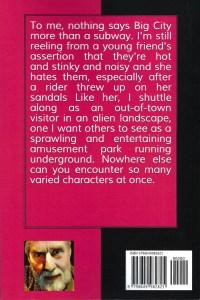
… and the back cover.
The original “Subway Hitchhikers” had a structure that ran like trains passing in opposite directions, which readers could find confusing rather than energizing. It also had a lacy air that reminded me of Robert Rauschenberg’s pop art “combines.” Gone, too, in the revisions is the protagonist’s hippie handle, substituting a more conventional nickname that better links this story to the others.
In the revised version, Subway Visions, there’s more focus on characters, plus new sections on Kenzie’s encounters of Tibetan Buddhism in a tenement near Greenwich Village as well as a graffiti artist known as T-Rex.
What’s evolved has a much straighter narrative and more arresting development, now linked to Kenzie’s ongoing life in the hills to the north. And elements of fantasy and heightened playfulness now augment the earlier surrealism.
I suspect I still have some classic coin tokens in my possession, somewhere.
Naturally, there have been moments when we find ourselves second-guessing our decision to relocate to a remote fishing village at the other end of Maine. Technically, it’s a city, reflecting its peak as the sardine-packing capital of the world, though today’s year-’round population is a mere 1,300 – about the same as the enrollment in my high school minus the 700 freshmen.
I could easily do a Tendrils on what the place doesn’t have – a Laundromat, Chinese or Mexican restaurant, even a pizza takeout, for starters. It’s in an economically challenged region, to put it politely, and the county has a population of only 32,000 stretched across an area about 2½ times the size of Long Island, New York. That comes to about 10 residents per square mile. What, three households? Around half of the townships have no residents at all or at least not enough to incorporate – they have to rely on the state for local governance.
The closest city of any size and resources is St. John, New Brunswick, population 68,000, an hour and three-quarters drive mostly east – once the U.S.-Canada border reopens.
Next, and more likely, is Bangor, 33,000 population, a two-hour-plus drive to the west. (Practically speaking, it’s also the nearest Toyota dealer, when we need serious work on the Prius, the closest medical specialists, the closest U.S. airport providing commercial service or even an Interstate highway.) Portland, seemingly cosmopolitan, takes four hours – with Boston an additional two or so beyond that. (More in the tourist season, when traffic backs up forever at the turnpike toll plazas.)
Are we crazy?
Yes, I’d have to say.
We’re also enchanted.
Crucially, Eastport – on the Bold Coast in what’s aptly dubbed Sunrise County – does have an active arts community, making me think of the TV series “Northern Exposure” and its quirky characters.
And there’s all that North Atlantic water and maritime activity. What makes an ocean so mesmerizing, anyway? The appeal goes far beyond romance for those who rely on moody appearances. This new realm is also deadly and terrifying and constantly changing, unlike anything I knew growing up in landlocked Ohio, for sure. Not even the then far-off Lake Erie.
Somehow, Eastport quickly revives my memories of Port Townsend on Washington state’s Olympic Peninsula, back in the late ’70s. At the time, it was an eclectic blend of working-class, outdoors types, and marginal artists, many somehow connected to the Fort Worden state park for the arts. Its proximity to booming Seattle, a mere 2½ to 3½-hour trip, plus any down time waiting for ferry connections, does put it in a cosmopolitan orb, unlike Eastport’s seven- to nine-hour drive or bus ride from the Hub of the Universe, Boston.
When I lived in Washington state, I harbored dreams of moving from our home in the desert orchards east of the Cascades Range and resettling somewhere like Port Townsend, perhaps even up in the Alaska Panhandle or on coastal British Columbia. That was crushed after the eruption of Mount Saint-Helens and career upheavals that had me reeling back to the Midwest and then Baltimore and finally New Hampshire. I really missed opportunities to spend time in the wilderness during much of that. Even small pockets of forest could be rarities.
Eastport, though, has rekindled that awareness. It’s not just the deer all over town or the eagles or the seal and then whale I saw from the lantern room of a lighthouse across the channel. There’s also the First People’s presence, which was a part of my Northwest experience. Did I mention you have to drive through the Passamaquoddy reservation to get to town?
In ways, I’m sensing the move promises me a chance to get down to some serious unfinished business. Me, with my certificate in urban studies, my yoga training, time among Plain Quakers and the more liberal end of Mennonites, my labors as a poet and novelist, and all those years in the newsroom.
So I lost the source, this still applies: “One of the first characteristics of a mood [the author distinguishes feeling, emotions, and moods] is that it robs us of all sense of meaning. Relatedness is necessary if we are to have a sense of meaning or fulfillment. If something is wrong with one’s ability to relate, the meaning in life is gone. So depression is another term for mood. … So a mood is a little madness, a slight psychosis that overtakes one.”
Also: “A woman is much more in control of her moods. She can use them. She tries them on and sees which one she is going to wear. A man doesn’t have as much control over his moods; in fact, he has almost no control. Many women are masters of the whole feeling department as few men ever are. Much difficulty arises because a woman presumes that a man has the same kind of control over his mood that she has over hers, but he doesn’t. She must understand and give him time, or help him a little bit. …
“There is a fine but important difference between mood and enthusiasm. The word enthusiasm is a beautiful word. In Greek it means ‘to be filled with God.’ . . . If one is filled with God, a great creativity will flow, and there will be a stability about it. If one is filled with the anima [a man’s shadow side, his feminine aspects; in a woman, it’s the animus, her male qualities] one may also feel creativity, but it will probably be gone before nightfall. One must be wise enough to know the difference between God and the anima; most men aren’t. … Laughter is positive and creative, unless it comes from a mood.”
Among the points the writer in question raises in that section is one noting the danger of a feminist stance pushing women into their animus side, which gives men no refuge. “In some respects this is necessary, but in some other respects it could be nearly fatal. Each [man and woman] should serve the other. This is the ideal. We can’t do without it. One cannot live without the service, without the love, without the nurturing and service of the other. Parsifal understands this …”
It’s not like I won’t be back. My next book is a unique history of the town’s Quakers, for one thing, and I’ll be promoting it. And I’ll still be connecting with Dover Friends, especially through New England Yearly Meeting. Yes, Downeast Maine is still part of New England, thank God.
Will I miss people? Definitely. Some great neighbors, the Greek Orthodox circle, the lifeguards and fellow swimmers at the city’s indoor pool would be high on that list. My fellow musicians, on the other hand, were down in Boston, and I haven’t seen them since before Covid. Our beloved conductor even stepped down in the face of its digital demands. The local writing circle, meanwhile, adds some valued faces to the list, though I can’t say we were close or even much on the same page. But that’s where I did learn about Smashwords, where all my novels quickly appeared.
Which brings up another point. This new move would be much harder if we were leaving extended family behind or, more crucially, that rare friend who connects intimately on a range of shared interests – those things that fit one’s life mission or identity. For me, that would be a nexus of Quaker spirituality, off-beat literature, classical music, natural wonder and wilderness, back-to-the-earth awareness, even folk dancing. Things like gardening and foody smarts would be more on my wife’s side of the equation.
What, you think there are tons of people who match my varied interests? Surely, you jest.
Death has already taken a toll there, as has spiraling illness, their moving away to a distance, or even insurmountable conflict. But in my new setting, I am meeting some fascinating eccentrics. More later, I’m sure.
I do wish we had more words to describe friendships, though I’m afraid any subtlety would quickly be eroded. The fact is there are few of those soul-mate connections, especially among males of our civilized species. Women seem to be naturally inclined toward that one-special-friend connection, the kind of person you have to phone (or text) every day. Or every-other hour. Not so guys, to our own detriment. Mea culpa.
Let’s also note that Covid precautions have also already detached us. We’re rarely in physical contact, no matter how much Zoom and other platforms allow me to catch up with buddies even when I’m way up Downeast Maine. And, from everything I’m seeing, that’s likely to continue into the foreseeable future.
~*~
My wife and I have both been surprised how quickly I’ve switched into my new center. Once my workstation and files were set up in our new address, that’s where my heart was. Dover is undergoing what I expect to be an amazing rebirth, but I won’t be part of it, and I’m aware of that.
Quite simply, it’s become a great place for me to visit, but no longer home. All of my goods have ether been moved to the new address or are in the storage unit we’ve rented.
In other words, the dream has stepped on.
~*~
As I look back on my years in Dover, I realize I see I hadn’t spent as much time in neighboring Portsmouth as I’d expected or at the University of New Hampshire just a town away. Even once I’d retired from the newsroom, I was largely hunkered down in writing, revising, and publishing. So much for the writer’s life!
I can say I feel comfortable in leaving Friends Meeting in good hands and wish the best for the new owners of our old house, barn, and precious gardens.
I can say Dover’s been the best years of my life. So far. You will be seeing more from that through the coming year, here at the barn.
There was no Nita for me during college or immediately after. Had she existed, my route would have been much less conflicted. Somehow, though, I managed to figure out enough on my own, often through seemingly chance introductions, to survive in an alien milieu.
After college I landed in a place where I knew nobody except a few people from my previous summer as a newspaper copy desk intern. I was a Midwesterner trying to comprehend the East Coast, a hippie working in a low-paid newsroom. Single and lonely.
The locale I create in Pit-a-Pat High Jinks is situated vaguely somewhere north of New York City. It could be in the Berkshires of Massachusetts or in southern Vermont or places like Oneonta or Cortland, New York, perhaps even Utica.
The paperback cover …
I paint it as smaller than Binghamton, the strange place where I was living and working. The Tri-Cities, as it was referred to locally, was flailing to recover from collapsing industry, especially its shoe-manufacturing ruins, as well as a deteriorating but expensive housing supply. The new state university attracted socially awkward straight-A geeks and nerds. My first year I resided in a neighborhood that was Italian by day and Black, as in ghetto, by night. And then there was the summer and autumn on the farm we shared up in the hills. My work schedule was crazy like Kenzie’s, except for the three-day weekend once a month, which I really wish had been in place – I took that from a newspaper where I worked a dozen years later.
Strangely, I also soon came to love the region. There’s something distinctive about Upstate New York, with its hills and forests and lakes, and almost all of my friends were from The City, meaning the Big Apple aka Gotham. Few of them confined their definition to Manhattan, I should note. Through them I got to know Brooklyn, the Queens, Staten Island, Long Island, and northern suburbs as much as the sliver between the Hudson and East rivers.
I initially addressed this fertile period in my life as two parallel novels – one where the hippie boy largely fails to connect with free love; the other, X rated, where his fantasies come to fruition. Either way, the plots arrived at the same finale. Later, in light of Cassia’s perspectives in What’s Left as well as a few of the early reviews, I returned to these two versions and blended them into a much more cohesive, and I hope more engaging tale, “Pit-a-Pat High Jinks.” Well, that is one of the advantages of ebook editions – you can always update them.
There’s still so much that baffles me about the time and place. How one housemate would come home with a different lover each night, all of them gorgeous to my famished gaze. What was his trick, other than that twinkle in his eye?
In the revised rendering, Kenzie encounters a sequence of hippie chicks, goddesses, lovers, each of them leading him to fresh understandings. Still, I’m left wondering how each of these interludes would sound from the woman’s point of view. I suspect Kenzie wouldn’t fare so well.
Also, for me, it was yoga rather than Buddhism as a new spiritual practice, but that’s told in Yoga Bootcamp.
More lingering are the questions of what’s happened to so many I’ve met in the broader Bohemian spectrum. I can’t even remember many of their names, but I have learned that some went on to become OBGYN physicians, United Way executives, federal attorneys, United Nations officials, photocopier technicians. Hardly what you’d expect of hippies, right?
Well, I’ve tried to record and reflect on what happened, seen mostly on the run. Can you experience something – live it – and still step back enough to record it? In my novels, that’s what the photographer tries to do, similar in its own way to my own struggle. And now you can see how much that role’s changed, too, in the shift from film and darkrooms to the digital ease of today.