Category: Personal Journey
I’ve engaged much of our world from a daily newspaper perspective
Let me express my own everlasting gratitude for Glenn Thompson and his eye for talent, in my case after my letter to the editor and then his offer of an internship, later followed by a full summer. In a seemingly casual interview, he urged me to keep a personal journal, which I actually have. And then came the job offer. Without him (and so many others), my life would have taken a different direction. Gee, indirectly he even led to my first lover. (Look for Mitch in Daffodil Uprising, who’d been a copy boy I met thanks to Glenn’s support. Mitch was the catalyst to the crucial introduction. That dimension, in itself, could be a novel.)
Glenn was the editor-in-chief of the morning newspaper in Dayton, Ohio, and in his own way, a visionary. Behind the scenes, he even brought together the first university I attended, Wright State. And also, through him, I became a professional journalist, even while still in college. Another long story.

And he asked questions no one had prodded me with before. How would I change the world? What issues could I raise and address? At first, I was speechless. We were so green, and within a year, everything would look different. The biggest item on the agenda was the Establishment, not even its war in ‘Nam. Civil rights issues were a distant second.
The next summer I was a hundred miles up the road from Woodstock, working for a publisher who totally ignored me and editors who kept their heads down. But a new direction was taking shape for me.
Alas, as I’m also seeing, mine are steps youth today cannot follow. The pathways simply no longer exist, to the larger society’s impoverishment.
As I describe in my novel Hometown News, American journalism has long been based on a precarious business model. News itself is a byproduct of trying to attract customers for advertisers, and many publishers considered news gathering mostly as a costly nuisance. Successful newspapers were defined mostly by their obscene profits, and the pay levels for reporters and editors were often at the bottom of pay scales for professionals. As a priest reminded me before my first marriage, we might as well have been bound by vows of poverty. Oh, yes, and some of the highest quality papers – the kind I aspired to – were fighting for their very survival. We can now add to the toll of the role of the Internet.
So it’s all in flux now.
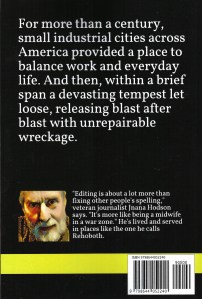
Still, newspapers show up in the majority of my novels, though in Nearly Canaan the field turned from journalism into non-profit organizations where the long, odd hours, public service, and stress nevertheless remained.
As I look back on my own years of being on the management track in a shrinking business, I see how I started out a hot-shot who thought the New York Herald Tribune in its last years was the best newspaper ever – led by an editor who later admitted in a letter to me he seemed to have become a specialist in trying to recover dying papers. Even then, I would have loved to have worked for him.
Despite my own honors, I had some crucial near misses. For one, I wound up in the final 24 for a dozen summer internships at the Washington Post but failed to make the final cut. The next summer, the Wall Street Journal was laying off staff rather than hiring, so their interest evaporated. Ten years later, something similar happened with timing for a high-level spot at the Detroit Free Press. And so my career veered away from the big cities where I had dreamed of living and from the big time, maybe for the best for me personally and ultimately professionally.
Somehow, this also has me thinking back to the lost hippie wannabes at the corner of Third and Main in Dayton during the summer of ’68. Theirs was a story I had hoped to write, but I couldn’t ask the right questions, I was too green myself. But, more honestly, maybe I just wasn’t cold-hearted enough to cut through to the real hurt and relate it without concern for the consequences.
Small’s Swamp Trail, Truro
pitch pine
black oak
bear oak
wild sarsparilla (ginseng family)
sweet pepperbush
bull briar
Why I keep returning to counterculture particulars
I wish there were a better label than “hippie” to apply to the counterculture explosion that swept the world in the late ’60s and early ’70s. Contrary to popular assumptions, there was no standard-issue hippie, male or female. Not everyone did pot or ventured into acid and beyond, nor did everyone participate in a protest march or have long hair or have sex every night or at least on the weekend. We all came in various degrees of separation from general society yet, somehow, we also recognized a kinship with each other.

“Are you sure you were a hippie,” my wife sometimes asks. So what if I didn’t like rock? Many of my friends had been at Woodstock just down the highway from the milieu I describe in Pit-a-Pat High Jinks. No, we didn’t recite a credo, you dig what I mean?
The only other flash in history I can see similar to this was the mid-1600s in England, with its World Turned Upside Down before the restoration of the monarchy – stresses that would fester until the American Revolution a century later. What we shared was a vision of a more just, equal, and caring society. We didn’t have standard-issue, card-carrying members. Alas, we didn’t have elders or cohesive discipline, either. And the breakdown that followed can’t be blamed entirely on a youth movement crossing over into the dreaded age 30. (Oh, how I’d love to be back there, if only I wouldn’t have to figure out how to survive in the current economy.)
Tom Wolfe, author of “The Electric Kool-Aid Acid Test,” pointedly asked why there wasn’t the big hippie novel, overlooking a few notable entries like Gurney Norman’s “Divine Right’s Trip.” The problem, as I see it, is that the scope of the events was too big and too fuzzy to be encapsulated in a single volume. You had the activist side, from civil rights and draft resistance to pacifism, feminism, and the environment, for starters. Add to that sexual revolution. And then drug use, abuse, and visions, as well as new spiritual teachings and practices. All before we even get to the music and its scene. How could you possibly wrap all of that, plus more, into a single volume?
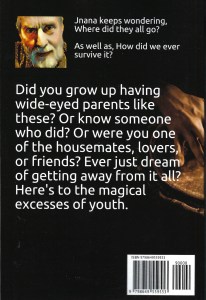
Believe me, I’ve tried with my own Daffodil Uprising and its companion “Pit-a-Pat High Jinks.” Hate to admit there’s so much more that could be added to the, uh, pot. Make that “pan.”
By the way, I think there are worthy nominations in each of the subcategories I’ve just mentioned. I’d love to hear more.
Frankly, I think we, as a nation, have been in a state of denial about the era, with its tension between the war in ‘Nam and the Establishment supporting it, on one side, and the opposition on multiple grounds, on the other. Those rifts in the soul of the nation have never been adequately examined and addressed from either side, much less healed. We could start with the MIA-POW myth, for one, or the ways we might have failed to answer our kids’ questions about pot use, for another. They are definitely exploding in our face now.
Meanwhile, Cassia, in What’s Left, has come along to try to make her own way out of the debris.
And so I humbly or brashly offer my own novels for discussion.
Way out of my league
Considering an ad for artisan designer closets with all those shelves and a few drawers a clear table square center everything clean, arranged so who takes care of all this the maid all the same it’s 25 percent off grand opening
Care to share in my field notes from a lifetime’s zigzag trip?
Writing has been a means for me to investigate the question, “Who am I,” and of recollecting fragments, especially those that might eventually coalesce into a larger perspective. Unlike many adults, I have few vivid childhood memories, but what I am piecing together is often troubling. I grew up in Ohio in a mainstream Protestant tradition, became an Eagle scout, loved chemistry, hiked and camped, that sort of thing. I can blame becoming a hippie on my first lover, and thank her, too, for pointing my life in an unanticipated direction even after she flew ever so far away.
In the years since, I’ve followed a zigzag journey that’s been rich in many ways excepting money. Let’s just say it’s been off-beat.
Now retired from a career in daily newspaper journalism, I’ve married for the second time, live in a historic mill town in the seacoast region of New Hampshire, and am an active Quaker. It’s a full plate. What I didn’t expect was how much of my own “contemporary” fiction is now history – so much has changed so quickly in my own lifetime.
It’s hardly the end of the story, though. Not if we can help it.
It’s been a hard lesson for me
Long ago, I was taught that it was wrong to assert what I want – to accept what was given instead. It’s embodied in a Christian concept of humility, for one thing, and reinforced by poverty, for another. Living in the yoga ashram underscored that as a spiritual lesson, differentiating between wants (or desires) and needs.
My first lover introduced me to the Asian concept of Tao, as taking a path of least resistance. In the long run, that didn’t help much. At least I still had ambitions and kept working toward them, albeit more as a team member or leader than as a social climber.
More recently, as part of some deep psychological work, I’ve instead learned the importance of being able to voice and engage those personal yearnings and preferences – to make them active in a way that’s not selfish, self-centered, but rather an embodiment of my very essence. You know, to give this life a direction rather than a passive reaction.
These days I find myself correcting a phrase from “I’d like” to “I WANT” … as in deciding to do or have such-and-such. It makes a huge difference.
In the jargon, I’m feeling empowered. In doing so, fewer things feel like duties or obligations, which in turn become weights and encumbering .
For instance, I’ll say “I want to mow the lawn today” rather than “I have to.” In this scenario, it becomes, “I want to get it now rather than later, when it’s harder to cut” or “I want the place to look better.” And I can even look closely at the wonder of how it all grows so quickly.
Well, Swami had tried to instill that kind of awareness in the mundane chores and labors we had to do in the ashram.
It comes round to faith, after all.
Prayer can be a time to choose and voice
WHAT I WANT!
As Jesus said, “You do not have because you do not ask.”
It doesn’t mean I can have everything, either. And that’s OK, too. In fact, I don’t want the burdens that so many things carry. And that, too, is liberating.
How about you?
Three guidelines in purging possessions and more
Does this lift my energy?
Do I love it?
Is it useful?
Enumerator insights
After 7½ years of retirement, I returned to the workplace part-time for two months this year.
The job was supposed to begin in May and run through the summer but got pushed back to August and then abruptly cut off at the end of September.
I was a federal agent.
The private identifying details we recorded are sworn to secrecy – or the equivalent, for those of us who follow Scripture and refuse to take oaths. But I’m still trying to put the experience into perspective.
For nearly 40 years, I’ve worked through the available Census files in my genealogical research, as you’ll see in the posts on my Orphan George blog. It’s become something of a specialty for me, along with the Quaker minutes. I mean, it’s how I learned that Grandpa married the girl next door. There’s also one set of ancestors who were recorded twice in 1860 but with enough differences to make me suspect there were two Jacob Ehrstines closely related – one detail in the 1870 Census cleared that up. And I have one ancestor who shaved another year or two off her age every decade, though I have no idea whether it was intentional or out of ignorance, considering that Quakers didn’t celebrate birthdays.
So I set forth in part out of gratitude for those earlier enumerators. The first ones, incidentally, were federal marshals. This was that important.
What surprised me as I hit the streets and knocked on doors on behalf of the Census Bureau was how physically hard it becomes – bending over an iPhone placed on a clipboard to input data quickly had my back aching, especially. For a dozen years, I managed to work a double shift every Saturday as a newspaper editor, yet here I was pushing my limits when it got close to five hours a day. (Wimp!) Six really maxed it. An article in the Washington Post enlightened me that I wasn’t alone here, so I couldn’t blame it all on age.
I am surprised by how many Americans don’t know what a census is or that it’s required every ten years or that they don’t want to be recorded.
Well, I now also have a clearer understanding of why one household might disappear ten years later but reappear again in a subsequent Census. You know, be there in 1800 and 1820 but not 1810.
I am also surprised how much of my brain space got wrapped in a job again. You know, replaying cases and wondering how I might have done them differently. This was supposed to be something I could let go of at quitting time. Not so, though.
Inputting data in an app on an iPhone still strikes me as tedious. You might have guessed I pretty much hate texting, except as an alternative to an actual phone call. (Emails seem to be my preferred form of communicating these days.) How do kids do it, texting with their thumbs? Or are their exchanges all typos?
Oh, yes, another confession. I’ve typed for nearly six decades now. Self-taught, earned my livelihood with it. Written whole books, even. But ask me to re-create a keyboard from memory, and I have no clue where the individual letters of the alphabet are. The memory is all in my fingers, not my head. Seriously.
So I can’t imagine keyboarding with my thumbs. As I was saying about the kids? Besides, thumbs are awfully fat for those tiny screens. My dry fingers had enough trouble connecting, even before getting to any issue of accuracy.
In my rounds, I had a few near falls (including one wooden step that wasn’t nailed down anymore), a couple of dogs who could have turned nasty, some close calls in traffic, but emerged unscathed.
Some of the most enjoyable interviews turned out to be those where I could put my very limited Spanish to work. Other enumerators had backed off, so I guessed it was up to me, and somehow, we got the required data, often with a lot of laughter. Yes, I made some funnies.
The best part of the job, though, was meeting people who, for the most part, were warm, friendly, helpful. I have a much clearer understanding of the neighborhoods around me.
Would I do it again?
No, I’ll be too feeble – or feebleminded – in another decade.
But maybe you’d want to give it a crack.
Is everybody crazy?
You know, like screwed up?
We’re reflecting on so many people we encounter, in person and their stories as well as in the news, and so often there’s a kind of lunacy involved. That, or plain tragic fate. I wouldn’t even call it bad luck.
Makes us question if anyone’s normal, whatever that is, or makes us see our own irrational failings and emotional struggles as nothing in comparison. (Yes, we still want to be better than those poor unfortunates.) As for paying the bills and that sort of thing – getting to medium income would be nice – though even that is beyond the range of possibility for many.
Lately, in revisiting the program booklets of so many musical performances I’ve attended over the years, I’ve been wondering whatever happened to so much of the rising talent I heard – the soloists or opera singers who never made it to the top, and that’s just one front.
Authors and journalists, too, as the written word has receded from the public spotlight. (No, Fox News anchors are not journalists, and that’s part of the problem.)
Makes me wonder if I’ve been looking at the whole world wrong. Maybe we should begin with an assumption of insanity somewhere in every psyche and work from there. Maybe that was the best part of the hippie outbreak, letting that side somehow out of the box. Dunno, but it was lively.
Of course, it also means looking into the dark side of life, if it’s possible to do so and not become engulfed in evil. That part’s scary.
And here we are, wishing everyone Merry Christmas.
Ding-a-ling!
 Jnana's Red Barn