The role rides on conflicted feelings

Sitting down to compose a novel requires some bravado, an assumption or presumption, even outright arrogance, that you have something important to say and an ability to do it in an interesting way.

You know, balls, swagger, mojo. Go to a writers’ group and just listen. But it’s not all sheer ego-driven. For many, at least, there’s an ongoing tension between believing in our own talents and shielding ourselves from the nagging self-doubts. Even Stephen King has them. Remember, the practice of the craft is a solitary act, not a team sport. It gets lonely, especially in the absence of feedback or fans in the stands, whether they’re cheering or jeering. Sometimes, to your surprise, harsh criticism is easier to handle than any praise.

Unless you’ve been there, you have no idea how precious a voiced reaction can be in nurturing you. Those brief reviews and star ratings are important, not just for guiding others to certain books but for guiding you as an author in your practice. An astute reader picks up important elements that have slipped right over their creator’s consciousness. Please, please, please take a few moments to weigh in when you finish a volume. We all need confirmation that we’re not wasting our time – or yours. Best of all is the epiphany when we’re left feeling that someone finally “gets it,” actually understands what we’re about. Don’t be shy.

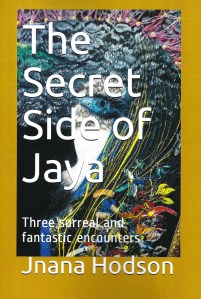
The paperback cover …

I recall giving a friend a booklet I’d written about the Quaker metaphor of Light. (By the way, in the first two centuries of the Society of Friends, the term was always Inward Light or some variant, never the Inner Light expressed today. It’s a crucial distinction.) When he finished, he thanked me, said the text had cleared up his understanding, and then added, “You write very well.”

Even after four decades in the words-on-paper business, I was taken aback, considering that he is, by any measure, an important American literary figure and a master of the language. It was like “welcome to the club,” the exclusive one with the dark paneling and Manhattan address. It was like a cup of fresh water in a desert. Within myself, I felt freed from the “hack writer” label so often applied to journalists from Dr. Samuel Johnson on.

Later, in an aside, he told me I was more of a poet than a novelist. Knowing his fondness for poetry, I took some comfort in the perspective, as well as some umbrage about the fiction part.

On reflection, I now have to agree on his assessment, at least as my novels stood then. He certainly helped my character Cassia press her case for the reworking of all my existing novels, as I did in the aftermath of What’s Left, where she’s the star.

There’s also that frightening moment in the gap between when a book’s been accepted for publication and when it actually comes out. We’re afraid someone’s going to somehow uncover our darkest secrets or that we’ll be shamed by some indiscretion or that we’re about to make an unforgivable transgression. Again, go to a writers’ group and listen … or even ask. If you’re an author, you think you’re somehow bonkers when you feel this, not knowing how much company you actually have.

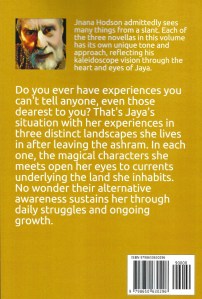
… and the back cover.

I’m of the camp that hews to Bukowski’s regime of daily “butt time” at the keyboard, day in and day out, regardless of how inspired you might be feeling. Many days it’s a dry struggle, but on others something different and amazing blossoms. From my perspective, it’s when writing becomes a kind of prayer and you find yourself in a “zone” where things come together as if by magic and characters start dictating to you, if only your fingers can keep up with what your soul is hearing. It’s a dialogue with the Other, as in Muse, and you’re the mere scribe at her service.

It’s what happened when Cassia started dictating to me.

It’s not always at the keyboard, either. Sometimes it happens while you’re in the shower or on the throne next to it or swimming laps in the pool or commuting to work.

You can’t control this. Realistically, it happens when you’re not in control.

It happened to me at the finale of “Subway Hitchhikers,” which years later became the launch pad for “What’s Left,” where I had to make sense of what I’d been given, however intuitively.

Perhaps the best, well, I just had a phone call and lost the thread of thought. Maybe it wasn’t that important.
 

A baroque twist runs through my distilled expression

Samuel Johnson and his baroque constructions gave a big push to my literary ambitions after high school. Let me just say I’ve loved the clarity of Mozart from my adolescence on, and Bach and Handel have risen in my estimation in the years since. The brash English master fell right into that, though I now see again just how irreverent he was, despite all of his professed orthodoxy.

What it means it that I’m comfortable reading and writing certain kinds of complex sentences that are foreign to modern readers. Perhaps I should apologize? At least it’s not the only way I put sentences in line. Still, there’s a richness that’s missing in Hemingway and his progeny.

And here I am, drilled in the newspaper journalism Papa Ernie claimed was his inspiration. Think again. (Ernie? Makes me think of Pyle, and his big desk at the Indiana Daily Student, where I once worked.)

My wife has noted the dichotomy between my fondness for many Old Ways and the rule-breaking, experimental edge of my writing and thinking. She can point, for instance, to my fascination with the fiery writings of early Quakers in the mid-1660s placed in contrast to wild hippie extremes.

Are they really that different, though? I feel they enrich and deepen each other.

An ongoing internal tension

Trying to strike a satisfying balance:

Between my local Meeting and serving the wider world of Friends.

With my writing, finding a wider audience for my existing work.

With the rest of my life – householding, exercise, reading, etc.

It just never seems to come together neatly!

So just what, exactly, holds it all together?

How I finally wrapped up some lively loose ends

The paperback cover …

Once I had gone back to better unify the stories of Cassia, the basis of What’s Left, and her father, I then saw a possibility of pulling two existing and somewhat problematic novellas into an overall more unified volume. (Yes, I’ll argue that what I have is something other than a conventional series, even when some of the characters appear in multiple novels.) And, I should emphasize, Cassia is far from the scene in the pieces I’m addressing, the ones that now involve Jaya, the center of Nearly Canaan, in a capstone work.

By weaving Jaya into the two novellas, I could pull them together. And since “Nearly Canaan” was set in three distinct parts of the country – Great Plains, the South, and Pacific Northwest – reflecting places where she had lived with Schuwa, a third section was required, one reflecting their interlude in the Ozarks.

Here, my imagination took over, along with some elaboration of earlier research. I might add that the Hodgson Mill cornmeal found on many supermarket and kitchen shelves has a personal connection – its founders were distant kin from North Carolina who spelled their name like mine at one stage in their migration to Missouri. I have to admit that “Miller at the Springs” is especially satisfying for me.

Together, the three form The Secret Side of Jaya, plus a little more.

… and the back cover.

I must admit the collection is deeply personal for me and leave it at that. I offer it to you, all the same.

While we’re at it and geography’s on my mind, I should also confess that in “What’s Left” and Daffodil Uprising, when I recast the town of Daffodil by moving it to the Ohio River and throwing in a touch of Dubuque, Iowa, from the Upper Mississippi, I was acknowledging a sense that southern Indiana gravitates toward the big river along its southern border, even though no place along the waterway is only an hour from Indianapolis. Poetic license, then. The Hoosier state was settled largely from the south – in 1850, nearly half of the households had roots in North Carolina, where many Quakers had fled because of the slaveholding culture. And then recasting that Indiana into the Ozarks, I turned heavily toward the use of photos and related documents, somewhat the same way I did in another series about what you don’t know when I tackled my Mediterranean poems.

And I’m somehow surprised that Baltimore, as beloved as it was in my residence later, has never come up in my fiction. And it won’t. The personal drama was mostly banal or I just never got to know the place well enough to go more than skin-deep.

One coot to another

As a preamble to a friend’s retirement, “Congratulations” doesn’t seem quite in order, other than, “Wow, you’ve survived!” Or “Hallelujah,” in a minor key full of wonder. Like making it to the end of a gauntlet.

Chronology doesn’t matter in these matters, older as I am but less mature, the eternal 17-year-old emotionally.

I still have no idea of how it feels to “be retired,” other than there seems to be a bit more space to savor what we’re doing or eating, if we want or can remember to do so. Golf? Tennis? Who has time? And yes, after all those years in the newsroom, I’m still “on the clock,” even when sleeping. Tick-tick-tick, only now there’s more of an urgency of mortality. Well, at least so much of my literary writing doesn’t feel like acts of graffiti.

Continue reading “One coot to another”

And you wonder how I work?

When I was employed full-time at the newspaper, I read interviews with successful authors who boasted they actively wrote two hours a day. Yes, boasted! As if two hours was such incredible labor! My reaction was, “What shirkers! What slackers!” And then, during my sabbatical, I typically spent eight to ten hours a day composing, though admittedly I did have a backlog of raw material to work down. And toward the end, I realized I was going at an unsustainable pace.

Besides, my two years on the road calling on newspaper editors for the media syndicate had convinced me that in a typical workday two hours of actually productive time was the optimum you could count on. In my case, it was the time spent in front of editors pitching our new goods and defending the ones they were already buying. The rest of my daily hours were preparation and cleaning up afterward and a host of other things I label as “infrastructure.”

You follow that? You still have to talk to the boss, do your research, keep in touch with colleagues, that sort of thing. And then there are doctor’s appointments and oil changes for the car. Welcome to the real world. It’s not an assembly line. Or maybe what lawyers would call billable time.

At the paper, I might now consider those two hours as actual keyboarding time. The rest would have included phone calls to interview subjects, plus background reading of the clips and even pondering what questions needed to be asked.

When I was employed, my literary world occurred in my off-the-clock hours. Much of it happened like graffiti, even notes jotted down while driving to the office or after. Flashes I might expand later in something that felt like jazz improv.

Two back-to-back Paris Review interviews in the late ’60s added perspective. The first was Jack Kerouac, with his two-week bursts of hammering away uncorrected on long rolls of teletype paper (like the ends I later used from the newsrooms where I worked – it’s the experience we now have on computers, where we don’t have to pause to insert a new sheet of paper page after page). Voila! He had a novel! Let the editors fix it, if they dare. The other was with Nabokov, the Russian émigré, who polished each sentence in English on a large index card his wife would later copy into a typescript.

I suspect no two writers work quite the same. Unlike one friend, who requires a new chair for each new work he tackles, I’ve been in the same one for 25 years or so now. I can’t imagine keyboarding in an aluminum fold-up lawn seat as he once did. Ahem.

Nor am I a Mozart, able to compose effortlessly on a stagecoach or in the middle of a loud party. I need my own Fortress of Solitude, currently in a corner of our attic though a treehouse might also be tempting.

When it comes to writing, my real work comes in the revisions, with all of the reflections and corrections and distillations and insertions. Initially, I found this oppressive. Something like our warmup exercises in choir, actually, though I really miss them when they don’t happen.

As a journalist, my dream was to have been like Hub Meeker at the Dayton Journal Herald with his State of the Arts column, though my own Corinthian Column at the Indiana Daily Student during my senior year of college at the height of the hippie upheaval did come close, only taking the larger counterculture as its vague subject. By the way, whatever happened to the Washington Post’s Nicolas von Hoffman, from that same frothy upheaval? A column, bang it out and you’re done. On to the next.

Poems and novels rarely happen like that. Still, they require daily “butt time,” in Bukowski’s term. That I finally understand and embrace.

As I’ve revised what I considered “experimental” novels, my emphasis has shifted from the events to the characters. Sometimes even the genders have shifted, adding new nuances. Yes, there are scenes that never happened to me personally, not that I would have resisted. They happened to somebody.

More recently, my now-wife has shown me instances in cooking where I bring in a big batch of something from the garden, say a basket of kale or tomatoes, and watch it cook down to almost nothing. A very, very tasty essence.

So you wonder about what writing’s like? Please pass me the pepper grinder, a lemon, and a stick of butter.

Funny, how that points me toward Cassia and her family in What’s Left.

Wrestling with Czeslaw Milosz, fellow poet

In one poem, which I’ve crunched here from my own journal entry, he replies: “You ask me how to pray to someone who is not. All I know is that prayer constructs a velvet bridge and walking it we are aloft, as on a springboard, above landscapes the color of ripe gold transformed by a magic stopping of the sun. That bridge leads to the shore of reversal where everything is just the opposite and the word is unveils a meaning we hardly envisioned. Notice: I say we there, everyone, separately, feels compassion for others entangled in the flesh and knows that if there were no other shore they will walk that aerial bridge all the same.”

Elsewhere he wrote: “’I could not have had a better life than the one I had,’ she writes to me in February 1983 from Warsaw, Irena who has lived through the occupation of her country by two enemy armies, had to live in hiding trailed by the Gestapo, then adapt herself to Communist rule, witness the terror and the workers’ responses in 1956, 1970, 1976, 1980, and the martial law proclaimed in December 1981.”

I’m not sure I agree fully with his theology, but I completely appreciate the richness of his grappling with 20th century unbelief and its practice with his discovery that there is, indeed, something larger than what we admit – something few other artists in our time have been able to pull off convincingly enough to be considered sound artistically. (Milosz won the Nobel Prize, 1980.)

He also wrote: “To find my home in one sentence, concise, as if hammered in metal. Not to enchant anybody. Not to earn a lasting name in posterity. An unnamed need for order, for rhythm, for form, which three words are opposed to chaos and nothingness.”

And, he quoted from Renee le Senne: “For me the principal proof of the existence of God is the joy I experience any time I think that God is.”

Again, Milosz: “To wait for faith in order to pray is to put the cart before the horse. Our way leads from the physical to the spiritual.” And himself: “My friend Father J.S. did not believe in God. But he believed God, the revelation of God, and he always stressed the difference.”

How existential!