An orange is an orange is an orange orange

The mystics and traditions I’ve encountered are anything but airy-fairy. In fact, they can be pretty down-to-earth and practical, based on personal experience and testing rather than empty speculation or dogma.

As George Fox said at the beginning of the Quaker movement, “This I knew experimentally.” That is, by first-hand experience including trial and error. Or as was said a few years later, “Some of the best barns in Rhode Island were designed during Quaker Meeting,” during quiet meditation.

Never underestimate the importance of the disciplined circle of fellow practitioners, either. Anyone who says “I’m spiritual, not religious,” but lacks that communal base is headed for trouble.

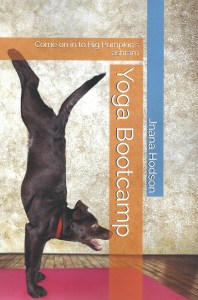
I learned that 50 years ago in a yoga ashram – see my novel Yoga Bootcamp for unorthodox examples of how it works – and have seen it in other traditions since, especially my Quaker circles.

One of my favorite stories comes via fellow blogger Tru-Queer, who relayed the incident this way:

A Tibetan lama and a famous Korean Zen master in the Rinzai school were to have a debate.

The Tibetan lama sat meditating, counting his mala. The Zen master produced an orange from his robes and asked the lama, “What is this?” It was a famous koan. Waiting for a response, the lama continued meditating. The Zen master asked again, “What is this?”

The Tibetan lama spoke with his translator for a moment, who said, “Do they not have oranges where he is from?”

~*~

I suppose I should explain that a koan is a kind of mental puzzle intended to push a student beyond rational thought. Zen is essentially black-and-white ascetic, while Tibetan Buddhism is full of colorful esoteric teaching and drama. Yet here the roles are reversed, in a great joke.

But it doesn’t end there. When’s the last time you really looked at an orange? How many varieties can you identify, much less their differences in uses or subtle flavors? Does your recognition that it’s “an orange” put a stop to regarding it fully? That is, when’s the last time you had an “OH WOW!” moment with something so seemingly commonplace.

Gertrude Stein was aiming at something similar with her “A rose is a rose is a rose,” which blows open when you learn she was also speaking of a friend named Rose and not just the metaphors associated with a specific flower that somehow too often gets lost in the entire equation.

So just how do we live full of wonder – a state a Friend hailed as the Holy Now?

I’d say having dear ones who share it with you does help. Even if they’re Zen Buddhists.
My encounters in a yoga ashram altered my perception of life

I stepped out of my journalism career three times in my life before retiring for good. The first was when I decided to move to the ashram where I could immerse myself in yoga philosophy and practice. Responding to Swami’s invitation to settle into her rural setup was something I did slowly and deliberately, with a large degree of trepidation. As I relate in my Yoga Bootcamp novel, the daily life was intense and evolving. Leaving the ashram was a different matter, with others largely resolving the outcome – out you go. For weeks afterward, I felt myself falling helplessly through space. Eventually, I reestablished my feet on the ground and then headed off for a new life in a town I call Prairie Depot.

The paperback cover …

What happened for me during my residency was life-changing. I regard it as my master’s degree and my introduction to psychotherapy of an amateur sort. Among other things, it led me to the Society of Friends, or Quakers, which turned out to be the faith of my Hodgson ancestors from the 1660s down through my great-grandfather.

In the novel, I chose to confine the structure to a single day, in part because I had so many lingering questions I could not answer. Yes, within that day individuals could look back on their previous history, but the focus was on the NOW. And a lot could happen there in a 24-hour span. Besides, as I later learned through some candid discussions with a former Episcopal nun, monastic life has some commonalities of its own. As she said, some of the most intense interactions came in trying to choose the flavor of ice cream when the rare opportunity arose. I’ll argue you’re the most human under such rarified circumstances.

On top of everything, when I was drafting the book, I was out of contact with the place and its people. Critically, I had refused an order to return to the ashram after I’d married and moved to Washington state and a follow-up stipulation of heavy financial support was out of the question. A half-dozen years later, back on the East Coast, I had an opportunity to stop by but was not admitted into the house. I did learn that Swami had died and I sat by her grave. So much for making amends.

… and the back cover.

Since then, I’ve reconnected through social media with some of the key players and had a few assumptions, not in the story, deflated. In addition, Devan Malore’s “The Churning” reflects life there a few years after I’d moved on.

The story itself could have gone another way, if I hadn’t wanted to present the ideals that drew us together and kept us going. Especially the humor and playfulness.

More compelling for many readers would have been a more sordid tale of just one more “new religion” outfit run into scandal of a sexual or financial sort, preferably both. There were enough elements for that, as I’ve since learned.

The story first came out as a pioneering ebook in PDF format only and was later updated to Smashwords and its affiliated partners. A more recent, quite thorough recasting (again, blame the influence of Cassia in “What’s Left”) changed Swami from female to male and introduced Jaya as one of the eight resident yogis, thus linking her to the heftier Nearly Canaan novel. Besides, the transformation made Swami more acceptable to the expectations of many readers and allowed the Big Pumpkin and Elvis dimensions. The role was already unconventional enough, and this was more fun.

Am I still doing yoga? If you mean hatha, the physical exercises, let me say rarely and embarrassingly, at that. As exercise, I’ll substitute my daily laps in the swimming pool, and as meditation, my weekly Quaker meeting for worship. And no, I’m no longer vegetarian, other than when I voluntarily follow the Greek Orthodox “fasting” of Advent and Great Lent (again, blame Cassia), though I also eat much less flesh than most Americans. Actually, in these seasons, the Eastern Orthodox Christians are stricter than we yogis were.

I do wish there were a similar haven for youth today, one freed from the burden of student college debt. I’ll let “Yoga Bootcamp” stand where it does.


Another twist on everyday personal unease

Everybody is searching for something. So I’ve heard.

That, rather than mere “anxiety”?

As if I ever had an answer, short of some piety.

Still, I am the son of a born worrier.

So just what, exactly, is that “something” in your life?

What, exactly, is your life (or mine) missing?

And just how much will it cost?

Some observers will argue it’s really an enemy, villain, or opponent in our life that we require.

Maybe even the devil in the details.


I’m going ‘round in circles!

No, I don’t mean that maddening activity of starting one thing but picking up another before the first is finished and then jumping ahead to the a third or fourth or fifth but having to backtrack to the second or first in some fashion. Know what I mean? Don’t we all have days like that?

This blog’s merry-go-round, meanwhile, feels more like a spiral.

The circles I’m looking at this morning are much calmer.

Let’s start with the fact I haven’t been getting much exercise this autumn and winter. It’s not like pre-Covid, when I was swimming laps in Dover’s indoor pool. Up here in Downeast Maine, the nearest such pool is in Canada, and the border’s essentially closed. I used to joke that I swam laps to keep my doctor happy, but now my new one has been concerned about my current blood pressure level, so I guess I’ll have to do something to keep her, too, happy. . Does that sound familiar to any of you? So we’re back to the lack of exercise and maybe a rising intake of salt.

After learning earlier this month that the high school gym is open weekday mornings for walkers, I’ve started venturing forth (it’s only eight blocks away, no need to drive) and begun circling the basketball court briskly in full comfort for an hour or so, switching directions about 30 minutes in. It’s nice not having tree roots, rocks, mud, or inclines to deal with, too. Frankly, even when they’re not snow covered, the local trails can be pretty challenging, not just where they’re along bluffs dropping into the churning ocean, either. There’s some pretty rough terrain around here.

As for the gym? I’m the only guy showing up so far, the rest are all women. Make of that what you will.

Guess the indoor track is gonna be the anchor of my new routine into spring, likely with pickleball thrown in somewhere during the week. (So far, I know nothing about said sport, other than what I found on the Web and that a couple of guys here have told me it’s a gas and I should try it and it seems to be the big social activity through the depth of deep cold. At least the avid players have a Facebook page here, and I’m kinda signed up, when the next round of newbies get introduced. Please stay tuned!) I do miss swimming those laps and some of the social connections I had many miles and months ago. Could that be a fine substitute?

That said, being back in high school, even it’s only a building, stirs up its own mixed feelings. I did resist an urge to deface a sign, TAKE THE SHOT, by altering one letter. I would be a horrible student if I had to do high school again. For instance, those PA announcements that interrupt the calm of my stroll really could prompt comedy. They’re unintelligible, far as I can tell, but they do have sound effects. BLARROOM! BLARROOM! Seriously. And you wonder that those kids aren’t learning anything? I think back in antiquity we relied mostly on bells, but I do vaguely recall that “come to the office” demand from a speaker box above the escape door.

In a more leisurely circle of activity, another highlight these days is the Eastport Arts Center’s Sunday afternoon free soirees through April. This coming week is some guy who’s invented a lot of instruments, starting with hubcaps, and is renting a U-Haul truck to bring them all up and perform. Some solid musicians insist it’s a revelation. I’m game. And last week was a discussion of dramaturgy. Hope I spelled that right. Well, how many other community theater companies do you know of that came out of the Covid shutdown with a Brecht-Cocteau double bill? By they way, I did know a fifth of the cast of their last production, Almost Maine, and a same proportion of the band. How’s that for a newcomer to town?

What anchors your life, week to week or even day to day?

Our glorious dawn is much more than just sunrise

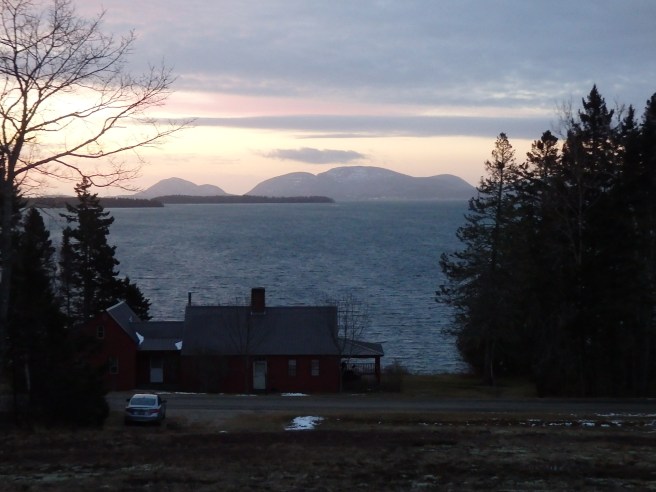
Except on overcast or stormy mornings, the early light of day in Eastport is amazing. Campobello Island in Canada blocks the first rays of the rising sun from striking us directly. Instead, the beam is deflected from the ocean into the air to become an ethereal rosy radiance, sometimes against a dark bank of clouds hovering off over the neighboring Fundy islands. And then, with that doubly-illuminated sky mirrored in the two-mile-wide channel separating Eastport from Campobello, the overhead color spreads out below as well.

Often, this scene is accompanied by the faint puttering of commercial fishing boats venturing out from the port.

When the sun itself finally swells into view, the blaze is nearly blinding, winter or summer.

Note to self: Keep sunglasses at hand.

This is the end of the road

But not a dead end. Rather, I see it as a destination, a place of arrival or culmination, rather than a fatal trap. Like Key West or Provincetown or Cape May that way. Or so I hope, only smaller and less touristy.

When I said it’s on the verge of being discovered, a neighboring couple shuddered and individually chorused, “I hope not!”

Well, an influx of income and youth wouldn’t hurt. Leave it at that.

Downtown Eastport in the dead of winter, as viewed from the Breakwater.

Maine has many fingers that reach out to the sea, but among them, tiny Eastport is unique. There are reasons it’s called the City in the Bay. Technically, it’s an island – or a group of them, with the two inhabited ones connected to the mainland by causeway. Moose Island, where most of us live, is still big enough for plenty of explorations, including a state park, forests, and rocky coves.

Along my life journey to here, I did write a novel about subways, which now has me thinking. A packed underground train can carry 1,200 to 1,800 passengers. Compare that to Eastport’s year-round population, around 1,300, swelling to 6,000 in high summer.

I can joke about coming here to die, but I’m not being morbid. Rather, I just don’t feel there’s anywhere else I’d rather live out my remaining years. Let’s call it focus.

Yes, I’ve loved big cities, though among them I’ve lived only in Baltimore. Meanwhile, Boston, close as it was, served largely as a place to visit, even if once or twice a week.

One thing that’s changed everything is the Internet. I’m not as isolated as I would have been even a decade ago. I can stream concerts, operas, and indie movies, as well as order self-published books or about anything I want retail, even download rare historic volumes, often for free.

In some ways, it’s seemed I’m just setting up shop – or camp – here.

Covid really has changed a lot of our social outlook. It made me hungry for face-to-face gatherings, which a small town can foster, yet it’s also made long-distance meetings more flexible. We don’t always have to drive for hours anymore.

I’ve long touted pedestrian-friendly communities, and that fits the tip of Moose Island where I’m living.

And, yes, via blogging, I can stay in touch with a world of folks like you.

Once the car’s parked, it can stay there as long as I want.

I’m East of Acadia, if not quite Eden

I like to think that natural beauty can be found anywhere, but I have to admit that too often, what’s happened is that brute ugliness has prevailed in far too many places, typically as a result of greed. There’s no excuse for much of that, either. A little extra expenditure could have added grace to any development, created visual intrigue, lessened the harshness. Urban or rural or what’s in-between, alas.

Whenever possible, I chose career moves that opened me to natural or artistic settings and inspiration – along with opportunities to shine professionally. It’s meant avoiding suburbs, for one thing. Sometimes, though, it’s also meant invoking a sliding scale of value – you know, finding pockets of serenity within otherwise harsh localities. And then there were some other postings that principally industrial, even when it was mostly farmland. So it’s been a mix.

Still, as I’ve said, I came to realize that had I remained in my native corner of Ohio, I wouldn’t have been able to write poetry, the vibe was simply wrong. Or, if I had, it would have been much different from what I’ve done.

On the other hand, the four years I lived two hours east of Mount Rainier, back in the late ’70s, gave me repeated access to one of America’s greatest national treasures, often from lesser-known perspectives. What memories! And that’s before I turn to much of the back country and wilderness that was closer to our home. I even came to love the beauty of the desert where I was living, a landscape that initially struck us as hideous.

Mount Desert Island, home of Acadia National Park, glimpsed from the east.

Now I’m finding myself dwelling two hours east of an even more popular natural park, Acadia. Already, I have glimmers of many backwoods and remote rocky shores to explore in-between.

Technically, all of Downeast Maine is also Acadia, the French name of the region. For most folks, though, Acadia means the park.

The biggest land mammal out west was the elk, while here in northern New England, it’s the moose. Just as the celebrated shellfish here is lobster, rather than Dungeness crab.

The fact is, for many people, either place is about as close to paradise as you’d find on earth.

And, yes, I’m feeling lucky – or especially blessed – that way.

How strange that so much later, these lines still stir up conflict within me

I am surprised how much the seemingly disjointed distillations of the prose-poem experiments I’ve been publishing here still capture my experience of my first years in New Hampshire some 35 or so years ago. All the hope, confusion, redirection that accompanied the upheaval.

And so much that evaporated, for the better, after meeting the woman I adore.

The weekly series continues, all the same. As I say, thanks for the memories, to all those who have been companions and positive influences in my zig-zag journey through life.

What are you thinking and feeling, looking back and looking ahead?