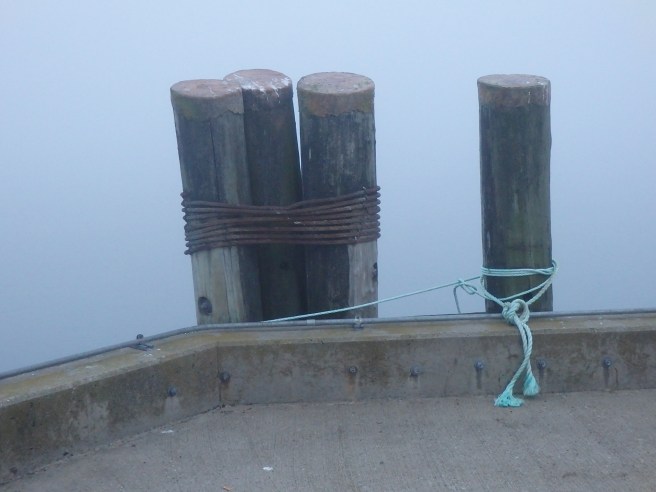
Slow rain outside, misty, foggy, nothing pressing to do, you just want to stay abed a while longer – or return after a leisurely hot shower. Maybe there’s some activity in the next room or down the hall, but it doesn’t matter.
Reminds me of a visit to a neighboring college back in Indiana, when I cracked open my poetry course assignment to an appropriate new vision – one of several breakthroughs that October weekend, actually. Savor another cup of coffee, reflect, recharge. You need those, at least in some proportion to the rest of your goals and life mission. Even if an ingrained Protestant work ethic guilt tries to kick in.
The fog around the island also reminds me of Washington state and visits to friends on the other side of the Cascades mountains. The same smoky indolence.
Do you have any memories of a special time or place of moody experiences like these?
The thought had once appalled me. Like was this the epitome of laziness, that you really didn’t bother to get dressed for the day? Or that perhaps you’d gained so much weight you wanted something that would hang loose rather than accentuate anything?
Skip ahead to retirement and then the Covid shutdown, and I’m having to admit there have been days when I’m living happily in sweats, especially in the depth of a northern New England winter.
Sometimes I even think of it as luxury, not having to venture outdoors.
The joke is that moose don’t have horns, they have antlers. The Moosehorn National Wildlife Refuge excuses itself by noting that it’s named after a brook that meanders through the preserve. Not that it’s the only fine body of water.
Canoeing, kayaking, and fishing are welcome.The marked lanes make for some lovely strolls.
And the U.S. Fish and Wildlife Service adds that the preserve is home to much more than moose, bear, beaver, and deer. For example, some 223 bird species have been identified in its two divisions – the 31-square-mile Baring Division to our northwest and the 13-square-mile Edmunds Division to our west, both within a half-hour drive from Eastport.
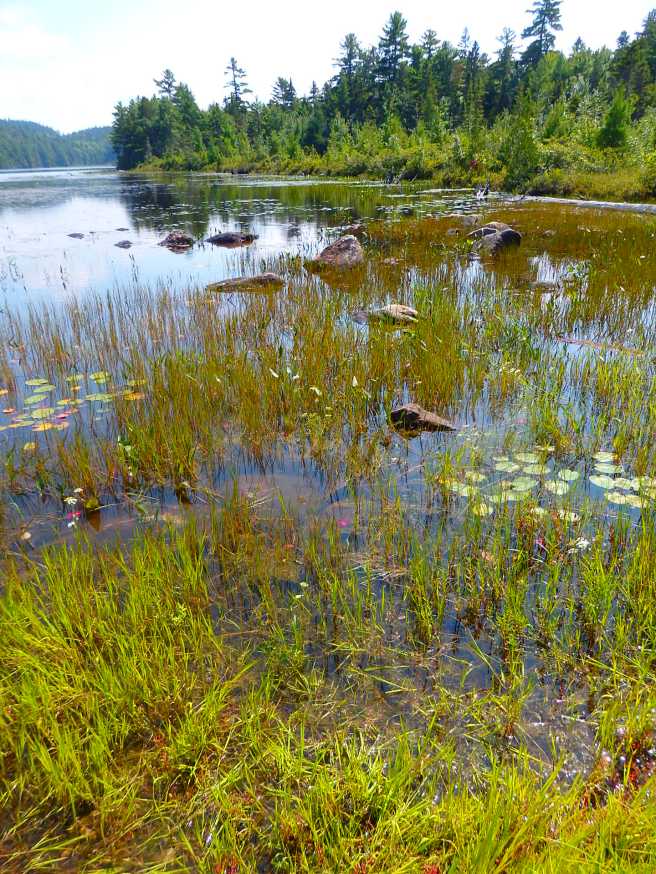
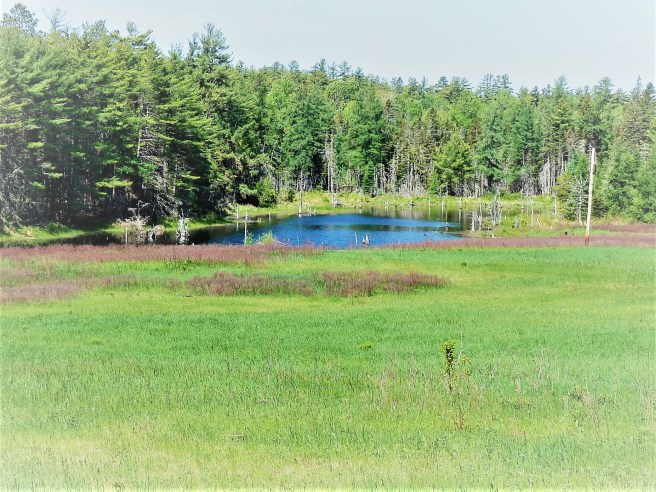
The terrain is varied, much of it wetlands, and a third is protected as wilderness.
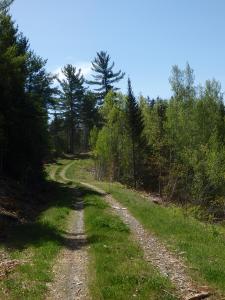
I especially appreciate the miles of hiking trails, some along former roads.
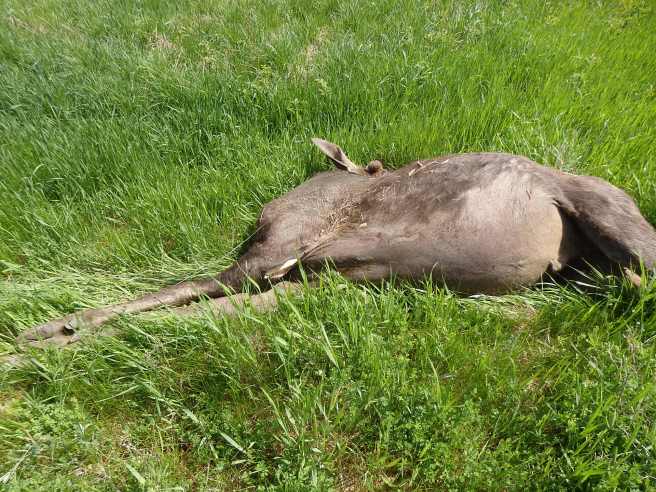
What I wasn’t expecting on one outing was the moose I encountered on a grassy roadside near a flowage.
When I first spotted the tawny hump amid the green, I thought it might have been one bent over grazing, in which case I’d need to approach cautiously, or else just a big rock.
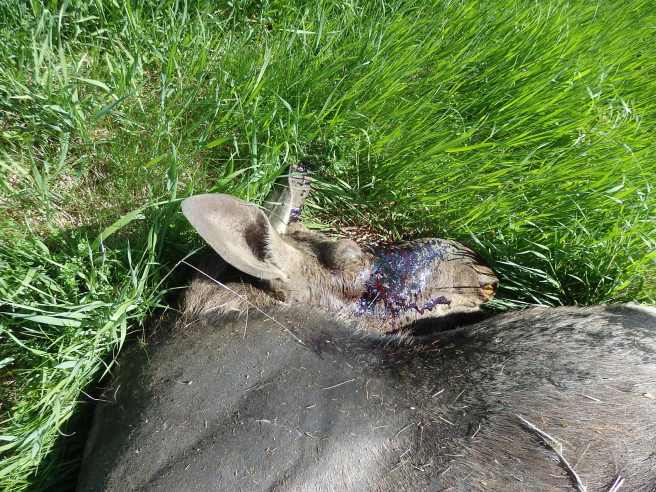
Instead, it became a mystery.
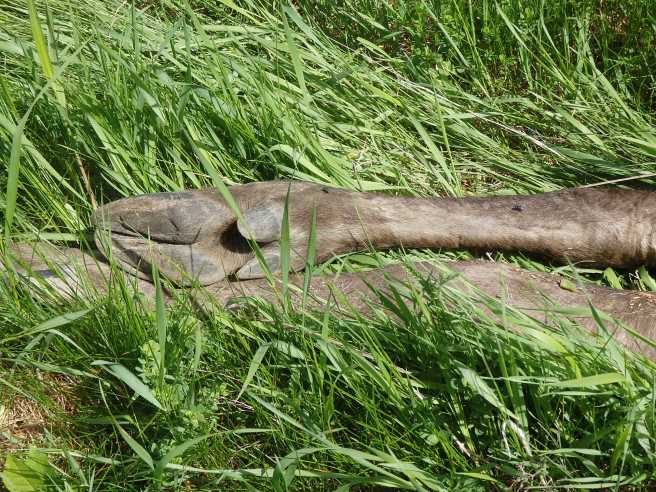
The hooves and legs.Apart from the head injury, the body was in fine shape – no mat of ticks, for one thing.It really is a big, powerful jaw.
Tire tracks in the grass had me wondering if a ranger driving down the gated-access lane had tried to veer away from the animal on the roadway, only to have it bolt into the oncoming vehicle.
The carcass was fresh enough that a solitary vulture overhead wasn’t even taking notice.
Later, back in town, I began picking up details. Everybody seemed to have more to add, most of it from Facebook.
Seems the baby male was hit on Charlotte Road earlier in the morning. (Baby? It was bigger than me.) Folks were wondering what took the wildlife officers so long to clear the road. They then took the remains into the preserve, to return to the food chain. Mama Moose, meanwhile, spent the rest of the day wandering forlornly.
It is a relief to know that moose collisions aren’t so common around here that they’re taken for granted. Deer, on the other hand, as everyone will remind me – keep your eyes open.
For my entire hike, I was the sole human experiencing sights like this.
What’s the most surprising thing you’ve ever encountered out on a walk? Or even a drive?
There I was complaining about not being able to continue swimming laps since Covid curtailed everything, especially followed by my relocation from Dover and its wonderful indoor pool. I certainly wasn’t getting in any regular exercise routine once I moved up here, and one month of yoga down by the waterfront did impress me with just how much this body’s deteriorated from 50 years of neglect. Geeze, how humbling!
I’ve never been one to pursue a solo fitness regime.
But then, when some enlightened souls opened the high school gym for walkers in the early morning, I stepped up, apologies for the pun, but it was something and definitely not at the mall, not that we have anything like that anywhere around. Well, I have posted some photos of Shead High’s gym. Maybe I was getting into shape for some summer hiking?
In the process, I met some interesting folks, all women – guys my age rarely seem to recognize how out of shape they’ve become, apart from maybe weight lifting – and the suggestion kept arising that I should try the twice-a-week fitness sessions at the, uh, senior center. (I really hate that term and definitely prefer to call it the Old Firehouse.)
Most of the time, though, once I started attending, I was the only male in the circle. What a revelation! Yes, I remember ages ago when I would have killed for such odds in my favor, yet these days I’m definitely married. (Got mine!) But still, you wouldn’t believe what I hear. It could be a highly rated TV series, if we could find a focus. Oh, well. As they say, laughter is the best medicine.
The hour-long class is definitely well planned, a blend of stretches, isometrics, cardios, and the like. It can challenge the beginner and adept equally well.
Nonetheless, when the temperature approaches 60 or so, indoors or out, they insist on opening the windows. Claim it’s too hot.
Back in my undergrad days, I was hired by a retired jazz musician or some such insider to gleam through microfilm copies of the Indiana Daily Student and other sources as research for a bio or history book he was writing in New York.
The project opened my eyes to a wide range of 1920s’ history revolving around Bloomington, especially the legendary cornet player Bix Biederbecke and the Hoosier native Hoagy Carmichael. Yes, the place was a jazz hothouse, hard as that might be to believe.
I wish I still had carbon copies of my correspondence on that effort, but I do remember learning of a hitchhiking trip to a Harvard-Indiana University football game that Carmichael shared with Ernie Pyle, editor-in-chief of the Indiana Daily Student.
Seems it took them three weeks or maybe six to get back to campus from Massachusetts.
It’s a great story, no question, kind of pre-hippie, in this case two future celebrities back before they became famous.
The only problem, I’m not finding any corroboration online. Worse yet, I’m not sure how much Pyle and Carmichael’s timelines overlap. Besides, they were members of different fraternities, lessening the likelihood of a joint spree.
The game happened in October 1927, the same time Carmichael was making the premiere recording “Star Dust” in Richmond, Indiana. Pyle, meanwhile, was likely employed by either the New York Post or Evening World and had married. Some of his details get fuzzy.
I don’t remember who the writer was or whether his book ever came out.
As you likely know, trying to record the changing colors is a challenge. Does your camera ever get the hues and shades to match what you’re seeing? Or is it usually either too cool or too garish? How about those of you who are instead using watercolors, oils, pastels, or acrylic?
One spoiler for a photo, as I’ve found the hard way, is utility lines along most roadways. They’re the prime culprit among a host of other distractions your eyes don’t catch but the lenses do. This year, I was on guard and enjoyed the color in those stretches without stopping to take a shot.
Since most of Maine’s forests is evergreen, I scoped out stretches of deciduous trees free of those intrusions before the color change and kept checking in weekly, at minimum. In my case, the core of the route was an unpaved lane in the Baring district of the Moosehorn National Wildlife Refuge, as well as the country roads getting there.
There’s no way of predicting how things will develop. Drought, blight, storms can take a toll.
But we know what will follow. Boy, do we.
Here’s a look at how it all unfolds here.
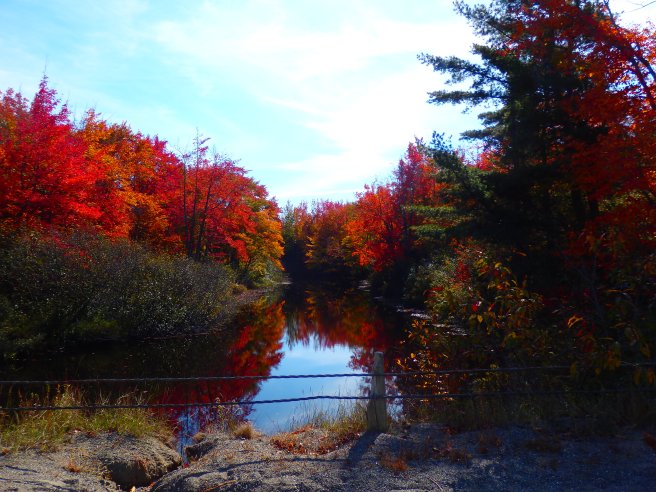
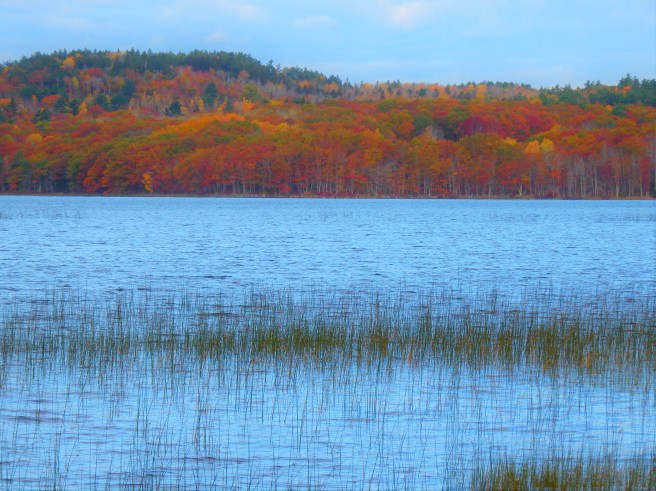
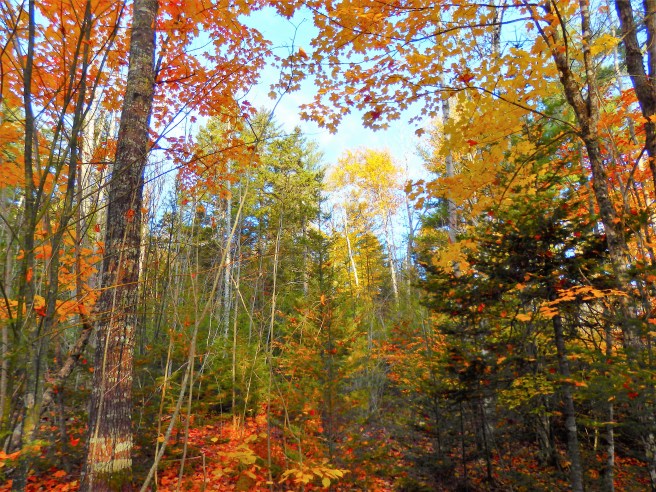
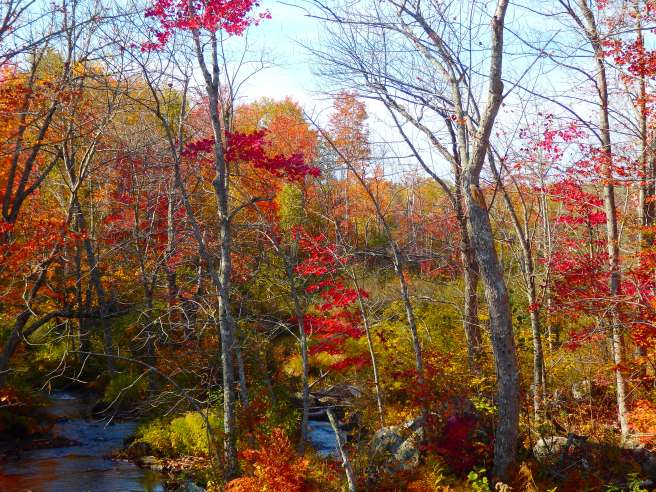
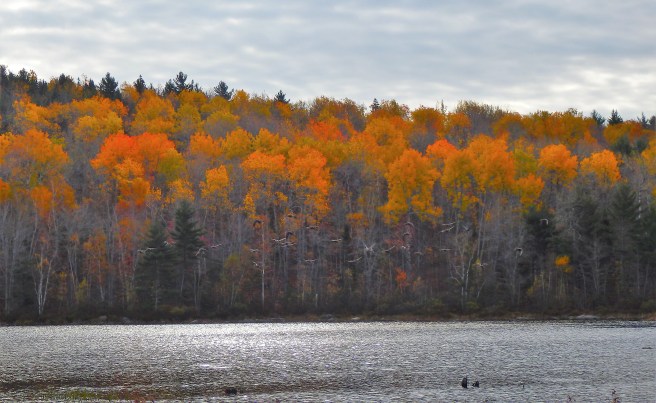
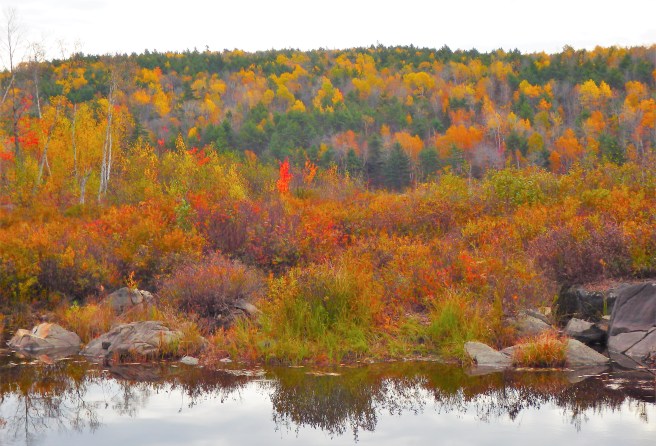
It is an invitation to kayak.Round Pond.How swiftly it passes.Even when half of the leaves have already fallen, there’s more to come.Loud geese take flight. Quaking aspen and birches give the forest a dominant range of yellows.By midmonth, the palette is turning somber.
And if you want to see what I experienced in New Hampshire, go to my Chicken Farmer blog, where I’ve also posted in-depth reflections on the soul of New England itself. The posts and slideshows appear in the New England Spirit category from August through October 2013.
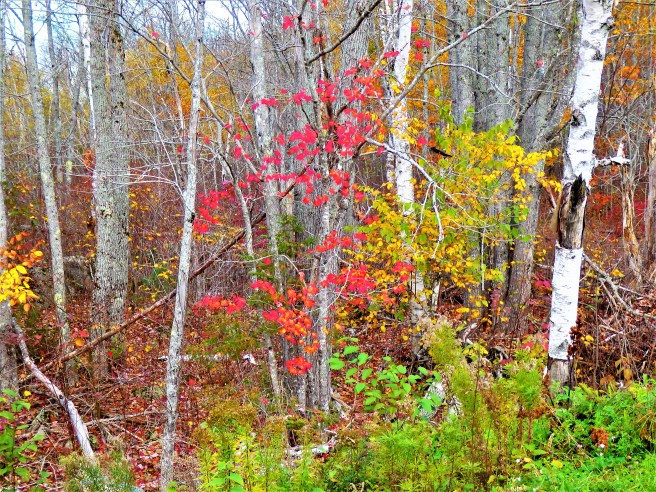
A fringe of intense red in swampy ground is often a vanguard of the changing foliage.
Let me be honest and admit that the most amazing fall foliage I’ve seen was in 1970 in the Susquehanna Valley of New York and neighboring Pennsylvania. I’m not sure how it would stack up today, if I had a way of reviving the actual color, but the experience was unlike any before or since.
I was fresh out of college – free of being cooped up on campus and indoors. I had my own wheels and a job that had me free by midafternoon, when the angular sunlight was kicking in. And the local forests blended the species of New England with those of the middle Appalachians. What I had known before was Ohio and Indiana, without the big foothills that propped the forests up before my eyes like giant canvases or, from the crests, arrayed them below me like vast quilts punctuated with villages and farm fields and meadows.
I suspect another major factor was a killing frost by late September, which would intensify the color and make, officially, Indian summer. With global warming, that frost has been delaying until all of the leaves have fallen.
All the same, living in New England for nearly half of my life now, I recognize how profoundly the autumn change strikes the region. My in-depth reflections and accompanying photos from New Hampshire are found in the archives of my Chicken Farmer blog. Do go there, if you can. The posts and slideshows appear in the New England Spirit category from August through October 2013.
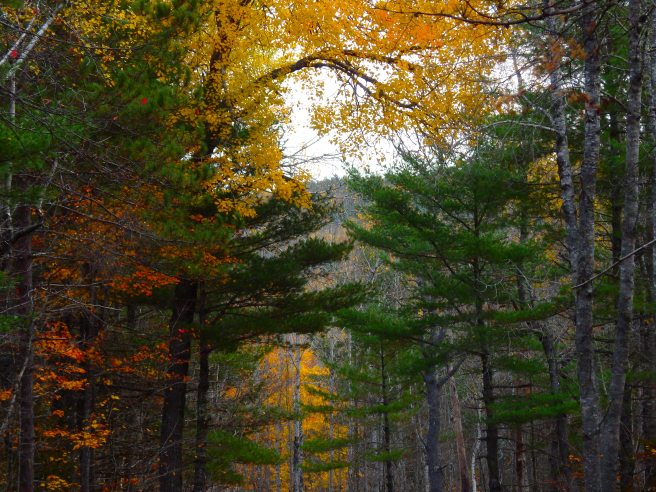
What I’m now encountering is Coastal Downeast Maine, with its own variations. The forest is largely evergreen, which of course stays green. But it does provide a solid background for the deciduous trees as they change.
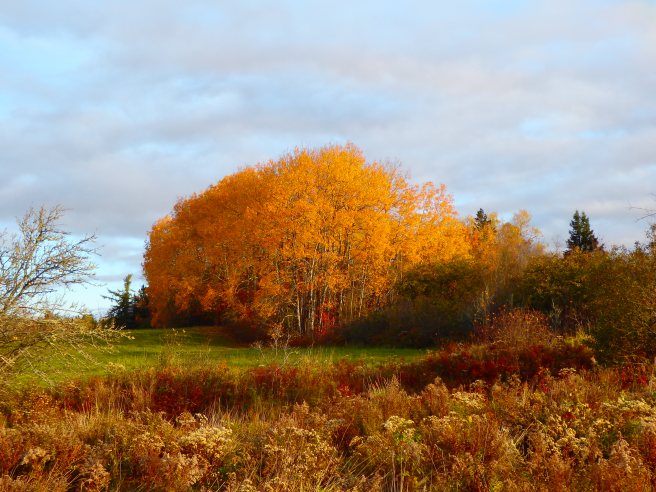
Having written that, I encounter an early morning drive across stretches where everything is perfect. The foliage is prime, a full range of the palette, nothing holding back. The temperature’s still chill, so maybe they’ve already had that hard frost up here. Better yet, the sunlight’s brilliant buttery and straight-on, rather than overhead, illuminating the leaves from the side facing me.
It reminds me of other “oh, wow!” epiphanies in northern New England that no doubt would equal or even surpass the year further south that set the standard.
So here’s a taste of how it happens around here.
The trees don’t all change color at the same time.Evergreens do provide a strong background.A few dramatic splashes.It’s not always the panoramic view that counts.On the other hand, when you’re faced with this at a bend in the road, how can you not be awed?



 Jnana's Red Barn