It’s one of those days when I can’t put two and two together as one.
Category: Personal Journey
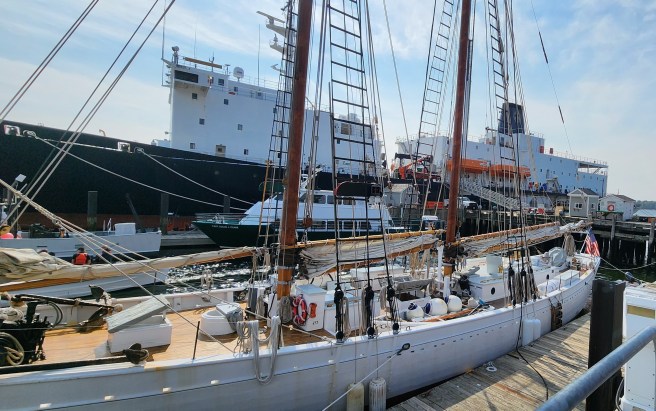
Time to meet her, the Louis R. French
So who was Louis Robbins French?
Father of the three sons
who built this in South Bristol, Maine

The French is 101 feet overall, 65 feet on deck, with 19 feet of beam, as the brochure proclaims. She draws 7.5 feet with a full keel. A proven vessel in all conditions, she is a nifty and quick sailor, having won the Great Schooner Race many times. The French has also participated in recent Tall Ships gatherings in Boston. It spent part of its life based out of Lubec just south of Eastport.
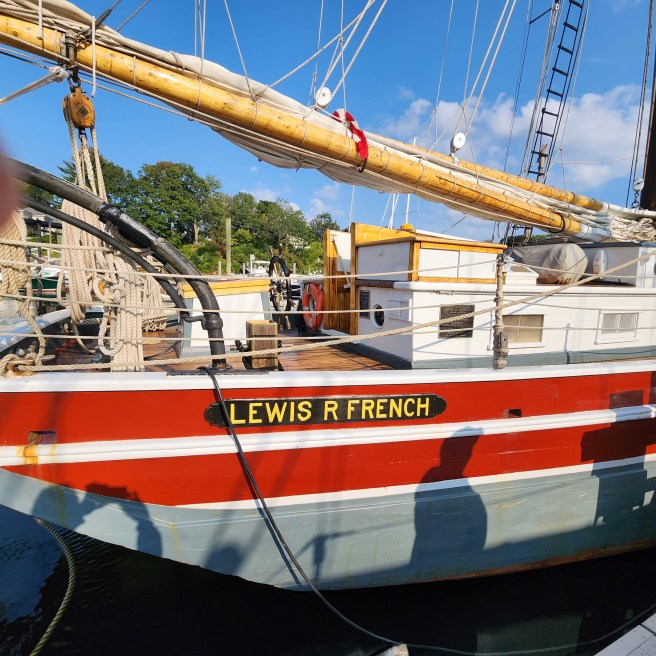
the French was largely stripped and gutted
and rebuilt for passengers
what’s left?
As my buddy Peter grinned at me at the end of our week:
“Your first love. You never forget.”
It’s been what you might call a zig-zag path
My professional life didn’t follow the conventional course, where the goal was to land on a major metropolitan daily. If not the New York Times, then the Washington Post, Chicago Tribune, Los Angeles Times, or the down the line from there. What were also called “destination” newspapers, with decent pay and more focused work in contrast to the sweatshops in smaller communities, or what are now called markets.
I had some near misses, but my route instead led me into places that remain largely unexplored, at least as far as literature or public awareness are concerned.
In my case?
- Binghamton, New York, along the Susquehanna River and the Southern Tier of the Allegheny foothills. What I encountered there appears in Pit-a-Pat High Jinks and, with a heavy New York City connection, Subway Visions.
- The Poconos of Pennsylvania, when I took off for a few years in a monastic setting based on yoga practice and back-to-the-earth community. This is the foundation of Yoga Bootcamp as well as portions of Subway Visions.
- Fostoria, a railroad crossing in the flat but very fertile farmland of northwest Ohio. Gives rise to Prairie Depot in Nearly Canaan and to the opening novella in the Secret Side of Jaya. And, personally, the bride in my first marriage.
- Back to Bloomington, this time not as a student but as a public policy research associate make that social sciences editor at Indiana University. My experiences as an undergraduate frame Daffodil Uprising and What’s Left, while those as college staff feed into Nearly Canaan and the middle novella of the Secret Side of Jaya, both extrapolated to the Ozarks in Arkansas.
- Yakima, Washington. It’s the Promised Land in Nearly Canaan and the final novella in the Secret Side of Jaya.
- Dubuque, Iowa, along the Upper Mississippi. Adds some detail to Daffodil and What’s Left. Personally and professionally, it was a disaster.
- Warren, Ohio, in the Rust Belt. Hometown News. And how!
- Baltimore, Maryland, my base as a field representative for the Chicago Tribune’s media syndicate. More detail for Hometown News.
- Manchester, New Hampshire, and later commuting from Dover an hour to the east. Revisions to the manuscripts and earlier versions.
- And now, Eastport, Maine, in supposed retirement.
Curiously, my professional locations before Baltimore all infuse my fiction. Strangely, I’ve never written about Dayton, where I grew up, or the places later, at least as fiction. Poetry is another matter altogether.
Vincent Katz and my little red journal
When I set about planning and packing for a week on the water last year, I knew I wouldn’t be bringing my laptop. The electrical power on the schooner was mostly from some powerful batteries and two small solar panels. We could charge our cell phones and had small lights in our cabins, but that was about it.
I did pack a Paris Review and a Harper’s magazine, should I feel like indulging in reading, but the heart of my “literary” life focused on a small red journal I had picked up a year or so earlier plus a few printouts of Vincent Katz poems that set a direction that has intrigued me.
Katz, like his father, the American painter Alex Katz, can look at mundane things in a seemingly flat tone that feels seminal.
Consider the line, “I wish I lived here but I do live here,” from “Francis Bacon.” It’s a feeling I know.
As he says in “Back on 8th Ave.”:
The job of the poet is not easy:
be utterly observant, tracking,
and to note down, in plain language,
with minimal emotional distortion,
what s/he sees.
For me, it had been ages since I’d sat down before a blank page and started off without any idea of where the words would be going. My usual journaling at least has a calendar full of events to catch up on, plus notes I’ve scribbled out, maybe even emails. And my more public writing has been things like this, with a purpose.
My goal was to fill the little notebook in a week. Quality or substance was not the measure. Just look and listen and try to be very much in the present moment.
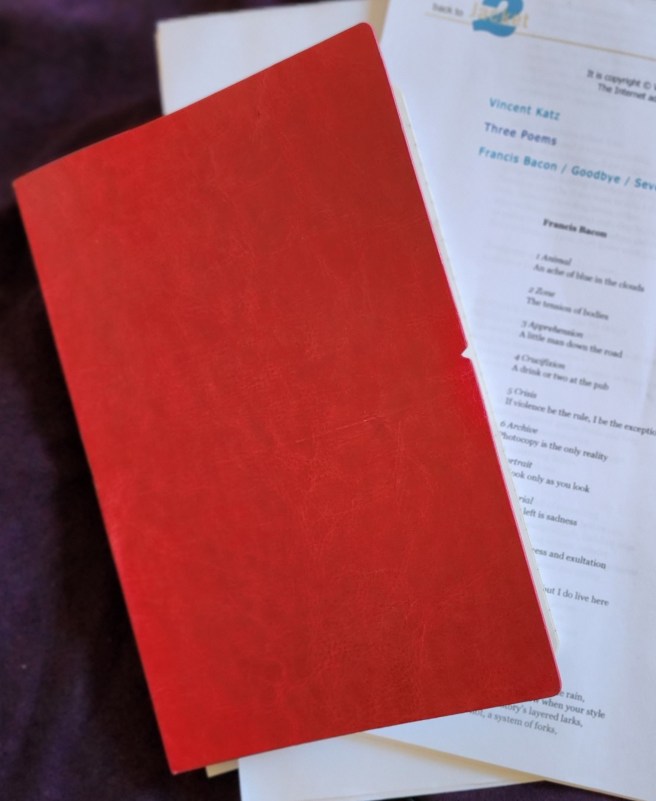
It was a harder assignment than you might think. But it did provide much of the text for many of the posts you’ll be seeing this year.
Here are a few samples of what I entered:
looking for the obvious can be a challenge
~*~
Yellow house
behind a brown one
on a hill
flagpole and staircase
down to a wharf
the dreadful verses
you attempted
page after page
of aspiring youth
reached and fell
that stuff now is flatter
but more secure
likely no more profound
or less
don’t worry, Jnana, nothing’s happening
you’d think I could fill this small notebook with drivel in a week
but I’m halfway short
I did end the entries
[to be continued]
Hopefully, on an upcoming cruise in late summer.
Get primed for a windjammer experience
It’s like camping, with the canvas over your head rather than a tent.
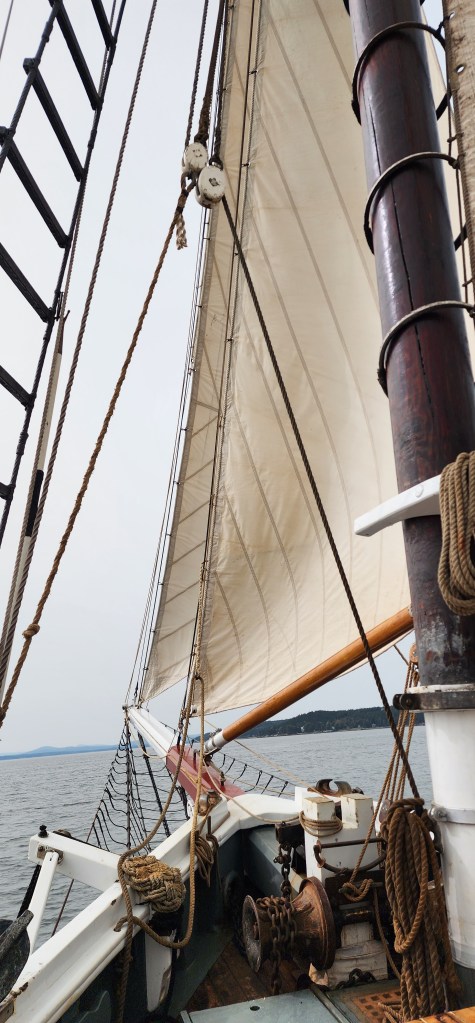
Peter tried to brace me for the, uh, unique quarters. And the pause when I mentioned taking a shower.
I had a snug berth, as you’ll see later. The only electricity on board came from some strong batteries and a small solar array.
Rather than a floating night club and hotel of a typical cruise ship, a Maine windjammer is small and laid-back. You even have to wash your own dishes.
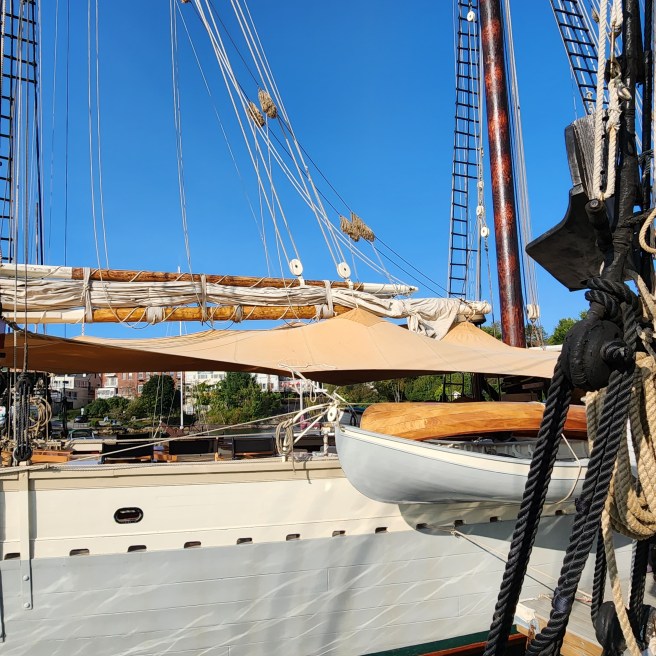
As the windjammers’ association brochure says:
Unlike large cruise ships, windjammers have bunks and cozy cabins, not monster staterooms and 24-hour buffets. Windjammers are woody and compact below decks. Crew and guests live and work in close quarters. The ship’s galley and dining areas are like your kitchen at home – everybody mingles there.
The Maine experience dates from 1936, when Captain Frank Swift started offering adventurous passengers sailing opportunities formerly only available to private yacht owners.
Last summer I got to be one of them. It really was memorable.
Can a location be a fictional character, too?
In my big writing projects, landscape and geography have formed a major thread.
It’s most prominent in the novel that became Nearly Canaan, which is outwardly more about tensions with an unstable spouse, the trials of career ambitions, and a sequence of three locales that culminate in volcanic explosion on all fronts. Perhaps raising a personified landscape to the fore would have been too melodramatic, but it was an option I’m now seeing I overlooked. You know, the fantasy genre.
Even so, places are a primary ingredient in my fiction and poems.
My four years in the desert of the Pacific Northwest were a revelation. I felt myself on the brink of everything I had hoped for. It seemed embodied in the landscape, including the ways the Indigenous presence resonated in the earth itself.
And then everything exploded and I was, essentially, exiled from Eden.
By the time I could hunker down to collect the debris, I was on the East Coast. I had also lost the extended elation of feeling that my big breakthrough as a poet was about to happen.
I’d say I’ve leaned toward celebrating the good and lovely sides of life – a hopeful optimist, though I loathe that term – but I finally recognized in later revisions the importance of acknowledging the ugly, too, and the overwhelming desecration that’s occurred across this land and the globe despite what I saw in the better sides of the hippie alternative.
~*~
I am a visual person and even considered a livelihood as a painter or graphic designer or architect back when I was in high school. Being named editor-in-chief of the Hilltopper ultimately changed all that. Well, much of my journalism career included selecting and cropping photos and designing newspaper pages. My visual art training wasn’t neglected altogether.
From early childhood on, I loved maps. Hiking and primitive camping in a rogue Boy Scout troop abetted that awareness. Growing up in flat Ohio, I imagined mountains. Even a bump on the horizon, say Mount Saint John in neighboring Greene County, seemed vast, at least on our bicycles. An ocean was inconceivable. The mountains I experienced were the Appalachians, especially a stretch of the Appalachian Trail we Scouts backpacked between my fifth- and sixth-grades. Those magnificent and dreamy heights didn’t have the craggy snowcaps that had captured my imagination, but they did introduce the sensation of being somewhere near heaven and looking down on the world, the way God would. (At least as I would have seen it then.)
Add to that history and historic places. Old log cabins and their unique smells are among the memories imprinted within me. I probably read the entire shelf of Landmark Books’ profiles of famous people in sixth grade, if not third.
In the middle of my sophomore year of college, I transferred from my hometown to the Bloomington campus of Indiana University, where I had hiked and camped in the surrounding hilly forests, but this was a more distinctive locale than I realized in my leap toward a degree.
I mention all this because I’m seeing how much a specific spot on the map has been an element of my poetry and fiction.
An important twist came when I was living in the yoga ashram in the Pocono mountains of Pennsylvania and our teacher, an American woman, returned from her first trip to India. She said the reason Hinduism has so many deities is that many of them reflect the unique vibrations – as she said, vibes – of the different locales.
Thus, it’s not just how a place looks but also how it feels with your eyes closed. Maybe even how it smells.
I hope I’ve conveyed that in my writing.
Subsequent relocations took me back to Ohio and Indiana, on to the mountains and interior desert of Washington state, and then, in exile as it felt at the time, eastward to Iowa, another corner of Ohio, and finally Baltimore and the year of intense keyboarding I’ll describe later. After that, I headed north to New Hampshire and now an island in Maine.
So here we are, wherever.
Schooner or later
Ships come in all sizes and shapes, and people aware of the differences see vessels that float quite differently than the rest of the population. Well, it’s like looking at birds and then birders.
Living beside the ocean I had learned to differentiate a sloop from a schooner, or so I thought. Both have triangular sails, with sloops having just one mast and schooners, two or more.
Not to be confused with square-riggers, the kind of tall-mast ships most people envision from history. Or so I once did. You know, Old Ironsides, the USS Constitution, or even the Mayflower, however much smaller.
As for triangular sails, like those on sailboats. Not quite accurate when it comes to schooners. There’s something called a gaff … creating the hip-roof look of a schooner’s sails.
My closeup introduction to a schooner came in a side trip earlier in the day I would step aboard one for my virgin voyage that will inform later posts. To kill time, so I thought, my buddy and I headed off to Castine, then a hole in my inner map of Maine, apart from references by friends.
And that’s where I was introduced to the Bowdoin, now named for the college of the same name but more importantly a historic vessel used by Donald Baxter MacMillan in his Arctic expeditions. Quite simply, she was designed to withstand incredible freezing – and did. I’m now wondering how the crew did, under those conditions.
That said, she was a schooner. I had seen one docked in Eastport, but this time I had a curator at hand to explain the distinctive parts.
Emphatically, it is not a square-rigger.
Schooner, as Dutch, it’s not SHOONER, after all, as my New Amsterdam Dutch-descendant Peter could easily point out, yet from deference, hasn’t. (Do I get points for noticing?)
Typically, a crew of 2½
two men and a boy
no cook?
an average life of 25 years
for a wooden ship
(owned in shares
spread the risk and profits)
Of course, they’re semi-autobiographical
Most of my literary writing has been done on the fly, amateur work on the side while pursuing a professional career in newspaper journalism. Early on, I was shunted from newspaper reporting to editing, with the advice that writers were more numerous than good editors. Was I really that good?
I can see now that stepping away from reporting allowed me the space to develop as a writer in ways I find more fulfilling.
My dream had been to be a fine arts columnist along the lines of Hub Meeker at the Journal Herald when I was growing up, or even as a more general columnist, as I was my senior year at Indiana University, but the reality was that such openings were few and far between. As I see now, I could have written freelance columns in my free time and offered them to my employers, showing them what I could do, but I needed to grow on other fronts as I worked myself through those early years. Much later, as one of my bosses said somewhat wistfully, “You have a life,” a very full one outside of the newsroom. Or workroom, in a wider perspective.
Besides, had I been writing a column, there would have been no energy for what I poured into the literary efforts instead.
My personal writing arose as an attempt to make sense of what was happening within and around me, often in chaotic times and remote locations. A college English teacher had left me with an appreciation for abstracting a detail to make it more universal, and thus more available for a reader to connect with personally, and I’ve seen that as a challenge for anyone writing literature. Unlike a news reporter, who is required to maintain an anonymous tone even when is or her byline is on the story, a literary writer has to be a more fully human presence.
In revising Quaking Dover, I discovered how difficult inserting myself into the text could be after one early reader suggested I develop the tone of a gently laughing curmudgeon narrator she sensed.
If only that weren’t my last book, one based on historical facts, I might have extended the perspective to my earlier novels.
In retrospect, I must admit that failing to concentrate on one stream of writing rather than many has been a mistake. I don’t lament writing poetry and fiction, but trying to span them can be seen as diluting the energy. Was it mistake, too, to not try breaking through as a columnist on the side when I was laboring as an editor? And ditch all the rest?
Nonetheless, my novels hew closely to what I encountered over a half century at fringes of American society or social consciousness, or how I’ve navigated through that to here. They also reflect my vision that a better way of life is possible, call it the Kingdom of God, if you will, but still more peaceful and just than the clasp of empire slash consumerism today.
In fiction, my stories are not just “me” who’s the protagonist. Sometimes, it’s “her,” instead. And sometimes that “me” is off to the side. As for others in the scene? They’re often composites of folks I’ve known, hopefully so disguised they won’t recognize themselves. How do you protect and respect their privacy, anyway? I’ve never wanted to be one of those authors whose family and friends hate what’s been done to them.
In the long run, you can tell me if that was a smart move or rather chicken.
~*~
Four of my eight novels spring from the first one that was published, though it’s no longer necessarily the starting point for readers, nor the endpoint. Another three are now also interwoven into one sweep. As for the eighth? Despite all the abstractions and switched genders, they’re ultimately semi-autobiographical and originate in an attempt to comprehend and remember what I could of some profound upheavals I’ve experienced. As has America and the rest of the world, in the background.
Here I am, about to reflect on those books over the course of this year and to share with you some of the personal encounters that underpin those stories.
While my poetry was written largely while having a full-time and often demanding job, the fiction came bursting forth largely in a break in Baltimore but then underwent huge revisions during weekends and vacations once I was back out in the workaday world based in New Hampshire.
My work was seen as experimental, though I now retranslate that as experiential. And once the novels appeared in ebook formats, I’ve welcomed the flexibility for revision and evolution, even if nobody else was noticing.
My self-imposed sabbatical in Baltimore was the source of a first-draft lode I revised intensely over the following decades. Hunkered down out in a suburban apartment for a year in my mid-30s … hmmm, a time that felt like midlife crisis or impending defeat … but with some unexpected savings I could live on for a year. (Having a company car turned out to be a huge benefit in the two years leading up to this.) And then?
I was newly divorced and then abandoned by my subsequent fiancée, laid off from a job that had exposed me to the emerging struggles of the American newspaper industry as a whole, and in the midst of a spiritual exploration that was leading me to unexpected frontiers.
Now that the novels have been out there for any who are interested, I’m feeling free to talk about many of the personal experiences that underpin them. Surprisingly, though, I find the process is far more secretive emotionally than I ever would have admitted.
In memoriam
Last year, a spate of deaths altered my position in a greater hierarchy.
First, a cousin born a few months before my dad, passed, having reached 100. Shortly after his death in 2009, we had a fruitful exchange of correspondence answering many of my questions about my grandparents, which now appear as Dayton’s Leading Republican Plumber on my Orphan George blog.
Also participating in that exchange was my dad’s youngest sister, who was halfway between him and me in age, as it turned out. She, too, died this year, shortly after her husband. They were the last of the generation in my close linage. So I’m now the eldest male in my grandfather’s descendants.
The year also had a series of deaths in Dover Friends Meeting, including a former clerk, a cherished elder (bishop), a fine minister, a very dedicated longtime treasurer, and a prominent social activist. That leaves me as the oldest surviving clerk of the congregation but living a distance away. The collective memory shrinks, in effect.
What I’m left facing is the reality that there’s no longer that umbrella of older, wiser figures over me, sheltering or guiding me. Instead, that’s now my role in reverse. Frankly, I feel inadequate.
It’s a responsibility, all the same. And a debt.
Let’s fill in some more blanks
Some people sit down in the depth of winter to peruse seed catalogs and dream of harvests. We’ll be doing some of that in our household, and you’ll no doubt sample some of the results here.
Some find it a good time to revisit highlights from the previous year or further back. Yup, that too.
The snowy months also offer delightful travel opportunities, and not just to warmer climes. Even if you stay close to a wood fire or the equivalent, taking time to sift through brochures can stimulate plans for trips long or short later in the year. Consider my upcoming posts based on my week on the waters of Penobscot Bay at the beginning of autumn in that vein.
Quite simply, retirement and winters aren’t a blank stretch in my life.
~*~
One movie I viewed as a kid in the Dayton Art Institute’s tapestry-walled auditorium left a lasting impression on me. I think the film was scheduled to be shown outdoors but this was the rain site. What I do recall is its presentations of windjammers racing along under full sails. I was still far from any actual encounter with the ocean or sailing, but from that point on I did realize I had no interest in a traditional cruise, or what I’ve seen as a floating nightclub. No, if I went out on a cruise, it would be under sail. Not that the option quite came in front of me.
Instead, the closest over the years were jaunts on ferryboats in the Pacific Northwest and then the Northeast, along with whale watch daytrips and, especially, my boss’ 32-foot sailboat in the Gulf of Maine.
One impression I gleaned from those outings is how differently a geography fits together when it’s experienced from its waters rather than its land. That awareness certainly came into play in my history research for Quaking Dover.
Being on the water filled in some blanks.
~*~
As a lover of maps, from childhood on, I’ve also learned how the mere fact of being in a place transforms the charts. A location becomes real when I’ve walked around in it. Or, as I learned in my time on Penobscot Bay, if I’ve walked around in a boat just offshore.
Listening to new friends in Maine presented a series of towns I could place only vaguely – Castine, Stonington, Brooklin, Islesboro, Southwest Harbor – along with related locations like Vinalhaven, Isle au Haut, Blue Hill, Swan’s Island (not to be confused with Swan Island in the Kennebec River), or Little Cranberry. I could nod along with a blank look. My week on the water filled in more of that comprehension.
Now, let me fill in the name of the ship in question here – the Lewis R. French – and the fact she was a schooner, a very special distinction, as I would learn.
And as you’ll see.
 Jnana's Red Barn